The best flux core welders for outdoor welding
Outdoors is the one place flux-core is not the budget option - it is the correct one. A five-mile-an-hour breeze is enough to ruin a gas MIG weld, and flux-core does not care.
Arc & Bead is an Amazon Associate. If you buy through a link on this page we may earn a commission, at no extra cost to you. We have not physically tested the machines on this page and we say so on How We Pick.
Quick picks
Tap any row to jump to the full write-up further down this page.
| # | Product | Best for | Price |
|---|---|---|---|
| 1 | 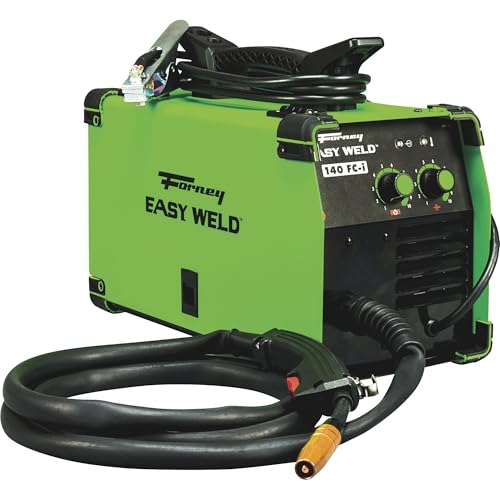 Forney Easy Weld 261 140 FC-iA 30% duty cycle at 90 A, 1/4 in capacity and infinite voltage control at 19 lb - the best-specified gasless machine we list. | Best overall | $337.99 · View on Amazon #ad How this is funded · Price as of November 13, 2026 |
| 2 | 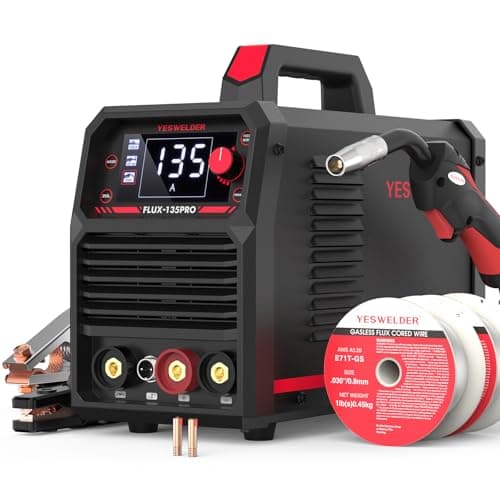 YESWELDER FLUX-135PROThe cheapest welder in our registry, at 11.4 lb, with a stick arc included for the rusty metal flux-core still struggles with. | Budget pick | |
| 3 | 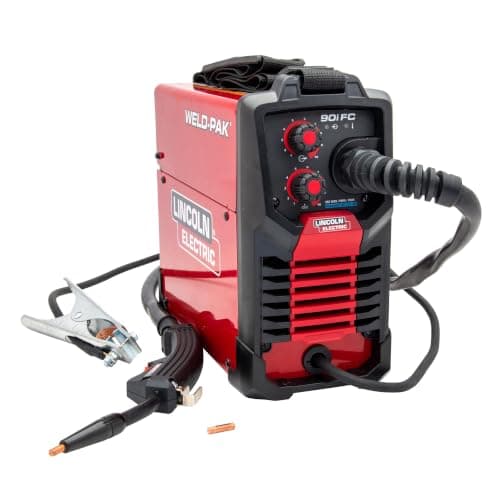 Lincoln Electric Weld-Pak 90i FC (K5255-1)Infinite voltage control, 1/4 in capacity and 15 lb in a metal case, with the best consumable network in the category. | Best supported | $328.00 · View on Amazon #ad How this is funded · Price as of November 13, 2026 |
| 4 | 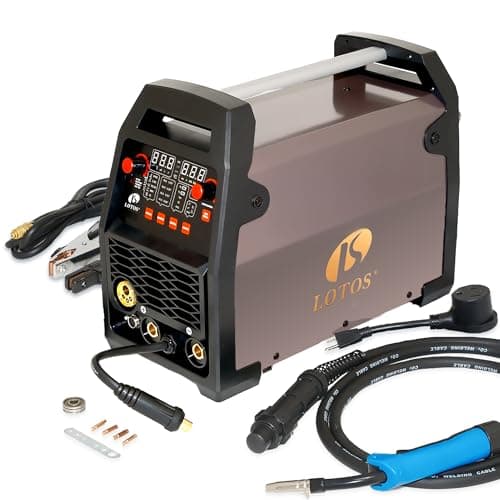 Lotos MIG180Gasless flux-core plus a published 160 A stick arc - the two processes outdoor repair work actually needs, in one machine. | Best for rusty outdoor steel | $359.98 · View on Amazon #ad How this is funded · Price as of November 13, 2026 |
The short answer
Gas MIG does not work outdoors in any wind. Shielding gas is a column of inert gas standing over a molten puddle, and a breeze of roughly five miles an hour is enough to blow it aside — which gives you porosity you cannot see until the weld fails. Self-shielded flux-core carries its shielding inside the wire, so wind is irrelevant to it.
Our overall pick is the Forney Easy Weld 261 140 FC-i for its published 30% duty cycle at 90 A, 1/4 in capacity and infinite voltage control at 19 lb. The budget pick is the YESWELDER FLUX-135PRO, the cheapest welder we list, at 11.4 lb. For rusty outdoor steel the Lotos MIG180 adds a published 160 A stick arc, which is the process rust actually needs.
Prices in the table are read from the live feed when the page loads, each with its own "as of" date inside the buy button.
Why wind beats shielding gas
A gas MIG weld depends on a continuous envelope of argon or an argon-CO2 mix displacing the air over the puddle. Air is the problem: nitrogen and oxygen dissolve into molten steel and come out of solution as it freezes, leaving gas pockets through the weld.
That envelope is fragile. It is held in place by nothing but its own flow rate, and the figure most commonly cited in welding practice is that wind above about five miles an hour starts to disrupt it — which is a light breeze, not a gale. You can raise the flow rate, and past a point that makes it worse by becoming turbulent and pulling air in.
Self-shielded flux-core avoids the whole problem by a different mechanism: the wire has a flux core that decomposes in the arc and produces its own shielding, plus a slag layer that covers the weld while it cools. There is nothing to blow away. That is why flux-core is the standard process on structural steel erection, and it is the only context in which this site calls flux-core the right answer rather than the cheap one.
The process background is in flux-core welding for beginners and flux-core welding advantages and disadvantages.
| Machine | Duty cycle | Steel capacity | Weight | Stick arc? |
|---|---|---|---|---|
| Forney Easy Weld 261 140 FC-i | 30% at 90 A | To 1/4 in | 19 lb | No - flux-core only |
| YESWELDER FLUX-135PRO | Not published | To 3/32 in | 11.4 lb | Yes - included |
| Lincoln Weld-Pak 90i FC | Not published | To 1/4 in | 15 lb | No - flux-core only |
| Lotos MIG180 | Not published | To 1/4 in | Not published | Yes - 160 A published |
The gap in that duty-cycle column is the honest finding. Only one of these four machines publishes a duty cycle at all, and on outdoor work — long repetitive runs rather than careful short ones — it is the specification most likely to interrupt you. That is why the Forney is the overall pick.
Flux-core is wind-proof, not rust-proof.
The shielding survives wind. It does not survive heavy mill scale, thick paint or pitted rust, which still cause porosity and poor fusion. Grind back to bright metal where you can, and where you cannot, use stick with a 6011 electrode — it is the process that genuinely tolerates dirty steel. Two machines on this page include a stick arc for exactly that reason.
The three outdoor problems that are not the machine
Power at the far end of a cord. Voltage drop on a long undersized extension cord shows up as an unstable arc that reads exactly like a faulty welder. It is the most common outdoor welding complaint and it is a cable problem. Welder extension cords has the gauge-and-length numbers, and if there is no outlet at all, what size generator to run a welder covers the sizing.
Fume, which outdoors you stop thinking about. Self-shielded flux-core produces considerably more fume than gas MIG, and being outside reduces the risk rather than removing it — with your head over the weld you are in the plume regardless of how much air is around you. Welding respiratory protection is the honest version.
Sunlight and the helmet. A bright day makes a dark lens harder to see through before the arc strikes, and a solar-assisted helmet behaves differently in full sun than under shop lights. A helmet with a lighter light state and an external grind button is worth more outdoors than in — the grind-mode roundup covers that control, and helmets under $500 is the band page.
Slag, and why outdoors makes it worse
Every flux-core weld is covered in slag that has to be chipped and wire-brushed off. Outdoors that is more annoying than in a shop, for two reasons: you are usually working on something you cannot reposition, and you often cannot see the weld properly in daylight until the slag is off.
The practical answer is a chipping hammer and a wire brush on your belt rather than in the truck, and an angle grinder with a flap disc for anything that will be painted. The best angle grinders for welding is that tool, and flux-core welding spatter covers reducing how much there is in the first place. Settings matter too: the flux-core settings chart and flux-core polarity are the two things most often set wrong.
Who should not buy a flux-core machine for outdoor work
If the outdoor steel you are joining is rusty, painted or galvanised and you cannot clean it, stick is the better process and a dedicated stick machine is cheaper than a wire one. The best stick welders for home use is that page, and flux-core vs stick for beginners is the comparison.
And if the work is mostly indoors with occasional outdoor jobs, buy a gas MIG machine and keep a spool of flux-cored wire for the days you go outside. Most dual-process machines run both, which is the cheapest version of this whole page. Flux-core vs MIG for beginners covers that choice properly.
How we picked these
Self-shielded flux-core capability was the entry requirement. Every machine here runs gasless flux-cored wire, which is the only thing that makes a wire machine usable in wind.
Ranked on duty cycle, weight and capacity, in that order. Outdoor work is long runs carried to the job on material you did not choose, so those are the three figures that decide it — not the headline amperage.
No hands-on, and unpublished figures marked. We have welded with none of these machines. Three of the four do not publish a duty cycle and the table says so rather than estimating. More on the method on how we pick.
1. Best overall
Forney Easy Weld 261 140 FC-i
A 30% duty cycle at 90 A, 1/4 in capacity and infinite voltage control at 19 lb - the best-specified gasless machine we list.
Forney publishes the Easy Weld 261 140 FC-i as flux-core (gasless) only, 120 V on a 20 A circuit minimum, 140 A maximum output, a 30% duty cycle at 90 A, 0.030 in flux-cored wire in 2 lb and 10 lb rolls, a steel capacity up to 1/4 in, and 19 lb.
The duty cycle is why it wins. Thirty percent at 90 A is unusually generous for a 120 V machine in this class, and duty cycle matters more outdoors than it does at a bench: outdoor jobs are fence lines, gate posts and trailer frames, which means long runs of repetitive welds rather than a few careful ones. A machine that needs to cool every three minutes turns an afternoon into an evening.
Infinite voltage and wire-speed control rather than four fixed taps is the second reason, and it matters outdoors specifically because the material is rarely what you planned for — rusty 3/16 in on one bracket and clean 1/4 in on the next. Dialling a setting beats choosing between four.
Nineteen pounds with a 10 lb wire roll is genuinely carryable to the work, which outdoors is the whole premise.
Against it: flux-core only, so it will never become your Level 2 machine; every weld leaves slag to chip and wire-brush; and it needs a 20 A circuit, so a 15 A garage lighting circuit will trip at the higher settings — which matters when you are on the end of a long cord.
What works
- 30% duty cycle at 90 A is unusually generous for a 120 V machine in this class
- Infinite voltage and wire-speed control rather than four fixed taps, so you can actually dial a setting in
- 19 lb — genuinely carryable to the job instead of the job coming to it
- No gas bottle, no regulator, no second purchase before your first weld
What does not
- Flux-core only. It will never run gas, so it cannot become your Level 2 machine
- Every weld leaves slag that has to be chipped and wire-brushed off
- Needs a 20 A circuit — a 15 A garage lighting circuit will trip at higher settings
2. Budget pick
YESWELDER FLUX-135PRO
The cheapest welder in our registry, at 11.4 lb, with a stick arc included for the rusty metal flux-core still struggles with.
YESWELDER publishes the FLUX-135PRO as gasless flux-core MIG, stick and lift TIG (TIG torch extra), 110 V input, 135 A maximum output, a steel capacity to 3/32 in (2.5 mm), 0.030 in and 0.035 in E71T-GS flux-cored wire, and 11.4 lb.
The budget pick in the strict sense: the least expensive machine in our registry. For outdoor work its real advantage is the 11.4 lb weight — this is a machine you carry to a fence post in one hand, which no 40 lb welder is.
The included stick arc is the other outdoor argument, and it is a genuine one. Stick welding is the process that tolerates rust, paint and mill scale best, and outdoor repair work is overwhelmingly rusty. Having both processes in one 11 lb box is a sensible outdoor kit.
Against it: a 3/32 in steel capacity is well short of the 1/4 in the 140 A machines reach, so gate frames and trailer tongues are outside it; there is no gas MIG ever, so it cannot become your Level 2 machine; and consumables are less widely stocked than Lincoln or Forney equivalents.
What works
- Among the least expensive 110 V flux-core machines that is genuinely sold and supported
- 11.4 lb — light enough to store on a shelf rather than a cart
- Synergic control matches voltage to wire speed, which is the single hardest setting for a beginner to get right
- Stick and lift TIG are included in the price, so rusty outdoor repairs are not a second machine
What does not
- No gas MIG. It will never run a shielding bottle, so it cannot become your Level 2 machine
- 3/32 in steel capacity is well short of the 1/4 in the 140 A machines reach
- Consumables and torch parts are less widely stocked than the Lincoln or Forney equivalents
- The lift TIG torch is not in the box — budget for it if TIG is the reason you are buying
Who this is wrong for: Anything structural outdoors. A published 3/32 in capacity does not cover gate frames, trailer repairs or fence rails in any thickness that matters.
3. Best supported
Lincoln Electric Weld-Pak 90i FC (K5255-1)
Infinite voltage control, 1/4 in capacity and 15 lb in a metal case, with the best consumable network in the category.
Lincoln publishes the Weld-Pak 90i FC (K5255-1) as flux-core (gasless) only on 120 V, with a steel capacity up to 1/4 in, two controls — wire speed and infinite voltage — 15 lb, and a welding gun, nozzle, contact tip, work cable and clamp plus a metal carry case in the box.
The carry case and the 15 lb weight are the outdoor features, and they are not trivial: a machine that travels in a case survives being thrown in a truck bed, and one that does not arrives with a bent wire-feed door.
The reason to pay the Lincoln premium outdoors specifically is consumables. When you are at the far end of a property and a contact tip burns out, the question is whether the nearest hardware store stocks it. Lincoln's dealer and consumable network is the best in the category, and that is worth more in the field than in a garage.
Against it: flux-core only; it costs noticeably more than a budget-brand 135 A gasless machine of similar output; and every weld leaves slag.
What works
- Infinite voltage control rather than fixed taps, so a setting can actually be dialled in rather than chosen from four
- Two knobs and nothing else — the shortest path from box to first bead of anything Lincoln sells
- 15 lb with a shoulder strap and a metal carry case, so it goes to the work
- Lincoln's dealer and consumable network is the best in the category, which matters on a first machine
What does not
- Flux-core only. It will never run gas, so it cannot become your Level 2 machine
- Costs noticeably more than a budget-brand 135 A gasless machine of similar output
- Every weld leaves slag that has to be chipped and wire-brushed off
4. Best for rusty outdoor steel
Lotos MIG180
Gasless flux-core plus a published 160 A stick arc - the two processes outdoor repair work actually needs, in one machine.
Lotos publishes the MIG180 for 110–125 V or 210–250 V, with gas MIG, gasless flux-core, stick, DC lift TIG, spot and spool-gun aluminum, MIG to 180 A, DC TIG to 180 A, stick to 160 A, mild steel to 1/4 in, wire 0.023–0.040 in, and synergistic MIG with voltage fine tuning.
It is on an outdoor page for one specification: a published 160 A stick rating. Flux-core is wind-proof but it is not rust-proof — mill scale, heavy paint and pitted rust still cause porosity and poor fusion. Stick welding with a 6011 or 7018 electrode is the process that genuinely tolerates that material, and a machine that does both means you pick the right process at the job rather than at the shop.
Dual voltage is the secondary outdoor advantage: a generator or a 240 V outlet on a barn both become usable. What size generator to run a welder is the sizing question that follows.
Against it: the headline 180 A and 160 A figures are the 240 V ratings with no published 120 V output; the TIG is lift-start DC and the torch is extra; and dealer support is not on Hobart's or Lincoln's level.
What works
- Stick capability matters more than it sounds: rusty, painted or outdoor steel is where MIG struggles and stick does not
- A published 160 A stick rating is a real stick machine, not a token third process on the switch
- Synergistic MIG sets voltage and wire speed together, so the first hour goes on welding rather than on a settings chart
What does not
- The headline 180 A and 160 A figures are the 240 V ratings; Lotos does not publish a separate 120 V output
- TIG is lift-start DC with no high-frequency start, and the torch is a separate purchase — treat it as a bonus, not a feature you bought
- The spool gun is also sold separately, and DC lift TIG cannot weld aluminum whatever gun you fit
- Dealer support and warranty handling are not on the level of Hobart or Lincoln
Questions people actually ask
Can you weld outside with flux core?
Yes - it is the process designed for it. Self-shielded flux-cored wire carries its shielding inside the wire and leaves a slag layer over the cooling weld, so there is no gas envelope for wind to blow away.
That is why flux-core is standard on structural steel erection, and it is the one application where it is the correct process rather than the cheap one.
How much wind is too much for MIG welding?
Less than most people expect. The figure commonly cited in welding practice is that wind above roughly five miles an hour begins to disrupt the shielding gas envelope - a light breeze, not a gale.
Raising the flow rate does not fix it and past a point makes it worse, because the flow becomes turbulent and pulls air into the puddle.
What is the best flux core welder for outdoor work?
Of the machines in our registry, the Forney Easy Weld 261 140 FC-i: Forney publishes a 30 percent duty cycle at 90 A, a 1/4 inch steel capacity, infinite voltage and wire-speed control, and 19 lb.
Duty cycle matters most outdoors because outdoor jobs are long repetitive runs, and it is the only machine of the four that publishes one.
Can you weld rusty metal with flux core?
Better than with gas MIG, but not well. Flux-core tolerates some surface contamination, and the flux produces deoxidisers that help - but heavy mill scale, thick paint and pitted rust still cause porosity and poor fusion.
Grind back to bright metal where you can. Where you cannot, stick welding with a 6011 electrode is the process that genuinely handles dirty steel.
Do I need a generator to weld outdoors?
Only if there is no outlet. A 120 V flux-core machine will run from a long extension cord, but the cord has to be heavy enough - voltage drop on an undersized cable produces an unstable arc that reads like a machine fault.
If you do need a generator, size it from the welder's input draw rather than its output amperage, which is a much larger number than people expect.
Is flux core strong enough for outdoor structural work?
Self-shielded flux-cored wire is used on real structural steel, so the process is capable. Whether your weld is strong enough depends on the machine's capacity, your joint preparation and your technique rather than on the process.
The practical limit on the machines here is thickness: three of the four publish a 1/4 inch capacity, and anything heavier needs multiple passes and proper preparation.
Sources
- Forney - Easy Weld 261 140 FC-i published specifications: flux-core (gasless) only, 120 V on a 20 A circuit minimum, 140 A maximum output, 30% duty cycle at 90 A, 0.030 in flux-cored wire in 2 lb and 10 lb rolls, steel capacity to 1/4 in, 19 lb (as recorded in this site's product registry, ASIN B07CP9CDVQ)
- YESWELDER - FLUX-135PRO published specifications: gasless flux-core MIG, stick and lift TIG (torch extra), 110 V, 135 A maximum, steel to 3/32 in (2.5 mm), 0.030 in and 0.035 in E71T-GS wire, 11.4 lb (corrected 2026-10-16 against the live listing; recorded in this site's product registry, ASIN B08CBBHFX5)
- Lincoln Electric - Weld-Pak 90i FC (K5255-1) published specifications: flux-core (gasless) only, 120 V, steel capacity to 1/4 in, two controls (wire speed and infinite voltage), 15 lb, welding gun, nozzle, contact tip, work cable and clamp and metal case included (replaced 2026-10-16; recorded in this site's product registry, ASIN B0BTV38YKM)
- Lotos - MIG180 published specifications: gas MIG, gasless flux-core, stick, DC lift TIG, spot and spool-gun aluminum, 110-125 V or 210-250 V, MIG to 180 A, DC TIG to 180 A, stick to 160 A, mild steel to 1/4 in, wire 0.023-0.040 in, synergistic MIG (read 2026-10-19, recorded in this site's product registry, ASIN B0FDZ15SD4)
- American Welding Society - flux-cored arc welding (FCAW) and gas metal arc welding process fundamentals, including shielding gas disruption and the use of self-shielded wire in field conditions
- OSHA - Welding, Cutting and Brazing standard (29 CFR 1910 Subpart Q), including ventilation requirements that apply to self-shielded flux-core fume
Read next
- The best flux-core welders for farm use
Gasless machines for outdoor, rusty, away-from-the-bench farm repairs — and what runs off a generator.
- The best flux-core welders for the money
Value per dollar in gasless welding, including the part that costs least and changes most: the wire.
- Flux Core Welding: Advantages and Disadvantages
What self-shielded flux-core is genuinely good and bad at, judged on its own terms rather than against gas MIG.
- What size generator do you need to run a welder?
How to size a generator to a welder, and the inverter-welder warning nobody prints on the box.
- Flux-core vs stick welding for beginners
Two processes that work outdoors on rusty steel — and why one is far easier to begin with.
- The best welders under $300
Four welders under $300 at current live prices, sorted by the one process each does properly, with the cheapest machine in our registry named as the budget pick.
Back to Level 1 · Flux-Core, or start over at Find Your Level.
Ryder M.
Ryder M. is the hands-on owner behind Magoo Media Group. He writes Arc & Bead's buying guides and picks every machine on the site. What every recommendation is based on — and what it is not based on — is set out on How We Pick.