What size generator do you need to run a welder?
The watt figure on a generator is not the number that matters. Three other things decide whether your welder will run on it.
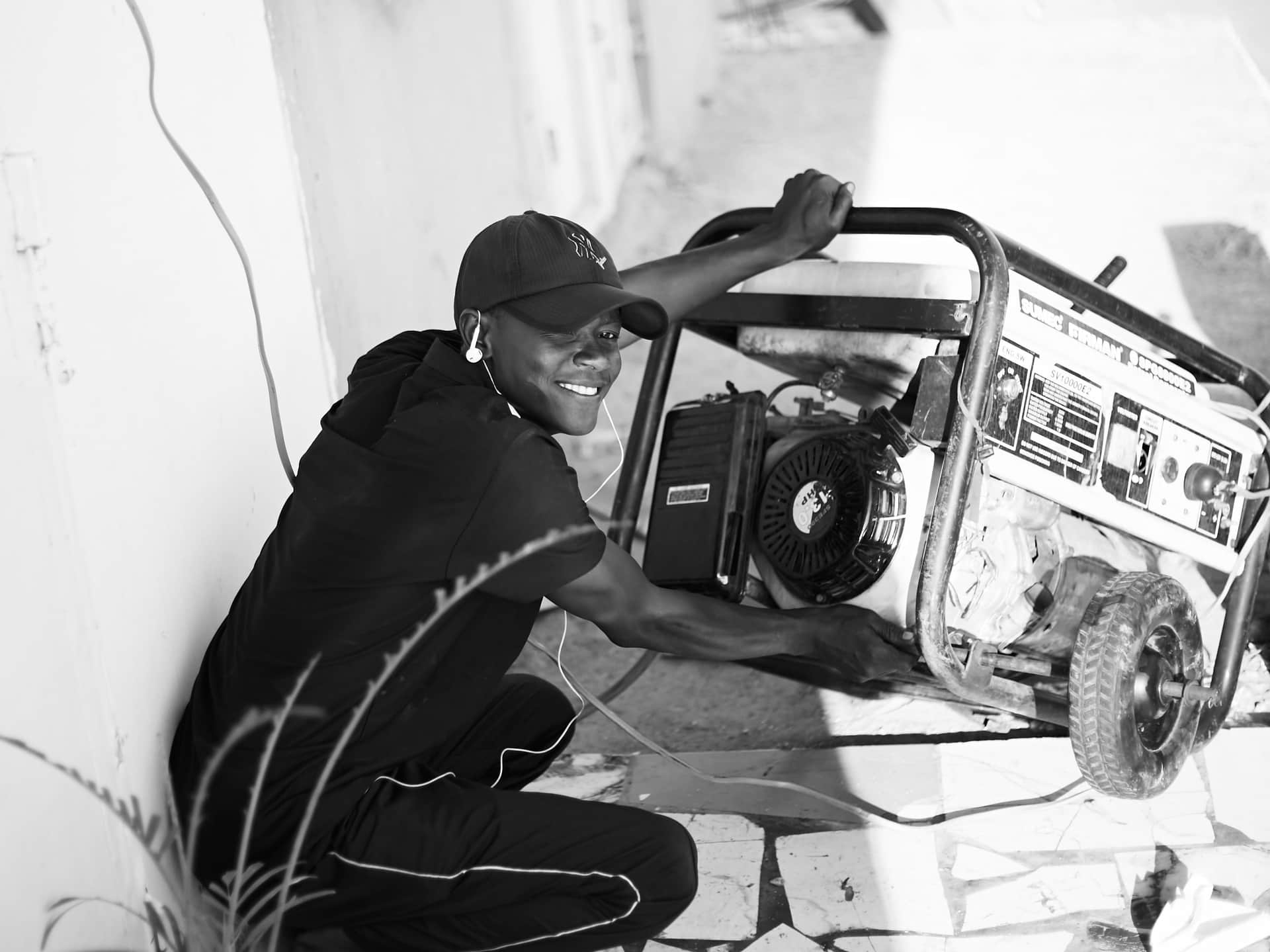
What size generator do you need for a welder?
For a 120 V welder drawing 20 amps, about 4,000 running watts. For a 240 V machine at 30 to 50 amps, about 8,000 to 12,000 running watts. Size on running watts, not peak or starting watts, and add at least 20% headroom because a welder loads a generator in sudden bursts. Multiply the welder's input amps by its input volts to get watts.
Three numbers get quoted on a generator and only one of them is the number you size on.
Running watts — also called rated or continuous watts — is what the generator will supply indefinitely. This is the figure to size against.
Peak or starting watts is a short surge, usually a few seconds, for motors spinning up. It is always the bigger number, it is always the one on the front of the box, and it is not what a welder runs on. A generator advertised at 4,000 peak watts may only have 3,200 running.
Voltage and outlet configuration decides whether a 240 V machine can be plugged in at all. Plenty of 7,000 watt generators provide 120 V only, and a 240 V welder cannot use them regardless of total capacity.
The arithmetic, worked
Watts = input amps × input volts. That is the whole calculation, and the input figures come off the welder's data plate — not its output rating. A 140 amp output machine does not draw 140 amps from the wall.
| Machine | Published input | Implied draw | Running watts | With 20% headroom |
|---|---|---|---|---|
| Forney Easy Weld 140 FC-i | 120 V, 20 A circuit minimum | 20 A at 120 V | 2,400 W | ~2,900 W — a 3,500 W generator |
| Hobart Handler 140EZ | 115 V, 20 A dedicated circuit | 20 A at 115 V | 2,300 W | ~2,800 W — a 3,500 W generator |
| Hobart Handler 210 MVP on 115 V | 115 V (MVP plug) | 20 A at 115 V | 2,300 W | ~2,800 W — a 3,500 W generator |
| Hobart Handler 210 MVP on 230 V | 230 V (MVP plug) | Up to ~30 A at 230 V | ~6,900 W | ~8,300 W — an 8,000–10,000 W generator with a 240 V outlet |
Two things to notice. The entire 120 V class lands in the same place — a 3,500 watt generator runs any of them — because they are all capped by the same 20 amp circuit assumption. And the step to 240 V roughly triples the requirement, which is the real cost of the capability.
Why a welder is harder on a generator than its watts suggest
Because the load arrives instantly and repeatedly. A fridge or a power tool ramps up; a welder goes from nothing to full draw the moment the arc strikes, then back to nothing when you stop, over and over.
A generator responds to that by dropping voltage and engine speed for a moment before its governor catches up. The consequences are two, and the first is the one you notice:
Poor arc performance. Voltage sag at the moment of arc strike means the machine gets less than it expects, and the symptom is poor penetration and an arc that will not establish cleanly — which reads exactly like a faulty welder.
Generator wear, and a risk to the welder. Repeatedly overloading a generator is hard on it, and in the worst case the voltage excursions can damage the welder's electronics.
That is why 20% headroom is a minimum rather than a safety margin for the cautious. If you can size to 50% over, the whole system behaves better.
Inverter welders and generators: check this before you buy either
Most modern welders — including essentially every multiprocess and TIG machine on this site — are inverter machines, and they are sensitive to the quality of the power they are given, not just the quantity.
A cheap contractor generator produces a rough waveform with harmonic distortion well outside what mains power delivers. Some inverter welders run on that happily; others behave erratically or refuse to run; and some manufacturers explicitly void the warranty for generator use or specify a maximum total harmonic distortion.
Read your welder's manual for a generator section before you spend money on either device. Where a machine states a requirement, it is usually a clean-power generator — an inverter generator, or a conventional set with an AVR and a stated low distortion figure. An old-fashioned transformer welder, by contrast, does not care.
We cannot tell you what your specific machine requires, because that varies by model and we do not invent specifications. The manual is the authority.
Which machines suit generator work, and which do not
Good fit: a 120 V gasless flux-core machine. Low draw, no bottle, light enough to carry to wherever the generator is. This is the combination that actually works in a field, which is why the Forney is the top pick here.
Workable: a dual-voltage machine run at 120 V. You give up output and keep the machine. The Hobart Handler 210 MVP at 115 V is a 140 amp machine, which is plenty for most field repair.
Expensive: a 240 V machine at full output. Possible, and it needs a large generator with a 240 V outlet. Make sure the outlet configuration matches your welder's plug — a 240 V receptacle is not one standard, and an adaptor is not always the right answer.
Awkward: anything needing shielding gas. Generator work is outdoor work, and gas blows off the puddle in a light breeze. If you are planning to weld on generator power, plan to run flux-core or stick. Flux-core versus MIG covers that trade.
Also awkward: plasma cutting. A plasma cutter plus an air compressor on one generator is two intermittent heavy loads fighting each other, and the compressor cycling while you cut is exactly the surge problem described above.
Running it well
Use the shortest, heaviest cord you can. Voltage drop on a long thin cord compounds the sag a generator already has, and the two together are the usual explanation for "it welds fine at home and badly on site". Welder extension cords has the gauge and length figures.
Do not run anything else on it. Grinders, lights and a radio all take capacity you sized for the welder. If a grinder has to run, size for both.
Weld below maximum. Your draw is set by the setting you use, not by the machine's ceiling, so a smaller generator goes further than the table suggests if you are welding thin material.
Follow the manufacturer's grounding instructions. Generator grounding and bonding is a real electrical question with a right answer per set, and the manual is where it is.
Never run a generator indoors or in a garage with the door open. Carbon monoxide from a portable generator kills people every year, and a partly open door is not ventilation. It goes outside, well away from doors and windows, every time.
If what you actually want to know is whether a wall circuit will carry your machine, how many amps a welder uses and what size breaker for a welder are the pages for that, and 120 V versus 240 V welders covers the choice itself.
What we would buy
Arc & Bead is an Amazon Associate. If you buy through a link on this page we may earn a commission, at no extra cost to you. We have not physically tested the machines on this page and we say so on How We Pick.
1. Easiest machine to run on a generator
Forney Easy Weld 261 140 FC-i
120 V, 140 A, 19 lb and gasless — the lowest generator demand of anything on this site.
Forney publishes flux-core only operation, 120 V input on a 20 amp circuit minimum, 140 amps maximum output, a 30% duty cycle at 90 amps, 0.030 and 0.035-inch wire, up to 1/4-inch steel capacity, and 19 pounds.
Everything about that is generator-friendly. A 120 V machine on a 20 amp circuit implies roughly 2,400 watts of draw at full output, which a common 3,500 to 4,000 watt portable generator supplies with headroom for the surge. A 240 V machine needs two to three times that.
Being gasless compounds the advantage. Generator work almost always means outdoor work, and shielding gas blows away outdoors — so a machine that needs a bottle is the wrong machine for the situation twice over.
At 19 pounds it also goes wherever the generator goes, which is the point of the exercise.
What works
- 30% duty cycle at 90 A is unusually generous for a 120 V machine in this class
- Infinite voltage and wire-speed control rather than four fixed taps, so you can actually dial a setting in
- 19 lb — genuinely carryable to the job instead of the job coming to it
- No gas bottle, no regulator, no second purchase before your first weld
What does not
- Flux-core only. It will never run gas, so it cannot become your Level 2 machine
- Every weld leaves slag that has to be chipped and wire-brushed off
- Needs a 20 A circuit — a 15 A garage lighting circuit will trip at higher settings
2. The capable option, with a bigger generator
Hobart Handler 210 MVP
Runs at 140 A on 115 V from a modest generator, or the full 210 A from a large 240 V one.
Hobart publishes 115 V or 230 V input via the multi-voltage plug, 25 to 210 amps (140 amps on 115 V, 210 amps on 230 V), a 30% duty cycle at 150 amps and 20% at 90 amps, a 24-gauge to 3/8-inch single-pass capacity, and seven voltage settings on 230 V.
Dual voltage is the feature that makes this work on a generator, and it works in two different ways depending on the generator you have. On a mid-size 120 V portable you run it at 115 V and get 140 amps, which is enough for most field repair. On a large 240 V generator you get the full 210 amps.
Be realistic about the second case. A 210 amp machine at full output is a substantial electrical load, and "a generator with a 240 V outlet" is not the same as a generator that will run it at maximum — the arithmetic below is how to tell.
It runs flux-core as well as gas, which matters for exactly the same reason it matters on the Forney: generator jobs are outdoor jobs.
What works
- The multi-voltage plug means you can buy it before you have run a 240 V circuit and get the full 210 A later
- 3/8 in single-pass capacity covers essentially every home fabrication job
- 30% duty cycle at 150 A is a real working duty cycle, not a demonstration figure
What does not
- Heavy enough that you will want a cart, which is another purchase
- On 115 V you get 140 A — no more than the Handler 140EZ, at a much higher price. The value only appears once you have the 240 V outlet
- No spool gun included, so aluminum is a further purchase
Who this is wrong for: Running at full 210 A output from a small portable generator. At that output it needs a large 240 V set.
3. How to stop guessing
Klein Tools CL390 digital clamp meter
Clamp-on AC/DC current measurement, so you find out what your machine actually draws.
Klein publishes a clamp-on AC/DC current meter with multimeter functions, measuring AC and DC current, voltage, resistance and continuity.
Every number on this page is arithmetic from published specifications. A clamp meter turns it into measurement of your own machine at your own settings, which is a different and better kind of answer — and the reason it is a pick on a sizing page rather than an accessory footnote.
Clamp the meter around one conductor of the welder's supply cable and weld at the setting you actually use. Input amps times supply volts gives you watts, and watts is what a generator is rated in. Most people discover their draw at real settings is well below the machine's worst case, because nobody welds at maximum output continuously.
It is also the tool that answers whether a circuit, a cord or a generator is the thing limiting you — which is otherwise a guess. How many amps a welder uses covers the arithmetic side.
What works
- Lets you measure real input current at real settings, which is the only way to know whether a breaker is marginal or fine
- Reads voltage drop at the outlet under load — the actual diagnosis when a machine underperforms on a long run
What does not
- It tells you what is happening; it does not make anything safe. Circuit work still belongs to a licensed electrician
- More tool than you need if you only ever plug into one known-good outlet
Questions people actually ask
What size generator do I need to run a welder?
For a 120 V welder drawing 20 amps, about 4,000 running watts - 2,400 watts of draw plus headroom. For a 240 V machine at 30 to 50 amps, about 8,000 to 12,000 running watts.
Size on running watts, not peak or starting watts, and add at least 20% headroom because a welder loads a generator in sudden bursts rather than steadily.
Can you run a 240V welder off a generator?
Yes, with a large generator that actually has a 240 V outlet - plenty of high-wattage generators are 120 V only, and total capacity does not help if the voltage is not available.
Check that the receptacle configuration matches your welder's plug, because 240 V outlets are not a single standard and an adaptor is not always the right answer.
How do I calculate the generator size for my welder?
Multiply the welder's input amps by its input volts to get watts, then add at least 20%. Use the input figures from the data plate, not the output amperage - a 140 amp output machine does not draw 140 amps from the supply.
A clamp meter around one supply conductor while you weld at your usual setting gives you the real figure, which is normally well below the worst case.
Will a generator damage an inverter welder?
It can. Inverter welders are sensitive to power quality, and a cheap contractor generator produces a rough waveform with harmonic distortion well outside what mains power delivers.
Some machines run on it fine, some behave erratically, and some manufacturers void the warranty for generator use or specify a maximum distortion figure. Read your welder's manual for a generator section before buying either device.
Why does my welder perform badly on a generator?
Voltage sag. A welder goes from no load to full draw the instant the arc strikes, and the generator drops voltage and engine speed for a moment before its governor catches up.
The result is poor penetration and an arc that will not establish cleanly. A long thin extension cord compounds it, which is why the same machine can weld well at home and badly on site.
What is the best welder to run on a generator?
A 120 V gasless flux-core machine. Low draw, no gas bottle, and light enough to carry to wherever the generator is - which matters because generator work is almost always outdoor work, where shielding gas blows off the puddle anyway.
A dual-voltage machine run at 115 V is the next best thing: you give up output and keep the machine.
Sources
- Forney — Easy Weld 261 140 FC-i published specifications: 120 V, 20 A circuit minimum, 140 A, 19 lb
- Hobart — Handler 210 MVP published specifications: 115 V or 230 V multi-voltage plug, 25–210 A
- Hobart — Handler 140EZ published specifications: 115 V, 20 A dedicated circuit
- Lincoln Electric — Weld-Pak 90i FC (K5255-1) published specifications: 120 V input
- Klein Tools — CL390 clamp meter published specifications: 400 A AC/DC current measurement
- Consumer Product Safety Commission — portable generator carbon monoxide hazard and placement guidance
Read next
- How many amps does a welder use?
Input amps by machine type and voltage, and why it is a completely different number from the output on the box.
- What size breaker do you need for a welder?
Read the rating plate, not the marketing. What decides the circuit, and what to tell your electrician.
- Welder extension cords: how to size one properly
Voltage drop, gauge and length — why a thin cord makes a good machine weld badly.
- 120V vs 240V welders: which one do you actually need?
The decision that sets your ceiling: what each supply voltage welds, and what the circuit really costs.
- The best welders for gates and fences
Outdoors, at the post, on an extension cord. Four gasless-capable machines for gate work.
- Gas and power: the two things that decide what you can actually run
A machine you cannot plug in is a machine you do not own yet. This is the hub for the two questions that quietly decide every purchase on this site.
Back to Gas & Power, or start over at Find Your Level.
Ryder M.
Ryder M. is the hands-on owner behind Magoo Media Group. He writes Arc & Bead's buying guides and picks every machine on the site. What every recommendation is based on — and what it is not based on — is set out on How We Pick.