Welding respiratory protection: fume mask, PAPR or extraction
A helmet protects your eyes and does nothing about what you breathe. There are three real answers to that, and only one of them is cheap.
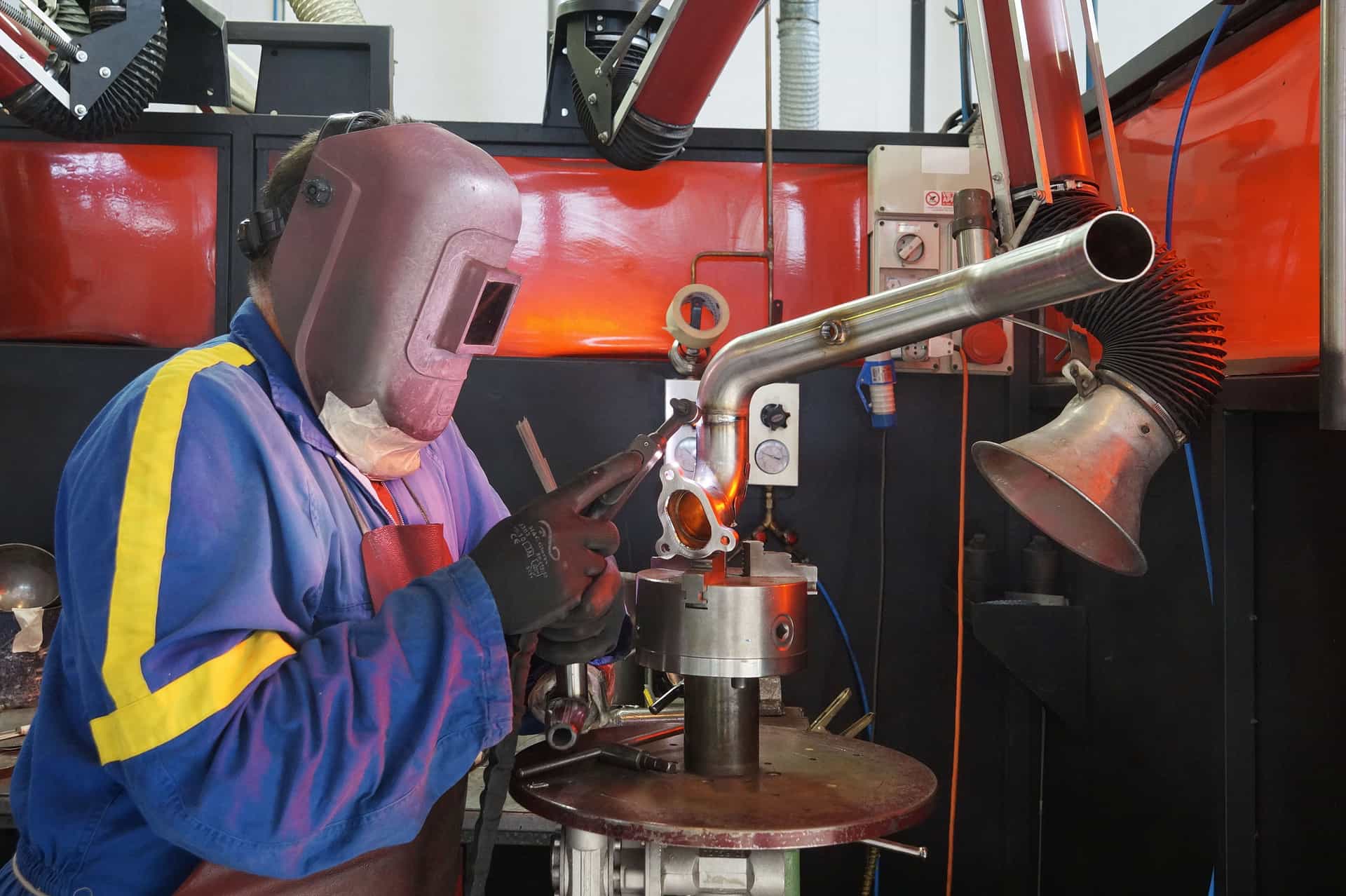
What is the best respiratory protection for welding?
For a home shop: a reusable half-mask respirator with P100 particulate filters, worn under the welding helmet, plus cross-ventilation that moves air across the bench and away from your face. A powered air-purifying respirator (PAPR) helmet is more comfortable and far more expensive; a fume extractor arm is the only option that removes the fume instead of filtering it at your face, and it is the right answer for a fixed bench.
This page is about choosing between the three systems. If what you want is what is actually in welding fume — the metals, the gases, which materials are regulated and at what exposure — that is respirators and fume safety, and it is worth reading first if you have not. The short version: the exposure in a home garage is respirable metal particulate, the particles are small enough to reach deep lung tissue, and the welding helmet does nothing whatsoever about it.
The three systems, and what each one really costs
| System | What it does | Comfort | Relative cost | Right for |
|---|---|---|---|---|
| Half-mask with P100 filters | Filters particulate at your face | Hot, and must seal to the skin | Lowest | Almost every home shop |
| PAPR welding helmet | Blows filtered air into the hood | Best — no face seal, cooler | Highest, by a wide margin | All-day welding, or a beard that breaks a seal |
| Fume extractor / local exhaust | Removes the fume at the source | Nothing worn at all | Middle, plus installation | A fixed bench you weld at repeatedly |
| A box fan in the doorway | Dilutes and moves air — not protection | n/a | Near zero | Supplementing any of the above, never replacing one |
The ranking people expect is cost order. The ranking that matters is compliance order — which system you will actually use every time. A half-mask is the cheapest and the one most likely to be left on the shelf on a hot afternoon; a PAPR is the one you forget you are wearing; extraction is the one that requires nothing of you at all once it is installed, which is why it wins for a bench you return to.
Why a fume mask is the right default
Three reasons, and the first is the only one that really decides it.
It is specified correctly for the hazard. P100 removes at least 99.97% of airborne particulate, and particulate is what home welding produces most of. You do not need a cartridge rated for organic vapour to weld clean mild steel.
It works anywhere. Under the car, out at the gate, up a ladder — the exposure follows the work, and a mask follows it too. Extraction does not.
It costs almost nothing against the machine. A respirator and a year of filters is a rounding error next to any welder on this site, which makes the usual objection to it a habit rather than a budget decision.
What a P100 filter does not remove
Gases. A particulate filter is a mechanical filter — it captures particles and does nothing about gas, because gas molecules pass straight through. That matters in three specific situations, none of them exotic:
Ozone, produced by ultraviolet light from the arc acting on the air around it, and most noticeable with aluminum and with high-current work. Nitrogen oxides, formed by the arc's heat. And decomposition products from coatings — the worst case in a home shop by a long way, because solvent residue, paint and especially galvanised zinc generate hazards a particulate filter was never meant to handle.
The answer to all three is the same and it is not a better filter. It is ventilation: move air across the work and away from your face, so the gases are diluted and carried off rather than breathed. Grind coatings back to bare metal before you weld them, and treat galvanised steel as a job that needs real airflow rather than a mask.
Ventilation is not optional just because you are wearing a mask
A respirator protects one person's airway. It does not reduce the concentration of fume in a closed garage, so the air you are standing in gets steadily worse for as long as you weld in it — and it is still there when you take the mask off to look at the work.
Cross-ventilation is the cheap fix: an inlet on one side, an extract or an open door on the other, so there is a current across the bench rather than a slow fill of the room. A fan blowing at you is worse than none at all on gas work — it disturbs the shielding gas and will give you porosity.
When a PAPR is genuinely the right answer
Two cases, and in both of them the half-mask is not a cheaper alternative — it is a worse one.
You cannot make a seal. A half-mask relies on skin contact all the way round. Facial hair crossing the seal line defeats it completely, and no strap tension fixes that. If shaving the seal line is not something you are going to do, a loose-fitting powered respirator is the honest option rather than a mask that is doing nothing.
You weld all day. The heat and breathing resistance of a half-mask under a hood is the reason people stop wearing them, and a system you remove at hour three is not protecting you at hour four. A PAPR pushes filtered air into the hood, so there is no seal and no added resistance, and it is measurably cooler.
Neither case describes most readers of this site, which is why a PAPR is not a pick above. If either describes you, it is worth the money, and the helmet specifications still apply — the same four numbers on the professional-grade page decide the lens in a PAPR hood too.
Which process needs this most
Flux-core, by a clear margin. The flux that makes gasless welding possible outdoors is burned off into the air you are standing in, and it is visibly smokier than any gas process. Flux-core welding safety covers that specifically, and it is the single strongest argument for buying a respirator alongside a first machine rather than later.
Gas MIG is cleaner and still produces particulate. TIG produces the least of all — but stainless introduces chromium and nickel compounds, and OSHA regulates hexavalent chromium under a dedicated standard, so cleanliness and low hazard are not the same thing.
Plasma cutting is its own case: it cuts through coatings rather than giving you the chance to grind them off first, and it moves a great deal of air. Extraction earns its place there more than anywhere.
What we would buy
For almost every reader: a half-mask with P100 filters, a fit check every single time, and cross-ventilation across the bench. That combination is most of the available protection for a very small fraction of the available money.
What we would buy
Arc & Bead is an Amazon Associate. If you buy through a link on this page we may earn a commission, at no extra cost to you. We have not physically tested the machines on this page and we say so on How We Pick.
1. Best for most home shops
3M 6000-series half-mask respirator with P100 filters
P100 filtration, a low enough profile to wear under a hood, and filters stocked everywhere.
A reusable half-facepiece respirator taking P100 particulate filters — 3M 2091 or equivalent — with NIOSH-approved filtration. P100 removes at least 99.97% of airborne particulate, which is the correct specification for welding fume, because the exposure in a home garage is respirable metal particulate rather than gas.
The reason this is the default rather than the Miller below is availability. The 6000 series is the most widely stocked half-mask platform in the United States, which means filters, straps and facepieces are on a shelf near you in five years as well as today. A respirator you stop replacing filters on is a respirator you stop wearing.
Fit is the whole game with a half-mask and it is the part nobody checks. A respirator that leaks at the seal does nothing useful. Do a negative-pressure check every time you put it on: cover the filters, inhale gently, and the facepiece should pull in slightly and hold. Facial hair at the seal line breaks it, and no amount of strap tension fixes that.
Under a welding hood, profile matters. The 6000 series is low enough that most helmets close over it, but check the clearance with your own helmet rather than assuming — a respirator that stops the hood seating is a respirator you will take off.
What works
- P100 filtration handles welding fume particulate, which is the actual exposure in a home garage
- Low-profile 6000-series shell fits under most welding helmets without breaking the seal
- Filters are cheap and universally stocked
What does not
- Needs a proper seal against clean-shaven skin. Facial hair defeats it, and a defeated respirator protects nothing
- Particulate filters do not remove gases such as ozone or carbon monoxide — ventilation is still required
- Adds warmth and breathing resistance under a helmet
2. Best fit under a welding hood
Miller LPR-100 half-mask respirator
P100 filtration in a profile designed from the start to sit under a helmet.
A reusable half-mask with P100 particulate filters, designed specifically to be worn under a welding helmet rather than adapted to it. The filtration specification is the same as the 3M; the difference is geometry.
That difference is worth more than it sounds. The failure mode for respirators in a home shop is not inadequate filtration — it is the owner taking the mask off because the hood does not sit right over it, or because the exhaled air fogs the lens. A low-profile design with directed exhalation addresses both, and compliance is the specification that actually determines your exposure.
The trade is availability. Miller's filter supply is a welding-supply channel rather than the general industrial-safety channel 3M filters move through, so plan on ordering replacements rather than picking them up locally.
Everything said above about fit checks applies identically here. A P100 filter on a facepiece that leaks is a filter doing nothing.
What works
- The lowest-profile option here — it was designed for exactly this use, not adapted to it
- Filters sit outboard, so the helmet shell does not press them into your face
- The large non-return exhaust valve is the reason it is less tiring to wear for a long session
What does not
- Filters are less widely stocked than 3M's, so plan replacements ahead
- The listing we link is the Small/Medium size — check the size before ordering, because the M/L is sold separately
- Same hard limit as any particulate respirator: it does not remove gases
Who this is wrong for: Anyone who wants filters available locally at short notice — the 3M platform is far more widely stocked.
Questions people actually ask
What respirator should I use for welding?
A reusable half-mask with P100 particulate filters, worn under the welding helmet. P100 removes at least 99.97% of airborne particulate, which is the right specification because home welding exposure is respirable metal particulate rather than gas.
Fit decides whether it works. Do a negative-pressure check every time: cover the filters, inhale gently, and the facepiece should pull in slightly and hold.
Is a welding helmet enough protection from fume?
No. A welding helmet protects your eyes and face from radiant energy and spatter. It is not a respirator and does nothing about what you breathe.
The fume passes freely into the space under the hood, which is why respiratory protection is a separate purchase rather than a feature of the helmet.
Does a P100 filter stop welding gases?
No. A particulate filter is mechanical - it captures particles, and gas molecules pass straight through.
That matters for ozone, nitrogen oxides, and decomposition products from coatings, especially galvanised zinc. The answer to all three is ventilation that moves air across the work and away from your face, not a different filter.
Do I need a PAPR welding helmet?
In two cases. If facial hair crosses the seal line of a half-mask, the mask is not working and no strap tension fixes it. And if you weld all day, the heat and breathing resistance of a half-mask is the reason people take them off.
For a few hours a week with a sealable face, a half-mask plus ventilation is most of the protection for a small fraction of the cost.
Which welding process produces the most fume?
Flux-core, clearly. The flux that makes gasless welding work outdoors is burned off into the air around you, and it is visibly smokier than any gas process.
Gas MIG is cleaner but still produces particulate. TIG produces the least, though stainless introduces chromium and nickel compounds that OSHA regulates separately.
Is a fan enough ventilation for welding?
A fan dilutes and moves air; it is not respiratory protection and does not replace a respirator. Use it as cross-ventilation - an inlet one side, an open door or extract the other, so there is a current across the bench.
Never aim a fan at the weld on a gas process. It disturbs the shielding gas and causes porosity.
Sources
- OSHA — 29 CFR 1910.134, respiratory protection standard
- OSHA — Hexavalent chromium standard (29 CFR 1910.1026)
- NIOSH — particulate filter classes (N, R, P series) and the 99.97% P100 efficiency rating
- American Welding Society — Safety and Health Fact Sheets on fume and ventilation
- 3M — 6000 series half facepiece and 2091 P100 filter published specifications
- Miller — LPR-100 half-mask respirator published specifications
Read next
- Welding respirators and fume safety
What is in welding fume, what a P100 filter does and does not remove, and when it is mandatory.
- Flux-core welding safety
Fume, eyes and fire — including the risks that show up hours after you stop welding.
- Welding gloves and jackets
Why MIG gloves and TIG gloves are opposite tools, and when a leather jacket stops being optional.
- The best welding helmets for MIG welding
MIG does not stress a lens the way TIG does, so the money goes to window size and headgear instead.
- The welding starter kit checklist
Everything that is not the welder, ordered by how much each item changes your results.
- Helmets and PPE: the gear that decides what you can see
Every level needs a helmet. What the right helmet is changes as the level changes — and a bad one is the most common reason a beginner's welds look worse than their technique.
Back to Helmets & PPE, or start over at Find Your Level.
Ryder M.
Ryder M. is the hands-on owner behind Magoo Media Group. He writes Arc & Bead's buying guides and picks every machine on the site. What every recommendation is based on — and what it is not based on — is set out on How We Pick.