The best plasma cutters for stainless steel
Stainless cuts easily with plasma. Getting an edge you can weld afterwards is the harder part, and the specification that decides it is the bottom of the amperage range, not the top.
Arc & Bead is an Amazon Associate. If you buy through a link on this page we may earn a commission, at no extra cost to you. We have not physically tested the machines on this page and we say so on How We Pick.
Quick picks
Tap any row to jump to the full write-up further down this page.
| # | Product | Best for | Price |
|---|---|---|---|
| 1 | 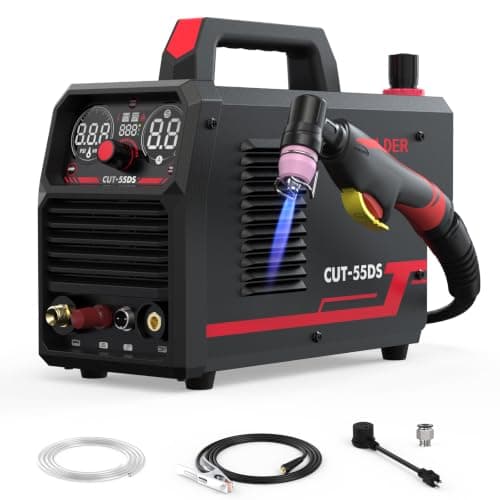 YESWELDER CUT-55DSA published 10 A floor, which is the single specification that separates a cut you can weld from a cut you have to re-make. | Best overall | |
| 2 | 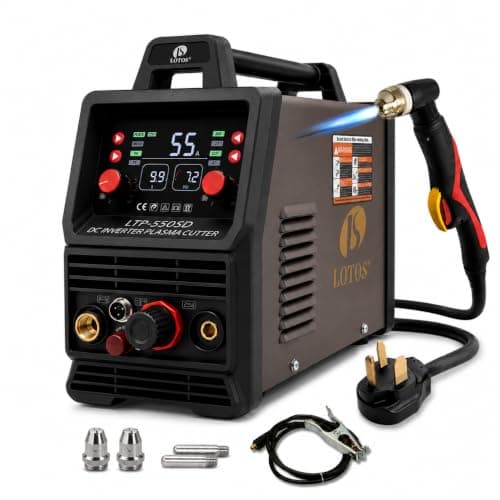 Lotos LTP5505DThe cheapest pilot-arc machine in our registry, with a published 100% duty cycle at 43 A and a complete spec on both supplies. | Budget pick | |
| 3 | 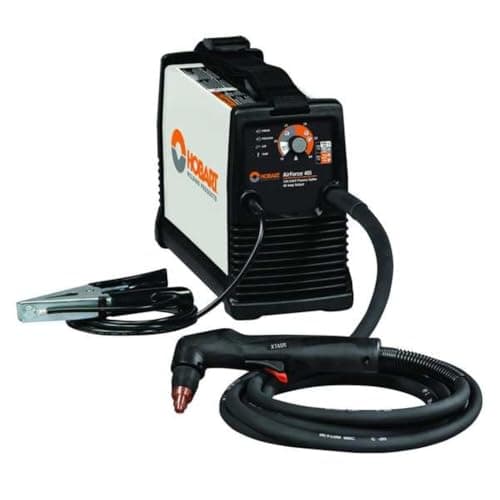 Hobart Airforce 40iForty amps is the useful middle for stainless sheet, and Hobart's dealer network matters most on a tool that eats consumables. | Best supported | $2,198.75 · View on Amazon #ad How this is funded · Price as of November 13, 2026 |
| 4 | 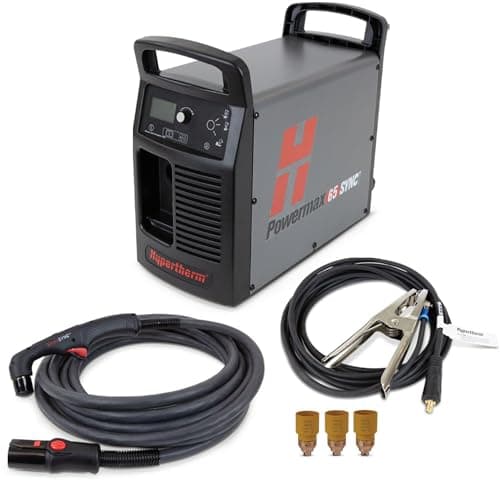 Hypertherm Powermax65 SYNCCartridge consumables and SpringStart. If the stainless edge has to be weld-ready off the torch, this is the machine that gets closest. | Best edge quality | $4,175.00 · View on Amazon #ad How this is funded · Price as of November 13, 2026 |
The short answer
Plasma cuts stainless steel readily — the process does not care that stainless is an alloy. The two things that make stainless different in practice are that it is usually thin and that the cut edge must be cleaned before welding, because plasma leaves oxide and heat tint that will contaminate a TIG weld.
Our overall pick is the YESWELDER CUT-55DS, because its published 10 A output floor is the specification that thin stainless depends on. The budget pick is the Lotos LTP5505D, the cheapest pilot-arc machine in our registry and the best continuous duty cycle here at 100% at 43 A. For edge quality off the torch, the Hypertherm Powermax65 SYNC.
Every price in the table is read live when the page loads, with its own "as of" date inside the buy button.
Why the bottom of the range matters more than the top
Stainless shows up in a home shop as sheet far more often than as plate: exhaust tube, splash-backs, guards, brackets, trailer fittings. Sixteen gauge is about 0.060 in, and that thickness needs very little current.
Over-current on thin stainless costs you three things at once. The kerf widens, so a part cut to a line comes out undersized. The sheet distorts, because stainless has a higher thermal expansion coefficient than mild steel and a lower conductivity — heat stays near the cut and the panel potato-chips. And the metal discolours in a band either side of the cut, which is chromium oxide and has to be removed before the surface is corrosion-resistant again.
All three are mitigated by running less current and moving faster, which is why a machine that dials down to 10 A is more useful on stainless than one with a bigger top end. The cut thickness chart has the amperage-to-thickness relationships, and plasma cutting for beginners covers travel speed and standoff.
| Machine | Output floor | Continuous (100%) rating | Rated cut | Supply |
|---|---|---|---|---|
| YESWELDER CUT-55DS | 10 A | 100% at 35 A | 3/8 in (220 V); 5/16 in (110 V) | 110 V or 220 V |
| Lotos LTP5505D | 20 A | 100% at 43 A | 5/8 in clean (240 V); 3/8 in clean (120 V) | 110/120 V or 220/240 V |
| Hobart Airforce 40i | Not published | Not published | Not published in our registry entry | 120 V or 240 V |
| Hypertherm Powermax65 SYNC | 20 A | 100% at 46 A | 3/4 in recommended | 200-480 V single phase |
A plasma-cut stainless edge is not a weld-ready edge.
Plasma leaves an oxidised, heat-tinted edge, and TIG welding stainless over oxide produces a dirty, porous weld. Grind or file back to bright metal and clean with a dedicated stainless brush — never one that has touched mild steel, which transfers carbon steel particles and causes rust spots. The welding side is in the best TIG welders for stainless steel and what gas for TIG welding.
Air quality is a stainless-specific concern
Moisture in the air supply matters on every material, but on stainless it has a visible consequence: wet air widens the heat-tinted band and pits the cut face, and both are then work to remove. A water separator and a drained tank are the cheapest cut-quality upgrade available for any machine on this page.
Volume is the other half. Published requirements here run to 6.0 CFM, and a small compressor that satisfies the pressure figure can still fall behind on volume partway through a long cut. The numbers are in plasma cutter air requirements, and the machines that carry their own compressor are on the built-in compressor page.
When a plasma cutter is the wrong stainless tool
For straight cuts in thin stainless sheet, a shear or a nibbler leaves no heat-affected zone at all, which means no discolouration to remove and no distortion. For tube and section, an abrasive chop saw with a stainless-specific wheel is faster and more accurate.
Plasma earns its place on curves, on thickness above about 1/8 in, on volume, and when the same machine also has to cut mild steel. The honest overall case for the purchase is in is a plasma cutter worth it, and plasma cutter vs angle grinder is the comparison most people are actually making.
How we picked these
Ranked on the output floor first. Stainless is usually thin, and the lowest current a machine can hold is what decides the result. That is the opposite of how a thick-plate page would rank the same machines, and it is why the cheapest machine here is not the winner.
Pilot-arc or equivalent start. Every machine here publishes a non-touch start, which matters on stainless because the passive oxide film is always present.
No hands-on and no invented stainless ratings. We have cut stainless with none of these machines, and no manufacturer here publishes a stainless-specific thickness figure, so this page does not print one. More on the method on how we pick.
1. Best overall
YESWELDER CUT-55DS
A published 10 A floor, which is the single specification that separates a cut you can weld from a cut you have to re-make.
YESWELDER publishes the CUT-55DS at 10–55 A on 220 V and 10–35 A on 110 V, with a 60% duty cycle at 55 A and 100% at 35 A, a rated cut of 3/8 in at 220 V and 5/16 in at 110 V, a 1/2 in maximum clean cut, 3/4 in severance at 220 V, non-touch pilot-arc start with HF ignition, an AG-60 torch, and 55–70 PSI at up to 6.0 CFM.
The 10 A floor is why it wins a stainless page. Most stainless in a home shop is thin — 16 gauge to 1/8 in sheet for brackets, guards, exhaust and food-contact work — and too much current on thin stainless does not just widen the kerf, it dumps heat into a material that distorts readily and discolours for an inch either side. Being able to dial down to 10 A rather than stopping at 20 A is the difference.
The 100% duty cycle at 35 A is the second reason. Stainless sheet work is usually long shallow cuts rather than short deep ones, and a machine that can run continuously at the amperage you are actually using is more useful than one with a bigger top end.
Against it: consumables do not last like the name brands, and owner reports describe more unit-to-unit variation than the established makers. A 3/8 in rated cut also means thick stainless plate is outside its range.
What works
- Pilot arc at the bottom of the market, which used to mean paying twice as much
- Dual voltage, so a 110 V outlet gets you started
What does not
- Consumables are the running cost and they do not last like the name brands
- Owner feedback reports more variation between units than the established brands
2. Budget pick
Lotos LTP5505D
The cheapest pilot-arc machine in our registry, with a published 100% duty cycle at 43 A and a complete spec on both supplies.
Lotos publishes the LTP5505D at 20–55 A on 220/240 V and 20–35 A on 110/120 V, a 5/8 in clean cut and 3/4 in severance at the higher supply, 3/8 in clean and 1/2 in severance at the lower, a 60% duty cycle at 55 A with 100% at 43 A, non-touch pilot arc, a front-panel regulator and gauge, and a three-year limited warranty including one year of new replacement.
The budget pick: the least expensive registry product that does the job. For stainless at 1/8 in and above it is genuinely well matched — a 100% duty cycle at 43 A is the best continuous rating on this page, and continuous is what long stainless cuts want.
Who it is for: stainless plate and heavier sheet, and anyone who values the published warranty on a machine whose consumables are a recurring cost.
The reason it is not the overall pick: a 20 A output floor. On 16 gauge stainless that is more current than the job needs, and the result is a wider kerf and more heat tint to clean off.
What works
- Pilot arc means it will start on painted, rusty or galvanized material where a touch-start machine stalls
- 5/8 in clean cut on 240 V is more capacity than most home shops will ever use
- Publishes a complete specification on BOTH supplies — output, clean cut, severance and duty cycle — which most dual-voltage machines do not
What does not
- You must supply clean dry air. A small pancake compressor will not keep up, and wet air destroys consumables fast
- On a 110 V outlet the top end falls from 55 A to 35 A and the clean cut from 5/8 in to 3/8 in
- The output floor is 20 A rather than the 10 A some competing machines publish, so it throttles down less far for thin sheet
- Consumable life is noticeably shorter than Hypertherm's, and the running cost shows it
Who this is wrong for: Thin stainless sheet at 16 gauge and below. The 20 A floor is the wrong end of the range for it, and heat tint on stainless is work you then have to undo.
3. Best supported
Hobart Airforce 40i
Forty amps is the useful middle for stainless sheet, and Hobart's dealer network matters most on a tool that eats consumables.
Hobart publishes the Airforce 40i at 40 A output on 120 V or 240 V dual voltage, with an external compressor required.
Forty amps is a deliberate middle: more capacity than a 30 A machine for 1/4 in stainless, and less air demand than a 50 or 60 A machine, which keeps a modest shop compressor viable. For a shop whose stainless work is sheet-metal fabrication rather than plate cutting, that trade is the right one.
The reason to pay for it is the network. A plasma cutter is unlike a welder in that it has a recurring consumable cost, and being able to buy tips and electrodes locally — and get a straight answer about which ones — is worth real money over a few years.
Against it: it is priced above the budget 50 A machines while cutting less, Hobart does not publish as full a specification table as Lotos or YESWELDER do, and it still needs a real compressor with a water separator.
What works
- Backed by Hobart's dealer network, which matters more for a plasma cutter than a welder because consumables are a recurring purchase
- 40 A sits in the useful middle: more capacity than a 30 A machine, less air demand than a 50 A one
What does not
- Priced above the budget 50 A machines while cutting less
- Still needs a real compressor with a water separator
4. Best edge quality
Hypertherm Powermax65 SYNC
Cartridge consumables and SpringStart. If the stainless edge has to be weld-ready off the torch, this is the machine that gets closest.
Hypertherm publishes the Powermax65 SYNC at 20–65 A, a recommended cut of 3/4 in and severance of 1-1/4 in, a 50% duty cycle at 65 A with 100% at 46 A, 200–480 V single-phase input, SpringStart arc initiation with no high-frequency circuit, and 61.7 lb with the 25 ft torch.
Cut quality on stainless is mostly a consumable-condition story. The swirl ring, nozzle and electrode have to be clean, correctly seated and the right set for the amperage, and a five-piece stack assembled slightly wrong is the usual cause of a bevelled, dross-heavy edge. Single-piece cartridge consumables remove that failure mode, which is why professionals buy these despite the price.
SpringStart is the other reason it belongs on a stainless page: no high-frequency circuit means it can run a CNC table without interfering with the controller, and repeated stainless profile work is exactly where a table earns its keep.
Against it: several times the price of a budget machine, a 200 V minimum supply, and the 1-1/4 in figure is a slow severance cut rather than a working thickness.
What works
- Single-piece cartridge consumables, which removes the five-piece stack-up that gets assembled slightly wrong every time
- SpringStart means no high-frequency noise, so it can drive a CNC table without interfering with the controller
- Hypertherm consumable life is why professionals buy these: the running cost per cut is far below a budget machine's
What does not
- Costs several times an 80 A budget machine, and cuts thinner plate than one at its recommended setting
- 3/4 in is the recommended cut; 1-1/4 in is a severance cut, which is a slow rough parting cut, not a working thickness
- Needs a serious supply — 200 V minimum, and the air volume to match
Questions people actually ask
Can a plasma cutter cut stainless steel?
Yes, easily. Plasma cutting blows ionised air through molten metal and works on any electrically conductive material, so stainless, aluminum and copper alloys all cut.
The published thickness ratings on every machine are mild-steel figures. Stainless conducts heat less well than aluminum but more than you might expect, so treat the ratings as a guide rather than a promise.
How many amps to cut stainless steel with plasma?
Far fewer than most people use. Thin sheet at 16 gauge needs very little current, which is why a machine with a 10 amp output floor is more useful for stainless fabrication than one that stops at 20 amps.
For 1/8 to 1/4 inch stainless, 30 to 45 amps is a sensible working range on the machines here.
Does plasma cutting ruin stainless steel?
It does not ruin it, but it does leave an edge that needs work. The cut face is oxidised and there is a band of heat tint - chromium oxide - either side of it, which reduces corrosion resistance until it is removed.
Grind or file back to bright metal and clean with a stainless-only wire brush. Never use a brush that has touched mild steel; the transferred particles cause rust spots.
Can you weld a plasma-cut stainless edge?
Not until it is cleaned. TIG welding stainless over an oxidised, heat-tinted edge gives a dirty, porous weld with poor corrosion resistance.
Remove the oxide mechanically back to bright metal, then degrease. This is a bigger deal on stainless than on mild steel, where a quick wire-brush is usually enough.
What is the best cheap plasma cutter for stainless?
In our registry, the YESWELDER CUT-55DS is the best match despite not being the cheapest, because YESWELDER publishes a 10 amp output floor and a 100 percent duty cycle at 35 amps - the two figures thin stainless depends on.
The Lotos LTP5505D costs less and has a better continuous rating at 43 amps, but its 20 amp floor is high for sheet work.
Will plasma cutting distort thin stainless?
It can, more than it would mild steel. Stainless expands more and conducts heat away from the cut less readily, so heat stays near the cut line and thin panels can buckle.
Run the lowest current that will cut, move at a steady pace rather than slowly, and where possible cut with the panel clamped flat or supported. For straight cuts in thin sheet, a shear or nibbler avoids the problem entirely.
Sources
- YESWELDER - CUT-55DS published specifications: 10-55 A on 220 V and 10-35 A on 110 V, 60% duty cycle at 55 A and 100% at 35 A, rated cut 3/8 in at 220 V and 5/16 in at 110 V, 1/2 in maximum clean cut, non-touch pilot arc with HF ignition, AG-60 torch, 55-70 PSI and 6.0 CFM max (read 2026-10-22, recorded in this site's product registry, ASIN B083GPXF8Y)
- Lotos - LTP5505D published specifications: 20-55 A DC on 220/240 V and 20-35 A on 110/120 V, clean cut 5/8 in and severance 3/4 in at 220/240 V, 60% duty cycle at 55 A and 100% at 43 A, non-touch pilot arc, front-panel regulator and gauge, 3-year limited warranty with 1-year new replacement (as recorded in this site's product registry, ASIN B0052OX876)
- Hobart - Airforce 40i published specifications: 40 A output, 120 V or 240 V dual voltage, external compressor required (as recorded in this site's product registry, ASIN B0828JNFG5)
- Hypertherm - Powermax65 SYNC published specifications: 20-65 A, recommended cut 3/4 in, severance 1-1/4 in, 50% duty cycle at 65 A and 100% at 46 A, 200-480 V single phase, SpringStart arc initiation, single-piece cartridge consumables, 61.7 lb with the 25 ft torch (as recorded in this site's product registry, ASIN B09S7P2KGM)
- American Welding Society - plasma arc cutting of stainless steel, including cut-edge oxide removal before welding
Read next
- The best plasma cutters for aluminum
Four plasma cutters ranked on the amperage headroom and air supply aluminum actually needs, with the cheapest pilot-arc machine in our registry named as the budget pick.
- The best TIG welders for stainless steel
Stainless is a DC job with a heat problem — the machines that control heat, and why you can skip AC.
- Plasma cutter cut thickness chart
Recommended versus severance capacity by amperage, and what you lose on a 110V outlet.
- Plasma cutter air requirements
How to read CFM and PSI, why tank size is not the answer, and what a compressor must sustain.
- The best plasma cutters under $1,000
Three pilot-arc plasma cutters under $1,000 at current live prices, ranked on published output on both supplies, continuous duty cycle and what the air supply will cost you.
- Plasma cutter vs angle grinder
An angle grinder cuts lengths; plasma cuts shapes. The one question that settles it.
Back to Level 4 · Plasma, or start over at Find Your Level.
Ryder M.
Ryder M. is the hands-on owner behind Magoo Media Group. He writes Arc & Bead's buying guides and picks every machine on the site. What every recommendation is based on — and what it is not based on — is set out on How We Pick.