Is a plasma cutter worth it?
For curves and thick plate, nothing else comes close. For straight cuts in thin steel, you probably already own the right tool.
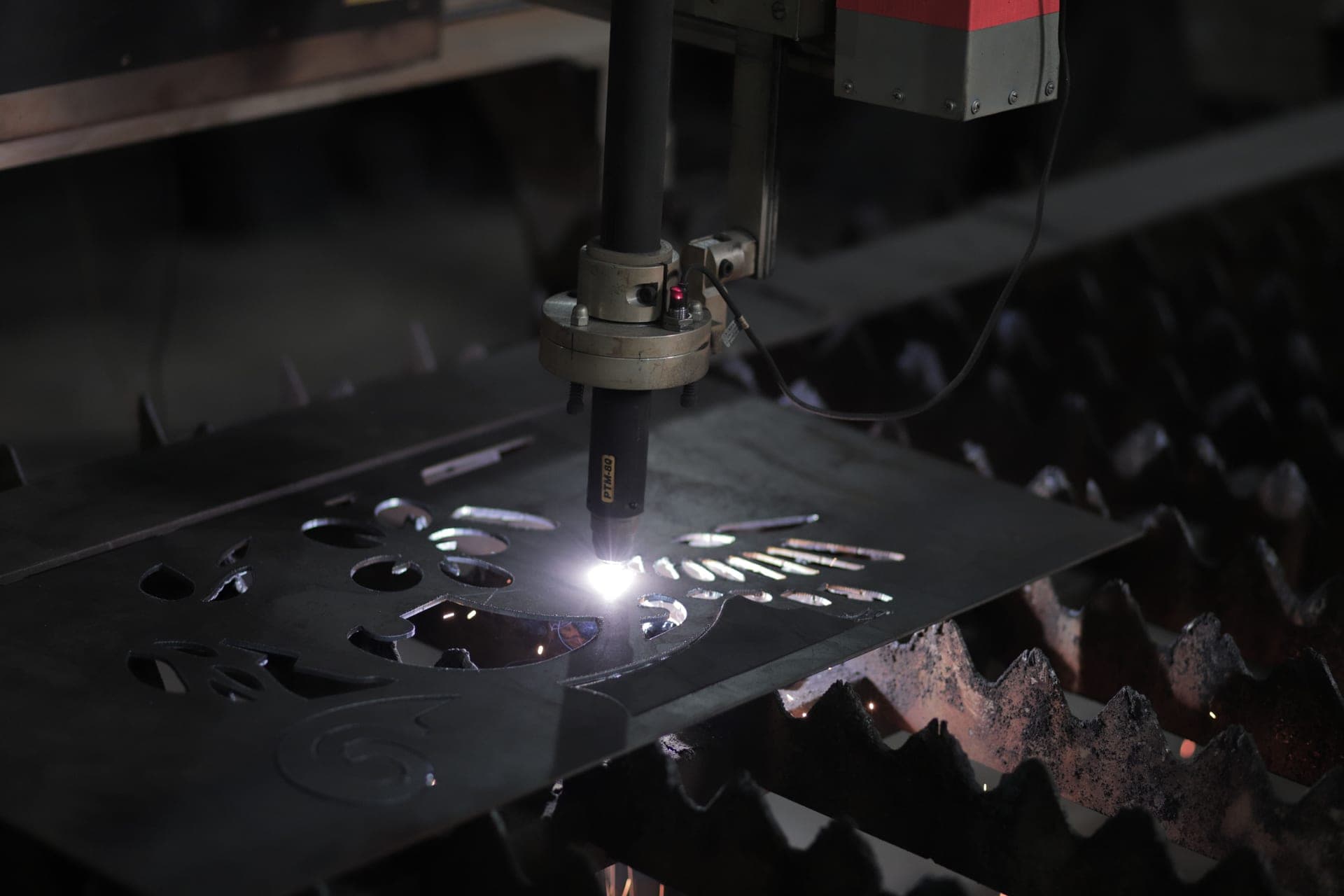
The short answer
A plasma cutter is worth it if you regularly cut curves, holes or shapes in steel, or cut plate much over a quarter inch — nothing else a home shop can own does those jobs well. It is not worth it if your cutting is short straight cuts in thin steel and tube, because an angle grinder with a cut-off wheel already does that faster and for a fraction of the money. The deciding question is shape, not thickness.
What plasma does that nothing else does
Three things, and they are the whole case.
Curves and shapes. A grinder cuts in straight lines because the disc is rigid and round. A bandsaw cuts straight because the blade runs in a plane. Plasma cuts wherever you move the torch, which means brackets with radiused corners, holes in the middle of a plate, and any shape traced from a template.
Thick plate, quickly. A grinder will eventually get through half-inch plate, at the cost of several discs and a great deal of time and noise. A 50-amp plasma machine cuts it in a pass.
Metals that are not mild steel. Plasma cuts anything conductive — stainless, aluminum, copper — because the process is electrical rather than chemical. An oxy-fuel torch works by oxidizing iron and genuinely cannot cut aluminum or stainless at all.
Plasma against an angle grinder is the head-to-head, and plasma against oxy-acetylene covers the gas-torch comparison.
| The job | Angle grinder | Bandsaw | Plasma cutter |
|---|---|---|---|
| Square ends on box section | Best | Best | Works, but overkill |
| Long straight cut in sheet | Workable, slow | No | Best |
| Curves and radiused brackets | No | No | Best |
| A hole in the middle of a plate | No | No | Best |
| 1/2 in plate | Possible, slow and loud | Best for straight cuts | Best for anything else |
| Stainless and aluminum | Workable with the right disc | Yes | Best |
| Cleaning up after any of the above | Required | Not needed | Needs a grinder afterwards |
The three costs that are not the machine
The honest total is usually well above the sticker price, and this is where worth-it questions get answered wrongly.
Air. Unless the machine has a built-in compressor, you need a compressor that can sustain the manufacturer's CFM at the stated pressure — plus a water separator and a desiccant filter, because moisture wrecks cuts and consumables. A compressor adequate for a 50-amp machine is not a small purchase. Plasma cutter air requirements covers the sizing and whether plasma cutters need gas covers why it is air rather than a bottle.
The circuit. Several machines worth owning are 220-volt only. If that circuit does not exist, an electrician does, and that is a real line in the budget. What size breaker a welder needs covers what to ask for. Circuit work belongs to a licensed electrician.
Consumables. The electrode and nozzle are wear items and they are the dominant running cost. This is where the cheapest machine stops being cheapest — budget consumables do not last like name-brand ones, and at higher amperage you get through them faster.
Add it up before you buy, not after
Write down four numbers: the machine, the compressor you would need, the electrical work, and a year of consumables at your expected use. A plasma cutter with a built-in compressor on a 120-volt circuit often wins that arithmetic even though its sticker price is higher, because three of those four numbers are zero.
When it is clearly worth it
You fabricate rather than repair. If you are making parts — brackets, plates, gussets, panels — shape is the job, and shape is what plasma does.
You work regularly above a quarter inch. Grinding through thick plate is slow and destroys discs. This is the thickness where plasma stops being a luxury.
You already have air and a 240-volt circuit. The two prerequisites are paid for, so you are only buying the machine, and the value proposition changes entirely.
You cut stainless or aluminum. There is no cheap alternative that does this well.
When it is not
Your cutting is square ends on tube and angle. A chop saw or a bandsaw does this better than plasma, with a cleaner edge and no cleanup.
You are buying it before your first welder. Cutting is not the bottleneck for someone learning to weld. The order of purchase is machine, helmet, grinder — and plasma later, if at all. The starter kit checklist sets out the sequence.
Your compressor is a pancake. A starved plasma cutter produces bad cuts and burns consumables, and the fault looks like the machine rather than the air. Fix the air first or buy a machine with its own.
You cut steel twice a year. A cut-off wheel costs a few dollars and keeps indefinitely. Consumables, compressor maintenance and shelf space do not.
The safety cost, which is not optional
Plasma cutting throws substantially more hot material and airborne particulate than welding does, because the process is designed to blow molten metal out of the kerf.
You need a helmet whose shade range reaches shade 8, which is OSHA's minimum protective shade for plasma arc cutting under 300 amps — and that covers all home plasma work. Helmets for plasma cutting covers which ones reach it and the shade chart has the table.
You also need genuine fume control. Cut outdoors or with extraction, and wear a half-mask respirator rated for metal fume under the hood — respirators and fume safety sets out what that means. None of this is optional and all of it belongs in the worth-it arithmetic.
What we would buy
Arc & Bead is an Amazon Associate. If you buy through a link on this page we may earn a commission, at no extra cost to you. We have not physically tested the machines on this page and we say so on How We Pick.
1. The tool to try first
DeWalt DWE402K 4-1/2 in angle grinder
If your cuts are short and straight, this is the honest answer and it costs a fraction.
An angle grinder with a cut-off wheel cuts mild steel up to a few millimeters thick quickly, accurately along a straight line, and with no compressed air, no consumables beyond discs, and no electrical circuit beyond a wall socket.
It belongs at the top of this page because it is genuinely the right answer for a lot of people asking the question. If your cutting is square ends on box section and angle iron, you do not need plasma and buying it will not make those cuts better.
You also need one anyway. Plasma leaves dross and an oxidized edge, and the grinder is what cleans it. Nobody owns a plasma cutter and no grinder.
What works
- Every weld needs prep and cleanup, so this earns its place from your first day regardless of process
- Cut-off, grinding and wire-wheel discs all fit the same tool
- No air, no gas, no dedicated circuit
What does not
- Slow and physical on anything thicker than about 1/4 in
- Cannot follow a curve accurately — that is the thing a plasma cutter buys you
- Makes far more mess and noise than plasma cutting
2. The lowest total cost to get cutting
Lincoln Electric Tomahawk 30 AIR
Internal compressor, so the machine price is close to the real price.
Lincoln publishes 15 to 30 amps, an internal air compressor that needs no external air supply or filter, a 230-volt single-phase input, a 5/16 inch recommended cut at 22 inches per minute, a 3/8 inch maximum at 14 ipm, a 1/2 inch severance cut at 5 ipm, and 40 pounds.
On a worth-it question this machine answers differently from every other one, because its sticker price is close to its total price. A cheaper machine that needs a compressor and a water separator can easily cost more by the time it cuts anything.
The trade is honest: it still wants a 240-volt circuit and publishes no 120-volt option, 30 amps is a real ceiling, the 1/2 inch figure is a severance cut at 5 inches per minute rather than a working thickness, and the internal compressor has a duty cycle of its own.
What works
- The compressor is inside the machine, so the hidden second purchase that sinks most first plasma buys does not exist
- It takes external air as standard as well, so a shop compressor can carry the long cuts the internal pump has to pause for
- 25 A at a 100% duty cycle is a genuinely continuous rating rather than a figure you have to work around
- Lincoln publishes three years on the machine and a dealer network behind a tool that eats consumables
What does not
- 230 V single phase only. There is no 120 V option, so a garage without a 240 V circuit cannot run it at all
- 40 lb, which is portable for a machine carrying its own compressor but not the under-30-lb class
- Costs multiples of a budget 50 A machine while cutting thinner material
- Buy on the 5/16 in recommended figure: 1/2 in is a severance limit at 5 ipm, not a working thickness
3. Best case for the money, if the shop is ready
Lotos LTP5505D
5/8 in clean cut on 240 V with a pilot arc — if you already own a real compressor.
Lotos publishes 20 to 55 amps on 220/240 volts and 20 to 35 amps on 110/120 volts, a 5/8 inch clean cut and 3/4 inch severance at 220 volts, a non-touch pilot arc, and an external compressor requirement.
If a real compressor and a 240-volt circuit already exist, the worth-it calculation changes completely, because the two expensive prerequisites are already paid for. This is where plasma becomes genuinely good value.
If they do not exist, be honest about the arithmetic. The compressor and the circuit can together cost more than the machine.
What works
- Pilot arc means it will start on painted, rusty or galvanized material where a touch-start machine stalls
- 5/8 in clean cut on 240 V is more capacity than most home shops will ever use
- Publishes a complete specification on BOTH supplies — output, clean cut, severance and duty cycle — which most dual-voltage machines do not
What does not
- You must supply clean dry air. A small pancake compressor will not keep up, and wet air destroys consumables fast
- On a 110 V outlet the top end falls from 55 A to 35 A and the clean cut from 5/8 in to 3/8 in
- The output floor is 20 A rather than the 10 A some competing machines publish, so it throttles down less far for thin sheet
- Consumable life is noticeably shorter than Hypertherm's, and the running cost shows it
Who this is wrong for: A garage with a small pancake compressor and no 240 V circuit. The machine is the cheap part of that purchase, and starved air ruins cuts and consumables together.
Questions people actually ask
Is a plasma cutter worth it for a home shop?
It is worth it if you cut curves, holes or shapes in steel, or regularly cut plate over about a quarter inch. Nothing else a home shop can own does those jobs well.
It is not worth it if your cutting is short straight cuts in thin steel and tube — an angle grinder with a cut-off wheel does that faster and for a fraction of the cost.
What does a plasma cutter actually cost to own?
The machine, plus three things people forget: a compressor able to sustain the manufacturer's CFM with a water separator and desiccant filter, a 220-volt circuit if the machine needs one, and consumables, which are the dominant running cost.
A machine with a built-in compressor on a 120-volt circuit often wins the total-cost comparison even at a higher sticker price, because three of those four numbers are zero.
Is a plasma cutter better than an angle grinder?
For curves, holes and plate over about a quarter inch, yes, and it is not close. For short straight cuts in thin steel, the grinder is faster, quieter to set up and far cheaper.
You need a grinder either way. Plasma leaves dross and an oxidized edge, and the grinder is what cleans it.
Can a beginner use a plasma cutter?
Yes — plasma cutting is substantially easier to learn than welding, because the machine does the work and you are mainly controlling travel speed and standoff.
The harder part is the setup around it: clean dry air at the right volume, the right lens shade, and real fume control.
Should I buy a plasma cutter before a welder?
No. Cutting is not the bottleneck for someone learning to weld, and most early projects need far more welding than shaped cutting.
The sensible order is welder, auto-darkening helmet, angle grinder — and plasma later, once you know your work actually calls for shapes rather than straight cuts.
Sources
- Lincoln Electric — Tomahawk 30 AIR (K5457-1) published specifications and recommended cut figures: 15–30 A, internal air compressor, 230 V 1-phase input, 5/16 in at 22 ipm, 3/8 in at 14 ipm, 1/2 in severance at 5 ipm, 40 lb
- Hypertherm — Gas selection guide for plasma cutting, air plasma operating cost
- Lotos Technology — LTP5505D published cut capacity and air requirement
- OSHA — Arc welding and cutting standard (29 CFR 1910.254), protective shade numbers
Read next
- Plasma cutter vs angle grinder
An angle grinder cuts lengths; plasma cuts shapes. The one question that settles it.
- Do plasma cutters need gas?
Every plasma cutter needs a gas — but for home machines that gas is shop air, not a bottle.
- The best plasma cutters for home use
Home-shop machines, why the compressor is the real purchase, and how to read cut-capacity numbers.
- Plasma cutter air requirements
How to read CFM and PSI, why tank size is not the answer, and what a compressor must sustain.
- The best welding helmets for plasma cutting
Plasma needs shade 8, not 10, plus a lens that triggers on an arc partly hidden in the kerf.
- Level 4 · Plasma: cutting as accurately as you weld
The only rung on this ladder that is about shaping metal rather than joining it — and the one where the machine is the smaller half of the purchase.
Back to Level 4 · Plasma, or start over at Find Your Level.
Ryder M.
Ryder M. is the hands-on owner behind Magoo Media Group. He writes Arc & Bead's buying guides and picks every machine on the site. What every recommendation is based on — and what it is not based on — is set out on How We Pick.