What gas for TIG welding?
Unlike MIG, TIG has one answer for almost everything. The interesting part is the short list of cases where it is not the answer.
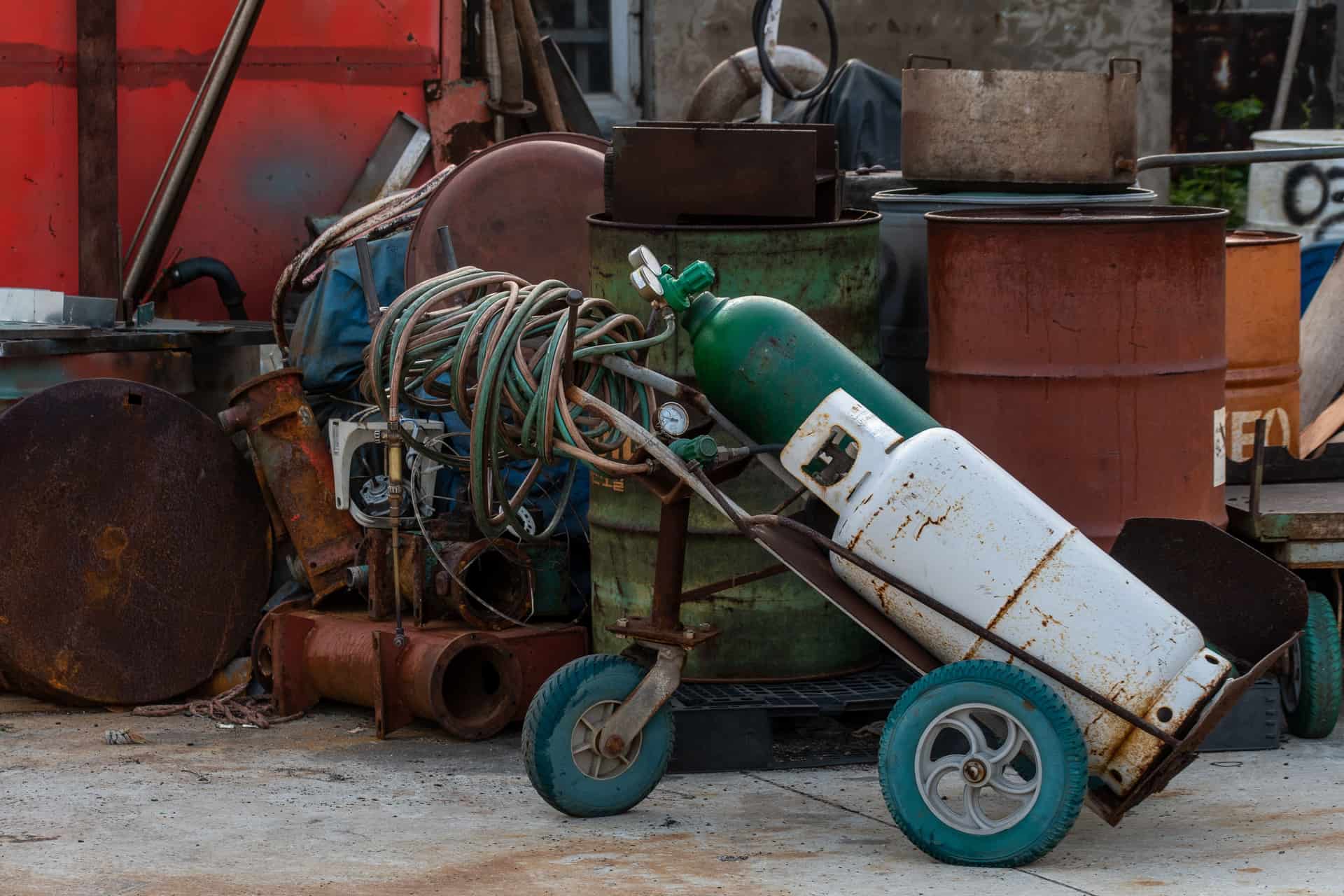
The short answer
Use 100% argon for TIG welding. It is the correct shielding gas for mild steel, stainless steel, aluminum, magnesium, copper and titanium, which is everything a home shop is realistically going to TIG. Unlike MIG, where the gas changes with the metal, TIG has one default and a very short list of exceptions: helium added to argon for thick aluminum, and a 95/5 argon/hydrogen mix for austenitic stainless only. Never use CO2 or oxygen for TIG — both destroy the tungsten electrode.
| Metal | Gas | Why |
|---|---|---|
| Mild steel | 100% argon | Default. Nothing else is needed |
| Stainless steel (304, 316) | 100% argon | Default; argon/hydrogen is an optional improvement on austenitic grades |
| Thin stainless | 100% argon, low flow, small cup | Low heat input is the constraint, not the gas |
| Aluminum | 100% argon with AC output | AC does the oxide cleaning, not the gas |
| Thick aluminum | Argon/helium mix | Helium raises arc voltage and heat input for penetration and travel speed |
| Austenitic stainless, optional | 95% argon / 5% hydrogen | Cleans surface oxides, stabilizes the arc, broadens penetration |
| Titanium | 100% argon, with trailing shield and back purge | Oxidizes aggressively above a few hundred degrees |
| Any metal | CO2 or oxygen | Never — both consume the tungsten electrode |
Why TIG is simpler than MIG here
In MIG, the shielding gas is partly a chemical participant. CO2 in a 75/25 mix breaks down in the arc and that reaction is what broadens penetration and drives fusion out to the toes of the bead. Change the gas and you change the weld, which is why 75/25 and 100% argon are not interchangeable in either direction.
In TIG, the gas has a different job. The tungsten electrode is not consumed, and it is extremely sensitive to anything reactive: oxygen and CO2 both oxidize it, which erodes the tip, destabilizes the arc and drops tungsten into the weld.
So TIG demands a fully inert gas, and argon is the cheap inert gas. That single requirement is why TIG gas selection is short.
The exceptions, in the order you will meet them
Argon/helium for thick aluminum. Helium produces a hotter arc at higher voltage and gives a wide, deep bead, which suits aluminum and copper alloys where heat conducts away from the joint quickly. Adding helium effectively buys penetration and travel speed you could otherwise only get from more amperage.
Two practical costs come with it. Helium is lighter than air, so it needs noticeably higher flow rates to maintain the same shielding — which is also why it empties a cylinder faster. And it is more expensive than argon to begin with.
For a home shop welding aluminum up to around a quarter inch, straight argon with AC balance set correctly is enough, and the helium question only becomes real on thick plate or on a machine that is out of amperage. The aluminum TIG roundup covers the machine side.
Argon/hydrogen for austenitic stainless. A 95% argon, 5% hydrogen mix cleans surface oxides, stabilizes the arc and produces a deeper, broader penetration profile on austenitic grades — the 300 series, so 304 and 316. It produces a visibly brighter, cleaner weld face.
It is also the gas with the sharpest restriction on this page, which is the next section.
Never use an argon/hydrogen mix on aluminum, mild steel, or ferritic, martensitic or duplex stainless
Hydrogen causes porosity in aluminum and hydrogen cracking in mild steel and in ferritic, martensitic and duplex stainless grades. It is safe only on austenitic stainless, where the austenitic structure tolerates dissolved hydrogen. Getting this wrong does not produce an obviously bad weld on the day — it produces cracking later, which is the worst kind of failure. If one cylinder has to cover a mixed shop, make it 100% argon.
Gases that will ruin a TIG weld
CO2, pure or in a mix. This is the most common mistake, and it comes from owning a 75/25 MIG bottle and wanting to avoid a second cylinder. The CO2 oxidizes the tungsten, the tip erodes within seconds, the arc wanders, and tungsten inclusions end up in the weld. The bottle sitting there is not the right bottle.
Oxygen, in any proportion. Oxygen is deliberately added to some MIG mixes. In TIG it does the same thing to the electrode that CO2 does, faster.
Nitrogen, as a general shield. Nitrogen has legitimate specialist uses as a backing gas on duplex stainless and as a plasma cutting gas, but it is not a TIG shielding gas for a home shop and it embrittles several common metals.
Welding-grade argon that has sat with the valve open. Less obvious and worth stating: a cylinder left open with a leaking regulator can be contaminated by back diffusion. Close the valve at the bottle, not just the regulator.
Flow rate, cup size and the two failure modes
Flow rate is where more TIG problems originate than gas selection, because there are two ways to be wrong and most people only know about one.
Too little flow leaves the puddle partly unshielded. On steel you get a dull gray or black weld face; on stainless a gray, rough, sugared surface; on aluminum a dirty, gray, hard-to-wet puddle.
Too much flow is the one that surprises people. Above a certain velocity the gas stream goes turbulent coming out of the cup and begins drawing air into itself, so the weld looks exactly as though it were under-shielded. Winding the flow up because the weld looks contaminated is the classic way to make it worse.
Flow is set in cubic feet per hour and the right figure scales with cup size, not with amperage. A larger cup needs more flow to fill it; a small cup on thin stainless wants very little. Start from the figure in your torch or machine manual, and judge by the color of the weld rather than by the number on the gauge.
A gas lens is the genuine upgrade here. It replaces the collet body with a layered mesh screen that straightens the flow, which gives better coverage at lower flow and allows more tungsten stickout for getting into corners. The TIG settings chart has the starting ranges.
Back purging, and when it stops being optional
The shielding gas protects the top of the weld. On full-penetration joints, the back of the weld is also molten and also exposed to air.
On mild steel nobody worries about this. On stainless it matters: an unpurged stainless root oxidizes into a gray, crystalline, sugary surface that is both weak and a corrosion site, and no amount of top-side shielding prevents it. On titanium it is absolute.
Purging means filling the back side with argon — inside a pipe, or in a simple purge chamber taped around the joint — before and during the weld. For exhaust tube and stainless pipework this is the difference between a joint that lasts and one that cracks at the root. The exhaust roundup covers where that bites in practice.
One cylinder or two?
If you only TIG: one cylinder of 100% argon covers everything.
If you MIG steel and TIG: two cylinders — a 75/25 argon/CO2 for steel MIG and a 100% argon for TIG — but only one regulator, because both use a CGA-580 valve outlet in the US. Swapping gases means changing the bottle, not buying a second regulator.
If you MIG aluminum as well, the 100% argon bottle serves both the TIG torch and the spool gun, so there is still no third cylinder. Cylinder sizes covers how big each should be — and for a second, less-used gas the answer is usually smaller than you expect.
The question that comes before this one
This page assumes you have accepted that a cylinder is part of the purchase. If you have not — or if you have read that "TIG welding flux" is a way around it — does TIG welding need gas answers that directly. The short version is that TIG is the one process on this site with no flux anywhere in it, so there is no self-shielded version and no gasless shortcut.
What we would buy
Arc & Bead is an Amazon Associate. If you buy through a link on this page we may earn a commission, at no extra cost to you. We have not physically tested the machines on this page and we say so on How We Pick.
1. The regulator that fits an argon bottle
Victor GRF400-580 argon/CO2 flowmeter regulator
CGA-580 inlet with a flow gauge reading cubic feet per hour.
Hobart publishes a CGA-580 inlet with a flow gauge, for argon and argon/CO2 mixes.
The useful practical fact is that 100% argon and 75/25 argon/CO2 cylinders both use a CGA-580 valve outlet in the US. If you already MIG with a 75/25 bottle, the regulator you own fits the argon bottle you are about to lease — two gases, two cylinders, one regulator.
It reads flow directly in cubic feet per hour, which is the unit every TIG settings chart uses, so there is no conversion step between the chart and the knob.
A gauge-type regulator is less precise than a true float flowmeter at low flow rates, and TIG runs at low flow rates. For a home shop it is fine; for very low-amperage work on thin stainless a flowmeter is a genuine improvement.
What works
- CGA-580 inlet is the fitting on the argon and argon/CO2 bottles a US gas supplier will hand you
- A true flow tube rather than a flow gauge, so what you read at low flow is what you are getting
- Reads directly in cubic feet per hour, which is the number the settings charts use
- Full brass body and a precision needle valve — this is a shop regulator, not a starter one
What does not
- Wrong fitting for 100% CO2 bottles, which use CGA-320 — check before you buy
- Costs several times a generic two-gauge regulator, and a generic one will get a beginner welding
- A flow tube has to hang vertically to read correctly, which constrains where it can sit on the bottle
2. One tungsten for both AC and DC
CK Worldwide 2% lanthanated tungsten electrodes
2% lanthanated works on AC aluminum and DC steel, so the gas is the only variable left.
CK Worldwide publishes 2% lanthanated electrodes — the blue band — rated for both AC and DC, in 1/16, 3/32 and 1/8 inch sizes.
Gas and tungsten are the two consumable variables in TIG, and keeping one of them fixed makes diagnosing the other far easier. One electrode type that covers AC aluminum and DC steel means that when a weld goes wrong you are not also wondering whether you fitted the right tungsten.
It contains no thorium, so the grinding dust carries no radioactive-material handling question — which matters because tungsten grinding is a routine part of TIG rather than an occasional one.
It still needs a dedicated grinding wheel. Sharing a wheel with steel contaminates the tip, and a contaminated tip produces exactly the arc wander people blame on gas.
What works
- Works on AC and DC, so one box covers aluminum and steel and you stop thinking about it
- Contains no thorium, so grinding dust carries no radioactive-material handling question
What does not
- More expensive per electrode than unbranded tungsten of the same designation
- Still needs a dedicated grinding wheel — sharing a wheel with steel contaminates the tip
3. The machine the argon is for
AHP AlphaTIG 200X
AC/DC TIG from 10 A with adjustable AC balance, so aluminum is on the table.
AHP publishes AC/DC TIG and stick, 10 to 200 amps TIG, a 60% duty cycle at 200 amps, mild steel from 24 gauge to three-eighths of an inch, aluminum to a quarter inch, AC balance adjustable from 30 to 70%, and 50 pounds.
Gas selection interacts with the machine in one specific way worth understanding. AC output is what breaks up the oxide layer on aluminum, and the AC balance control sets how much of each cycle goes to cleaning rather than penetration.
That is a cleaning mechanism the shielding gas does not provide. People sometimes look for a gas that will clean aluminum oxide; there is not one, and 100% argon with correctly set AC balance is the answer instead.
A 10-amp published minimum is also what lets a low flow rate work — small cup, low amps, low flow is a coherent setup, and a machine with a high minimum forces you out of it.
What works
- AC output is what makes aluminum possible at all — this is the cheapest widely supported machine that has it
- 60% duty cycle at 200 A is a genuinely high rating for the price
- Adjustable AC balance lets you trade cleaning action against penetration instead of accepting one compromise
What does not
- The bundled torch and consumables are the first thing most owners replace
- The manual is thin. Budget time for learning the machine as well as the process
- 50 lb and a foot pedal means it lives in one place
Questions people actually ask
What gas do you use for TIG welding?
100% argon, for mild steel, stainless steel, aluminum, magnesium, copper and titanium. Unlike MIG, where the gas changes with the metal, TIG has one default that covers essentially everything a home shop welds.
The exceptions are argon/helium mixes for thick aluminum, where helium raises heat input, and a 95/5 argon/hydrogen mix for austenitic stainless only.
Can you TIG weld with 75/25 argon CO2?
No. The CO2 oxidizes the tungsten electrode, which erodes the tip within seconds, destabilizes the arc and puts tungsten inclusions into the weld.
This is the most common TIG gas mistake, and it comes from owning a MIG bottle and wanting to avoid leasing a second cylinder. TIG needs a fully inert gas.
Do you need pure argon for TIG aluminum?
Yes — and the gas is not what cleans the oxide. AC output is: the alternating polarity breaks up the aluminum oxide layer, and the AC balance control sets how much of each cycle goes to cleaning rather than penetration.
People sometimes look for a gas that cleans aluminum oxide. There is not one. 100% argon with AC balance set correctly is the answer.
What flow rate should I set for TIG welding?
Start from the figure in your torch or machine manual and judge by the weld's appearance rather than the gauge. Flow is set in cubic feet per hour and scales with cup size rather than amperage.
Too much flow is a real failure mode, not just waste: above a certain velocity the stream goes turbulent at the cup and draws air in, producing a weld that looks exactly under-shielded. A gas lens gives better coverage at lower flow.
When do you need to back purge a TIG weld?
On full-penetration joints in stainless and on titanium. The shielding gas protects the top of the weld, but the back is also molten and also exposed to air — an unpurged stainless root oxidizes into a gray, sugary surface that is weak and a corrosion site.
On mild steel it is not necessary. On stainless pipe and exhaust tube it is the difference between a joint that lasts and one that cracks at the root.
Sources
- American Welding Society — GTAW shielding gas practice
- Wikipedia — Shielding gas: inert gases in GTAW, helium arc characteristics and flow rates
- Compressed Gas Association — CGA-580 valve outlet designation for inert gases
- CK Worldwide — 2% lanthanated tungsten electrode AC/DC rating
- AHP Welds — AlphaTIG 200X published AC balance range and output
Read next
- What gas do you need for MIG welding?
Which shielding gas for which metal, and the one combination that cannot work.
- 75/25 argon/CO2 vs 100% argon: which do you need?
Not two grades of one thing — two gases for two metals. What happens when you swap them.
- TIG welding settings chart
Amperage, tungsten and filler size by metal and thickness, plus symptom-by-symptom diagnosis.
- The best TIG welders for stainless steel
Stainless is a DC job with a heat problem — the machines that control heat, and why you can skip AC.
- Welding gas cylinder sizes
What each common cylinder holds, how long it lasts at real flow rates, and lease versus buy.
- Gas and power: the two things that decide what you can actually run
A machine you cannot plug in is a machine you do not own yet. This is the hub for the two questions that quietly decide every purchase on this site.
Back to Gas & Power, or start over at Find Your Level.
Ryder M.
Ryder M. is the hands-on owner behind Magoo Media Group. He writes Arc & Bead's buying guides and picks every machine on the site. What every recommendation is based on — and what it is not based on — is set out on How We Pick.