The best argon regulators for welding
Every one of these will put gas on your weld. What separates them is whether the number you set is the number you get - and whether the fitting on the end matches the bottle your gas supplier hands you.
Arc & Bead is an Amazon Associate. If you buy through a link on this page we may earn a commission, at no extra cost to you. We have not physically tested the machines on this page and we say so on How We Pick.
Quick picks
Tap any row to jump to the full write-up further down this page.
| # | Product | Best for | Price |
|---|---|---|---|
| 1 | 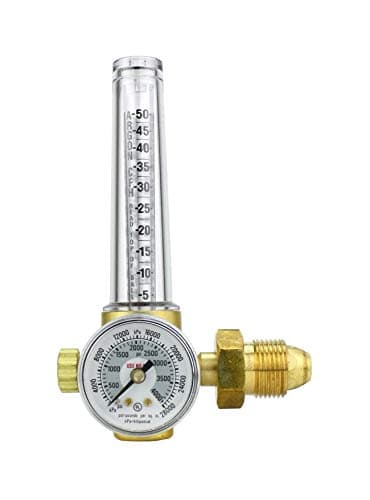 Victor GRF400-580 argon/CO2 flowmeter regulatorA true brass flowmeter regulator with a Lexan flow tube and published scales for argon, CO2 and helium - the one to buy if you want it right once. | Best overall | $84.98 · View on Amazon #ad How this is funded · Price as of November 28, 2026 |
| 2 | 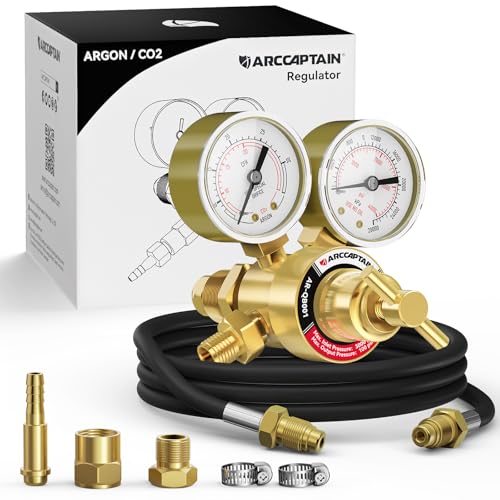 ARCCAPTAIN argon/CO2/helium regulator with hoseThe cheapest way to get gas flowing, and the only one here with the hose, clamps and barb already in the box. | Budget pick | |
| 3 | 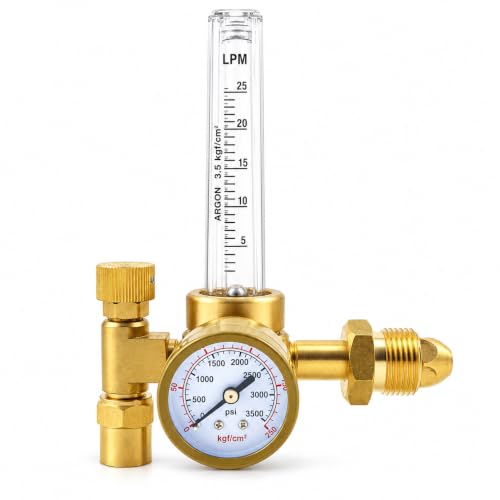 SUA MD argon flowmeter regulatorA real ball-in-tube flowmeter with dual LPM and CFH scales, at close to gauge-regulator money - provided you buy a hose. | Best value flowmeter | $48.99 · View on Amazon #ad How this is funded · Price as of November 28, 2026 |
| 4 | 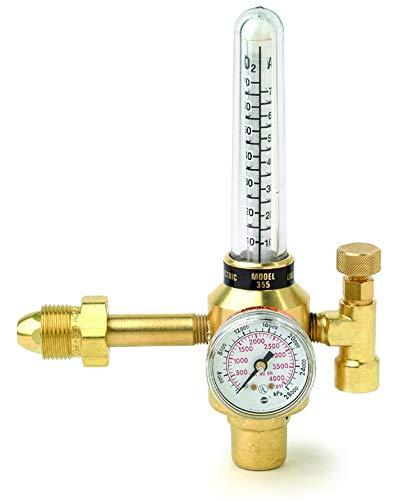 Harris 355-2AR/HE-580 flowmeter regulatorPressure-compensated: the flow you set stays where you set it as the bottle empties, instead of drifting down over a cylinder. | Best for weekly TIG | $219.00 · View on Amazon #ad How this is funded · Price as of November 28, 2026 |
The short answer
Three instruments get sold as "argon regulators" and they are not equivalent. A flow gauge infers flow from pressure drop through an orifice — cheap, and vague at low flow. A flow tube (a ball floating in a vertical tube) reads flow directly. A pressure-compensated flowmeter holds the flow you set as the cylinder empties.
Our overall pick is the Victor GRF400-580: a full-brass flowmeter regulator with a Lexan flow tube and published scales for argon, CO2 and helium. The budget pick is the ARCCAPTAIN CGA-580 regulator, the only one here with the hose and clamps in the box. For a flow tube at less money, the SUA MD flowmeter regulator; for weekly TIG, the pressure-compensated Harris 355-2AR/HE-580.
Check one thing before you buy any of them: all four have a CGA-580 inlet, which fits argon and argon/CO2 mix bottles. A 100% CO2 bottle uses CGA-320 and none of these connects to it directly.
Prices in the table are read from the live price feed when the page loads, each with its own "as of" date inside the buy button. Availability of all four was confirmed through that feed before publishing.
The criteria, in the order they decide the purchase
1. The CGA fitting, which is a hard compatibility gate. Not a preference. The inlet nut has to match the valve on the cylinder your supplier rents you. CGA-580 is argon, argon/CO2 mixes and helium — the fittings on the bottles a US gas supplier hands a welder. CGA-320 is 100% CO2 and is a different thread entirely. Get this wrong and the regulator does not go on the bottle at all.
2. How flow is measured. The real axis of this page. A flow gauge is adequate for MIG, where you are running 20–25 CFH and a couple either way changes nothing you can see. A flow tube earns its money on TIG, where 8–15 CFH is the working range and the bottom of a gauge's scale is where it is least trustworthy.
3. The flow range against the work. Published argon ranges here run from 0–30 CFH to 5–50 CFH. Home MIG and TIG both sit comfortably inside all of them, so the range matters less than the resolution at the low end — but a unit that tops out at 30 CFH has nothing left for a large cup or a drafty shop.
4. What is in the box. One of these four includes a hose. The others need a 5 ft or 10 ft hose kit, which is a real cost and the most common second order in this category. Compare delivered cost, not ticket price.
5. Gas coverage. If you run MIG on an argon/CO2 mix and TIG on pure argon, an instrument with published scales for both is one less thing to think about. Helium is a bonus almost no home shop uses.
6. Parts and support. A regulator is a safety-adjacent device with a diaphragm and a seat that eventually wear. Victor and Harris are the two patterns a welding supply counter will have parts and answers for.
We did not rank on gauge accuracy claims, because none of these publishes a tested accuracy figure and we have measured nothing ourselves. Arc & Bead publishes no scores.
What each one publishes
| Regulator | Flow measurement | Inlet | Published flow range | Hose included? |
|---|---|---|---|---|
| Victor GRF400-580 | Lexan flow tube, precision needle valve | CGA-580 | 5-50 SCFH argon; 5-40 CO2 (20% duty); 20-150 helium | No (5 ft / 10 ft versions sold separately) |
| SUA MD flowmeter regulator | Ball-style flow tube | CGA-580 | 0-25 LPM / 0-50 CFH argon and argon/CO2 | No |
| Harris 355-2AR/HE-580 | Pressure-compensated flowmeter, 20 psig compensation | CGA-580 | Argon/helium calibration (CO2 is a separate part number) | No |
| ARCCAPTAIN CGA-580 regulator | Gauge-type flow indication | CGA-580, with inlet filter | 0-30 CFH argon; 0-20 CFH CO2; 0-4000 psi inlet | Yes - 8.2 ft hose, 2 clamps, barb |
CGA-580 or CGA-320 - get this right before anything else.
Every regulator on this page has a CGA-580 inlet. That is the fitting for argon, argon/CO2 mixtures and helium, which covers TIG on pure argon and MIG on a 75/25 mix — the two bottles almost every home welder rents. If you have chosen 100% CO2 for MIG because it is cheaper, the bottle will have a CGA-320 valve and none of these fits it.
Decide the gas first, then the regulator. What gas for MIG welding and what gas for TIG welding are those decisions, and 75/25 argon-CO2 vs 100% argon is the comparison most people are actually weighing.
Flow gauge, flow tube, compensated flowmeter
A flow gauge looks like a second pressure gauge marked in CFH. Internally it is exactly that: gas passes through a fixed orifice and the gauge reads the pressure behind it, which maps to a flow rate. It is cheap, compact, robust, and it does not care what angle it sits at. Its weakness is resolution at the bottom of the scale, which is precisely where TIG runs.
A flow tube is a clear vertical tube with a ball or float in it. Gas lifts the ball against gravity, and where the ball sits is the flow. You are reading the thing itself rather than a proxy for it, and the scale is linear and legible at low flow. The trade is that it must hang vertically, and the tube is a plastic part that can be damaged.
A pressure-compensated flowmeter adds a mechanism that keeps the pressure behind the tube constant as the cylinder empties. Without compensation, the set flow drifts as bottle pressure falls over weeks of use; the Harris publishes 20 psig compensation for exactly that.
The practical consequence of all of this is in MIG welding gas flow rate: too little gas gives porosity, and too much causes turbulence that pulls air into the puddle, so the instrument that lets you hit a number is worth something. It is not worth everything — a beginner with a flow gauge set roughly right will weld perfectly well.
The parts nobody budgets for
The hose. Three of these four ship without one. A 5 ft or 10 ft inert gas hose with the right fittings is the second order, and it is why the cheapest regulator here is not the cheapest way to get gas flowing.
The fitting on your machine. Gas inlets on machines in this class are split between 5/8 in-18 threads and bare barbs for push-on hose. Two of these regulators publish a three-way outlet set that covers both; the other two do not.
The cylinder itself. In the US you usually rent or exchange rather than buy, and bottle size drives both the deposit and how often you drive to the supplier. Welding gas cylinder sizes covers that arithmetic, including why the smallest bottle is rarely the cheapest answer.
A leak check. Soapy water on every joint the first time you assemble it. Gas you cannot see leaking is gas you are paying for, and a slow leak empties a bottle between sessions.
Which one is yours?
First gas bottle, MIG, want it working today: ARCCAPTAIN — hose in the box, and a flow gauge is adequate for MIG flow rates.
You TIG weld and want to set a real number: SUA MD for the flow tube at the lower price, Victor GRF400-580 if you want the brass body and three calibrated scales.
One instrument for MIG on a mix and TIG on pure argon: Victor GRF400-580.
Weekly TIG, and porosity that appears near the end of a bottle: Harris 355-2AR/HE-580.
You have not bought the bottle yet: read do you need gas for MIG welding first. Gasless flux-core needs no regulator at all, and the best flux core welding wire is that route. The machines that can use a bottle are on the best 110 V MIG welders with gas.
How we picked these
CGA-580 only. Every regulator here fits the argon and argon/CO2 bottles a US supplier rents a home welder. A CGA-320 CO2-only regulator is a different product and is not on this page.
Ranked on how flow is measured. That is the axis that actually separates these four, and it is why the most expensive unit is not the overall pick — pressure compensation is a weekly-TIG feature, not a general one.
Availability verified before featuring. All four returned a buyable offer in the price refresh run on the publication date. Three of them were resolved into our registry for this page by a live lookup and title-verified against brand and model.
No hands-on, and no accuracy testing. We have used none of these regulators and have measured no flow. Every figure is the manufacturer's own published specification, and where one publishes a caveat — as SUA does about CGA-320 cylinders — this page repeats it rather than burying it. More on the method on how we pick.
1. Best overall
Victor GRF400-580 argon/CO2 flowmeter regulator
A true brass flowmeter regulator with a Lexan flow tube and published scales for argon, CO2 and helium - the one to buy if you want it right once.
Victor publishes the GRF400-580 as a full-brass flowmeter regulator with a high-impact Lexan flow tube and a precision needle valve, a CGA-580 inlet for argon, argon/CO2 mixtures and helium, a maximum inlet pressure of 3,000 psi, and controlled flow of 5–50 SCFH on argon, 5–40 SCFH on carbon dioxide at a 20% duty cycle, and 20–150 SCFH on helium. Victor also publishes an operating temperature range of 0–120 degrees F.
The flow tube is the pick. A regulator can indicate flow two ways: a round gauge that infers it from pressure drop across a fixed orifice, or a vertical tube with a ball floating in a gas stream. The tube is a direct reading, and at the flows welding actually uses — 15 to 25 CFH — the difference between the two is the difference between setting a number and guessing at one.
Three published scales is the second reason. One instrument covers 100% argon for TIG, an argon/CO2 mix for MIG and helium if you ever get there, and all three are calibrated rather than converted in your head. The precision needle valve is what makes a 2 CFH adjustment mean something.
Against it: the CGA-580 inlet is the wrong fitting for a 100% CO2 bottle, which uses CGA-320 — check which gas you are renting before ordering. It costs several times a generic two-gauge regulator, and a generic one will get a beginner welding. And a flow tube has to hang vertically to read correctly, which constrains where it can sit on the bottle.
What works
- CGA-580 inlet is the fitting on the argon and argon/CO2 bottles a US gas supplier will hand you
- A true flow tube rather than a flow gauge, so what you read at low flow is what you are getting
- Reads directly in cubic feet per hour, which is the number the settings charts use
- Full brass body and a precision needle valve — this is a shop regulator, not a starter one
What does not
- Wrong fitting for 100% CO2 bottles, which use CGA-320 — check before you buy
- Costs several times a generic two-gauge regulator, and a generic one will get a beginner welding
- A flow tube has to hang vertically to read correctly, which constrains where it can sit on the bottle
2. Budget pick
ARCCAPTAIN argon/CO2/helium regulator with hose
The cheapest way to get gas flowing, and the only one here with the hose, clamps and barb already in the box.
ARCCAPTAIN publishes this as a brass-bodied regulator for argon, helium and carbon dioxide, with a CGA-580 inlet carrying an inlet filter, an inlet pressure range of 0–4000 psi, an argon output range of 0–30 CFH and a carbon dioxide range of 0–20 CFH, a pressure relief valve, and outlet fittings in 9/16 in male thread, 5/8 in female thread and a 1/4 in hose barb. An 8.2 ft inert gas hose, two hose clamps and the barb are in the box.
It is the budget pick in the strict sense this site uses, and the box is why it is a genuine recommendation rather than just the cheap one. Every other regulator on this page arrives without a hose, and a hose kit closes a good part of the price gap. This one connects a bottle to a machine the day it arrives.
Three outlet fittings is more useful than it sounds. Machine gas inlets in this class are split between 5/8 in-18 fittings and bare barbs for push-on hose, and having all three means you do not discover the mismatch at the bottle. A published pressure relief valve and an inlet filter at this price is also more than the category usually offers.
Against it: this is a gauge-type flow indicator, not a flow tube — it reads flow from pressure drop through an orifice, which is less accurate at the low end where TIG lives. The CGA-580 inlet is wrong for a 100% CO2 bottle. And brand support and warranty handling are not on the level of Victor or Harris, which is what you notice if a gauge fails.
What works
- The hose, clamps and barb are in the box, so the bottle is connected the day it arrives rather than after a second order
- Three outlet fittings cover essentially every machine inlet you will meet
- A published pressure relief valve and an inlet filter at this price is more than the category usually offers
- Reads flow directly in CFH, which is the unit every settings chart on this site uses
What does not
- A gauge-type flow indicator rather than a true flow tube: it reads flow by pressure drop through an orifice, which is less accurate at the low end than a ball-in-tube flowmeter
- CGA-580 inlet is wrong for a 100% CO2 bottle, which uses CGA-320
- Brand support and warranty handling are not on the level of Victor or Harris
Who this is wrong for: Low-flow TIG work where the exact number matters. A flow gauge is a good-enough instrument for MIG at 20-25 CFH and a vague one at 8 CFH on thin stainless.
3. Best value flowmeter
SUA MD argon flowmeter regulator
A real ball-in-tube flowmeter with dual LPM and CFH scales, at close to gauge-regulator money - provided you buy a hose.
SUA publishes the MD flowmeter regulator as a brass regulator with a ball-style flowmeter in one unit for TIG and MIG welding on argon or argon/CO2 mixtures, with a CGA-580 cylinder connection, a round gauge indicating cylinder pressure and a clear vertical tube displaying flow on 0–25 LPM and 0–50 CFH scales, and three outlet options: a 9/16 in-18 RH male outlet, a supplied 5/8 in-18 female adapter, and a hose barb for 1/4 in gas hose. It ships as the regulator plus a three-piece outlet connector, with no hose.
This is the pick for anyone who wants a flow tube rather than a flow gauge without paying shop-regulator money. The dual scales are a quietly useful detail: machine manuals and settings charts in this niche are split between CFH and liters per minute, and an instrument marked in both removes a conversion you would otherwise do wrong at least once.
Keeping a separate cylinder-pressure gauge matters too. Some pure flowmeters drop it, and then you cannot tell how much gas is left in the bottle until the arc tells you.
Two honest notes, both published by SUA itself. There is no hose in the box, and a 5 ft or 10 ft hose kit is a separate purchase that closes most of the gap to a bundled regulator. And SUA states plainly on its own listing that it does not connect directly to pure CO2 cylinders with CGA-320 valves — which is the single most common buying mistake in this category, and the only maker here that warns you about it up front.
What works
- A ball-in-tube flowmeter, not a flow gauge — what you read at 15 CFH is much closer to what you are actually getting
- Dual LPM and CFH scales, so it reads in whichever unit your settings chart or machine manual uses
- Separate cylinder-pressure gauge means you can still see how much gas is left, which some pure flowmeters drop
- SUA publishes the CGA-320 caveat on its own listing rather than leaving you to discover it
What does not
- No hose in the box — a 5 ft or 10 ft hose kit is a separate purchase, which closes most of the price gap to a bundled regulator
- A flow tube has to hang vertically to read correctly, which constrains how it can sit on the bottle
- Argon and argon/CO2 only on the published scales; nothing for helium
4. Best for weekly TIG
Harris 355-2AR/HE-580 flowmeter regulator
Pressure-compensated: the flow you set stays where you set it as the bottle empties, instead of drifting down over a cylinder.
Harris publishes the model 355-2-Ar/He-580 (part number 3100204) as a pressure-compensated flowmeter regulator with argon/helium calibration, 20 psig compensation, a 3,000 psig maximum inlet pressure and a CGA-580 inlet connection, combining a regulator and flowmeter in one compact unit with a sensitive needle valve for fingertip flow control.
Pressure compensation is the specification that separates this from everything else on the page, and it is worth understanding. A simple flowmeter's reading depends on the pressure behind the tube, so as a cylinder empties the actual flow drifts away from the number you set. A compensated unit holds it. Over one bottle that is the difference between consistent shielding on the last ten welds and gradually worsening porosity nobody can account for.
The sensitive needle valve is the other half. Setting 8 CFH for thin stainless TIG repeatably needs a valve with fine control, not a coarse knob you nudge past the mark.
Who it is for: someone who TIG welds every week and has had an unexplained porosity problem near the end of a bottle. Who it is not for: a beginner. It costs several times a gauge-type regulator and the difference is invisible in the first month. It is also argon/helium calibrated — the carbon dioxide version is a different part number — with no hose and no outlet adapter set in the box, and the CGA-580 inlet is still wrong for a pure CO2 bottle.
What works
- Pressure compensation is the specification that separates this from everything else here: flow stays where you set it as cylinder pressure falls, instead of drifting down over a bottle
- A fine needle valve rather than a coarse knob, which is what makes 8 CFH on a thin-stainless TIG job repeatable
- Harris 355-series regulators are the pattern most welding supply counters stock parts for
- Regulator and flowmeter in one compact unit, so it does not stand far off the bottle
What does not
- Several times the price of a gauge-type regulator, and a beginner will not be able to tell the difference in the first month
- Argon/helium calibration — the carbon dioxide version is a different part number
- No hose included, and no outlet adapter set in the box
- CGA-580 inlet, so it is wrong for a 100% CO2 bottle
Who this is wrong for: A first gas bottle. Nothing about a compensated flowmeter helps a beginner more than spending the same money on gas, tungsten and a better helmet would.
Questions people actually ask
What is the best argon regulator for welding?
Of the regulators in our registry, the Victor GRF400-580. Victor publishes it as a full-brass flowmeter regulator with a high-impact Lexan flow tube and precision needle valve, a CGA-580 inlet, a 3,000 psi maximum inlet pressure, and calibrated flow scales of 5-50 SCFH argon, 5-40 SCFH CO2 and 20-150 SCFH helium.
For less money with the hose included, the ARCCAPTAIN CGA-580 regulator is the budget pick.
What is the difference between an argon regulator and a flowmeter?
A plain regulator reduces cylinder pressure and indicates flow with a gauge, which infers the rate from pressure drop through a fixed orifice. A flowmeter reads the flow directly, usually as a ball floating in a vertical tube.
The gauge is cheaper and adequate for MIG at 20 to 25 CFH. The tube is more trustworthy at the 8 to 15 CFH range TIG welding uses, which is the bottom of a gauge's scale.
Will an argon regulator fit a CO2 bottle?
Not a 100 percent CO2 bottle. Argon and argon/CO2 mix cylinders use a CGA-580 valve; pure CO2 cylinders use CGA-320, which is a different thread. Every regulator on this page is CGA-580.
Decide the gas before the regulator. If you have chosen pure CO2 for MIG because it is cheaper, you need a CGA-320 regulator instead.
What flow rate should I set on an argon regulator?
As a starting point, roughly 20 to 25 CFH for MIG and 15 to 20 CFH for TIG with a standard cup, adjusted for cup size and drafts. Our MIG gas flow rate page covers the variables.
More is not better: too much flow becomes turbulent and pulls air into the puddle, which produces exactly the porosity you were trying to avoid.
Do I need a pressure-compensated flowmeter?
Only if you weld often enough to notice the drift. Without compensation, the flow you set falls gradually as cylinder pressure drops over weeks, which can show up as unexplained porosity near the end of a bottle.
Harris publishes 20 psig compensation on the 355-2 for exactly that. For occasional work it is a refinement, and the money is better spent on gas and consumables.
Does an argon regulator come with a hose?
Usually not. Of the four on this page only the ARCCAPTAIN includes one - an 8.2 ft hose with two clamps and a barb. The Victor is also sold in versions with a 5 ft or 10 ft hose as a separate option.
Factor the hose into the comparison: it closes a good part of the price gap between a bundled budget regulator and a bare mid-range one.
Can one regulator handle both MIG and TIG?
Yes, as long as it is calibrated for the gases you use and its inlet matches the bottle. The Victor GRF400-580 publishes separate scales for argon, argon/CO2 mixes and helium, which covers TIG on pure argon and MIG on a 75/25 mix from one instrument.
What you cannot do is move one CGA-580 regulator between a mix bottle and a pure CO2 bottle, because the cylinder fittings differ.
Sources
- Victor - GRF400-580 flowmeter regulator published specifications: full-brass flowmeter with high-impact Lexan flow tube, CGA-580 inlet connection for argon, argon/CO2 mixtures and helium, designed for MIG and TIG processes, maximum inlet pressure 3,000 psi, precision needle valve, one-piece flow tube cover, controlled flow 5-50 SCFH argon / 20-150 SCFH helium / 5-40 SCFH carbon dioxide at 20% duty cycle, operating temperature 0-120 degrees F, also available with 5 ft or 10 ft hose (model 0781-2701; availability and specifications reconfirmed 2026-11-20, ASIN B07S1PQBKF)
- SUA - MD argon flowmeter regulator published specifications: brass regulator with ball-style flowmeter in one unit for TIG and MIG welding with argon or argon/CO2 mixtures, CGA-580 cylinder connection, round gauge indicating cylinder pressure with a clear vertical tube displaying flow on 0-25 LPM and 0-50 CFH scales, outlet options of 9/16 in-18 RH male, supplied 5/8 in-18 female adapter and 1/4 in hose barb, supplied as regulator plus three-piece outlet connector with no hose; SUA publishes that it does not connect directly to pure CO2 cylinders with CGA-320 valves (resolved by live Creators searchItems + getItems lookup 2026-11-20, ASIN B086Z758DY)
- Harris - model 355-2-Ar/He-580 pressure-compensated flowmeter regulator, part number 3100204, published specifications: argon/helium calibration, 20 psig compensation, 3,000 psig maximum inlet pressure, CGA 580 inlet connection, regulator and flowmeter combined in one compact unit with a sensitive needle valve for fingertip flow control (resolved 2026-11-20, ASIN B00DSWA6W4)
- ARCCAPTAIN - argon/CO2/helium regulator with 8.2 ft hose published specifications: usable with argon, helium and carbon dioxide, inlet pressure range 0-4000 psi, argon output 0-30 CFH, carbon dioxide output 0-20 CFH, brass regulator body with pressure relief valve, CGA-580 inlet with filter, outlet connectors of 9/16 in external thread, 5/8 in internal thread and 1/4 in hose barb, package includes regulator, 8.2 ft inert gas welding hose, two hose clamps and hose barb (resolved 2026-11-20, ASIN B0D1KD5ZPT)
- Compressed Gas Association - CGA valve outlet connection standards, the source of the CGA-580 (argon, argon mixes, helium) and CGA-320 (carbon dioxide) distinction this page turns on
- Arc & Bead live price layer (lib/prices.ts) - availability of all four regulators confirmed against the price feed generated 2026-11-20; each buy button renders the live price with its own 'as of' date
Read next
- Welding gas cylinder sizes
What each common cylinder holds, how long it lasts at real flow rates, and lease versus buy.
- MIG Welding Gas Flow Rate
Flow rate by wire size and condition in CFH and L/min, why more gas causes porosity, and how long a bottle lasts at each setting.
- What gas for TIG welding?
100% argon covers almost everything. When helium or hydrogen blends help, and what will ruin a weld.
- 75/25 argon/CO2 vs 100% argon: which do you need?
Not two grades of one thing — two gases for two metals. What happens when you swap them.
- What gas do you need for MIG welding?
Which shielding gas for which metal, and the one combination that cannot work.
- The best flux core welding wire
Three self-shielded flux-cored wires ranked on AWS classification, spool size against the machine that has to feed it, and published feed behavior - with the cheapest per pound named as the budget pick.
Back to Gas & Power, or start over at Find Your Level.
Ryder M.
Ryder M. is the hands-on owner behind Magoo Media Group. He writes Arc & Bead's buying guides and picks every machine on the site. What every recommendation is based on — and what it is not based on — is set out on How We Pick.