Welding gas cylinder sizes
How much welding each common cylinder actually represents — and why the lease arrangement usually matters more than the size.
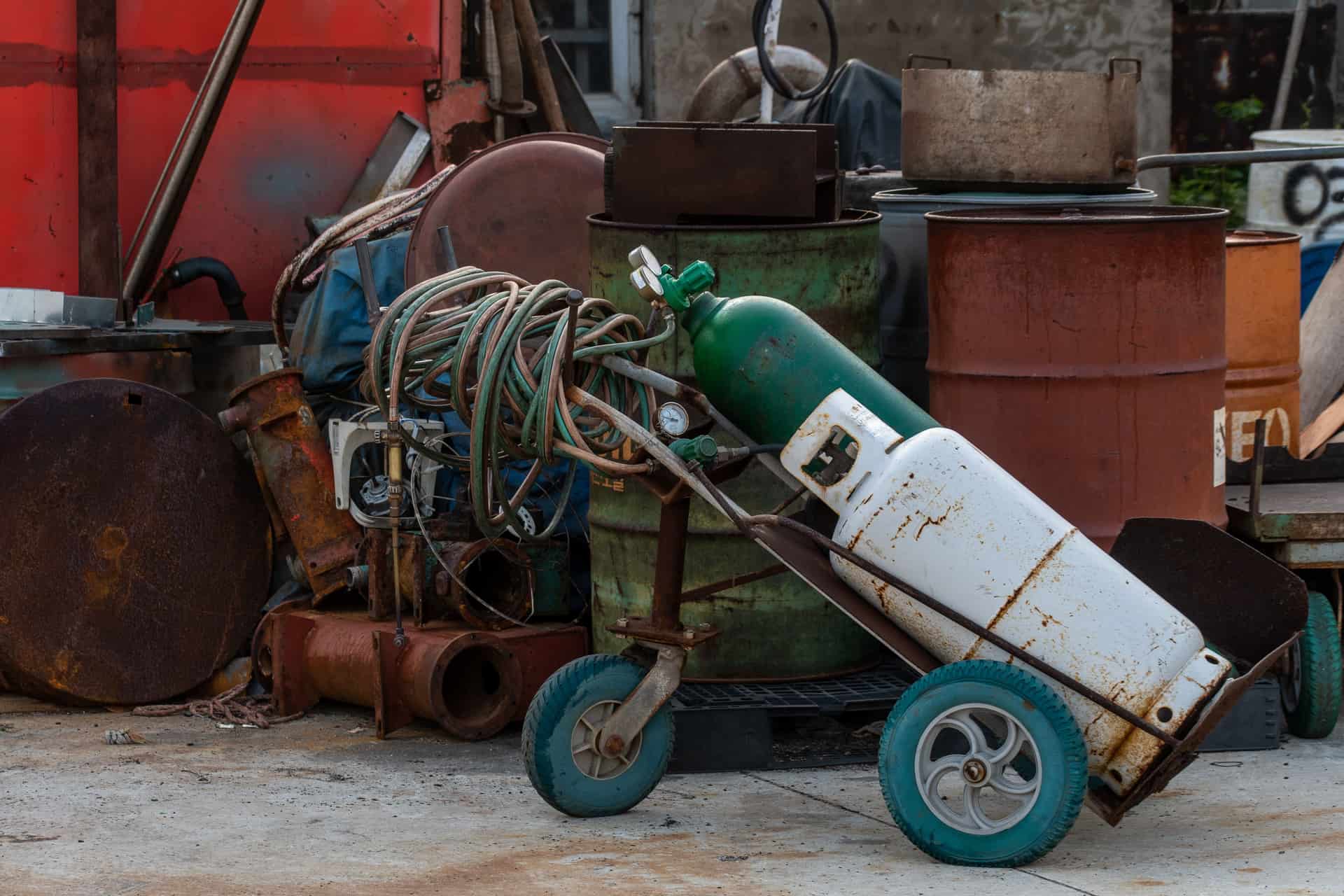
Cylinder sizes and what they hold
| Common name | Capacity | Approx. arc time at 20 CFH | Practical note |
|---|---|---|---|
| 20 cu ft | About 20 cu ft | About 1 hour | Genuinely portable, swapped constantly |
| 40 cu ft (size RR) | About 40–44 cu ft | About 2 hours | Easy to carry alone |
| 80 cu ft (size Q) | About 80–83 cu ft | About 4 hours | The usual first bottle for a home shop |
| 125 cu ft (size S) | About 125 cu ft | About 6 hours | Roughly 43 in tall; stays on the cart |
| 155 cu ft | About 155 cu ft | About 7.5 hours | Two-person lift in practice |
| 250 cu ft | About 250 cu ft | About 12 hours | Shop cylinder, not a portable one |
How to read the arc time figures
The arithmetic is simple and worth doing yourself: capacity in cubic feet divided by flow rate in cubic feet per hour gives hours of gas flow. An 80 cubic foot cylinder at 20 CFH is four hours. At 25 CFH it is a little over three.
The important qualification is that this is arc time, not shop time. Gas only flows while the trigger is pulled. Most home welding is a few seconds of arc followed by a minute of repositioning, clamping, measuring and reconsidering — so a genuinely productive afternoon might involve fifteen minutes of actual arc time.
In calendar terms, an 80 cubic foot cylinder lasts most hobby welders many months. People who have not done this arithmetic routinely over-buy on their first cylinder.
Which size to start with
For a home shop, 40 or 80 cubic feet is the sensible first bottle.
Smaller than 40 and you are making trips to the supplier constantly, and each trip has a cost in time that dwarfs the price difference. Larger than 80 and you have a cylinder you cannot comfortably move alone — which matters more than it sounds, because a cylinder you cannot lift is a cylinder you cannot take to the supplier to exchange.
The 80 is the default recommendation for one specific reason: it is the largest size most people can handle alone, and it still fits a standard welding cart rack.
For a second, occasionally used gas — 100% argon for aluminum, typically — go smaller rather than matching your main bottle. See 75/25 versus 100% argon for when a second cylinder becomes necessary.
Lease, exchange or own
This is where the real cost lives, and it varies enough between suppliers that a general answer is impossible. There are three arrangements.
Leased cylinders remain the supplier's property. You pay a recurring lease and exchange for a full one when it empties. Low entry cost, permanent ongoing cost, and you are tied to that supplier.
Customer-owned cylinders you buy outright, then pay only for refills or exchanges. Higher up-front, cheaper long-term, and you can shop around. Worth checking whether local suppliers will exchange a customer-owned cylinder or only refill the one you bring — this varies and it changes the economics.
Exchange programs at hardware chains offer convenience at higher per-cubic-foot cost, and cylinder sizes tend to be small.
Ask two local suppliers before choosing a size. Their lease terms will affect your total cost more than the choice between a 40 and an 80.
Storage and handling
A few things are not optional, and they are worth stating plainly rather than assuming.
Cylinders are stored and used upright and secured — chained to a cart, a wall bracket or a stand. The valve cap goes on whenever the regulator is off, because the valve is the vulnerable part and a sheared valve on a pressurized cylinder is genuinely dangerous.
Keep cylinders away from heat sources and out of direct sun, and never transport one lying loose in a car boot — upright and secured applies in transit too. The Compressed Gas Association publishes the handling guidance, and it is worth reading once properly.
What we would buy
1. What the bottle actually requires
Hobart welding cart
A chained cylinder rack is the point, not the shelf space.
Cylinders must be stored and used upright and secured. This is not a formality: a falling cylinder that shears its valve becomes an uncontrolled projectile, which is why the Compressed Gas Association's handling guidance is unusually blunt about it.
A cart with an integral rack and chain solves both the securing problem and the practical one — once you own a bottle, the machine and the bottle have to travel together, and carrying a cylinder separately is how they end up unsecured.
What works
- A chained cylinder is the single most important safety change in a home shop once you own gas
- Gets the machine and bottle moving together, which is what actually makes a gas setup usable in a garage
What does not
- Assembly is fiddly and the hardware is not generous
- Adds footprint to a shop that probably has none to spare
2. Reads in the unit the charts use
Hobart argon/CO2 gas regulator
Flow gauge in cubic feet per hour, which is what every settings table specifies.
Cylinder capacity is quoted in cubic feet and flow is set in cubic feet per hour, so the arithmetic on this page only works if your regulator reads in CFH. Most do; some cheaper units read in liters per minute, which means converting every time.
CGA-580 inlet covers both 75/25 and 100% argon, so a single regulator serves both cylinders if you end up running two gases.
What works
- CGA-580 inlet is the fitting on the argon and argon/CO2 bottles a US gas supplier will hand you
- Reads flow directly in cubic feet per hour, which is the number the settings charts use
What does not
- Wrong fitting for 100% CO2 bottles, which use CGA-320 — check before you buy
- A gauge-type regulator is less precise than a true float flowmeter at low flow rates
Questions people actually ask
What size gas cylinder should a beginner get?
An 80 cubic foot cylinder suits most home shops: roughly four hours of arc time at a normal 20 CFH flow, and still light enough for one person to move.
If you expect to weld rarely, a 40 is easier to handle and cheaper to fill.
How long does an 80 cu ft argon cylinder last?
About four hours of actual arc time at 20 cubic feet per hour, or a little over three at 25 CFH.
Because gas only flows while the trigger is pulled, that typically translates into many months of hobby welding.
Should I lease or buy a cylinder?
Leasing has a low entry cost and a permanent ongoing one, and ties you to a supplier. Buying costs more up front and less over time, and lets you shop around.
If you expect to weld for years, owning usually wins. Check first whether local suppliers will exchange a customer-owned cylinder, because some only refill.
Can I transport a gas cylinder in my car?
Yes, with care: upright, secured so it cannot fall or roll, valve cap fitted, and with ventilation.
Never leave a cylinder in a closed hot car, and never transport one loose in a boot. The Compressed Gas Association's handling guidance covers this properly.
Do argon and 75/25 cylinders use the same fitting?
In the US, yes — both use a CGA-580 valve outlet, so one regulator fits both.
Pure CO2 uses CGA-320, which is a different fitting and needs its own regulator.
Sources
Read next
- What gas do you need for MIG welding?
Which shielding gas for which metal, and the one combination that cannot work.
- Do you need gas for MIG welding?
When shielding gas is genuinely required and when flux-cored wire is the better answer.
- 75/25 argon/CO2 vs 100% argon: which do you need?
Not two grades of one thing — two gases for two metals. What happens when you swap them.
- The best MIG welders for beginners
Gas-capable machines for a home shop, and the one specification that makes learning MIG easier.
- Gas and power: the two things that decide what you can actually run
A machine you cannot plug in is a machine you do not own yet. This is the hub for the two questions that quietly decide every purchase on this site.
Back to Gas & Power, or start over at Find Your Level.
Ryder M.
Ryder M. is the hands-on owner behind Magoo Media Group. He writes Arc & Bead's buying guides and picks every machine on the site. What every recommendation is based on — and what it is not based on — is set out on How We Pick.