The best flux core welding wire
Two letters on the spool label separate a wire that will run a vertical fillet from one rated for a single flat pass. Almost nobody reads them, and they matter more than the brand name.
Arc & Bead is an Amazon Associate. If you buy through a link on this page we may earn a commission, at no extra cost to you. We have not physically tested the machines on this page and we say so on How We Pick.
Quick picks
Tap any row to jump to the full write-up further down this page.
| # | Product | Best for | Price |
|---|---|---|---|
| 1 | 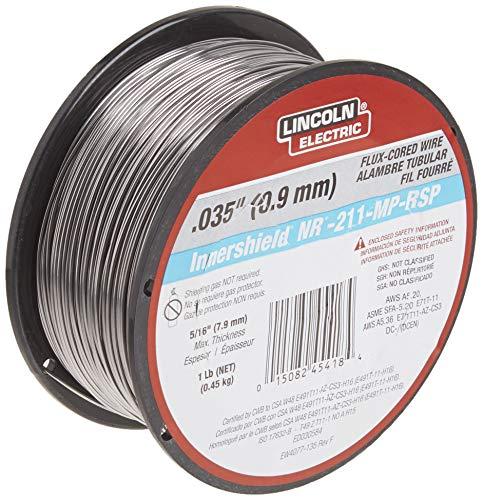 Lincoln Electric Innershield NR-211-MP flux-cored wireThe only wire here classified E71T-11 rather than E71T-GS, which is what puts a vertical fillet and a documented procedure table in scope. | Best overall | $19.92 · View on Amazon #ad How this is funded · Price as of November 28, 2026 |
| 2 | 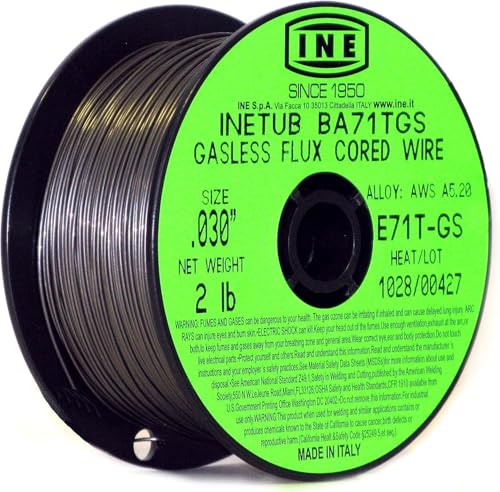 INETUB BA71TGS 0.030 in flux-cored wire (2 lb)A 2 lb spool of 0.030 in in the diameter and spool size a 120 V machine is actually built around, with feed consistency as the published selling point. | Best for a small machine | $26.98 · View on Amazon #ad How this is funded · Price as of November 28, 2026 |
| 3 | 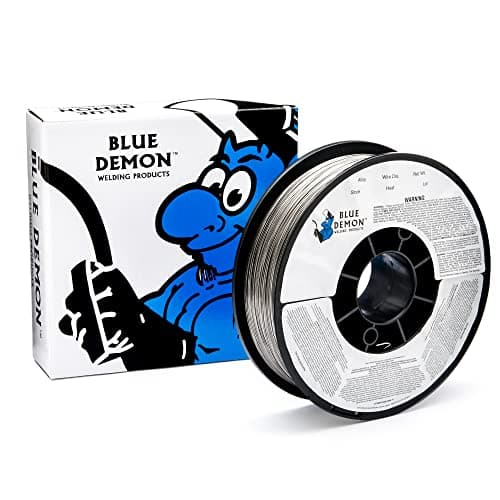 Blue Demon E71TGS flux-cored wireA 10 lb spool at the lowest cost per pound here - the wire to learn on, when you are burning spools rather than counting them. | Budget pick |
The short answer
Self-shielded flux-cored wire comes in two classes you will actually meet. E71T-11 is a specified AWS class with published mechanical properties and an all-position rating. E71T-GS is the general-specification class most hobby wire falls under — it welds steel perfectly well, it is single-pass rated, and its properties are whatever the maker publishes. Both run gasless on DCEN polarity.
Our overall pick is Lincoln Innershield NR-211-MP, the only E71T-11 wire here, which is what puts a vertical fillet and a documented procedure table in scope. For a compact 120 V machine, the INETUB BA71TGS 0.030 in 2 lb spool is the better buy, because spool size and feed consistency decide more on a light feeder than alloy chemistry does. The budget pick is the Blue Demon E71TGS 10 lb spool — the lowest cost per pound here, which is the figure that matters for a consumable.
Prices in the table are read from the live price feed when the page loads, each with its own "as of" date inside the buy button. Availability of all three spools was confirmed through that feed before publishing.
The criteria, in the order they decide the purchase
1. AWS classification. The two letters and two digits on the label are the only part of a wire spool that carries a standardized meaning. E71T-11 is specified; E71T-GS is general-specification. If the work is a bracket, a gate or a repair, either is fine. If it is a vertical joint or anything load-bearing you want to think about, the specified class is the one with published properties and a published procedure table.
2. Diameter, against the metal you are welding. 0.030 in is the default for a 120 V machine and for anything under about 3/16 in. 0.035 in carries more current and suits thicker plate and a 240 V machine. Going up a diameter to weld thinner metal is the most common way people cause their own burn-through. The welding wire size chart has the thickness-to-diameter mapping.
3. Spool size, against your machine. This is the criterion nobody ranks on and it causes more trouble than the alloy. A 2 lb spool is what most compact 120 V machines are designed around; a 10 lb spool is cheaper per pound and needs a feeder with the hub and the drive torque for it. Check your machine's published spool capacity before you buy a big one.
4. Published feed behavior. Flux-cored wire is softer than solid wire and tangles more readily. Consistent diameter and a tightly wound spool are what stop it bird-nesting at the drive rolls, and INE publishes both as the reason its wire feeds — which is a more useful claim than a tensile number you will never test.
5. Cost per pound, not ticket price. Wire is a consumable. The honest comparison divides the price by the spool weight, and on that measure the figures on this page differ by more than a factor of two.
6. Polarity, which is not a choice. Every self-shielded flux-cored wire here runs DCEN — electrode negative — which is the opposite of solid MIG wire. Get it wrong and the arc is unstable and the spatter enormous, and most people conclude the wire is bad. Flux-core polarity: DCEN or DCEP is the five-minute fix.
We did not rank on tensile strength figures, because every wire here publishes the class minimum rather than a measured result, and we have tested none of them. Arc & Bead publishes no scores.
What each spool publishes
| Wire | AWS class | Diameter linked | Spool | Positions |
|---|---|---|---|---|
| Lincoln Innershield NR-211-MP | E71T-11 | 0.035 in (Lincoln ED030584) | Line available in 1, 5 and 10 lb | All-position; 5/16 in max plate for 0.045 in and under |
| INETUB BA71TGS | E71T-GS (AWS A5.20) | 0.030 in | 2 lb | Flat, horizontal, vertical, overhead - single pass |
| Blue Demon E71TGS | E71T-GS | 0.030 in (part E71TGS-030-10) | 10 lb | All-position, published as gasless with easy slag removal |
The row that decides most purchases is the spool column, not the class column. A 10 lb spool at the bottom of that table costs roughly a third per pound of what the 1 lb spool at the top does — and is the wrong product entirely for a machine specified for 2 lb spools.
E71T-GS is not bad wire. It is differently rated wire.
The GS suffix means general specification: the maker states the properties rather than certifying to a table. Plenty of E71T-GS wire lays a clean, strong single-pass bead on mild steel, which is what a gate, a bracket, a trailer fender and a shelf frame all are. What it is not rated for is multi-pass structural work, and the makers say so on their own listings. Treat the class as information about scope, not quality.
Why self-shielded wire exists at all
A gas MIG weld depends on a column of shielding gas standing over the puddle, and that column is held in place by nothing but its own flow. A light breeze disturbs it, which is why gas MIG is an indoor process. Self-shielded flux-cored wire carries its shielding inside the wire: the flux decomposes in the arc, produces its own gas, and leaves a slag layer over the cooling bead. Nothing to blow away.
That is the whole reason this category exists, and it is why flux-core is the right answer outdoors rather than merely the cheap one — the best flux core welders for outdoor welding ranks the machines for that work. The trade is slag and spatter on every weld, and the advantages and disadvantages in full are in flux-core welding advantages and disadvantages.
The settings that make any of these wire look good
A wire can only be as good as the machine setting behind it, and three things get set wrong more than anything else.
Polarity. DCEN for all self-shielded wire. If your machine shipped wired for solid MIG wire you have to swap the leads, and nothing else on this list matters until you do.
Stickout. Flux-cored wire wants more stickout than solid wire — roughly 3/4 in rather than 3/8 in. Too short and the arc is harsh and the nozzle fills with spatter.
Direction of travel. Flux-core is a drag process: you pull the gun away from the finished bead rather than pushing into the joint, which is the opposite of gas MIG. Flux-core push or pull covers why, and the settings chart has the voltage and wire-speed starting points by thickness.
Which spool is yours?
Compact 120 V machine, learning: INETUB BA71TGS 0.030 in 2 lb. Right diameter, right spool size, published for feed consistency.
Burning through a lot of wire on scrap: Blue Demon 10 lb, if your feeder takes an 8 in spool.
Vertical joints, gappy fit-up, or you want a published procedure table: Lincoln Innershield NR-211-MP.
Thin sheet and body panels: none of these, honestly. Flux-core runs hotter than gas MIG at the same wire speed and the thinnest common diameter is 0.030 in, which is a lot of heat for 20 gauge — the best welders for sheet metal and MIG vs flux-core for body work are the honest answers there.
You do not own the machine yet: start at the best flux core welders for the money and flux-core welding for beginners.
One thing to buy with the wire
Self-shielded flux-core produces considerably more fume than any gas process, and the helmet does nothing about it. A sealed P100 half mask under the hood costs less than two spools of wire — the best respirators for welding is that purchase, and flux-core welding safety is the wider picture. Storage matters too: flux-cored wire absorbs moisture, and a spool left open on a damp bench for a season will run porous. Keep it bagged with the machine, not on a shelf in an unheated garage.
How we picked these
Self-shielded only. Every wire here runs without a gas cylinder, which is the category. Gas-shielded flux-cored wire (E71T-1 and similar) is a different product for a different machine and is not on this page.
Ranked on class, then spool, then cost per pound. That order is deliberate: the class tells you what the wire is rated to do, the spool tells you whether your machine can feed it, and the per-pound figure tells you what practice costs.
Availability verified before featuring, and one listing repaired to get here. The Lincoln entry had returned no buyable offer in two previous price refreshes; it was re-resolved by a live lookup to Lincoln's own ED030584 listing, title-verified for brand and part number, and now returns In Stock with a live price. The INETUB spool was resolved into the registry the same way.
No hands-on and no measured properties. We have welded with none of these wires. Every figure is the manufacturer's own, and where a figure describes the product line rather than the exact spool we link, the table says so. More on the method on how we pick.
1. Best overall
Lincoln Electric Innershield NR-211-MP flux-cored wire
The only wire here classified E71T-11 rather than E71T-GS, which is what puts a vertical fillet and a documented procedure table in scope.
Lincoln publishes Innershield NR-211-MP as AWS E71T-11, all-position, DCEN (electrode negative) polarity, with a maximum plate thickness of 5/16 in for 0.045 in and smaller diameters, available in 0.030 in and 0.035 in. The listing we link is Lincoln's own ED030584 — the 0.035 in spool.
The classification is the pick. E71T-11 is a specified AWS class with published mechanical properties and an all-position rating; E71T-GS, which is what most hobby wire is, is the class for "general specification" wires whose properties are whatever the maker says they are. Both weld steel. Only one of them comes with a procedure table telling you where to set a machine for a given thickness, and Lincoln publishes those for this wire.
The practical result is that a vertical or overhead fillet is in scope rather than a hope. Fast-freezing characteristics also accommodate poor fit-up, which is Lincoln's own phrasing and is exactly what a beginner's joints are: gappy. A wire that bridges a gap instead of falling through it is worth real money on a gate or a trailer repair.
Against it: it is noticeably more expensive per pound than unbranded E71T-GS, and the listing we link is a small spool, so the per-pound figure is the worst on this page. Like every self-shielded wire it leaves slag to chip and throws more spatter than any gas process. And the 5/16 in plate limit is a real ceiling — above it you are into multiple passes and preparation.
What works
- Lincoln publishes full procedure tables for it, so there is a documented starting setting for every thickness
- All-position rated — it will run a vertical fillet, not just a flat bead
- Available in 1 lb, 5 lb and 10 lb spools, so a small machine does not need a big spool
What does not
- Noticeably more expensive per pound than unbranded E71T-GS wire
- Like every self-shielded wire it produces slag and more spatter than a gas process
2. Best for a small machine
INETUB BA71TGS 0.030 in flux-cored wire (2 lb)
A 2 lb spool of 0.030 in in the diameter and spool size a 120 V machine is actually built around, with feed consistency as the published selling point.
INE publishes the INETUB BA71TGS as AWS A5.20 E71T-GS, 0.030 in diameter on a 2 lb spool, self-shielded with no gas cylinder required, DCEN polarity, rated for flat, horizontal, vertical and overhead single-pass work on mild and low-alloy steel, made in Italy by INE SpA. Its published notes include suitability for outdoor, field and windy conditions, and for mild and light-gauge steel even with light surface rust or mill scale.
The reason this is the pick for a small machine is the combination of 0.030 in and 2 lb. INE publishes consistent wire diameter and a tightly wound spool as the reason it does not bird-nest, and bird-nesting — wire buckling and tangling at the drive rolls — is the failure that ruins most first flux-core sessions. On a light 120 V machine with a plastic spool hub and a single drive roll, a wire that feeds evenly matters more than its alloy chemistry does.
Spool size is the other half. A 2 lb spool is what a compact machine is designed to take; hanging a 10 lb spool on a light feeder adds inertia the drive roll has to overcome every time it starts, which is its own feeding problem. If your welder came with a 2 lb spool in the box, buy 2 lb spools.
Against it: E71T-GS is single-pass rated and INE says so outright — not for multi-pass structural certification. It costs more per pound than a 10 lb spool of the same class, which is the price of the small spool. And self-shielded means slag and spatter, same as everything here.
What works
- INE publishes consistent wire diameter and a tightly wound spool as the reason it does not bird-nest — which is the failure that ruins most first flux-core sessions
- A 2 lb spool is what a small 120 V machine is designed around; a 10 lb spool on a light machine is a feeding problem waiting to happen
- Published for mild and light-gauge steel even with light surface rust or mill scale, which is what outdoor repair work actually is
- All-position rated, so a vertical fillet is in scope rather than a hope
What does not
- E71T-GS is single-pass rated and INE says so plainly — not for multi-pass structural certification
- More expensive per pound than a 10 lb spool of the same class, which is the cost of the small spool
- Self-shielded means slag to chip and more spatter than any gas process
3. Budget pick
Blue Demon E71TGS flux-cored wire
A 10 lb spool at the lowest cost per pound here - the wire to learn on, when you are burning spools rather than counting them.
Blue Demon publishes this as E71TGS in 0.030 in on a 10 lb spool (part E71TGS-030-10), made in the United States, gasless and all-position, with easy slag removal. Our registry records the line as available in 0.030 in and 0.035 in, DCEN polarity.
It is the budget pick on the measure that matters for a consumable: cost per pound, not ticket price. A 10 lb spool is the cheapest way to own a lot of wire, and a lot of wire is exactly what learning takes — the first few pounds go on finding your travel speed, your gun angle and your settings, and none of that should feel expensive.
Who it is for: someone with a machine that takes an 8 in spool and a pile of scrap to practice on. The settings side of that practice is in the flux-core settings chart, and the two mistakes it is for are in flux-core burn-through and flux-core welding spatter.
Against it: E71T-GS is single-pass rated, so it is not the wire for a structural multi-pass joint. A 10 lb spool is too much inertia for some light 120 V feeders — check what spool size your machine is specified for before buying one. And our registry notes it runs dirtier than NR-211-MP, which matters while you are still learning to read your own bead.
What works
- Cheap enough per pound that practicing on scrap does not feel expensive
- Widely stocked, so a spool is rarely more than two days away
What does not
- E71T-GS is single-pass rated — it is not the wire for a multi-pass structural joint
- Runs dirtier than NR-211-MP, which matters when you are also learning to read your own bead
Who this is wrong for: A compact 120 V machine specified for 2 lb spools. A 10 lb spool on a light drive roll is a feeding problem rather than a bargain - take the 2 lb INETUB instead.
Questions people actually ask
What is the best flux core welding wire?
Of the wires in our registry, Lincoln Innershield NR-211-MP - because it is classified AWS E71T-11 rather than E71T-GS, which means published mechanical properties, an all-position rating and a documented procedure table for setting your machine.
For a compact 120-volt machine, the INETUB BA71TGS 0.030 inch 2 lb spool is often the better buy, because spool size and feed consistency matter more on a light feeder than alloy chemistry does.
What is the difference between E71T-11 and E71T-GS wire?
E71T-11 is a specified AWS class with published mechanical properties and an all-position rating. E71T-GS is the general-specification class - the maker states the properties rather than certifying to a table, and it is single-pass rated.
Both weld mild steel gasless on DCEN polarity. The difference is scope: brackets, gates and repairs are fine on either, while a vertical or multi-pass joint is where the specified class earns its money.
What size flux core wire should I use?
0.030 inch for a 120-volt machine and for material up to about 3/16 inch; 0.035 inch for thicker plate and a 240-volt machine, because the larger diameter carries more current.
Going up a diameter to weld thinner metal is the most common cause of self-inflicted burn-through. Our welding wire size chart maps diameter to material thickness.
Does flux core wire need to be DCEN?
Yes - every self-shielded flux-cored wire runs DCEN, electrode negative, which is the opposite polarity to solid MIG wire.
If your machine is wired for solid wire you have to swap the leads. Running flux-core on DCEP gives an unstable arc and enormous spatter, and almost everyone who does it blames the wire.
Is a 10 lb spool of flux core wire better value?
Per pound, clearly - a 10 lb spool can cost around a third per pound of a 1 lb spool of the same class. It is the right buy if you are practising on scrap.
The catch is the machine. Many compact 120-volt welders are specified for 2 lb spools, and a 10 lb spool adds inertia the drive roll has to overcome on every start. Check your welder's published spool capacity first.
Can you weld thin sheet metal with flux core wire?
Badly. The thinnest commonly sold diameter is 0.030 inch, flux-core runs hotter than gas MIG at the same wire speed, and it leaves slag and spatter on a panel you then have to finish.
For body panels and anything under about 18 gauge, gas MIG with 0.023 inch wire or TIG is the honest answer.
Does flux core wire go bad?
It degrades rather than expiring. Flux-cored wire absorbs moisture from the air, and damp flux produces porosity - small holes through the bead that you cannot see until the weld is cut or it fails.
Keep spools bagged, ideally with the machine rather than on an open shelf in an unheated garage, and treat a spool that has sat open through a damp season as practice wire.
Sources
- Lincoln Electric - Innershield NR-211-MP published specifications: AWS E71T-11, all-position, DCEN (electrode negative), maximum plate thickness 5/16 in for 0.045 in and smaller diameters, available in 0.030 in and 0.035 in; published listing bullets include versatile welding capability on a variety of base materials, easy slag removal and fast-freezing characteristics that accommodate poor fit-up. The listing linked is Lincoln part ED030584, the 0.035 in spool (ASIN re-resolved 2026-11-20 by live Creators searchItems + getItems lookup after the previous ASIN returned no buyable offer; brand and part number verified against the listing)
- INE SpA - INETUB BA71TGS published specifications: classified AWS A5.20 E71T-GS, 0.030 in diameter on a 2 lb spool, self-shielded with no external gas required, DCEN polarity, rated for flat, horizontal, vertical and overhead single-pass welding on mild carbon and low-alloy steel, published for outdoor, field and windy conditions and for mild and light-gauge steel with light surface rust or mill scale, published consistent wire diameter and tightly wound spool to prevent bird-nesting, made in Italy; INE states it is a single-pass wire and not for multi-pass structural certification (resolved 2026-11-20, ASIN B003E2RF0E)
- Blue Demon - E71TGS .030 x 10 lb spool published specifications: part E71TGS-030-10, gasless, all-position, easy slag removal, country of origin United States, 10 lb spool (availability and spool weight reconfirmed 2026-11-20, ASIN B00F429RM6; line-level diameters and DCEN polarity as recorded in this site's product registry)
- AWS A5.20 - specification for carbon steel electrodes for flux cored arc welding, the standard that defines the E71T-11 and E71T-GS classifications referenced throughout this page
- Arc & Bead live price layer (lib/prices.ts) - availability of all three spools confirmed against the price feed generated 2026-11-20; each buy button renders the live price with its own 'as of' date
Read next
- Welding wire size chart
Which diameter for which thickness, and why the wrong wire looks like a machine fault.
- Flux-core welding settings chart
Starting settings by thickness, and a symptom-by-symptom guide to fixing a bad bead.
- Flux-core polarity: DCEN or DCEP?
Self-shielded flux-core runs DCEN, the opposite of gas MIG. How to check and what wrong looks like.
- The best flux-core welders for the money
Value per dollar in gasless welding, including the part that costs least and changes most: the wire.
- The best respirators for welding
Six half-mask respirators and filters for welding, ranked on filter class, profile under a helmet and filter availability - with the cheapest ready-to-weld option named as the budget pick.
- The best flux core welders for outdoor welding
Four gasless flux-core welders ranked for outdoor work on published duty cycle, weight and steel capacity, with the cheapest machine in our registry named as the budget pick.
Back to Level 1 · Flux-Core, or start over at Find Your Level.
Ryder M.
Ryder M. is the hands-on owner behind Magoo Media Group. He writes Arc & Bead's buying guides and picks every machine on the site. What every recommendation is based on — and what it is not based on — is set out on How We Pick.