Best 110V MIG welders with gas
Running gas on a household outlet is a different purchase from running flux-core on one — and the machine is only part of what you are buying.
Arc & Bead is an Amazon Associate. If you buy through a link on this page we may earn a commission, at no extra cost to you. We have not physically tested the machines on this page and we say so on How We Pick.
Quick picks
Tap any row to jump to the full write-up further down this page.
| # | Product | Best for | Price |
|---|---|---|---|
| 1 | 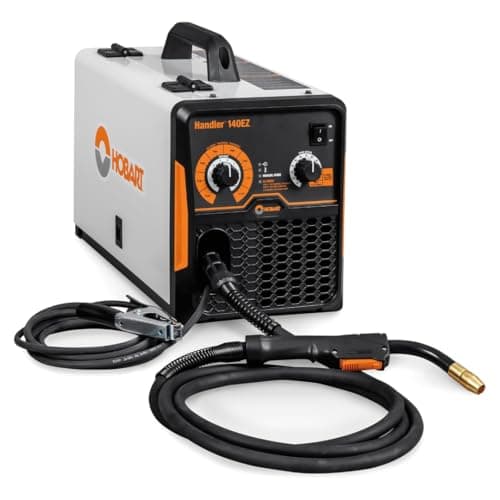 Hobart Handler 140EZ30 to 140 A on 120 V, rated from 24 gauge upward — the machine built around thin solid wire. | Best overall gas MIG on 110 V | $720.00 · View on Amazon #ad How this is funded · Price as of November 13, 2026 |
| 2 | 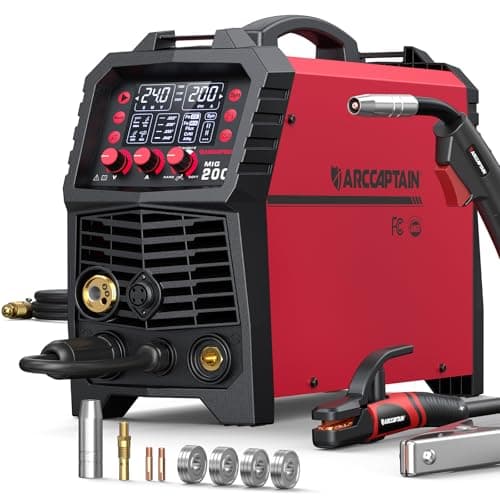 ARCCAPTAIN MIG200Synergic control that sets voltage from wire speed, plus built-in spool-gun support — on either voltage. | Best if you want the machine to help | |
| 3 | 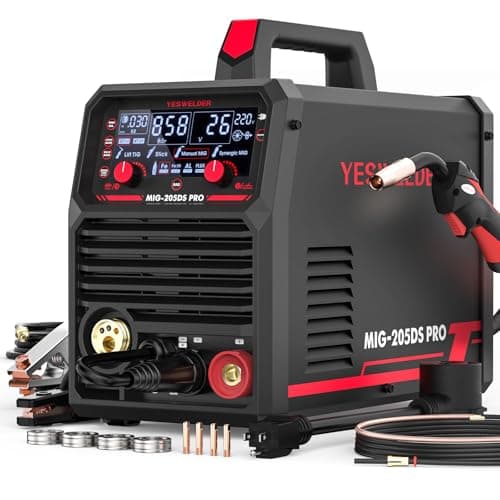 YESWELDER MIG-205DS PRO160 A of MIG on 110 V — published — rising to 205 A on 220 V, from a 22.7 lb machine. | Best headroom for the money | |
| 4 | 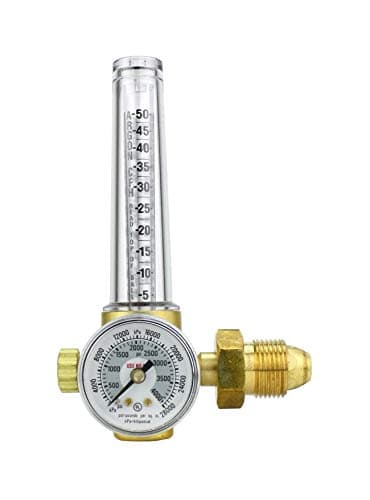 Victor GRF400-580 argon/CO2 flowmeter regulatorThe regulator a first gas bottle needs — and the purchase people forget is separate from the welder. | The part that comes with the bottle | $84.99 · View on Amazon #ad How this is funded · Price as of November 13, 2026 |
The short answer
The best 110-volt MIG welder with gas is the Hobart Handler 140EZ: 30 to 140 A on 120 V, rated from 24 gauge to three-sixteenths of an inch in a single pass, with infinite voltage control — the specifications that matter when you are feeding solid wire rather than flux-cored. Budget for the cylinder, regulator and hose as well: on a 110-volt gas setup they are a meaningful fraction of the total.
The phrase "with gas" is doing real work in this question. Plenty of 110-volt machines are sold as MIG welders and run only self-shielded flux-cored wire, which is a different process with a different consumable and a different polarity. What you want here is a machine with a gas valve and a drive system suited to solid wire, plus a clear-eyed view of what the bottle adds.
If you have not settled whether gas is worth it at all, do you need gas for MIG welding is the page to read first. This one assumes you have decided you do.
What each one publishes on a household circuit
| Machine | Output on 110/115 V | Output on 220/230 V | Duty cycle | Spool gun |
|---|---|---|---|---|
| Hobart Handler 140EZ | 30–140 A | Not applicable — single voltage | 30% at 90 A | Not supported |
| ARCCAPTAIN MIG200 | Not separately published | 200 A maximum | Not published | Supported |
| YESWELDER MIG-205DS PRO | 160 A MIG | 205 A MIG | Not published | Supported |
Note which machine states a duty cycle and which states a 110-volt output. Only the Hobart does the first; only the YESWELDER does the second. Neither does both, and the third does neither — which is a fair summary of disclosure in this part of the market.
Why a gas machine is a different purchase from a flux-core one
Four things change once a bottle is involved, and none of them is amperage.
The wire is less forgiving. Solid MIG wire has no tube structure, so it deforms or slips when drive-roll tension is wrong, and feed problems show up in the bead as stutters and cold starts. This is why drive-roll tension is worth setting carefully on a gas machine when it matters less on a flux-core one.
Polarity reverses. Gas MIG runs electrode positive; self-shielded flux-core runs electrode negative. A machine that does both has a polarity change to make, and getting it wrong is the single most common cause of a weld that looks catastrophically bad — flux-core polarity covers which way round each goes.
Draughts become your problem. Shielding gas can be blown off a weld by an open door or a fan, producing porosity that looks exactly like a settings fault. Flux-core carries its own shielding and does not care. This is the one genuine reason to keep a flux-core spool even after you buy a bottle.
There is a third variable to learn. Voltage, wire speed and now gas flow. A synergic machine collapses the first two into one decision, which is why the ARCCAPTAIN ranks as highly as it does.
The dedicated circuit is not optional
Hobart specifies a 115 V, 20 A dedicated circuit, and that word is the one people skip. Shared with a freezer or a shop light, a 140 A machine will trip — and will seem to trip at random, which reads as a fault. What size breaker a welder needs covers reading the rating plate.
What the gas actually adds to the bill
This is the part that is missing from most roundups, and on a 110-volt budget it changes the decision.
The cylinder. Bought, leased or exchanged, and the economics differ sharply between those three. Welding gas cylinder sizes covers what each size holds and why the smallest bottle is usually the worst value per cubic foot.
The regulator and hose. A separate purchase, and the fitting has to match the cylinder your supplier will actually hand you.
The gas itself, as a running cost. 75/25 argon/CO2 is the default for steel — what gas for MIG welding covers why, and 75/25 versus 100% argon covers the alternative that is wrong for steel.
Somewhere to put it. A cylinder has to be secured upright, which in practice means a cart or a wall bracket. This is the purchase nobody plans.
And a second bottle, if aluminum arrives. Aluminum MIG needs 100% argon, so the steel bottle does not do double duty.
How we ranked these
Gas-specific hardware first. Drive system quality, tension adjustment, gas valve and burn-back control — the parts that only matter once solid wire is involved.
Published figures second, and specifically figures stated at the supply you will actually use. A 220-volt number is not an answer on a 110-volt page.
How much the machine helps you learn third. Synergic control and documented settings tables both reduce the number of ways a first gas weld can go wrong.
Honest ceilings throughout. Two of these machines have no aluminum route at all, and both say so in their entry. Our how we pick page sets out the method, including the fact that we have tested none of these machines.
1. Best overall gas MIG on 110 V
Hobart Handler 140EZ
30 to 140 A on 120 V, rated from 24 gauge upward — the machine built around thin solid wire.
Hobart publishes 30 to 140 A of output on a 115 V, 20 A dedicated circuit, gas MIG and flux-core capability, a 30% duty cycle at 90 A, a single-pass capacity from 24 gauge to three-sixteenths of an inch, and infinite voltage control.
The 24-gauge bottom end is why it leads on a gas-specific page rather than a general one. Solid MIG wire on thin material is where a machine's low end is tested, and a published rating that starts at 24 gauge means the bottom of the range was designed for sheet rather than being the unused end of a range built for plate.
It is also the most documented 120-volt MIG machine there is. Every settings question has been answered somewhere, which matters a great deal when you are learning three variables at once: voltage, wire speed and gas flow. The MIG settings chart is the companion.
Two real limits. The published capacity stops at three-sixteenths of an inch, which puts a trailer tongue on the wrong side of it. And it is single-voltage, so it will never take advantage of a 240 V circuit if you later run one.
What works
- The most documented 120 V MIG family there is — every settings question has already been answered somewhere
- Runs flux-core on day one and gas MIG the day you buy a bottle, so the machine survives the level change
- EZ Mode sets the machine from two turns of a knob, and infinite voltage control is still there when you want to override it
- Spool-gun ready, so aluminum is a gun purchase rather than a new machine
What does not
- 3/16 in is the published capacity. A trailer deck in one sitting is beyond it
- Single-voltage: it will never take advantage of a 240 V circuit if you later run one
- 53 lb is heavy for a 120 V machine — it wants a cart rather than a shelf
Who this is wrong for: Anyone who expects to run a 240 V circuit within a year. A dual-voltage machine costs more now and does not have to be replaced later.
2. Best if you want the machine to help
ARCCAPTAIN MIG200
Synergic control that sets voltage from wire speed, plus built-in spool-gun support — on either voltage.
ARCCAPTAIN publishes 200 A maximum output, dual 110 V and 220 V input, synergic control with 2T/4T and burn-back adjustment, and gas MIG, flux-core, stick, lift TIG, spot and spool-gun capability.
Synergic control earns its place specifically on a gas page. Running gas MIG means balancing voltage and wire speed, and getting that balance wrong is what produces the ropey, spattery bead that makes people conclude their new machine is faulty. A machine that holds the two in step while you learn where the window is removes the single hardest part of the process.
Burn-back adjustment is a smaller gas-specific benefit worth naming: it controls how much wire is left protruding when you release the trigger, which decides whether your next start is clean or begins with a ball of fused wire stuck to the work.
Two caveats. 200 A is the 220 V figure and the 110 V output is not separately published, so what you get on a household outlet is unstated. And dealer support is thin next to Hobart or Lincoln, which is what you notice when something breaks.
What works
- Spool-gun support is built in rather than a model-specific accessory question, and that question is the whole aluminum decision on a MIG machine
- Synergic control sets voltage from wire speed, so the first hour is spent welding rather than reading a chart
- Dual voltage and six processes mean it stays useful well past the point most first machines stop
What does not
- The spool gun is a separate purchase, and not a small one
- 200 A is the 220 V figure. On a household outlet the usable output is much lower
- Dealer support is thin next to Hobart or Lincoln, which is what you notice when something breaks
3. Best headroom for the money
YESWELDER MIG-205DS PRO
160 A of MIG on 110 V — published — rising to 205 A on 220 V, from a 22.7 lb machine.
YESWELDER publishes 30 to 160 A of MIG output on 110 V and 30 to 205 A on 220 V, plus stick and DC lift TIG, a wire feed speed range of 58 to 858 inches per minute, and a weight of 22.7 lb.
The published 110-volt figure is the reason it is here. 160 A of gas MIG on a household circuit is more than either of the machines above it is rated for at that supply, and a manufacturer stating the number rather than implying it is worth something on its own.
The wide wire-feed range is a genuine gas-MIG advantage too. Solid wire at the thin end needs high feed speeds to carry low current, and a machine whose feed tops out early limits how thin you can sensibly go.
Set expectations on the extras. The lift TIG is DC with no pedal, so it will not weld aluminum and is not a route to Level 3. It is not spool-gun capable, so aluminum MIG is out. Five processes means five sets of consumables, and the duty cycle is not published at all.
What works
- Synergic mode sets voltage and wire speed from the thickness you select, which removes the single hardest part of learning MIG
- Spool-gun capable, so aluminum is a gun purchase rather than a machine purchase
- 22.7 lb for a 205 A dual-voltage machine is remarkable
What does not
- Lift TIG is DC only and has no foot pedal, so it will not weld aluminum and is not a route to Level 3
- Five processes means five sets of consumables to stock
- Dealer support and warranty handling are not on the level of Hobart or Lincoln
Who this is wrong for: Aluminum. No spool-gun support and DC-only lift TIG means there is no aluminum route on this machine at all.
4. The part that comes with the bottle
Victor GRF400-580 argon/CO2 flowmeter regulator
The regulator a first gas bottle needs — and the purchase people forget is separate from the welder.
A gas MIG machine does not include a regulator in any meaningful sense beyond, sometimes, a basic one. The regulator is what turns cylinder pressure into a usable flow rate at the torch, and it is the component that decides whether your gas setting is a number you set or a guess you make.
It is on this page because the whole point of the page is that the machine is not the purchase. A cylinder, a regulator and a hose arrive together, and the first time most people price them is after the welder is already on the bench.
Check the fitting against the cylinder your supplier will actually give you. Cylinder valve connections differ by gas, and a regulator for a 75/25 mix is not automatically right for a pure argon bottle if you later want aluminum — what gas aluminum MIG needs covers that.
What works
- CGA-580 inlet is the fitting on the argon and argon/CO2 bottles a US gas supplier will hand you
- A true flow tube rather than a flow gauge, so what you read at low flow is what you are getting
- Reads directly in cubic feet per hour, which is the number the settings charts use
- Full brass body and a precision needle valve — this is a shop regulator, not a starter one
What does not
- Wrong fitting for 100% CO2 bottles, which use CGA-320 — check before you buy
- Costs several times a generic two-gauge regulator, and a generic one will get a beginner welding
- A flow tube has to hang vertically to read correctly, which constrains where it can sit on the bottle
Questions people actually ask
What is the best 110V MIG welder with gas?
The Hobart Handler 140EZ, on published specifications: 30 to 140 A on 120 V, a single-pass capacity from 24 gauge to three-sixteenths of an inch, and infinite voltage control.
The 24-gauge bottom end is what matters on a gas machine specifically, because solid MIG wire on thin sheet is far less tolerant of too much heat than flux-cored wire on plate is.
Can you run gas MIG on a 110V outlet?
Yes. Gas MIG on a household circuit is a normal setup, and 140 to 160 A is typical of what these machines publish at that supply.
What the outlet limits is thickness and arc time, not whether gas works. Hobart specifies a dedicated 20 A circuit for the Handler 140EZ, and the word dedicated is the part that gets skipped.
How much does the gas setup add to the cost?
A meaningful fraction of a 110-volt machine's price, and it is four items rather than one: the cylinder, a regulator, a hose, and something to secure the bottle upright.
The gas itself is then a running cost. 75/25 argon/CO2 is the default for steel, and the smallest cylinder is usually the worst value per cubic foot.
Do you need a dedicated circuit for a 110V MIG welder?
Yes, and manufacturers say so explicitly - Hobart specifies 115 V on a dedicated 20 A circuit for the Handler 140EZ.
A welder's draw is heavy and intermittent, which is exactly the pattern that nuisance-trips a breaker shared with a motor load like a freezer or compressor. The trips then look random, which reads as a machine fault.
Is gas MIG better than flux-core on 110V?
On clean steel indoors, yes - less spatter, no slag, a tidier bead and much less grinding. That is what the bottle buys.
Flux-core keeps two real advantages even after you own gas: it tolerates draughts, because it carries its own shielding, and it penetrates more aggressively at the same amperage, which matters on a 110-volt machine welding thicker stock.
Can a 110V MIG welder weld aluminum?
Only with a spool gun and 100% argon, and only if the machine supports a spool gun at all. Of the machines here, the ARCCAPTAIN MIG200 does; the Hobart Handler 140EZ and the YESWELDER MIG-205DS PRO do not.
Aluminum wire is too soft to push reliably through a long liner, so without a spool gun no bottle of argon will make it work.
What gas do I need for a 110V MIG welder?
75% argon / 25% CO2 for mild steel, which is the mix almost every home shop runs and the one worth owning if you only own one cylinder.
Pure argon is for aluminum, not steel - it produces a narrow, ropey bead with poor wetting on steel. Pure CO2 penetrates deeply but runs hot and harsh, which is a liability on the thin material a 110-volt machine suits.
Sources
- Hobart Welders — Handler 140EZ published specifications: 30–140 A, 120 V, 30% duty cycle at 90 A, 24 ga to 3/16 in single pass, infinite voltage control
- ARCCAPTAIN — MIG200 published specifications: 200 A maximum, dual 110/220 V, synergic with 2T/4T and burn-back adjustment, spool-gun capable
- YESWELDER — MIG-205DS PRO published specifications: 160 A MIG on 110 V, 205 A MIG on 220 V, 58–858 in/min wire feed, 22.7 lb
- Hobart Welders — argon/CO2 gas regulator published specifications and cylinder connection details
- American Welding Society — shielding gas selection for gas metal arc welding of carbon steel
Read next
- The best MIG welders for beginners
Gas-capable machines for a home shop, and the one specification that makes learning MIG easier.
- Do you need gas for MIG welding?
When shielding gas is genuinely required and when flux-cored wire is the better answer.
- What gas do you need for MIG welding?
Which shielding gas for which metal, and the one combination that cannot work.
- The best 120V welders for beginners
Machines that run on an ordinary household circuit, and what that ceiling means for what you can build.
- MIG welding settings chart
Starting settings by thickness, plus symptom-by-symptom diagnosis for a bad MIG bead.
- Level 2 · MIG: when the gas bottle is finally worth it
You can already lay a bead. This level is about what changes when you add a gas bottle — and about being honest that it is not only an upgrade.
Back to Level 2 · MIG, or start over at Find Your Level.
Ryder M.
Ryder M. is the hands-on owner behind Magoo Media Group. He writes Arc & Bead's buying guides and picks every machine on the site. What every recommendation is based on — and what it is not based on — is set out on How We Pick.