Do you need gas for MIG welding?
The answer people give is yes. The answer that helps you is: it depends on whether you are welding indoors, and whether you mind chipping slag.
The short answer
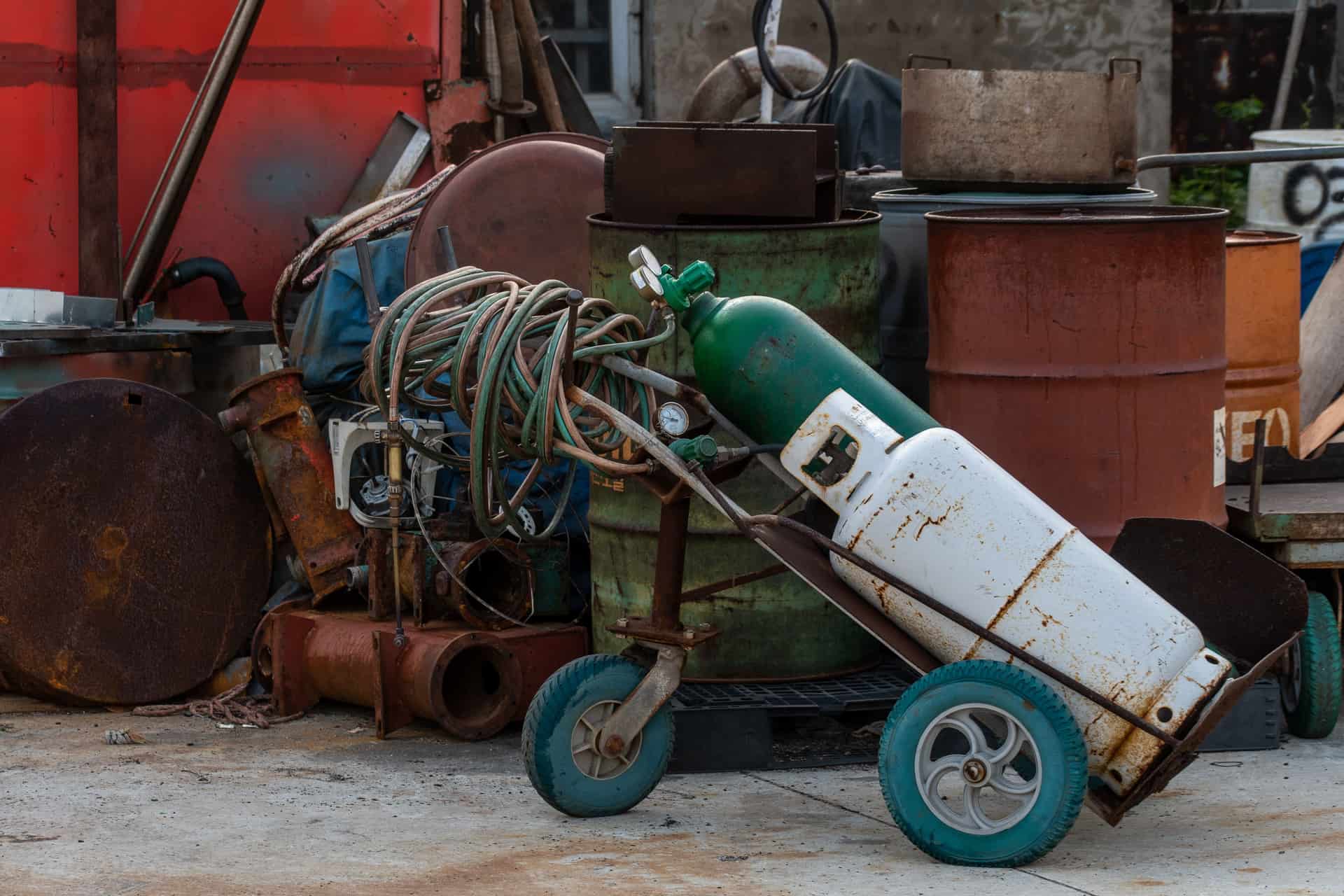
For true MIG welding with solid wire, yes — the shielding gas is what keeps air off the weld, and without it the weld turns porous and brittle. But most machines sold as MIG welders also run self-shielded flux-cored wire, which needs no gas at all. So you only need gas if you want the cleaner, slag-free, low-spatter weld that gas MIG produces.
What the gas is actually doing
Molten steel is chemically greedy. Exposed to air it absorbs oxygen and nitrogen, and the weld that results is porous, brittle and weak — visibly pitted if it is bad enough. Every arc welding process has to solve this, and there are only two solutions.
Gas metal arc welding blows shielding gas over the weld pool from a bottle. Self-shielded flux-cored arc welding packs flux inside a hollow wire; the flux burns in the arc, generates its own shielding, and leaves a glassy slag layer behind.
Both work. They produce different compromises, and the right one depends entirely on where you are welding and what the weld has to look like.
When you genuinely need gas
Thin material. Below roughly 16 gauge, flux-core becomes a fight against burn-through. The gas MIG arc is softer and more controllable, which is why body shops use it and why sheet metal work effectively requires it.
Anything that will be seen. Flux-core leaves slag and throws spatter. On a gate you will paint, that is a cleanup job. On a piece of furniture, it is the difference between something finished and something functional.
Aluminum and stainless. There is no practical self-shielded route for aluminum at all. Stainless flux-cored wire exists but is a specialist product.
Volume. If you are running many joints, the chipping and brushing step after every one of them stops being a minor annoyance and becomes most of your time.
When flux-core is genuinely the better answer
This half gets skipped in most guides, and it matters more than the first half.
Outdoors, or anywhere with a draft. A breeze that flux-core ignores entirely will blow the gas shield off a MIG weld and leave a chalky, porous bead with no obvious cause. Outdoors, flux-core is not the compromise — it is the correct process, and this is why plenty of well-equipped shops keep a spool of self-shielded wire permanently on hand.
Rusty, painted or mill-scaled steel. Flux-core copes with imperfect material far better. Gas MIG wants clean bright metal.
Portability. A bottle is heavy, has to be secured upright, and turns a carryable machine into a cart-borne one.
Occasional use. If you weld a few times a year, a leased cylinder sitting in the garage is a standing cost against very little welding, and cylinder lease terms are often the larger part of that cost.
What adding gas actually costs
Four things, and only the first is obvious.
The cylinder, which most suppliers lease rather than sell — so there is a deposit or lease plus a refill charge each time. The regulator, which must match the cylinder valve fitting. A cart, because the machine and bottle now travel together and a cylinder must be secured upright. And solid wire rather than flux-cored, which is a separate consumable.
On sizing: welding gas cylinder sizes sets out what each common cylinder holds and how long it lasts. On which gas: what gas for MIG welding covers it metal by metal.
The arrangement most people end up with
Buy a gas-capable machine. Run self-shielded flux-cored wire while you learn and for outdoor work. Add a bottle when you catch yourself resenting the chipping hammer. You get both processes, and you are never the person standing in a breeze with the wrong one.
The one thing that is not a reason
Strength. Neither process is inherently stronger — a correct weld in either, with the right wire for the joint, will be stronger than the steel around it. AWS classifies both E71T-11 flux-cored wire and ER70S-6 solid wire at the same 70,000 psi tensile class.
What differs is how easy each one makes it to produce a correct weld in given conditions. That is a real difference and it is the one worth deciding on. Flux-core versus MIG for beginners goes through it in full.
What we would buy
1. If the answer turns out to be yes
Hobart Handler 140
Runs flux-core today and takes a bottle the day you decide to add gas.
The sensible way to resolve this question is not to decide it in advance. A gas-capable machine runs self-shielded flux-cored wire out of the box, so you can weld the week you buy it, and it accepts a regulator and solid wire whenever you decide the slag has become tiresome.
Hobart publishes 25 to 140 amps, a 20% duty cycle at 90 amps, and a 20-amp dedicated circuit. That is a modest machine by 240-volt standards and an entirely adequate one for the work most people are describing when they ask this question.
What works
- The most documented 120 V MIG machine there is — every settings question has already been answered somewhere
- Runs flux-core on day one and gas MIG the day you buy a bottle, so the machine survives the level change
- Built-in five-position drive-roll tension and a genuine cast-aluminum drive system
What does not
- 20% duty cycle at 90 A is roughly two minutes of arc time in ten. Fine for a gate, not for a trailer deck in one sitting
- Single-voltage: it will never take advantage of a 240 V circuit if you later run one
- Needs its own 20 A circuit. Shared with a freezer and a shop light, it will trip
2. What you need alongside the bottle
Hobart argon/CO2 gas regulator
CGA-580 inlet, which is the fitting on argon and argon/CO2 bottles in the US.
The regulator is the part people forget to budget for. It has to match the cylinder valve: CGA-580 for argon and argon/CO2 mixes, CGA-320 for pure CO2. Those are different fittings and an adapter is not the right answer.
A flow gauge reading directly in cubic feet per hour is what you want, because that is the unit every settings chart uses.
What works
- CGA-580 inlet is the fitting on the argon and argon/CO2 bottles a US gas supplier will hand you
- Reads flow directly in cubic feet per hour, which is the number the settings charts use
What does not
- Wrong fitting for 100% CO2 bottles, which use CGA-320 — check before you buy
- A gauge-type regulator is less precise than a true float flowmeter at low flow rates
Who this is wrong for: Anyone running pure CO2. That takes a CGA-320 inlet, and this regulator will not fit the valve.
3. If the answer turns out to be no
Lincoln Electric Innershield NR-211-MP flux-cored wire
The best-documented self-shielded wire there is, so settings are never guesswork.
If you conclude you do not need gas — and plenty of people legitimately do — this is the wire that makes that decision comfortable. Lincoln classifies it AWS E71T-11, all-position, available in 0.030 and 0.035 inch, with a published maximum plate thickness of 5/16 inch for 0.045 inch and smaller diameters.
What sets it apart is documentation: Lincoln publishes full procedure tables, so there is a stated starting voltage and wire feed speed for every thickness instead of trial and error.
What works
- Lincoln publishes full procedure tables for it, so there is a documented starting setting for every thickness
- All-position rated — it will run a vertical fillet, not just a flat bead
- Available in 1 lb, 5 lb and 10 lb spools, so a small machine does not need a big spool
What does not
- Noticeably more expensive per pound than unbranded E71T-GS wire
- Like every self-shielded wire it produces slag and more spatter than a gas process
Questions people actually ask
Does flux core welding use gas?
Self-shielded flux-cored wire does not. The flux packed inside the hollow wire burns in the arc and produces its own shielding gas plus a protective slag layer.
There is a separate product, gas-shielded flux-cored wire, which uses both flux and a gas bottle. That is mostly an industrial product and is not what a 120-volt home machine runs.
Do you need a gas tank for MIG welding?
For solid-wire MIG, yes — the gas is the shielding and there is no substitute. For a machine running self-shielded flux-cored wire, no.
Most home machines sold as MIG welders do both, so the tank is a choice rather than a requirement.
Is MIG or flux core stronger?
Neither, inherently. AWS classifies both E71T-11 flux-cored wire and ER70S-6 solid MIG wire in the same 70,000 psi tensile class, and a correct weld in either will be stronger than the mild steel around it.
What differs is which process makes a correct weld easier in your conditions.
Can I use a gas MIG machine without gas?
Yes, if you switch to self-shielded flux-cored wire and reverse the polarity. Flux-core runs DCEN, electrode negative, while solid-wire MIG runs DCEP, electrode positive.
The polarity change is a physical swap of two leads inside the machine on most models, and the manual shows where. Running the wrong polarity produces a terrible weld and confuses a lot of beginners.
How long does a gas bottle last?
It depends on flow rate and arc time. At a typical 20 to 25 cubic feet per hour, an 80 cubic foot cylinder gives roughly three to four hours of actual arc time.
That is arc time, not shop time — most people weld for a small fraction of the hours they spend in the garage, so a bottle usually lasts far longer in calendar terms than the arithmetic suggests.
Sources
Read next
- What gas do you need for MIG welding?
Which shielding gas for which metal, and the one combination that cannot work.
- Welding gas cylinder sizes
What each common cylinder holds, how long it lasts at real flow rates, and lease versus buy.
- Flux-core vs MIG for beginners: which should you learn on?
Where the shielding comes from, and how that one difference changes everything downstream.
- The best MIG welders for beginners
Gas-capable machines for a home shop, and the one specification that makes learning MIG easier.
- Gas and power: the two things that decide what you can actually run
A machine you cannot plug in is a machine you do not own yet. This is the hub for the two questions that quietly decide every purchase on this site.
Back to Gas & Power, or start over at Find Your Level.
Ryder M.
Ryder M. is the hands-on owner behind Magoo Media Group. He writes Arc & Bead's buying guides and picks every machine on the site. What every recommendation is based on — and what it is not based on — is set out on How We Pick.