Flux-core welding: push or pull?
On gas MIG this is a preference. On flux-core it is not — one direction traps slag in the weld, and the other does not.
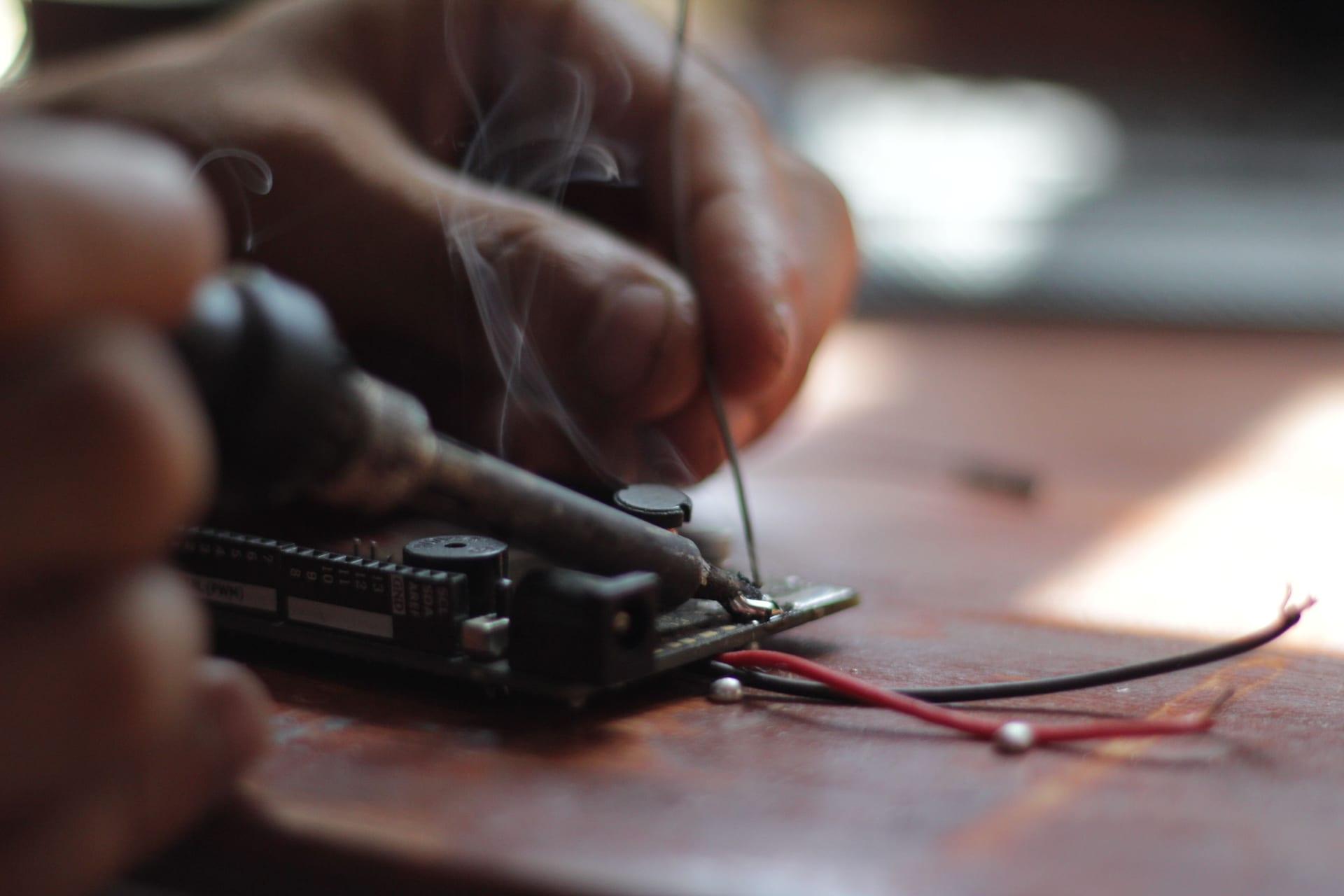
Do you push or pull flux-core welding?
Pull — drag it. Point the gun back toward the weld you have already made and drag away from it, at roughly 15 to 20 degrees from vertical. Self-shielded flux-core produces slag, and dragging keeps the slag behind the puddle where it belongs. Pushing drives the slag ahead of the arc and it gets trapped in the weld as an inclusion. The rule of thumb is: if it makes slag, you drag it.
Gas MIG with solid wire can be pushed or pulled, and welders argue about it — pushing gives a flatter, wider bead with less penetration; pulling gives a narrower, more penetrating one. Both work, so it is a preference.
Flux-core is not like that, and the reason is slag. The flux in the wire does its job and then becomes a glassy layer floating on top of the molten puddle, protecting it while it cools. Where that layer goes relative to the arc is decided entirely by your gun angle.
Drag, and the slag stays behind the arc. The puddle solidifies under it, the slag freezes on top, and you chip it off a sound weld.
Push, and you drive the slag forward into the joint ahead of the arc. The weld metal then flows over it. That is a slag inclusion — a non-metallic void inside the weld — and it is a genuine defect, not a cosmetic one. It also blocks your view of the leading edge of the puddle, so you cannot see what you are doing.
The rule that covers every process
| Process | Makes slag? | Direction | Why |
|---|---|---|---|
| Self-shielded flux-core (FCAW-S) | Yes | Drag | Keeps slag behind the arc instead of ahead of it |
| Gas-shielded flux-core (FCAW-G) | Yes | Drag | Same reason — the slag is the deciding factor, not the gas |
| Stick (SMAW) | Yes | Drag | Same reason; the flux coating behaves the same way |
| Gas MIG, solid wire (GMAW) | No | Either | No slag to trap. Push for a flatter bead, drag for more penetration |
| TIG (GTAW) | No | Push the torch, feed ahead | No slag; the filler is added at the front of the puddle |
"If it makes slag, drag it" is one of the few rules in welding with essentially no exceptions worth learning as a beginner. It is worth memorising in that form, because it generalises to stick the first time you pick up an electrode holder.
What angle, exactly
Two angles describe gun position, and only one of them is the subject of this page.
Travel angle: 15 to 20 degrees. That is how far the gun tilts back along the direction of travel, measured from perpendicular to the work. Dragging means the nozzle leans back over the finished bead and the wire points slightly backward into the puddle.
Too little — close to vertical — and the slag does not get pushed clear behind the puddle properly. Too much, past about 25 degrees, and the arc starts to blow the puddle around, the shielding from the flux degrades, and you get porosity. There is a usable band and it is not very wide.
Work angle: 45 degrees on a fillet, 90 degrees on a flat butt joint. That is the side-to-side angle between the gun and the two surfaces being joined, and it does not change between push and drag. On a T-joint you bisect the corner; on a flat plate you stay square to it.
Direction of travel out of position
Flat and horizontal: drag, either direction, whichever your arm does more comfortably.
Vertical: downhill drags naturally and is fast, but the puddle tends to run ahead of the arc and the result is often poor penetration — fine on thin sheet, not on anything structural. Uphill gives much better penetration and is how structural vertical welds are made, and uphill with a drag angle means the gun points down at the finished bead below you. That feels wrong the first few times and it is correct.
Overhead: drag, with slightly lower heat and a faster travel speed so the puddle freezes before gravity has time to act on it. This is where the all-position rating on the wire stops being a spec-sheet line and starts being the thing that makes the weld possible.
The one time to push flux-core — and it is not really welding
Tacking very thin sheet. A short push-angle tack puts less heat into the joint and is less likely to blow through 18 or 20 gauge material, and on a single tack there is no bead for slag to get trapped in front of.
That is the whole exception. As soon as you are running a bead rather than making a dot, drag it. And if thin sheet is most of your work, flux-core is the wrong process for it anyway — see MIG versus flux-core for body work.
Other things that look like a gun-angle problem
If you are dragging at a sensible angle and the weld is still wrong, the usual suspects in order are:
Stick-out. The length of wire between the contact tip and the work. Flux-core generally wants more than gas MIG — around 3/4 inch where MIG wants 3/8 — and too little stick-out is a common cause of a stuttering arc on a new machine.
Polarity. If the arc is loud and erratic and the spatter is extreme, check this before you change anything else. Flux-core polarity covers how.
Voltage and wire speed. The settings chart has starting figures by thickness.
Spatter specifically. Excessive spatter runs through the full diagnosis in order of likelihood.
And if you have not welded before at all, flux-core welding for beginners is the page that puts gun angle in context with everything else you are learning at once.
What we would buy
Arc & Bead is an Amazon Associate. If you buy through a link on this page we may earn a commission, at no extra cost to you. We have not physically tested the machines on this page and we say so on How We Pick.
1. Best all-position wire
Lincoln Electric Innershield NR-211-MP flux-cored wire
E71T-11, published all-position, so the drag technique works vertically and overhead too.
Lincoln publishes AWS classification E71T-11, all-position capability, 0.030 and 0.035-inch diameters, a maximum plate thickness of 5/16 inch for 0.045-inch and smaller diameters, and DCEN polarity.
"All-position" is the specification that matters for a page about gun angle. It means the wire is formulated so the slag freezes fast enough to support the puddle out of position — vertically, horizontally and overhead — rather than running out of the joint.
A wire that is not all-position restricts you to flat and horizontal work, and the drag technique described on this page assumes you may need to leave the bench. If you are going to own one spool, this is the one that does not limit where you can use it.
What works
- Lincoln publishes full procedure tables for it, so there is a documented starting setting for every thickness
- All-position rated — it will run a vertical fillet, not just a flat bead
- Available in 1 lb, 5 lb and 10 lb spools, so a small machine does not need a big spool
What does not
- Noticeably more expensive per pound than unbranded E71T-GS wire
- Like every self-shielded wire it produces slag and more spatter than a gas process
2. Best for practicing the angle
Blue Demon E71TGS flux-cored wire
E71T-GS, DCEN, in both common diameters — the wire to burn while you learn the technique.
Blue Demon publishes AWS classification E71T-GS, 0.030 and 0.035-inch diameters, and DCEN polarity.
The E71T-GS classification is a single-pass wire, which is the honest limitation and also what makes it the right practice wire. You are not going to build a load-bearing multi-pass joint with it, and while you are learning to hold a consistent 15 to 20 degree drag angle you are not building anything load-bearing anyway.
Learning gun angle takes a lot of wire. The arm position that produces a steady drag angle at the start of a bead is not the one that maintains it eighteen inches later, and the only way to find that out is to run beads until the muscle memory exists.
Buy it by weight and burn it on scrap. It is the cheapest part of getting good at this.
What works
- Cheap enough per pound that practicing on scrap does not feel expensive
- Widely stocked, so a spool is rarely more than two days away
What does not
- E71T-GS is single-pass rated — it is not the wire for a multi-pass structural joint
- Runs dirtier than NR-211-MP, which matters when you are also learning to read your own bead
Who this is wrong for: Multi-pass or structural work. E71T-GS is classified single-pass; use an E71T-11 wire for anything load-bearing.
3. Best machine for the technique
Forney Easy Weld 261 140 FC-i
Infinite voltage and wire-speed control, so you can isolate gun angle from a wrong setting.
Forney publishes flux-core only, 120 V on a 20 amp circuit minimum, 140 amps, a 30% duty cycle at 90 amps, 0.030 and 0.035-inch wire, up to 1/4-inch capacity, 19 pounds, and infinite voltage and wire-speed control rather than fixed taps.
Infinite control is directly relevant to learning technique. On a four-tap machine, a bad bead could be your angle or it could be that the nearest available setting is wrong for the material — and you cannot separate the two. With a dial you can set the machine correctly, hold it there, and know that what changes in the bead is coming from your hands.
The 30% duty cycle at 90 amps also means a practice session is not interrupted every two minutes, which matters more when you are building muscle memory than when you are making one repair.
What works
- 30% duty cycle at 90 A is unusually generous for a 120 V machine in this class
- Infinite voltage and wire-speed control rather than four fixed taps, so you can actually dial a setting in
- 19 lb — genuinely carryable to the job instead of the job coming to it
- No gas bottle, no regulator, no second purchase before your first weld
What does not
- Flux-core only. It will never run gas, so it cannot become your Level 2 machine
- Every weld leaves slag that has to be chipped and wire-brushed off
- Needs a 20 A circuit — a 15 A garage lighting circuit will trip at higher settings
Questions people actually ask
Do you push or drag flux-core welding?
Drag it. Point the gun back toward the weld you have already made and pull away from it, at roughly 15 to 20 degrees from vertical.
Flux-core produces slag, and dragging keeps the slag behind the puddle. Pushing drives it ahead of the arc, where the weld metal flows over it and traps it as an inclusion.
What happens if you push flux-core wire?
The slag gets driven ahead of the arc and trapped inside the weld as a slag inclusion - a non-metallic void, which is a genuine defect rather than a cosmetic one.
It also blocks your view of the leading edge of the puddle, so you cannot see where the weld is going.
What gun angle for flux-core welding?
A travel angle of 15 to 20 degrees back from perpendicular, dragging. Below that the slag is not cleared behind the puddle properly; past about 25 degrees the arc starts to blow the puddle around and shielding degrades.
The work angle is separate: 45 degrees on a fillet joint, 90 degrees on a flat butt joint, and it does not change between push and drag.
Should you weld flux-core uphill or downhill?
Uphill for anything structural. It gives much better penetration, because the puddle stays behind the arc instead of running ahead of it.
Downhill is faster and easier and is acceptable on thin sheet. Note that uphill with a drag angle means pointing the gun down at the finished bead below you, which feels wrong at first and is correct.
Is it push or pull for MIG welding?
Either, because solid MIG wire with gas makes no slag so there is nothing to trap. Pushing gives a flatter, wider bead with less penetration; dragging gives a narrower, deeper one.
The rule that covers both processes is simple: if it makes slag, drag it. That applies to flux-core and to stick, and not to gas MIG or TIG.
Sources
- Lincoln Electric — Innershield NR-211-MP published data: E71T-11, all-position, 5/16 in max plate
- Blue Demon — E71TGS published data: E71T-GS single-pass classification, DCEN
- Forney — Easy Weld 261 140 FC-i published specifications: infinite control, 30% at 90 A
- American Welding Society — A5.20 flux-cored electrode classifications and conventional travel-angle practice
Read next
- Flux-core welding settings chart
Starting settings by thickness, and a symptom-by-symptom guide to fixing a bad bead.
- Flux-core polarity: DCEN or DCEP?
Self-shielded flux-core runs DCEN, the opposite of gas MIG. How to check and what wrong looks like.
- Excessive flux-core spatter, diagnosed in order
Flux-core spatters by design. The six causes of excessive spatter, in order of likelihood.
- Flux-core welding for beginners
Drag or push, polarity, reading your first bead, and what to change when it is wrong.
- MIG vs flux-core for body work
On body panels gas MIG wins clearly. Why flux-core burns through, and the one exception.
- Level 1 · Flux-Core: one machine, one wall socket, no gas bottle
If you have never struck an arc, this is your page. One machine, a standard household outlet, and nothing else to buy before your first weld.
Back to Level 1 · Flux-Core, or start over at Find Your Level.
Ryder M.
Ryder M. is the hands-on owner behind Magoo Media Group. He writes Arc & Bead's buying guides and picks every machine on the site. What every recommendation is based on — and what it is not based on — is set out on How We Pick.