Flux-core welding safety
The risks here are real, well understood and largely manageable. What matters is knowing which ones arrive hours later rather than immediately.
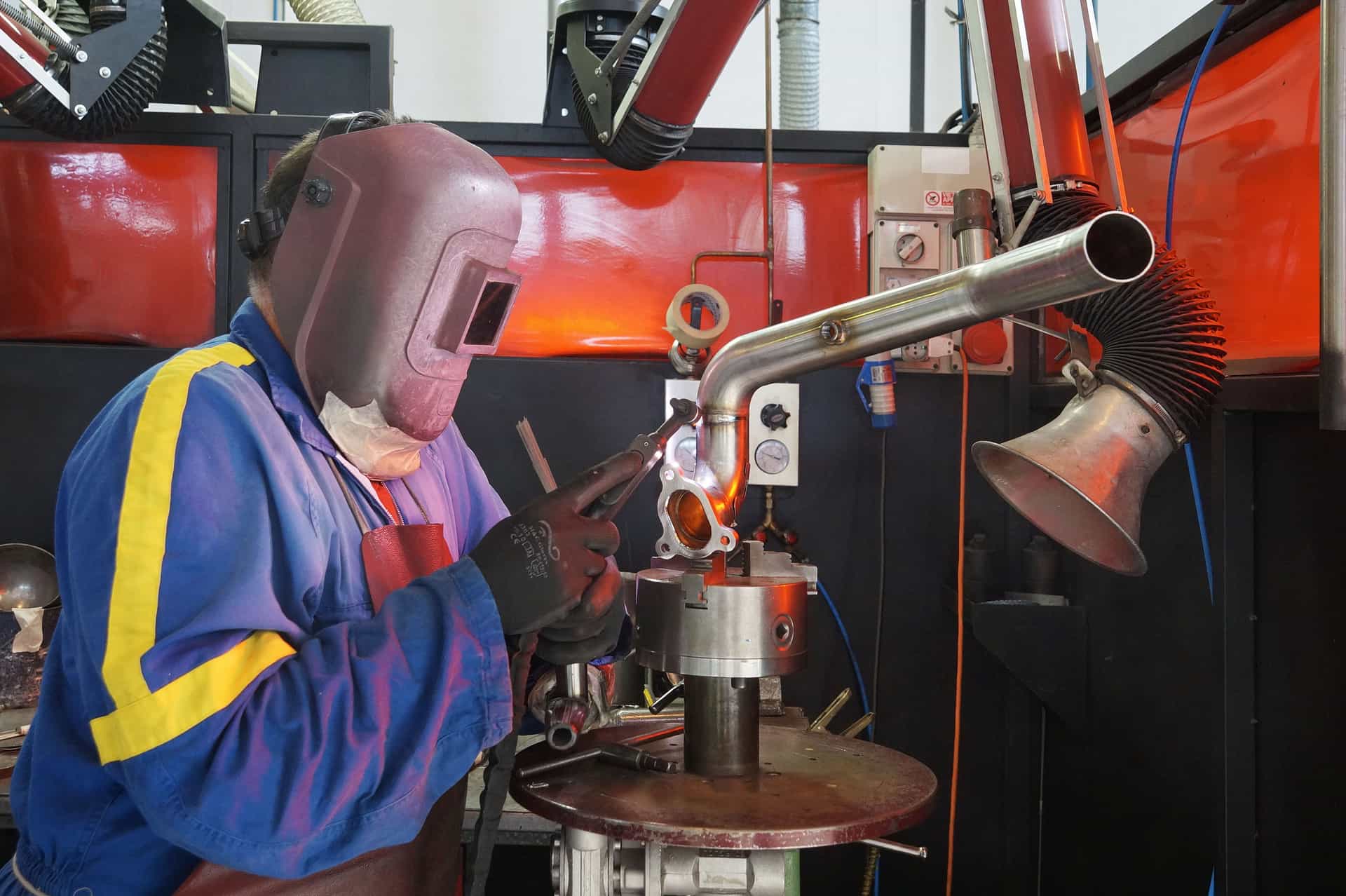
The risk that is specific to flux-core
Fume. Self-shielded flux-cored wire produces noticeably more welding fume than gas MIG, because the flux is burning as well as the metal. In an enclosed garage that accumulates quickly, and the symptoms — headache, metallic taste, a flu-like feeling — often arrive hours after you stop rather than while you weld.
Ventilation, practically
"Ventilate the area" appears in every manual and tells you nothing actionable. Here is what it means in a home garage.
Get air moving out, not around. A fan blowing at you across the weld disturbs the shield on any gas process and merely stirs fume on flux-core. The useful arrangement is a fan positioned to pull air away from your breathing zone and out of the space — ideally a box fan in an open doorway or window, extracting.
Do not put your head over the weld. Fume rises directly into your face if you lean over the joint. Position yourself to the side of the plume rather than above it. This is free and it is the single most effective thing on this page.
Open two things, not one. A single open door gives you no cross-flow. Air needs somewhere to enter and somewhere to leave.
Treat a closed garage as unacceptable for anything long. A short repair with the door open is different from an afternoon of continuous welding. The distinction is exposure over time.
What is actually in the fume
On plain mild steel with standard flux-cored wire, the fume is predominantly iron oxide and flux compounds — irritating, and the reason for long-term exposure limits rather than for acute concern at hobby volumes.
Three materials change the picture significantly, and they are worth knowing by name.
Galvanized steel releases zinc oxide, which causes metal fume fever: a genuinely unpleasant flu-like illness with fever, chills and aching that typically appears four to twelve hours after exposure and resolves within a day or two. Grinding the coating off the weld area first substantially reduces it. Serious ventilation and a respirator are not optional here.
Stainless steel introduces chromium and nickel compounds. OSHA regulates hexavalent chromium exposure specifically, and the concerns are long-term rather than acute.
Painted, coated or previously treated metal can release anything. Old paint may contain lead; some coatings produce genuinely toxic decomposition products. Grind it back to bright metal before welding — which improves the weld anyway.
Your eyes
Arc eye — photokeratitis — is a UV burn to the cornea. Its defining characteristic is that it does not hurt at the time. It arrives six to twelve hours later and feels like sand under the eyelids. It generally heals within a day or two, and it is entirely preventable.
A helmet that meets ANSI Z87.1 blocks UV and infrared even in its light state, because that filtering is in the lens rather than in the electronics. That is why the marking matters and why an unmarked helmet is an unknown quantity.
The failure mode to guard against is a sensor being blocked. Two-sensor helmets can fail to darken when your hand or the work covers one — exactly during out-of-position welding. Four-sensor helmets largely eliminate this. Beginner welding helmets covers what to look for.
One thing people forget: anyone else in the space needs protection too. The arc does not distinguish between the welder and a bystander, and a helper watching from a few feet away gets the same UV dose.
Burns and fire
Spatter is molten metal at welding temperature. It lands in shoes, in trouser cuffs, in pockets, and down the collar of a shirt when you weld overhead.
Practical measures: leather over cotton, especially overhead; boots rather than trainers; no cuffs turned up; nothing flammable in your pockets. Synthetic fabrics are worse than useless because they melt onto skin.
On fire risk in a garage, the underestimated problem is that sparks travel much further than people expect — regularly ten feet or more, and they roll. Clear the area of anything flammable rather than merely moving it aside, pay attention to what is behind and below the work, and keep an appropriate extinguisher within reach rather than across the room.
The genuinely dangerous case is welding on a container that has held anything flammable — a fuel tank, a drum, a can. Residual vapor ignites explosively, and this is a leading cause of serious welding injuries. Do not do it without proper cleaning and purging procedures.
Electrical
Welding voltages are low and the shock risk is correspondingly low compared with the fume and burn risks, but a few things still matter.
Keep gloves and clothing dry, because damp gloves conduct. Do not weld standing in water or on a wet floor. Inspect cables for damaged insulation. And attach the work clamp directly to the workpiece rather than to a bench the workpiece happens to be sitting on — a poor return path causes arcing at unexpected places.
Your machine's manual governs its electrical requirements, and any work on circuits, breakers or outlets is for a licensed electrician working to the National Electrical Code and local rules.
What this page is and is not
This is general guidance for home welding. It does not replace your machine's own manual, your wire manufacturer's safety data sheet, or the applicable OSHA and AWS standards — all of which govern where they differ from anything here.
What we would buy
1. Fume protection under the helmet
3M 6000-series half-mask respirator with P100 filters
P100 particulate filtration in a shell low-profile enough to wear under a hood.
Welding fume is respirable metal particulate, and flux-core produces significantly more of it than gas MIG. A P100 filter handles that particulate, which is the actual exposure in a home garage.
The 6000-series shell is low enough in profile to sit under most welding helmets without the shell pressing the seal open — which is the practical requirement, because a respirator you cannot wear under your hood does not get worn.
Two limits that must not be glossed over: a particulate filter does not remove gases such as ozone or carbon monoxide, so ventilation is still required with one on; and it only works with a proper seal against clean-shaven skin.
What works
- P100 filtration handles welding fume particulate, which is the actual exposure in a home garage
- Low-profile 6000-series shell fits under most welding helmets without breaking the seal
- Filters are cheap and universally stocked
What does not
- Needs a proper seal against clean-shaven skin. Facial hair defeats it, and a defeated respirator protects nothing
- Particulate filters do not remove gases such as ozone or carbon monoxide — ventilation is still required
- Adds warmth and breathing resistance under a helmet
Who this is wrong for: Anyone with a beard along the seal line. Facial hair defeats the seal, and a defeated respirator protects nothing while feeling like it does.
2. Eye protection that actually triggers
Antra AH6-660
Four arc sensors and ANSI Z87.1 at an entry price.
Antra publishes four arc sensors, a 4/5 to 9 and 9 to 13 shade range, and ANSI Z87.1 compliance. The four sensors matter for safety rather than convenience: two-sensor helmets can fail to darken when your hand or the workpiece blocks a sensor, which is precisely when you are looking at the arc.
The ANSI Z87.1 marking is the line worth insisting on. A compliant lens blocks UV and IR even in its light state, because that filtering is built into the lens rather than depending on the electronics.
What works
- Four sensors and a shade-4 light state at a price where two sensors is the norm
- ANSI Z87.1 rated, which is the line between eye protection and a novelty
- Cheap enough that starting here and upgrading later costs less than agonizing over it
What does not
- Headgear is the weak point — it is the part owners most often report replacing
- Optical class is not published as 1/1/1/1, and over a long session you can feel the difference
- Switching speed is adequate for MIG and stick but is not a low-amperage TIG helmet
3. For overhead and out-of-position work
Lincoln Electric traditional split-leather welding jacket
Split leather stops spatter that a cotton shirt only delays.
Spatter that falls away from you on a flat weld falls onto you overhead, and a cotton shirt does not stop a hot ball of metal — it delays it long enough for you to notice.
The high collar is the underrated part. A neck burn is the one that genuinely ends a session, and it is the area a helmet does not cover once you look down.
What works
- Leather stops spatter that a cotton shirt merely delays — the difference matters most overhead
- High collar protects the neck, which is where a burn ruins a whole day
What does not
- Hot to wear. In a summer garage you will weld in shorter bursts
- Heavy and restricts reach compared with a flame-resistant cotton jacket
Questions people actually ask
Can flux core welding make you sick?
Yes, in a poorly ventilated space. Welding fume is respirable metal particulate, and flux-core produces more of it than gas MIG.
The classic outcome is metal fume fever from galvanized steel — fever, chills and aching that typically starts four to twelve hours after exposure and resolves within a day or two.
Do I need a respirator for flux core welding?
For anything more than a short repair in a well-ventilated space, yes. A P100 particulate respirator worn under the helmet handles the particulate exposure.
Two limits matter: it does not remove gases, so ventilation is still required, and it only works with a proper seal against clean-shaven skin.
Is it safe to weld in a closed garage?
Not for any sustained session. Fume accumulates with nowhere to go, and the symptoms often appear hours after you have finished.
Open two things so air can cross-flow, position a fan to extract air away from your breathing zone, and keep your head out of the plume.
What is arc eye and how do I avoid it?
Photokeratitis — a UV burn to the cornea. It does not hurt at the time; it arrives six to twelve hours later feeling like sand under the eyelids, and usually heals in a day or two.
Avoid it with a helmet meeting ANSI Z87.1, and make sure anyone else in the space is protected too. The arc does not distinguish between the welder and a bystander.
Is welding galvanized steel dangerous?
It releases zinc oxide fume, which causes metal fume fever — genuinely unpleasant and usually self-limiting within a day or two.
Grind the galvanizing off the weld area first, ventilate seriously, and wear a respirator. This is the case where 'open the door' is not sufficient.
Sources
Read next
- Welding respirators and fume safety
What is in welding fume, what a P100 filter does and does not remove, and when it is mandatory.
- The best welding helmets for beginners
The purchase that improves a beginner's welds fastest, and where spending more stops helping.
- Flux-core welding for beginners
Drag or push, polarity, reading your first bead, and what to change when it is wrong.
- Welding gloves and jackets
Why MIG gloves and TIG gloves are opposite tools, and when a leather jacket stops being optional.
- Level 1 · Flux-Core: one machine, one wall socket, no gas bottle
If you have never struck an arc, this is your page. One machine, a standard household outlet, and nothing else to buy before your first weld.
Back to Level 1 · Flux-Core, or start over at Find Your Level.
Ryder M.
Ryder M. is the hands-on owner behind Magoo Media Group. He writes Arc & Bead's buying guides and picks every machine on the site. What every recommendation is based on — and what it is not based on — is set out on How We Pick.