The best welders for sheet metal
Every other welder page ranks machines by how much they can do. On sheet metal the useful question is the opposite: how little can it do, and how precisely.
Arc & Bead is an Amazon Associate. If you buy through a link on this page we may earn a commission, at no extra cost to you. We have not physically tested the machines on this page and we say so on How We Pick.
Quick picks
Tap any row to jump to the full write-up further down this page.
| # | Product | Best for | Price |
|---|---|---|---|
| 1 | 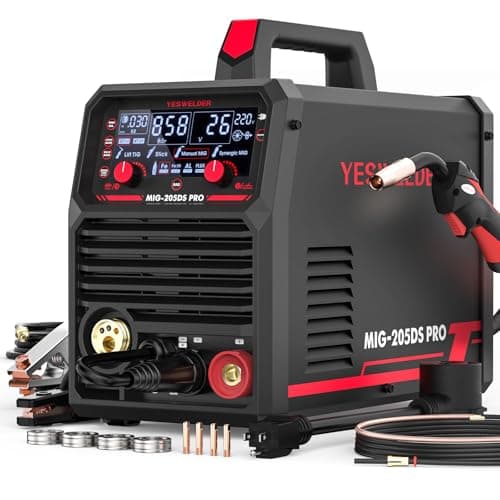 YESWELDER MIG-205DS PROA published 30 A MIG floor - the lowest in our registry - with synergic setting and a wide wire-feed range. | Best overall | |
| 2 | 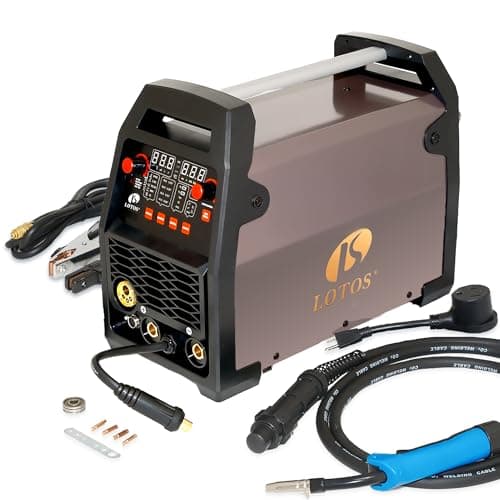 Lotos MIG180The cheapest gas MIG machine in our registry, and it publishes 0.023 in wire - the actual sheet-metal specification. | Budget pick | $359.98 · View on Amazon #ad How this is funded · Price as of November 13, 2026 |
| 3 | 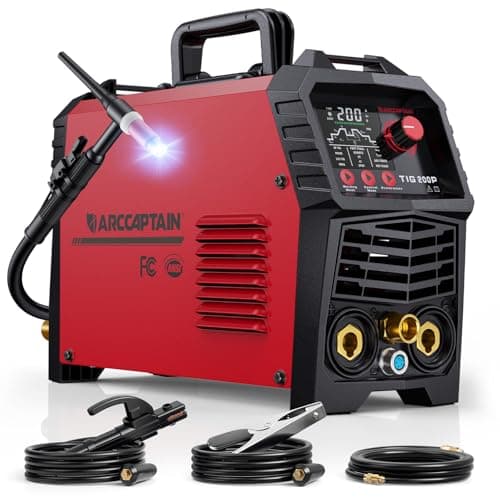 ARCCAPTAIN TIG200PA 10 A TIG floor and HF start. If the weld will be seen, or the sheet is stainless, this is the process rather than wire. | Best for visible and stainless sheet | $249.99 · View on Amazon #ad How this is funded · Price as of November 13, 2026 |
| 4 | 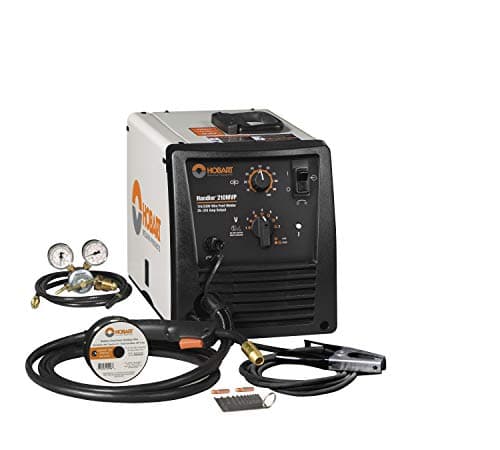 Hobart Handler 210 MVPThe only machine here that publishes a 24 gauge capacity, with four voltage settings on 115 V to find it with. | Best published thin-gauge figure | |
| 5 | 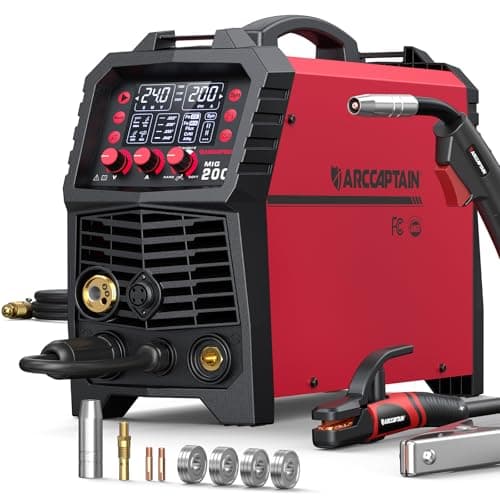 ARCCAPTAIN MIG200Synergic control with built-in spool-gun provision, so aluminum sheet stays a gun purchase rather than a second machine. | Best for mixed sheet and structural work |
The short answer
Sheet metal is ruined by too much current, so the specification to buy on is the bottom of a machine's output range and the smallest wire it takes. A 30 A MIG floor with 0.023 in wire will join 20 gauge steel; a 60 A floor with 0.030 in wire will blow holes in it whatever you do with the dials.
Our overall pick is the YESWELDER MIG-205DS PRO, which publishes a 30 A MIG floor — the lowest in our registry — plus synergic setting and a 58 in/min minimum wire speed. The budget pick is the Lotos MIG180, the cheapest gas MIG machine we list and one that publishes 0.023 in wire. If the weld will be seen, or the sheet is stainless, the answer is TIG: the ARCCAPTAIN TIG200P holds 10 A.
Prices in the table come from the live feed when the page loads, each with its own "as of" date inside the buy button.
Why the floor is the specification
Thin steel has almost no thermal mass. Heat that arrives faster than the panel can conduct it away melts straight through, and the hole gets bigger while you look at it. Everything about sheet-metal welding is a way of putting in less heat: less current, thinner wire, shorter bursts, more backing, more pauses.
That is why a page like this ranks machines upside down compared with the best welders for thick steel. There, the figure that matters is the top of the range and the duty cycle. Here it is the bottom of the range, the smallest wire, and whether the machine has a spot or stitch timer.
The technique half of the problem is in MIG welding sheet metal, and the settings baseline is in the MIG settings chart. Gas matters more here than on thick steel too — what gas for MIG welding sheet metal explains why a higher-argon mix runs cooler.
| Machine | Published floor | Smallest wire | Thin-gauge capacity | Stitch / spot |
|---|---|---|---|---|
| YESWELDER MIG-205DS PRO | MIG 30 A; TIG 15 A | Not published | Not published | Not published |
| Lotos MIG180 | Not published | 0.023 in | Not published (1/4 in maximum) | Spot mode published |
| ARCCAPTAIN TIG200P | TIG 10 A | n/a - filler rod by hand | Not published | Spot TIG and pulse TIG published |
| Hobart Handler 210 MVP | 25 A | Not published | 24 gauge single pass | Not published |
| ARCCAPTAIN MIG200 | Not published | Not published | Not published | Spot mode and burn-back adjustment |
Read that table as an argument for asking harder questions. Only two of these five machines publish an amperage floor, and only one publishes a thin-gauge capacity. On thick steel the marketing numbers point the same way as the work; on sheet metal they point away from it.
Flux-core is the wrong process for sheet metal.
Self-shielded flux-core runs hotter than gas MIG at the same wire speed, throws more spatter and leaves slag, and the thinnest wire it is commonly sold in is 0.030 in. On 20 gauge that is a burn-through machine. If flux-core is what you own, flux-core burn-through covers how to minimise it — but the honest answer is gas MIG or TIG. MIG vs flux-core for body work is the comparison in full.
The three things that are not the machine
Gas. A higher-argon mix runs cooler and wets in flatter than 75/25, and on thin-gauge panels that difference is visible. Gasless flux-core has no gas lever to pull at all.
Wire diameter. 0.023 in rather than 0.030 in is the cheapest improvement available on any machine that takes it, because thinner wire needs less current to melt. The sizes are in the wire size chart.
Backing and fit-up. A copper backing bar behind a butt joint conducts heat away and gives the puddle something to sit on; a tight fit-up means there is no gap for the arc to fall into. Both matter more than an extra 20 A of range.
Who should buy what
Car body panels, mild steel: gas MIG with 0.023 in wire. The YESWELDER or the Lotos. The best MIG welders for auto body is scoped to that work.
Exhaust tube and stainless: TIG. The ARCCAPTAIN TIG200P, and the best welders for exhaust pipe goes through that job in detail.
Aluminum sheet: AC TIG, or MIG with a spool gun. Not a DC machine.
Mixed sheet and heavier fabrication: Hobart Handler 210 MVP, which publishes 24 gauge at one end and 3/8 in at the other. It is the widest published span here.
How we picked these
Ranked on the floor, not the ceiling. Every machine in our registry was assessed on its published minimum output, its smallest wire, and whether it has a spot or stitch timer. That deliberately reverses the usual order and is the whole point of the page.
Unpublished figures are marked, not filled. Three of these five machines do not publish an amperage floor, and the table says so. We did not infer one from a maximum.
No hands-on. We have welded no sheet metal with any of these machines and publish no scores. More on the method on how we pick.
1. Best overall
YESWELDER MIG-205DS PRO
A published 30 A MIG floor - the lowest in our registry - with synergic setting and a wide wire-feed range.
YESWELDER publishes this machine at MIG 30–160 A on 110 V and 30–205 A on 220 V, stick 20–140 A and 20–205 A, lift TIG 15–140 A and 15–205 A, a wire feed speed range of 58–858 in/min, and 22.7 lb.
The 30 A floor is why it wins. On 18 or 20 gauge steel — a body panel, a mudguard, a toolbox — the failure is always the same: the arc puts in more heat than the metal can carry away and blows a hole. A machine that will hold 30 A gives you somewhere to stand. Most wire machines publish only a maximum.
The 58 in/min bottom of the wire-feed range matters for the same reason. Thin-gauge MIG is stitch welding: a short burst, a pause, a short burst, letting the panel cool between them. You need the feeder to run slowly and consistently, not just quickly.
Synergic mode is the third reason. You select the thickness and the machine sets voltage and wire speed together, which is the hardest part of thin-gauge work to get right by hand.
Against it: the lift TIG is DC only with no foot pedal, so it is not the route to thin stainless or aluminum; five processes means five sets of consumables; and support is thinner than the established brands.
What works
- Synergic mode sets voltage and wire speed from the thickness you select, which removes the single hardest part of learning MIG
- Spool-gun capable, so aluminum is a gun purchase rather than a machine purchase
- 22.7 lb for a 205 A dual-voltage machine is remarkable
What does not
- Lift TIG is DC only and has no foot pedal, so it will not weld aluminum and is not a route to Level 3
- Five processes means five sets of consumables to stock
- Dealer support and warranty handling are not on the level of Hobart or Lincoln
2. Budget pick
Lotos MIG180
The cheapest gas MIG machine in our registry, and it publishes 0.023 in wire - the actual sheet-metal specification.
Lotos publishes the MIG180 for 110–125 V or 210–250 V input, with gas MIG, gasless flux-core, stick, DC lift TIG, spot and spool-gun aluminum, MIG to 180 A, DC TIG to 180 A, stick to 160 A, a mild steel capacity of 1/4 in, wire from 0.023 to 0.040 in, and synergistic MIG with voltage fine tuning.
The budget pick in the strict sense used here: the least expensive machine in our registry that does this page's job, which is gas MIG on thin steel. And the specification that earns it the slot is the wire range. 0.023 in is the sheet-metal wire — thinner wire melts at lower current, so you can run cooler and still get a stable arc. A machine whose smallest published wire is 0.030 in is working against you on 20 gauge.
Spot mode is worth naming too: a timed burst is exactly the tool for tacking panels without standing on the trigger.
Against it: the 180 A and 160 A headline figures are the 240 V ratings and Lotos does not publish a separate 120 V output, the TIG is lift-start DC with no HF start, and dealer support is not on the level of Hobart or Lincoln.
What works
- Stick capability matters more than it sounds: rusty, painted or outdoor steel is where MIG struggles and stick does not
- A published 160 A stick rating is a real stick machine, not a token third process on the switch
- Synergistic MIG sets voltage and wire speed together, so the first hour goes on welding rather than on a settings chart
What does not
- The headline 180 A and 160 A figures are the 240 V ratings; Lotos does not publish a separate 120 V output
- TIG is lift-start DC with no high-frequency start, and the torch is a separate purchase — treat it as a bonus, not a feature you bought
- The spool gun is also sold separately, and DC lift TIG cannot weld aluminum whatever gun you fit
- Dealer support and warranty handling are not on the level of Hobart or Lincoln
3. Best for visible and stainless sheet
ARCCAPTAIN TIG200P
A 10 A TIG floor and HF start. If the weld will be seen, or the sheet is stainless, this is the process rather than wire.
ARCCAPTAIN publishes the TIG200P with HF TIG, lift TIG, pulse TIG, spot TIG and stick on 110 V or 220 V, TIG output 10–200 A, stick 10–170 A, a 60% duty cycle, non-contact high-frequency arc start, and 11.8 lb.
A 10 A floor is three times finer than the best MIG floor here, and on sheet metal that is the whole argument. TIG puts heat exactly where you point it, the filler is added by hand so you control the bead volume, and pulse TIG lets the puddle freeze between pulses — which is the single most effective way to weld thin material without distortion.
Who it is for: stainless sheet, exhaust tube, and anything where the weld is part of the finished appearance.
The limits are absolute and worth stating. It is DC only, so aluminum sheet is off the table — that needs AC, and the AC TIG page is where those machines are. TIG is also far slower than wire, and the foot pedal is a separate purchase.
What works
- High-frequency start rather than scratch start — the difference between a clean arc and a contaminated tungsten on every single strike
- 11.8 lb, so it goes to the work instead of the work coming to the bench
- Dual voltage, so it runs on a household outlet now and a 240 V circuit later
- The lowest price at which HF DC TIG is genuinely available from a supported brand
What does not
- DC only. No aluminum, now or ever, and no accessory changes that
- Still DC only, so the pulse that helps on thin stainless does nothing for aluminum
- A foot pedal and a better torch are extra, and both are worth budgeting for
Who this is wrong for: Aluminum sheet, and any job where speed matters. DC-only TIG cannot weld aluminum at any setting, and a long seam in mild steel sheet is an afternoon rather than an hour.
4. Best published thin-gauge figure
Hobart Handler 210 MVP
The only machine here that publishes a 24 gauge capacity, with four voltage settings on 115 V to find it with.
Hobart publishes the Handler 210 MVP as gas MIG and flux-core on 115 V or 230 V via its multi-voltage plug, 25–210 A output (140 A on 115 V, 210 A on 230 V), a 30% duty cycle at 150 A and 20% at 90 A, a single-pass steel capacity of 24 gauge to 3/8 in, and seven voltage settings on 230 V against four on 115 V.
Twenty-four gauge is roughly 0.024 in, and it is the only published thin-gauge figure in our registry — most makers publish a maximum thickness and leave the minimum to you. A 25 A output floor backs it up.
The tapped voltage settings are a genuine advantage on sheet rather than a limitation. Infinite voltage control sounds better and makes repeatability harder; a tap you can return to is how you weld forty identical tacks the same way.
Against it: it is the most expensive machine on this page, on 115 V you get 140 A, it is heavy enough to want a cart, and its listing price has lately been running above its usual street price — check the live figure in the table.
What works
- The multi-voltage plug means you can buy it before you have run a 240 V circuit and get the full 210 A later
- 3/8 in single-pass capacity covers essentially every home fabrication job
- 30% duty cycle at 150 A is a real working duty cycle, not a demonstration figure
What does not
- Heavy enough that you will want a cart, which is another purchase
- On 115 V you get 140 A — no more than the Handler 140EZ, at a much higher price. The value only appears once you have the 240 V outlet
- No spool gun included, so aluminum is a further purchase
5. Best for mixed sheet and structural work
ARCCAPTAIN MIG200
Synergic control with built-in spool-gun provision, so aluminum sheet stays a gun purchase rather than a second machine.
ARCCAPTAIN publishes the MIG200 as gas MIG, flux-core, stick, lift TIG, spot and spool gun on 110 V or 220 V, at a 200 A maximum with synergic control, 2T/4T operation and burn-back adjustment.
Burn-back adjustment is the quietly useful control on thin material. It sets how long the arc continues after the trigger releases, which determines whether the wire sticks in the weld or balls up at the tip — and on short stitch welds you release the trigger constantly, so it matters more than it does on a long seam.
The spool-gun provision is the other reason to pick it here: aluminum sheet is a common sheet-metal job and it is the one a DC machine cannot do. The spool-gun page ranks machines on that provision specifically.
Against it: 200 A is the 220 V figure with no published 110 V number, the gun is a separate purchase, and dealer support is thin.
What works
- Spool-gun support is built in rather than a model-specific accessory question, and that question is the whole aluminum decision on a MIG machine
- Synergic control sets voltage from wire speed, so the first hour is spent welding rather than reading a chart
- Dual voltage and six processes mean it stays useful well past the point most first machines stop
What does not
- The spool gun is a separate purchase, and not a small one
- 200 A is the 220 V figure. On a household outlet the usable output is much lower
- Dealer support is thin next to Hobart or Lincoln, which is what you notice when something breaks
Questions people actually ask
What welder is best for sheet metal?
A gas MIG machine that will hold a low amperage and take 0.023 inch wire, or a TIG machine for anything thin, stainless or visible. In our registry the YESWELDER MIG-205DS PRO publishes the lowest MIG floor at 30 amps, and the ARCCAPTAIN TIG200P holds 10 amps in TIG.
Gasless flux-core is the wrong process: it runs hotter, the thinnest common wire is 0.030 inch, and it leaves slag on a panel you will have to finish.
How many amps do you need to weld sheet metal?
Far fewer than most machines advertise. As a working guide, 18 gauge wants roughly 40 to 60 amps and 20 gauge nearer 30 to 45, which is why a published amperage floor matters more than a maximum.
The practical rule is that you cannot weld thin steel with a machine that will not turn down far enough, no matter how good it is at everything else.
Can you weld sheet metal with flux core?
You can, badly, and most people who try conclude the metal is at fault. Self-shielded flux-core runs hotter than gas MIG at the same wire speed, the thinnest commonly sold wire is 0.030 inch, and it leaves slag and spatter on a surface you have to finish.
If it is the machine you own, stitch rather than running a bead, use a backing bar and accept more cleanup.
What wire size for sheet metal MIG welding?
0.023 inch where the machine accepts it, and 0.030 inch as the fallback. Thinner wire melts at lower current, so it lets you run cooler and still hold a stable arc - which is the entire problem on thin gauge.
In our registry the Lotos MIG180 publishes a 0.023 to 0.040 inch range, which is why it is the budget pick on this page.
Is TIG better than MIG for sheet metal?
For thin, stainless or visible work, yes. TIG puts heat exactly where you aim it, you add filler by hand so you control the bead volume, and pulse TIG lets the puddle freeze between pulses - which is the most effective way to avoid distortion.
MIG is far faster, easier to learn, and the right answer for long seams in mild steel panels where the weld will be filled and painted.
Why do I keep blowing holes in sheet metal?
Too much heat arriving too fast, and usually three causes together: the current is above what the gauge can carry, you are running a continuous bead instead of stitching, and there is a gap in the joint for the arc to fall into.
Turn the machine down, weld in short bursts with pauses between them, close the fit-up, and put a copper backing bar behind the joint to conduct heat away.
Sources
- YESWELDER - MIG-205DS PRO published specifications: MIG 30-160 A at 110 V and 30-205 A at 220 V, stick 20-140 A and 20-205 A, lift TIG 15-140 A and 15-205 A, wire feed speed 58-858 in/min, 22.7 lb (as recorded in this site's product registry, ASIN B07TVCWDGW)
- Lotos - MIG180 published specifications: gas MIG, gasless flux-core, stick, DC lift TIG, spot and spool-gun aluminum, 110-125 V or 210-250 V, MIG to 180 A, DC TIG to 180 A, stick to 160 A, mild steel to 1/4 in, wire 0.023-0.040 in, synergistic MIG with voltage fine tuning (read 2026-10-19, recorded in this site's product registry, ASIN B0FDZ15SD4)
- ARCCAPTAIN - TIG200P published specifications: HF TIG, lift TIG, pulse TIG, spot TIG and stick, 110 V or 220 V, TIG 10-200 A, stick 10-170 A, 60% duty cycle, non-contact HF arc start, 11.8 lb (recorded in this site's product registry, ASIN B0GXK5BVPJ)
- Hobart - Handler 210 MVP published specifications: gas MIG and flux-core, 115 V or 230 V via multi-voltage plug, 25-210 A (140 A on 115 V, 210 A on 230 V), 30% duty cycle at 150 A and 20% at 90 A, 24 gauge to 3/8 in single pass, seven voltage settings on 230 V and four on 115 V (as recorded in this site's product registry, ASIN B004USV5UC)
- ARCCAPTAIN - MIG200 published specifications: gas MIG, flux-core, stick, lift TIG, spot and spool gun, 110 V or 220 V, 200 A maximum, synergic control with 2T/4T and burn-back adjustment (as recorded in this site's product registry, ASIN B0B1TGZ8XN)
- American Welding Society - gas metal arc welding and gas tungsten arc welding fundamentals, including heat input and thin-section distortion
Read next
- MIG welding sheet metal without burning through
Stitch welding, heat management and copper backing — the techniques thin sheet actually needs.
- The best MIG welders for auto body work
Thin panels need low controllable heat, not power. Which machines deliver it and which wire to run.
- What gas for MIG welding sheet metal?
Thin-gauge steel changes the gas question: least heat that still fuses, not most penetration.
- The best welders for exhaust pipe
Exhaust tube is 16-gauge wall and burns through easily. The machines with a low enough minimum to weld it.
- The best welders under $500
Five welders under $500 at current live prices, ranked on what this band uniquely unlocks - gas MIG with dual voltage and synergic control - with the cheapest machine as the budget pick.
- Welding wire size chart
Which diameter for which thickness, and why the wrong wire looks like a machine fault.
Back to Find Your Level, or start over at Find Your Level.
Ryder M.
Ryder M. is the hands-on owner behind Magoo Media Group. He writes Arc & Bead's buying guides and picks every machine on the site. What every recommendation is based on — and what it is not based on — is set out on How We Pick.