Lincoln VIKING 3350 review
The helmet most welders end up with, at every level. Its best published figure is not the window size - it is a 2 amp TIG rating stated for AC as well as DC, which almost nothing else commits to.
Arc & Bead is an Amazon Associate. If you buy through a link on this page we may earn a commission, at no extra cost to you. We have not physically tested the machines on this page and we say so on How We Pick.
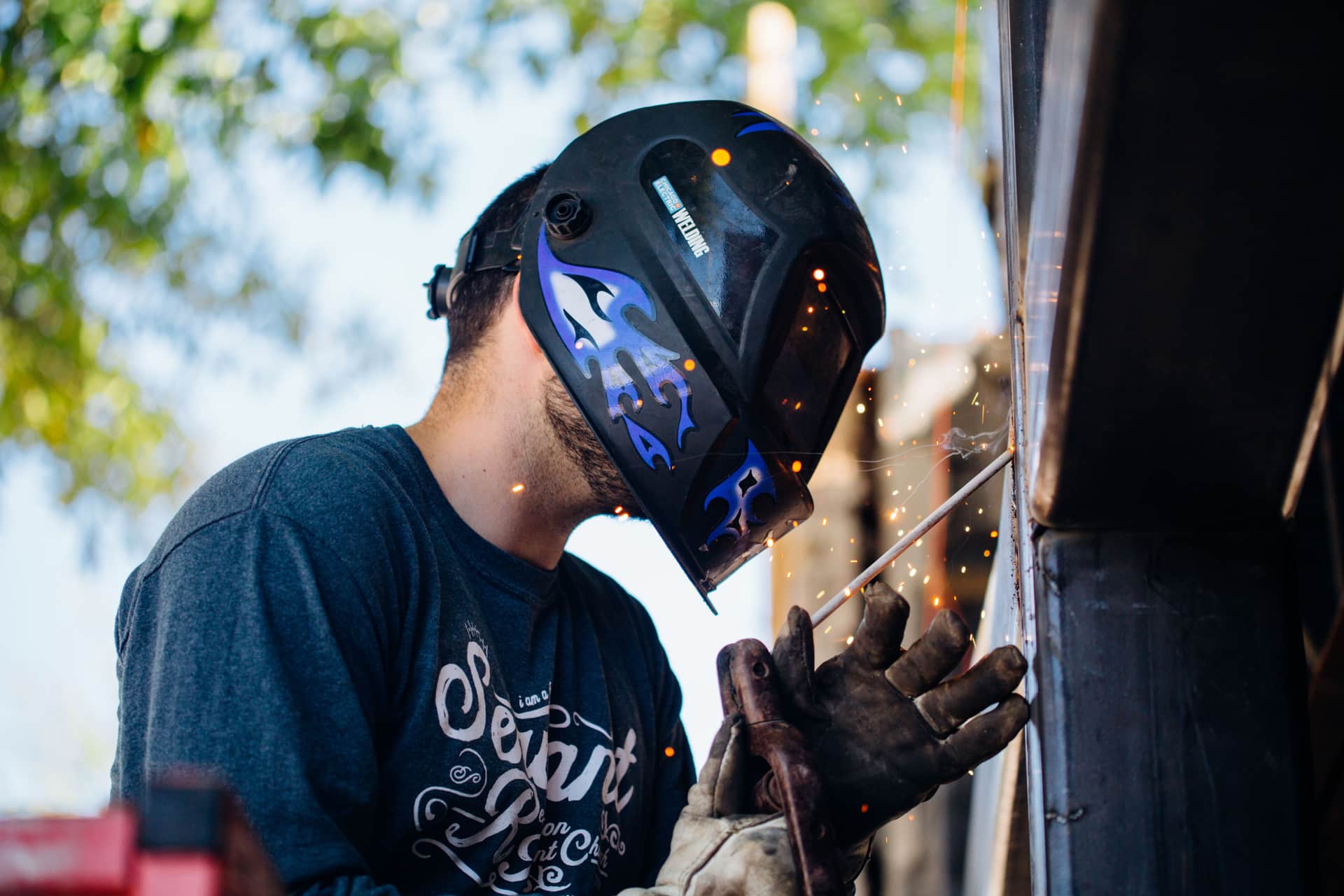
The verdict in one paragraph
The Lincoln VIKING 3350 is the helmet to buy if you want one hood to cover every process you are likely to run. Its standout published figure is a 2 A TIG rating stated for AC as well as DC — a stronger commitment than the DC-only ratings almost everything else publishes — alongside 12.5 sq in at a full 1/1/1/1 optical class, a shade 5 low end that covers plasma cutting, an external grind button and a five-year warranty.
Do not buy it if your work is bench welding on steel and the window is not your complaint: the Lincoln VIKING 1840 has the same lens technology, optical class, 2 A DC rating and external grind control for much less. The real alternative at the same level is the ESAB Sentinel A60, which trades the AC rating and the warranty for half-shade increments and nine memories.
Arc & Bead has not worn this helmet. Everything here is Lincoln's own published specification, and the prices in the table come from the live feed with their own "as of" date rather than being written into this copy.
What the published specification commits to
| Specification | Published figure | What it means in practice |
|---|---|---|
| Viewing area | 12.5 sq in (95 x 85 mm cartridge) | Large-view class. You see the clamp, the joint and your hand without moving your head |
| Optical clarity | 1/1/1/1 | Top marks in all four EN 379 categories, including angle dependence - the one a big window stresses |
| Shade range | Variable 5-13 | Shade 5 covers plasma cutting, 13 covers high-amperage stick. One helmet across all four levels |
| TIG rating | 2 A, stated for AC and DC | The strongest low-amperage commitment here. AC current passes through zero each half cycle, which is where marginal lenses flicker |
| Sensors | 4 arc sensors | Fewer blocked-sensor failures in awkward positions than a two-sensor lens |
| Switching speed | 1/25,000 s light to dark | Fast enough that the transition is not a visible event |
| Lens / headgear | 4C lens with X6 headgear | The X6 is the part that decides comfort; four contact points and a ratchet adjustment |
| Grind mode | Low-profile external grind button | Mode switching with the hood down - the feature you use most and notice most |
| Power | One CR2450 with solar assist | Replaceable battery rather than a sealed unit |
| Weight | 22 oz | Not a light helmet. The cartridge is the heavy part |
| Warranty | Five years | The longest published warranty of any helmet we list |
The two honest costs
Price. It costs several times a budget auto-darkening helmet, and a budget helmet with a published TIG rating — the Antra DP3-6404 in our registry — exists. If the helmet is the thing standing between you and a first weld, buy the cheap one now and this one later; that is a better order of spending than waiting.
Size. Twelve and a half square inches comes in a physically large shell, and in a tight corner — inside a wheel arch, under a vehicle, between two uprights — the shell finds things to bump into. At 22 oz it is also not light. If your sessions end because of your neck rather than your eyes, a narrower helmet such as the Jackson on our under-$500 page is the more honest buy.
What the five-year warranty is actually on.
Lincoln publishes five years, which is the longest in our registry, and it is the figure worth weighing against a cheaper helmet's. The part that fails on an auto-darkening helmet is the lens cartridge, and a cartridge is most of the cost of the helmet — so warranty length on this product is closer to a replacement policy than to a formality. Cover lenses are a consumable and are not the same thing: welding helmet lens covers covers that running cost.
Who should buy it
Anyone running more than two processes. The 5–13 range plus the AC-and-DC TIG rating means it covers flux-core, gas MIG, DC TIG on steel, AC TIG on aluminum and plasma cutting from one hood. Most helmets at any price cover three or four of those.
Aluminum TIG welders specifically. The AC half of the TIG rating is the reason, and it pairs with the machines on the best AC TIG welders.
Anyone who grinds as much as they weld. The external button, again.
Glasses wearers. The shell depth is why it is a common choice — welding helmets for glasses wearers goes through the fit question properly.
Who should buy something else
First-time welders on a budget. Welding helmets under $100 includes a helmet with a published 2 A DC rating, which is the specification that matters most.
Bench welders on steel. VIKING 1840. Same lens technology for much less; you are only giving up window size and the plasma shade range.
Anyone in tight spaces or with neck complaints. A narrow shell, and accept the smaller window.
Professionals who want nine stored settings. ESAB Sentinel A60.
How this review was done
No hands-on, said plainly. We have not worn the VIKING 3350. This is a specification-and-fit review: what Lincoln publishes, what those figures mean against the helmets either side of it, and who the trade-offs suit. We publish no scores and no test results.
Comparisons are to helmets we also list. Both alternatives above are registry products with their own published figures. The full field is in the best welding helmets for the money.
Availability through the price layer. The buy button shows a live price with its own date whenever the listing has a buyable offer, and falls back to "Check price on Amazon" when it does not. More on the method on how we pick.
What we would buy
1. The helmet reviewed
Lincoln Electric VIKING 3350
12.5 sq in at full 1/1/1/1 clarity, a 2 A TIG rating stated for AC and DC, a shade 5 low end and a five-year warranty.
Lincoln publishes the VIKING 3350 with a 12.5 sq in viewing area from a 95 x 85 mm cartridge, 1/1/1/1 optical clarity, a variable 5–13 shade range, a 2 A TIG rating stated for AC and DC, four arc sensors, a 1/25,000 s light-to-dark switching speed, the 4C lens with X6 headgear, a low-profile external grind button, one CR2450 battery with solar assist, a 22 oz weight and a five-year warranty.
The specification to buy on is the one most reviews skip: 2 A for AC as well as DC. Nearly every helmet that publishes a low-amperage TIG rating publishes a DC figure, because DC TIG is the common case. AC TIG — which is how aluminum is welded — has a current that passes through zero on every half cycle, and a lens that is marginal at low amperage can flicker on it. A rating stated for both is a different and stronger commitment.
The second thing it buys is range. A shade 5 low end covers plasma cutting, a shade 13 top covers high-amperage stick, and 1/1/1/1 covers the long sessions in between. One hood for all four levels of this site is not a marketing line here; it is what the published range says.
The third is the external grind button, which is the feature owners mention most and the one you notice most often — switching modes without lifting the hood, dozens of times in a fit-up session.
What works
- 12.5 sq in of view at 1/1/1/1 clarity is the combination that makes a helmet stop being something you tolerate
- The external grind button means you switch modes without lifting the hood — the single feature you notice most every day
- Shade 5 low end covers plasma cutting, so one helmet spans all four levels
What does not
- Costs several times a budget auto-darkening helmet
- Physically large, and in a tight corner the shell finds things to bump into
2. The real alternative
ESAB Sentinel A60
Fractionally larger window, half-shade increments and nine memories, at the same optical class and the same 2 A DC rating.
ESAB publishes the Sentinel A60 at 13.02 sq in, a 1/1/1/1 optical class, a 3/5–13 shade range in 0.5-step increments with shade lock, a 2 A DC TIG rating, four arc sensors, a 1/25,000 s switching speed with an adjustable 0.1–0.9 s dark-to-light delay, nine memory settings, an external grind button and adjustable Halo headgear.
This is the genuine head-to-head, and it usually comes down to two things. The ESAB gives you half-shade increments and stored settings, which suit someone switching between processes often. The Lincoln gives you the AC-and-DC TIG rating and a five-year warranty.
The full comparison is on the 3350 against the Sentinel A60, which goes through the published figures row by row.
What works
- Published DC TIG rating down to 2 A — the one specification that decides whether a helmet is usable on thin stainless
- 13.02 sq in at a full 1/1/1/1 optical class, which is a combination almost nothing else offers
- Half-shade increments and shade lock let you settle on an exact shade rather than jumping between whole numbers
- External grind button, so switching modes does not mean lifting the hood and losing your torch position
What does not
- The most expensive helmet on this site apart from the Miller, and much of what it adds over a VIKING 3350 is refinement
- Nine memory settings is more configuration than a home shop running one or two processes will ever use
- Replaces the outgoing Sentinel A50, so older reviews and accessory guides may not match this shell
3. The cheaper Lincoln
Lincoln Electric VIKING 1840
Same 4C lens technology, same 1/1/1/1 class, same 2 A DC rating, same external grind control - in a 7.0 sq in window for much less.
Lincoln publishes the VIKING 1840 at 7.0 sq in, a variable 7–13 shade range, 1/1/1/1 optical clarity, a DC TIG rating down to 2 A, the 4C lens, 4-point pivot headgear with ratchet tightening, a low-profile external grind control and a DIN 2.5 light state.
It is on this review because it isolates exactly what the 3350 premium buys. Same maker, same lens technology, same optical class, same external grind control, same 2 A DC rating. What you give up is 5.5 sq in of window, the shade 5 low end for plasma, and the AC half of the TIG rating.
Who should take it instead: bench welders and TIG-on-steel welders who do not own a plasma cutter. Who should not: anyone welding aluminum on AC, cutting with plasma, or working out-of-position where the window earns its keep.
What works
- A published 2 A DC TIG rating — the same figure as helmets costing several times more
- Full 1/1/1/1 optical clarity, which budget helmets almost never publish at all
- 4-point pivot headgear with two top straps spreads weight properly for long seated TIG sessions
What does not
- 7.0 sq in is a small window — noticeably tighter than the 12.5 to 13.4 sq in helmets above it
- Shade range starts at 7, so it does not reach the shade 5 end that plasma cutting wants
- DIN 2.5 light state rather than the 3 or 4 of the helmets above it, so the view between welds is darker
Questions people actually ask
Is the Lincoln VIKING 3350 worth the money?
If you run more than two processes, yes. Lincoln publishes a 12.5 square inch window at a full 1/1/1/1 optical class, a 2 amp TIG rating stated for AC as well as DC, a shade 5 low end that covers plasma cutting, an external grind button and a five-year warranty.
If your work is bench welding on steel, the VIKING 1840 has the same lens technology, optical class and 2 amp DC rating for much less.
What is the viewing area of the VIKING 3350?
Lincoln publishes 12.5 square inches, from a 95 x 85 mm lens cartridge. That puts it in the large-view class - for comparison, the VIKING 1840 is 7.0 square inches and the ESAB Sentinel A60 is 13.02.
The practical benefit is peripheral: you see the clamp, the joint line and your own hand without moving your head.
Does the VIKING 3350 work for TIG welding?
Yes, and it is one of the better choices for it. Lincoln publishes a 2 amp TIG rating stated for AC and DC, which is a stronger commitment than the DC-only ratings most helmets publish.
That matters for aluminum: AC current passes through zero on every half cycle, and a lens that is marginal at low amperage can flicker on it.
Can you use the VIKING 3350 for plasma cutting?
Yes. Its variable shade range starts at 5, which is the low end plasma cutting needs - plasma produces far less light than an electric arc, so a helmet whose range starts at 9 is too dark to see the cut line.
The external grind button is also useful for plasma work, since cutting is usually followed immediately by cleaning the edge.
VIKING 3350 or ESAB Sentinel A60?
They are close. Both publish a full 1/1/1/1 optical class, a 2 amp DC TIG rating, four arc sensors, a 1/25,000 second switching speed and an external grind button.
The ESAB adds half-shade increments and nine memory settings, which suit frequent process switching. The Lincoln adds the AC half of the TIG rating and a five-year warranty.
How heavy is the VIKING 3350?
Lincoln publishes 22 ounces, which is not light - the Miller Digital Infinity is published at 21.4 ounces and most of the weight in any auto-darkening helmet is the lens cartridge.
The X6 headgear is what makes it tolerable, because spreading the load across four contact points matters more than the total mass. If neck fatigue is your main complaint, a narrower helmet with a smaller cartridge is the better answer.
Sources
- Lincoln Electric - VIKING 3350 published specifications: 12.5 sq in viewing area (95 x 85 mm cartridge), variable shade 5-13, 1/1/1/1 optical clarity, 2 A TIG rating stated for AC and DC, four arc sensors, 1/25,000 s light-to-dark switching, 4C lens with X6 headgear, low-profile external grind button, one CR2450 with solar assist, 22 oz, five-year warranty (specs expanded 2026-10-29; recorded in this site's product registry, ASIN B07V9T5XQ1)
- ESAB - Sentinel A60 published specifications, used for the head-to-head: 13.02 sq in, 1/1/1/1 optical class, shade 3/5-13 in 0.5-step increments with shade lock, DC TIG down to 2 A, four sensors, 1/25,000 s with 0.1-0.9 s adjustable delay, nine memory settings, external grind button, Halo headgear (recorded in this site's product registry, ASIN B0BLQ92744)
- Lincoln Electric - VIKING 1840 published specifications, used for the value comparison: 7.0 sq in, variable shade 7-13, 1/1/1/1 optical class, DC TIG down to 2 A, 4C lens, 4-point pivot headgear, low-profile external grind control, DIN 2.5 light state (recorded in this site's product registry, ASIN B0H1JTHQTN)
- Miller - Digital Infinity published weight (21.4 oz), used for the weight comparison (read 2026-10-29, recorded in this site's product registry, ASIN B0DC1V62WG)
- EN 379 - optical class designation for automatic welding filters (the four-digit rating: optical class, diffusion of light, variation in luminous transmittance, angle dependence)
Read next
- Lincoln VIKING 3350 vs ESAB Sentinel A60
The VIKING 3350 and the Sentinel A60 compared row by row on published specifications, including the TIG rating most people get wrong.
- The best welding helmets under $500
Six welding helmets under $500 at current live prices, ranked on published optical class and low-amperage TIG rating, with the cheapest helmet in our registry as the budget pick.
- The best large view welding helmets
Four welding helmets ranked on published viewing area in square inches, with optical class read alongside it and the cheapest panoramic helmet in our registry named as the budget pick.
- The best welding helmets for the money
Where the price curve flattens, the four specifications you pay for, and what wins at each point.
- The best welding helmets for TIG welding
TIG helmets are decided by minimum trigger amperage, not viewing area. Four that publish the figure.
- The best welding helmets with grind mode
Five auto-darkening helmets ranked on grind-mode access - external button versus internal menu - with the cheapest helmet in our registry that has a dedicated grind button.
Back to Helmets & PPE, or start over at Find Your Level.
Ryder M.
Ryder M. is the hands-on owner behind Magoo Media Group. He writes Arc & Bead's buying guides and picks every machine on the site. What every recommendation is based on — and what it is not based on — is set out on How We Pick.