The best welding helmets for the money
Helmet prices span a factor of ten for a product that does one thing. Almost all of the real difference is bought in the first third of that range.
Arc & Bead is an Amazon Associate. If you buy through a link on this page we may earn a commission, at no extra cost to you. We have not physically tested the machines on this page and we say so on How We Pick.
Quick picks
Tap any row to jump to the full write-up further down this page.
| # | Product | Best for | Price |
|---|---|---|---|
| 1 | 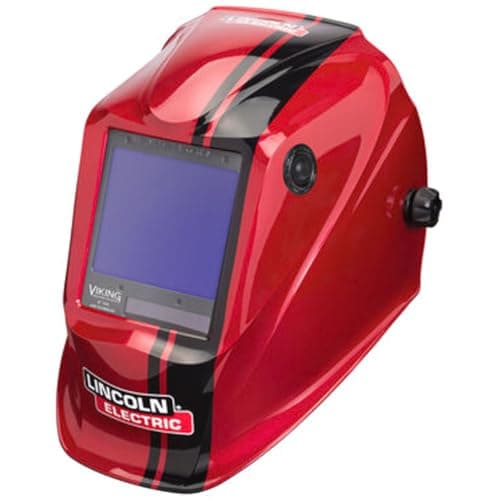 Lincoln Electric VIKING 335012.5 sq in at 1/1/1/1, shade 5–13 and an external grind button. The curve flattens here. | Best overall for the money | $556.55 · View on Amazon #ad How this is funded · Price as of November 13, 2026 |
| 2 | 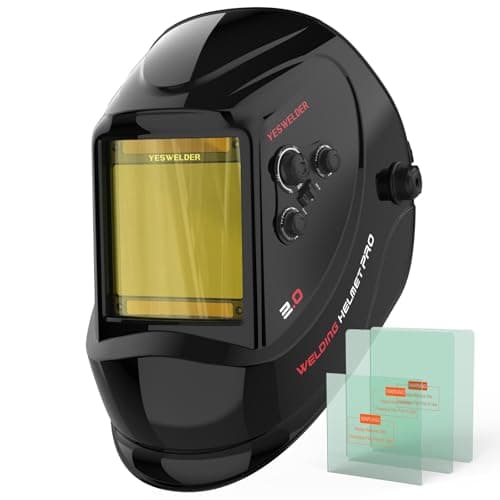 YESWELDER LYG-M800H large-view helmetPanoramic true-color lens at a fraction of a name-brand large-view helmet. | Best large view for the money | |
| 3 | 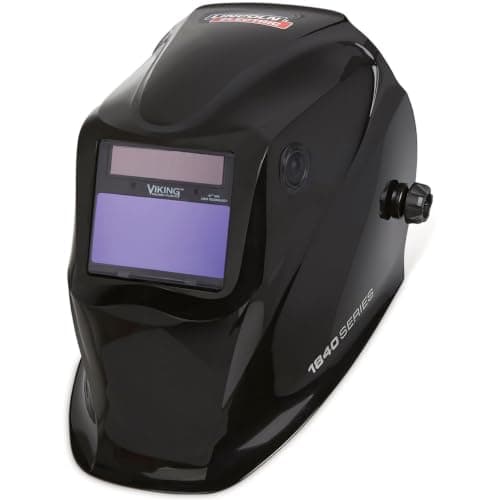 Lincoln Electric VIKING 1840A published 2 A DC TIG rating and full 1/1/1/1 clarity, at the bottom of the brand range. | Best optics per dollar | |
| 4 | 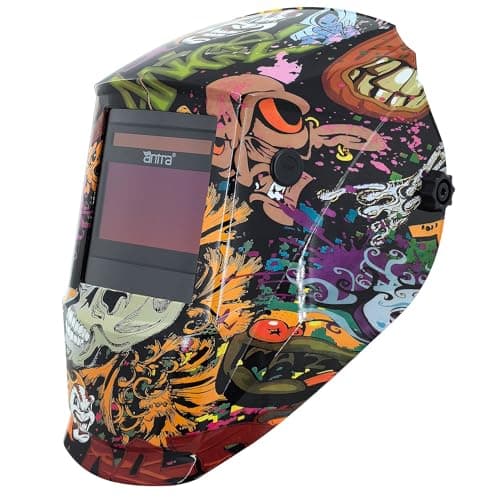 Antra DP3-6404A 2-amp trigger rating and ANSI Z87.1 at a price where neither is published at all. | Best for the least money | $69.95 · View on Amazon #ad How this is funded · Price as of November 13, 2026 |
Where the curve flattens
For most welders the best helmet for the money is the Lincoln Electric VIKING 3350 — 12.5 square inches of view at a full 1/1/1/1 optical rating, shade 5 to 13 and an external grind button. That combination is where every specification that matters is simultaneously good, and everything above it on price buys refinement rather than capability. Below it, the YESWELDER LYG-M800H buys the most viewing area per dollar and the Antra DP3-6404 is the cheapest helmet that still carries ANSI Z87.1 and a published 2-amp trigger rating.
| Lincoln VIKING 3350 | YESWELDER LYG-M800H | Lincoln VIKING 1840 | Antra DP3-6404 | |
|---|---|---|---|---|
| Viewing area | 12.5 sq in | Panoramic (not published as sq in) | 7.0 sq in | Not published |
| Optical class | 1/1/1/1 | Not consistently published | 1/1/1/1 | Not published |
| Shade range | Variable 5–13 | Variable, with grind mode | Variable 7–13 | 3/5–13 with shade lock |
| DC TIG rating | Not published as an amp figure | Not published | Down to 2 A | Down to 2 A |
| Sensors | Not published | Not published | Not published | 4 |
| External grind button | Yes | Light-state grind mode | Not on the base model | Shade 4 light state |
| Reaches shade 5 for plasma | Yes | Not published | No — starts at 7 | Yes |
The four things you are actually paying for
Helmet pricing looks arbitrary until you know which four specifications move it. Every one of them is worth money and only some of them are worth money to you.
Optical class. Published as four digits, each scored 1 to 3, lower being better: optical clarity, diffusion of light, luminous transmittance variation, and angle dependence. A 1/1/1/1 lens is the best available in all four. The practical difference is not sharpness in the first minute, it is eye fatigue in the second hour, and it is the specification cheap helmets most often simply do not publish.
Viewing area. Measured in square inches and ranging roughly from 7 to 13.4 among the helmets here. More window means less repositioning your head to see the joint, and the difference on long fabrication work is real rather than cosmetic.
Trigger sensitivity and sensor count. Sensors detect the arc and darken the lens. Four sensors rather than two matters when your hand or the workpiece blocks part of the lens, which happens constantly out of position. A published low-amperage DC TIG rating — 2 amps on the Lincoln VIKING 1840 — is the specification that decides whether the lens triggers at all on thin stainless.
Headgear. The least glamorous and the most underrated. A helmet that spreads its weight across the crown rather than hanging off the forehead is the difference between a tolerable two-hour session and a sore neck. It is also the part that fails first on cheap helmets.
Where the money stops buying capability
Above the VIKING 3350, the helmets on this site add refinement rather than capability, and saying so is the point of a value page.
The Miller Digital Infinity publishes 13.4 square inches — the largest here — plus X-Mode, which holds the lens dark through sensor blockage. That is a genuine solution to a genuine problem in out-of-position work. It is also rated to 5 amps DC TIG rather than the 2 amps of the much cheaper VIKING 1840, so it is not uniformly better.
The ESAB Sentinel A60 publishes 13.02 square inches at a full 1/1/1/1, a 2-amp DC TIG rating, 0.08 millisecond switching, half-shade increments with shade lock, and nine memory settings. It is an excellent helmet. Nine memory settings is also more configuration than a home shop running one or two processes will ever use.
If budget is not a constraint, both are easy to justify. The auto-darkening roundup covers them in their own right. On a value page they are the illustration of a curve that has flattened.
What genuinely does not matter
Graphics. A flame-painted shell is the same shell. It is worth saying because the market prices it as though it were not.
Very high headline switching speeds. Switching time matters, but the difference between the figures quoted at the top of the market is far below what your eye resolves. What matters more is whether the lens triggers at all at your lowest working amperage, which is a different specification.
Solar versus battery. Essentially every auto-darkening helmet worth buying uses a solar cell with a replaceable battery behind it. A helmet with a non-replaceable battery is the thing to avoid, and that is a different question from how it charges.
Buy the helmet before you buy the better machine
A good helmet on a modest welder produces better welds than a modest helmet on a good welder, because you cannot control a puddle you cannot see clearly. If the budget is split and something has to give, give on the machine. This is the single most reliable piece of value advice in the category.
Matching the helmet to your level
Level 1 and 2 — flux-core and MIG. Almost any ANSI Z87.1 auto-darkening helmet with four sensors is adequate, because MIG and flux-core arcs are bright and easy to detect. Spend on viewing area and headgear. Helmets for beginners goes through this.
Level 3 — TIG. The low-amperage trigger rating stops being optional. A published DC TIG rating down to 2 amps is what you are looking for, and it is the single specification worth paying for at this level. Helmets for TIG is the dedicated page.
Level 4 — plasma. The shade range has to reach shade 8, OSHA's minimum for plasma arc cutting under 300 amps. A helmet stopping at 9 in weld mode is awkward here. Helmets for plasma cutting covers which ones reach it, and the shade chart has the full table.
Narrower ways to choose, if value is not your only axis
Four pages split this field on one specification each. The best large view welding helmets ranks on published viewing area in square inches. The best welding helmets with grind mode ranks on whether the control is external rather than buried in a menu. Welding helmets under $500 is the band where a published optical class and a low-amperage TIG rating stop being a trade-off. And the VIKING 3350 review takes apart the helmet that keeps winning these comparisons, while 3M Speedglas alternatives is the page for anyone who arrived from a premium brand.
1. Best overall for the money
Lincoln Electric VIKING 3350
12.5 sq in at 1/1/1/1, shade 5–13 and an external grind button. The curve flattens here.
Lincoln publishes 12.5 square inches of viewing area, a variable shade 5 to 13, a 1/1/1/1 optical clarity rating, the 4C lens with X6 headgear, and a low-profile external grind button.
This is the helmet most welders end up with, and the reason is that it is where every specification that matters is simultaneously good. A full 1/1/1/1 optical rating — the best score available in all four categories — with a genuinely large window, on headgear designed to spread the weight rather than hang it off your forehead.
The external grind button is the feature you notice most every day. Switching between welding and grinding without lifting the hood sounds minor on a spec sheet and is the single biggest difference to how a session feels.
Shade 5 at the low end also means one helmet spans all four levels, including plasma cutting, which a helmet stopping at shade 9 cannot do.
It costs several times a budget helmet, and it is physically large — in a tight corner the shell finds things to bump into.
What works
- 12.5 sq in of view at 1/1/1/1 clarity is the combination that makes a helmet stop being something you tolerate
- The external grind button means you switch modes without lifting the hood — the single feature you notice most every day
- Shade 5 low end covers plasma cutting, so one helmet spans all four levels
What does not
- Costs several times a budget auto-darkening helmet
- Physically large, and in a tight corner the shell finds things to bump into
2. Best large view for the money
YESWELDER LYG-M800H large-view helmet
Panoramic true-color lens at a fraction of a name-brand large-view helmet.
YESWELDER publishes a true-color panoramic lens, a variable shade range with a light-state grind mode, and solar power with a replaceable battery.
If viewing area is the specification you care about most — and for a lot of people it genuinely is — this delivers the most of it per dollar by a wide margin. A true-color lens on top of that makes the weld pool and its edges much easier to read than the green cast of a conventional lens.
The deep shell is a real secondary benefit: it accommodates most prescription glasses without pressure on the temples, which is otherwise an expensive problem to solve. Helmets for glasses wearers covers that properly.
The honest caveat: published optical-class figures are inconsistent between listings for this helmet. Treat unstated clarity as unverified rather than assuming it matches a helmet that publishes 1/1/1/1. Headgear adjustment is also coarse next to the X6 or Halo systems.
What works
- Panoramic view at a fraction of a name-brand large-view helmet's price
- True-color lens makes the puddle and the weld pool edge much easier to read than a green lens
- Deep shell accommodates most prescription glasses without pressure on the temples
What does not
- Published optical-class figures are inconsistent between listings — treat unstated clarity as unverified
- Headgear adjustment is coarse compared with the X6 or Halo systems
3. Best optics per dollar
Lincoln Electric VIKING 1840
A published 2 A DC TIG rating and full 1/1/1/1 clarity, at the bottom of the brand range.
Lincoln publishes 7.0 square inches of viewing area, a variable shade 7 to 13, a 1/1/1/1 optical class, a DC TIG rating down to 2 amps, the 4C lens, and 4-point pivot headgear with a padded headband.
Two of those figures are the ones premium helmets charge for. A 2-amp DC TIG rating is the same number ESAB publishes on a helmet costing several times more, and it is the specification that decides whether a lens triggers reliably on a low-current arc on thin stainless. Full 1/1/1/1 clarity is something budget helmets almost never publish at all.
Getting both at the bottom of Lincoln's range is the best optics-per-dollar position on this page.
What you give up is window size and convenience. Seven square inches is noticeably tighter than the 12.5 to 13.4 above it, the shade range starts at 7 so it does not reach the shade 5 end for plasma, and the base model has no external grind button.
What works
- A published 2 A DC TIG rating — the same figure as helmets costing several times more
- Full 1/1/1/1 optical clarity, which budget helmets almost never publish at all
- 4-point pivot headgear with two top straps spreads weight properly for long seated TIG sessions
What does not
- 7.0 sq in is a small window — noticeably tighter than the 12.5 to 13.4 sq in helmets above it
- Shade range starts at 7, so it does not reach the shade 5 end that plasma cutting wants
- DIN 2.5 light state rather than the 3 or 4 of the helmets above it, so the view between welds is darker
4. Best for the least money
Antra DP3-6404
A 2-amp trigger rating and ANSI Z87.1 at a price where neither is published at all.
Antra publishes a true-colour lens with a 3/5 to 13 shade range and shade lock, a DC TIG rating down to 2 amps, tack, weld and cut memory presets, a quick grind button, ANSI Z87.1 certification, and solar power with battery backup.
The reason this belongs on a value page rather than only a budget one is the ANSI Z87.1 rating. That standard is the line between eye protection and a novelty, and plenty of very cheap helmets do not carry it. A published 2-amp trigger rating at this price is also unusual — most helmets here publish no trigger figure at all, which leaves you finding out on a live arc.
Buying here and upgrading in a year genuinely costs less than agonizing over the decision, and you will know far more about what you want by then.
What works
- A published 2 A TIG rating at the bottom of the market, where the usual answer is no rating at all
- Shade 5 low end covers plasma cutting, so one cheap helmet spans more than MIG
- Quick grind/weld button and shade lock — two things that are normally the first upgrade
- Cheap enough that starting here and upgrading later costs less than agonizing over it
What does not
- Antra does not publish a 1/1/1/1 optical class for it, and over a long session you can feel the difference
- Headgear is the weak point on budget helmets generally, and this one is no exception
- A small shell: next to a VIKING 3350 the view is noticeably tighter
Who this is wrong for: Anyone who wants a published optical class. Antra does not state one for this lens, and over a long session clarity is what you feel; the headgear is also the part owners most often report replacing.
Questions people actually ask
What is the best welding helmet for the money?
For most welders, the Lincoln Electric VIKING 3350 — 12.5 square inches of view at a full 1/1/1/1 optical rating, shade 5 to 13, and an external grind button. That is the point where every specification that matters is simultaneously good.
Above it, helmets add refinement rather than capability. Below it, you start giving up either optical class or viewing area.
How much should I spend on a welding helmet?
Enough to get an ANSI Z87.1 rating and four sensors at minimum, which is available very cheaply. The step that buys the most is moving to a helmet that publishes a 1/1/1/1 optical class and a viewing area over about 12 square inches.
Beyond that the curve flattens quickly, and the next useful spend is on the machine or the gas setup rather than the hood.
What does 1/1/1/1 mean on a welding helmet?
It is the optical class, four scores from 1 to 3 with lower being better: optical clarity, diffusion of light, luminous transmittance variation, and angle dependence. 1/1/1/1 is the best available in all four.
The practical difference is eye fatigue over a long session rather than sharpness in the first minute. Cheap helmets usually do not publish the figure at all, which should be read as unverified rather than assumed good.
Is an expensive welding helmet worth it?
Up to a point, clearly yes — optical class, viewing area, sensor count and headgear all cost money and all affect how well you weld. Past that point you are buying refinement: memory settings, half-shade increments, marginally larger windows.
A useful test is whether a feature solves a problem you have actually had. X-Mode, which holds the lens dark through sensor blockage, is worth real money if you weld out of position and nothing if you do not.
Can one helmet cover welding and plasma cutting?
Yes, if its shade range reaches shade 8 — OSHA's minimum protective shade for plasma arc cutting under 300 amps, which covers all home plasma work.
A helmet with a variable range starting at 5 covers both comfortably. One that only goes down to 9 in weld mode does not, and that is the specification to check before buying rather than after.
Sources
- Lincoln Electric — VIKING 3350 and VIKING 1840 published specifications
- YESWELDER — LYG-M800H published product information
- Antra — DP3-6404 published specifications: 3/5–13 shade range, 2 A DC TIG rating, ANSI Z87.1
- OSHA — Arc welding and cutting standard (29 CFR 1910.254), protective shade numbers
- ANSI/ISEA Z87.1 — occupational and educational eye and face protection devices
Read next
- The best welding helmets for beginners
The purchase that improves a beginner's welds fastest, and where spending more stops helping.
- The best auto-darkening welding helmets
Viewing area, optical clarity and low-amperage triggering, compared across four helmets.
- The best welding helmets at the entry end of the market
What an entry-level helmet compromises, and the two specifications to insist on regardless.
- The best welding helmets for plasma cutting
Plasma needs shade 8, not 10, plus a lens that triggers on an arc partly hidden in the kerf.
- Welding helmet shade chart
OSHA's minimum protective shades by process and arc current, and how to use them in practice.
- Helmets and PPE: the gear that decides what you can see
Every level needs a helmet. What the right helmet is changes as the level changes — and a bad one is the most common reason a beginner's welds look worse than their technique.
Back to Helmets & PPE, or start over at Find Your Level.
Ryder M.
Ryder M. is the hands-on owner behind Magoo Media Group. He writes Arc & Bead's buying guides and picks every machine on the site. What every recommendation is based on — and what it is not based on — is set out on How We Pick.