The best welding gloves for beginners
Every welding glove is a trade between heat protection and feel, and almost every beginner buys the wrong end of it. Here is which pair for which process, and the one pair not to start with.
Arc & Bead is an Amazon Associate. If you buy through a link on this page we may earn a commission, at no extra cost to you. We have not physically tested the machines on this page and we say so on How We Pick.
Quick picks
Tap any row to jump to the full write-up further down this page.
| # | Product | Best for | Price |
|---|---|---|---|
| 1 | 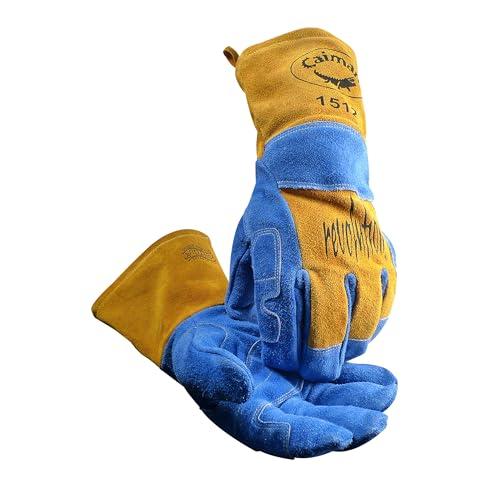 Caiman 1512 split cowhide MIG/stick glovesThe only glove here with a standards-based heat rating you can actually check, in the thickness a beginner should be welding in. | Best first pair | $28.99 · View on Amazon #ad How this is funded · Price as of November 13, 2026 |
| 2 | 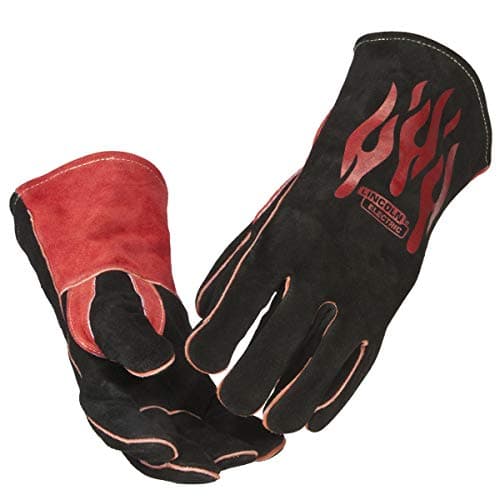 Lincoln Electric traditional MIG/stick welding glovesA 14-inch glove with a cotton-lined interior and a twill cuff — the length is the feature, and overhead is where you find out why. | Best for stick and overhead work | |
| 3 | 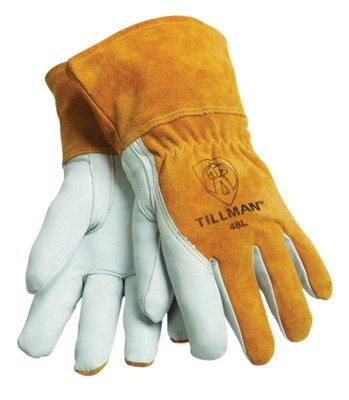 Tillman 48 top-grain goatskin MIG glovesTop-grain goatskin, fleece lined, 3-1/2 inch cuff. The thinnest glove here that is still honestly a MIG glove. | Best for gun control | |
| 4 | 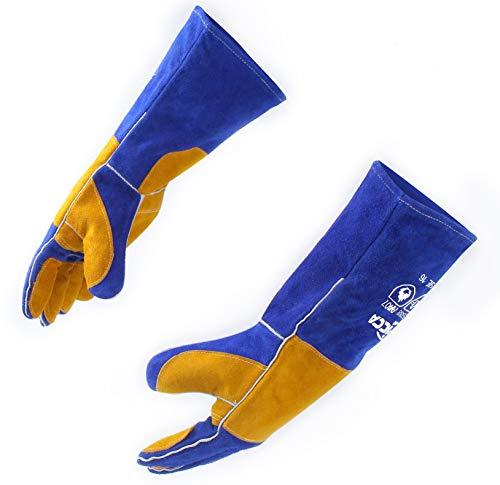 RAPICCA 16-inch welding glovesSixteen inches with a 7.5 inch sleeve and a foil insulating layer — the cheapest honest way to cover the arm flux-core spatter actually reaches. | Best forearm coverage | |
| 5 | 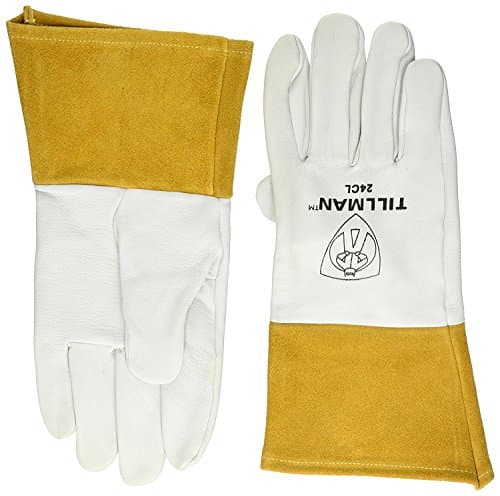 Tillman 24C TIG glovesThe reference TIG glove, and the single most common wrong first purchase. Buy these second, not first. | Best for when you reach TIG | $22.75 · View on Amazon #ad How this is funded · Price as of November 13, 2026 |
The short answer
For a first pair, buy a thick MIG/stick glove, not a TIG glove. The Caiman 1512 is the pick because it is the only glove here that publishes a standards-based heat rating — ANSI contact heat level 3 under ASTM F1060-18 — in the thickness a beginner should be welding in. The Lincoln K2979-ALL is the one to take for stick and overhead work because it is 14 in long; the Tillman 48 goatskin is the pick if gun control is your problem; the RAPICCA 16-inch covers the forearm that flux-core spatter actually reaches; and the Tillman 24C is the TIG glove to buy second, never first.
Welding gloves look like the easy purchase on the list and they are the one most beginners get backwards. The mistake is nearly always the same: buying the thin, pale, expensive- looking gloves, because those are the gloves in every TIG photograph, and then using them on a flux-core machine that throws spatter and runs the workpiece hot.
There is no single best welding glove, because a glove is a fixed trade between two things that cannot both go up. Thicker leather stops more heat and lets you feel less. Thinner leather lets you feel more and stops less. Every glove below sits somewhere on that line, and the right one depends entirely on which process you are about to run — which is why this site is organized by level in the first place.
What we ranked on, in order
1. Published heat protection, and whether the figure means anything. One glove on this page publishes a standards-based result: ANSI contact heat level 3, tested to ASTM F1060-18. One publishes a brand figure in degrees Fahrenheit with no standard attached. Three publish no heat figure at all and describe the leather instead. We rank the first kind above the second and we do not pretend the second and third are comparable.
2. Leather type, because it is the real spec. In the absence of test figures, the leather is the information. Split cowhide is thick, cheap and heat-tolerant; top-grain goatskin is thinner, more supple and more dexterous; kidskin is thinnest of all and is a TIG material. A listing that only says "leather" is telling you less than it looks like it is.
3. Length, which nobody thinks about until the first overhead weld. The standard glove ends at the wrist. Spatter does not oblige by falling straight down, so weld at chest height and it lands on your forearm. A 14 in glove covers it; a 16 in gauntlet covers it and gets in the way; a 3-1/2 in cuff needs a jacket with it.
4. Lining and seam construction. A lining is insulation and it is also what stops the glove abrading your hand. Kevlar stitching matters because the seams are the part that fails first: cotton thread exposed to spatter burns through and the glove opens up along a finger while the leather around it is still fine.
5. Feel, judged against the process it is for. A glove that scores well on the first four and lets you feel nothing is not a good MIG glove. We weighted dexterity by what the glove is for, which is why a goatskin MIG glove and a kidskin TIG glove are both on this page and are not in competition with each other.
One pair of gloves does not cover every process.
This is the practical conclusion of the whole page. A MIG/stick glove is unusable for TIG and a TIG glove is unsafe for stick, so a welder who runs both ends up owning both — and the order matters. Buy the thick pair first, because that is the process you are starting with. The welding starter kit checklist puts that purchase in order against everything else you need on day one.
Leather types, and what each one is actually for
| Leather | Character | Right for | Wrong for |
|---|---|---|---|
| Split cowhide | Thick, stiff, heat-tolerant, inexpensive | Stick, flux-core, heavy MIG, handling hot stock | TIG, fine fit-up, anything needing fingertip feel |
| Top-grain cowhide | Thinner and smoother than split, more durable surface | MIG and general shop work | TIG |
| Top-grain goatskin | Supple and dexterous while still rated for welding | MIG, light flux-core, grinding, fit-up | Stick, sustained heat, holding hot parts |
| Kidskin | Thinnest welding leather, almost no insulation unlined | TIG only | MIG, flux-core and especially stick |
| Leather with a foil or reflective layer | Adds radiant-heat insulation at the cost of bulk | Long-sleeve forearm protection, forge and furnace work | Bench work, TIG, anything needing a slim cuff |
Read that table as a ladder rather than a ranking. You start at the top, because flux-core and MIG are where you start, and you move down it as the work gets finer. Someone welding a trailer frame and someone welding 0.040 in stainless need different gloves for the same reason they need different machines.
How to read a heat rating without being sold to
Glove listings are full of numbers in degrees Fahrenheit, and most of them mean less than they look like they do. There are three kinds of claim and they are not interchangeable.
A standards-based rating names the test. ANSI contact heat level 3 under ASTM F1060-18 at 392 degrees F, as the Caiman publishes, means a sample of that glove was held against a hot surface at a stated temperature for a stated time before the inside reached a pain threshold. It is comparable across brands because the test is the same.
A brand figure is a number with no test attached — "heat resistant to 932 degrees F", as the RAPICCA publishes. It is not a lie and it is not nothing: it tells you what the maker intends the glove for. What it does not tell you is how long the glove holds out at that temperature, which is the only part that matters when you are holding something.
A material description is the most common and, oddly, often the most useful. "Split cowhide, wool lined" or "unlined kidskin" tells an experienced welder exactly what the glove will do. That is why the table above exists, and why three of the five gloves here are ranked on their leather rather than on a number.
What none of them tell you is fit, which is the thing that decides whether you wear them. Gloves that are too big catch on the work and cost you more control than thick leather does; gloves that are too small stop your hand closing. Welding gloves are normally sold in S/M/L/XL with little consistency between brands, so size to the brand rather than to your usual glove size, and expect a new pair to be stiff for the first few hours.
What gloves do not do
Gloves are the most visible piece of welding PPE and the least important one. They protect your hands from spatter and conducted heat, and that is the whole list. They do nothing about the two things that actually injure home welders.
The first is your eyes, and the answer there is a helmet with a lens you can see the puddle through — the best welding helmets for beginners is scoped to that purchase, and the shade chart is the number to set it to. The second is what you are breathing. Self-shielded flux-core produces a great deal more fume than gas MIG, and gloves are irrelevant to it — see welding respiratory protection.
The arms and body in between are a jacket's job, and the cheap version of a jacket is a long-sleeved cotton shirt, never a synthetic one. Welding gloves and jackets covers which combination for which process. And the tool that follows the gloves in every beginner's shop is a grinder, because fit-up and cleanup are most of welding: the best angle grinders for welding is that purchase.
How we decided this
Published figures only. Every spec line on this page is the manufacturer's own published description or specification as carried on its product or retailer listing, read on the publication date. Where a measurement in a listing could not be separated from a packaging dimension, we left it out rather than print it. We have not worn any of these gloves, we have not heated any of them, and we do not publish scores.
We did not line up incomparable numbers. The obvious way to write this page would have been a table of temperature ratings, sorted. That table would have been misleading, because only one of these gloves publishes a tested figure. Separating the standards-based rating from the brand claims is the most useful thing on the page.
Availability checked before publishing. All five pairs were confirmed purchasable and title-matched to their registry entries on the publication date. A product we cannot confirm is currently on sale does not get recommended here.
Honest cons on every pick, including the winner. Two of the five carry an explicit "wrong for" note, and one of them — the TIG glove — is on the page mostly to tell you not to buy it first. More on the method on how we pick.
The whole band, not just a first pair
This page is scoped to a first purchase, which is why it tells you not to buy the thin TIG glove yet. If you want the band rather than the beginner answer, the best welding gloves under $50 covers the entire useful range of welding gloves at current prices, including when the TIG pair becomes the right second purchase.
1. Best first pair
Caiman 1512 split cowhide MIG/stick gloves
The only glove here with a standards-based heat rating you can actually check, in the thickness a beginner should be welding in.
Caiman publishes this glove as premium split cowhide with a wool lining, Kevlar seam stitching, a Kontour pre-curved finger pattern, and — the part that makes it the pick — ANSI contact heat level 3 under ASTM F1060-18 at 392 degrees F. That last line is a test result against a published standard. Nothing else on this page has one.
For a first pair that matters more than it sounds. A beginner is welding at settings that are slightly wrong, holding the gun slightly too close and resting a hand somewhere it should not be, and the glove is what absorbs all three mistakes. Split cowhide with a wool liner is the combination that stops conducted heat rather than just radiant heat, which is the difference between steadying work on a plate you welded two minutes ago and dropping it.
The pre-curved pattern is the second reason it wins. A flat-cut glove has to be forced into the shape of a closed hand, and that resistance is exactly what makes people grip a MIG gun too hard. A glove already shaped like a hand holding something means your grip pressure is yours rather than the leather's, and gun pressure is most of what a bead looks like. If you are still learning that, the technique side is in how to weld for the first time.
What it costs you: thickness. Split cowhide plus wool is the warmest and least sensitive combination here, so it is the wrong glove for TIG and it will be hot in a summer garage. The warranty is 30 days against defects, which is honest — welding gloves are consumables and a pair you use weekly will not last a year.
What works
- Caiman publishes an actual tested heat figure — ANSI contact heat level 3 under ASTM F1060-18 — which almost nothing else in this price band does
- Wool lining insulates better than cotton at the same thickness, which is why it is in gloves intended for stick work
- The pre-curved pattern means the glove is already the shape of a closed hand, so holding a gun does not fight the leather
What does not
- Split cowhide plus a wool liner is thick. Fine for MIG and stick, hopeless for feeding TIG filler
- Wool is the warmest liner here and the slowest to dry out if it gets wet
- A 30-day warranty is a warranty against defects, not against wear — these are consumables
2. Best for stick and overhead work
Lincoln Electric traditional MIG/stick welding gloves
A 14-inch glove with a cotton-lined interior and a twill cuff — the length is the feature, and overhead is where you find out why.
Lincoln publishes the K2979-ALL as a 14 in glove in high-grade leather with a soft cotton hand liner, a fully lined interior, Kevlar stitching with leather-reinforced stress points, a straight thumb and a twill cotton cuff lining that absorbs moisture in use. It is specified for stick, MIG and flux-core.
Fourteen inches is the number to pay attention to. A standard welding glove ends just past the wrist, and every beginner discovers the same thing in the same way: spatter does not fall straight down. Weld anything at chest height or above and it arrives on the forearm, and the gap between a short cuff and a rolled-up sleeve is where it lands. A 14 in glove closes that gap without the bulk of a 16 in gauntlet.
The straight thumb is a quieter advantage. A wing thumb — angled out from the hand — is more comfortable standing still, and worse the moment you need to pinch something or hold a rod. Straight thumbs are what stick welders buy, because stick is a process of constant small adjustments with a consumable electrode that gets shorter as you go.
The cost is feel. These are thick, they are stiff until broken in, and the cotton liner makes them warm. They are also genuinely wrong for TIG, which the listing does not claim and neither do we. If stick is where you are heading, the best stick welders for home use is the machine side of the same decision.
What works
- Thick enough that you can rest a hand near the work without flinching, which improves your gun control more than any setting
- Long cuff protects the wrist gap where spatter finds you
What does not
- Far too thick for TIG — you cannot feel a filler rod through them
- Stiff until broken in
3. Best for gun control
Tillman 48 top-grain goatskin MIG gloves
Top-grain goatskin, fleece lined, 3-1/2 inch cuff. The thinnest glove here that is still honestly a MIG glove.
Tillman publishes the 48 as top-grain goatskin with a fleece lining, Kevlar stitching, a 3-1/2 in cuff, a straight thumb and an elastic back, intended for MIG welding, cutting, grinding and general metalwork. It is the glove most welding supply counters hand you when you ask for a MIG glove, and the sizing is predictable because of it.
Goatskin is the point. It is the most dexterous leather used in a welding glove that is still rated for welding — thinner and more supple than cowhide at the same protection class — which means you can feel the gun rather than operate it through a mitten. Anyone who has struggled to hold a steady 3/8 in stickout on a wire feeder will notice the difference inside one bead.
The elastic back and straight thumb are what keep the glove on your hand instead of rotating around it. That sounds like a comfort note and is actually a control note: a glove that twists means your hand is gripping to stop it twisting, and a gripping hand does not travel smoothly. The settings that go with that travel speed are in the MIG settings chart.
Where it stops: a 3-1/2 in cuff protects the wrist and nothing beyond it, so overhead work needs a sleeve or a jacket with it. Goatskin is thinner than cowhide, which makes it the wrong choice for stick welding or for handling hot stock. And the fleece lining is warm — a real cost in July, when the glove you reach for is the one you can stand to wear.
What works
- Top-grain goatskin is the most dexterous leather used in a MIG glove, so you can feel the gun rather than wrestle it
- Straight thumb and an elastic back keep the glove on your hand instead of twisting round it on a long bead
- The reference MIG glove in most welding supply houses, which means the sizing is predictable and replacements are easy to find
What does not
- A 3-1/2 in cuff is short. It protects the wrist and no more, so overhead work needs a sleeve or a jacket
- Fleece lining is warm — a real cost in a summer garage
- Goatskin is thinner than cowhide, so it is the wrong glove for stick welding or for resting a hand on hot steel
Who this is wrong for: Stick welding, and anything where you will be holding or steadying hot metal. Goatskin trades heat capacity for feel, and stick spends its whole day at the heat end.
4. Best forearm coverage
RAPICCA 16-inch welding gloves
Sixteen inches with a 7.5 inch sleeve and a foil insulating layer — the cheapest honest way to cover the arm flux-core spatter actually reaches.
RAPICCA publishes this as a leather outer over an insulating aluminum-foil middle layer and a flame-retardant cotton liner, 16 in overall including a 7.5 in sleeve, Kevlar stitched, with double leather padding at the fingers, palm, back and elbow, and rated by the brand to 932 degrees F (500 degrees C). It is specified for stick, MIG and flux-core.
The reason it is on this page is self-shielded flux-core, which is where most people on this site start. Flux-core throws noticeably more spatter than gas MIG, it throws it further, and a beginner running slightly hot throws more still. A 16 in glove with a reinforced sleeve puts leather where that spatter lands, and it does it for less than a jacket costs.
The foil layer is the construction detail that makes the sleeve useful rather than decorative. Radiant heat off a hot workpiece is what makes a long sleeve uncomfortable, and a reflective layer under the leather is the standard answer to it. That is why these turn up in forges and foundries as often as in weld shops.
Two honest caveats. First, the 932 degrees F figure is the brand's own published rating with no standard attached — it is not comparable to the Caiman's ANSI contact heat level 3, and we are not going to put the two numbers in the same column as though it were. Second, it is bulky: a long reinforced sleeve is in the way on a bench and impossible for TIG. The ventilation and fume side of flux-core is in flux-core welding safety, which matters more than the gloves do.
What works
- A 16 in glove covers the forearm, which is exactly where self-shielded flux-core spatter arrives when you are welding anything above waist height
- The foil-and-cotton sandwich is why the sleeve stays comfortable near a hot workpiece rather than just near an arc
- Cheapest honest way to cover the gap between a short glove and a jacket sleeve
What does not
- The 932 degrees F figure is the brand's own published rating, not an ANSI or ASTM contact-heat level — it is not directly comparable to the Caiman's level 3
- Bulky. A long reinforced sleeve is in the way for bench work and impossible for TIG
- Marketed for fire pits, ovens and barbecue as much as for welding, so judge it on the construction rather than on the listing
5. Best for when you reach TIG
Tillman 24C TIG gloves
The reference TIG glove, and the single most common wrong first purchase. Buy these second, not first.
Tillman's 24C is kidskin, unlined, and intended for TIG. It is the glove other TIG gloves get compared against, because TIG technique is feeding filler rod by feel and kidskin is thin enough to let you do it. If you are TIG welding, this is the answer and there is not much argument about it.
It is on a beginners' page for the opposite reason. These are regularly the first welding gloves people buy, because they are the gloves you see in TIG photographs and because thin gloves feel more skilled. On a MIG or flux-core machine they are close to useless and genuinely unsafe for stick: there is almost no heat capacity in unlined kidskin, so you feel the work through them in the way you were trying to avoid.
The right way to own them is as a second pair, bought the week you start TIG welding and kept away from the MIG gun. Thin leather also wears through at the fingertips within a year of regular use, which is normal for the type and not a defect.
If TIG is where you are heading rather than where you are, the best TIG welders for beginners is the machine decision and welding helmets for TIG is the other piece of kit that changes at that point.
What works
- Thin enough to feed filler rod by feel, which is most of TIG technique
- The reference TIG glove that other TIG gloves are compared against
What does not
- Almost no heat protection. They are wrong for MIG and dangerous for stick
- Thin leather wears through at the fingertips within a year of regular use
Who this is wrong for: MIG, flux-core and especially stick. An unlined kidskin glove has almost no heat capacity, and finding that out with a hot electrode holder in your hand is a bad way to learn it.
Questions people actually ask
What kind of welding gloves should a beginner buy?
A thick MIG/stick glove in split cowhide or top-grain goatskin, not a TIG glove. Beginners almost always start on flux-core or MIG, and both throw spatter and leave the workpiece hot - which is the job thick leather does and thin leather does not.
Look for Kevlar stitching, a lined interior and a cuff of at least a few inches. Buy the thin kidskin TIG gloves later, when you actually start TIG welding.
Are expensive welding gloves worth it?
Up to a point. The difference between the cheapest gloves on a shelf and a mid-priced pair from a welding brand is real: Kevlar stitching instead of cotton thread, a lined interior, and leather reinforcement at the stress points. Those are the things that decide whether the glove survives a season.
Above that, you are mostly paying for specialization - a pattern cut for TIG, a wool liner, a published heat rating. Those are worth buying when you know which process you are buying for.
Can I use TIG gloves for MIG welding?
You can, briefly, and you should not. A TIG glove is thin unlined kidskin designed to let you feel a filler rod, which means it has very little heat capacity. On MIG and flux-core it transmits spatter heat straight to your hand, and for stick welding it is genuinely unsafe.
The reverse is equally true: a thick MIG glove makes TIG almost impossible, because you cannot feel the rod. Welders who run both processes own both gloves.
How long should welding glove cuffs be?
Long enough to cover the gap between the glove and your sleeve, which depends on what you are welding. For bench work at waist height a standard wrist-length glove is fine. For anything at chest height or above, spatter arrives on the forearm and a 14 inch glove is the shortest that covers it.
A 16 inch gauntlet covers more and is more awkward for fine work. If you are welding overhead regularly, the real answer is a glove plus a leather sleeve or a jacket.
What does ANSI contact heat level 3 mean on a welding glove?
It means a sample of that glove was tested under ASTM F1060-18 against a hot surface at a stated temperature - 392 degrees F for level 3 - and the inside of the glove took a defined minimum time to reach a pain threshold.
It is useful because the test is the same across brands, so two gloves with the rating are genuinely comparable. A listing that quotes a temperature with no standard named is making a different and much weaker claim.
Do welding gloves wear out?
Yes, and faster than most people expect. Gloves are consumables: the seams take spatter, the fingertips abrade on the work, and the palm stiffens as the leather cooks. A pair used weekly is usually done inside a year, and thin TIG gloves go sooner.
Replace them when a seam opens or the leather goes hard and shiny at the fingertips. A glove with a burned-through seam is a glove with a hole in exactly the wrong place.
Should welding gloves be tight or loose?
Snug on the hand and loose at the cuff. A glove that is too big catches on the work and makes a MIG gun hard to hold steady, which costs you more control than thick leather does. One that is too small stops your hand closing fully and pulls the lining out of position.
Sizing is inconsistent between brands, so size to the brand rather than to your usual work-glove size, and expect a new pair to be stiff for the first few hours of use.
Sources
- Caiman - 1512 Premium Split Cowhide MIG/Stick Welding Gloves published specifications: premium split cowhide, wool lining, Kevlar stitching, Kontour finger alignment, ANSI contact heat level 3 (ASTM F1060-18, 392 degrees F), 30-day limited warranty; published on its Amazon product listing, ASIN B07T2PN838 (checked 2026-11-05)
- Lincoln Electric - K2979-ALL Traditional MIG/Stick Welding Gloves published specifications: 14 in lined leather, high-grade leather exterior with soft cotton hand liner and fully lined interior, Kevlar threading, leather-reinforced stress points, straight thumb, twill cotton cuff lining, recommended for stick (SMAW), MIG (GMAW) and flux-core (FCAW); published on its Amazon product listing, ASIN B00547HD0O (checked 2026-11-05)
- Tillman - 48L top-grain goatskin MIG welders gloves published specifications: top-grain goatskin, fleece lined, Kevlar stitching, straight thumb, 3-1/2 in cuff, elastic back, specified for MIG welding, cutting, grinding and general metalworking; published on its Amazon product listing, ASIN B0195UGKFO (checked 2026-11-05)
- RAPICCA - 16-inch welding gloves published specifications: fireproof leather exterior, insulating aluminum-foil middle layer, flame-retardant cotton liner, double leather reinforcement at fingers, palms, elbows and backs, Kevlar stitching, 16 in overall with 7.5 in sleeves, brand-published heat resistance to 932 degrees F (500 degrees C), specified for stick (SMAW), MIG (GMAW) and flux-core (FCAW); published on its Amazon product listing, ASIN B01N1VJDIQ (checked 2026-11-05)
- Tillman - 24C/24CL TIG welding gloves published description: kidskin leather, unlined, Kevlar and leather construction, welding application TIG; published on its Amazon product listing, ASIN B008BJ2KA0 (checked 2026-11-05)
- ASTM F1060-18, Standard Test Method for Thermal Protective Performance of Materials for Protective Clothing for Hot Surface Contact - the test referenced by the ANSI contact heat level quoted on the Caiman listing
Read next
- Welding gloves and jackets
Why MIG gloves and TIG gloves are opposite tools, and when a leather jacket stops being optional.
- The welding starter kit checklist
Everything that is not the welder, ordered by how much each item changes your results.
- The best welding helmets for beginners
The purchase that improves a beginner's welds fastest, and where spending more stops helping.
- Flux-core welding safety
Fume, eyes and fire — including the risks that show up hours after you stop welding.
- The best angle grinders for welding
Four 4-1/2 inch grinders ranked on kickback protection, dust sealing and tool-free changes rather than on raw amperage, scoped to welding work.
- How to weld for the first time
A first-session walkthrough in order: setup, scrap, posture, your first bead, and what to look at afterwards.
Back to Helmets & PPE, or start over at Find Your Level.
Ryder M.
Ryder M. is the hands-on owner behind Magoo Media Group. He writes Arc & Bead's buying guides and picks every machine on the site. What every recommendation is based on — and what it is not based on — is set out on How We Pick.