Eastwood TIG 220 vs AHP AlphaTIG 200X
Almost everyone who decides they want AC/DC TIG at home ends up with two machines in a browser tab. The difference between these two is smaller than the price gap and more specific than the spec sheets suggest.
Arc & Bead is an Amazon Associate. If you buy through a link on this page we may earn a commission, at no extra cost to you. We have not physically tested the machines on this page and we say so on How We Pick.
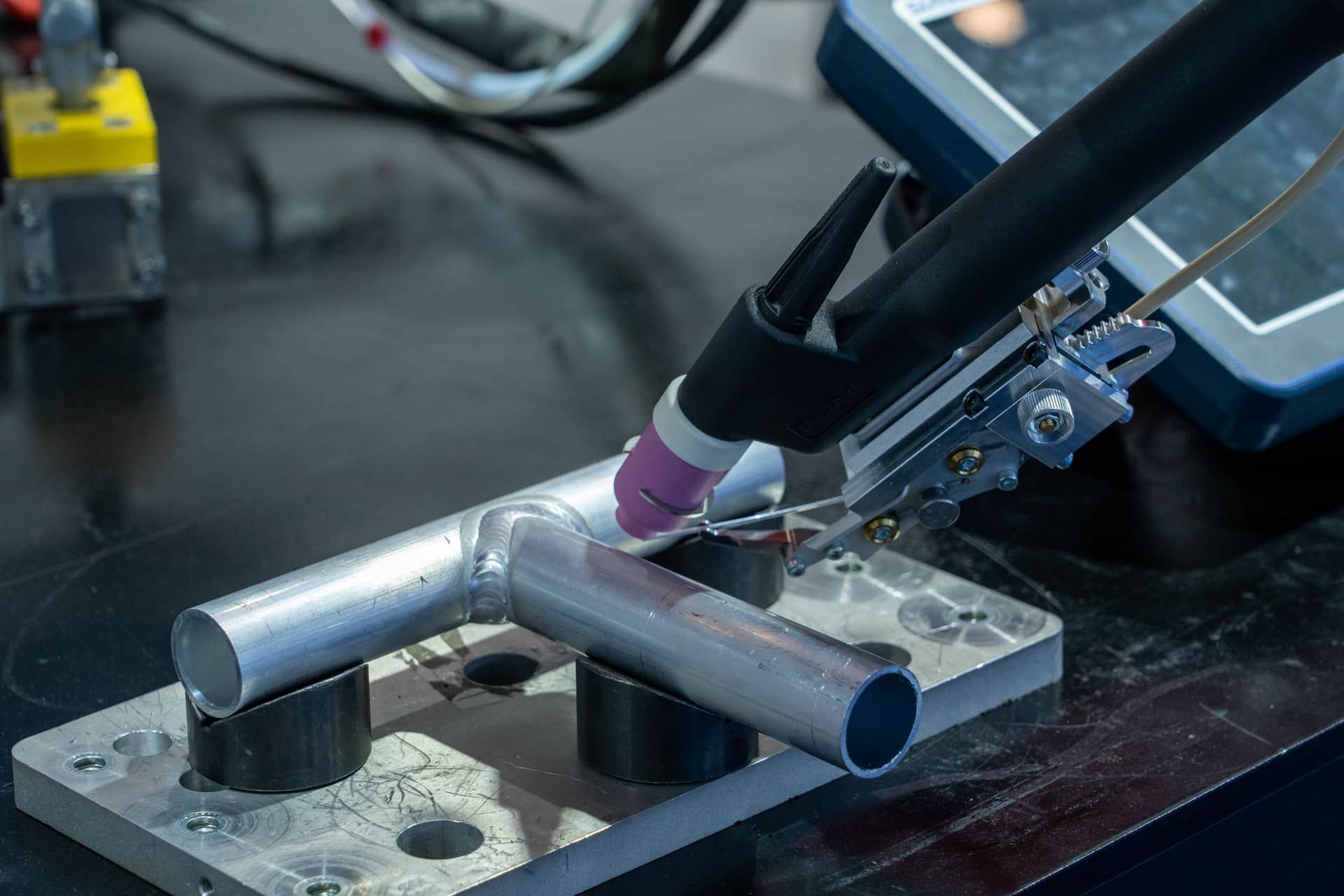
The PrimeWeld TIG225X is no longer buyable here
This page used to compare the PrimeWeld TIG225X with the AlphaTIG. As of October 2026 the TIG225X has no live Amazon listing — the product page reads "currently unavailable" with no offer behind it, and PrimeWeld's live Amazon range contains the MIG180, the plasma/TIG combo machines and accessories but no AC/DC TIG machine at all. PrimeWeld still sells it direct, so it is not discontinued everywhere; we just will not point a buy button at a listing you cannot buy from.
The machine in that slot now is the Eastwood TIG 220 AC/DC, which sits in the same price band and ships the same kind of complete kit. Every figure below is Eastwood's own; nothing was carried over from the PrimeWeld.
The short answer
Buy the Eastwood TIG 220 AC/DC if you can afford it: more output (220 A against 200 A), a published 120 V figure (140 A of TIG, which AHP does not state), and the flex torch, gas-lens kit, foot pedal and argon regulator included rather than bought later. Buy the AHP AlphaTIG 200X if the saving is what gets you into an AC machine at all — it publishes the higher duty cycle (60% at 200 A against 40% at maximum) and welds the same metals.
Both machines do the thing that actually matters at this level: they produce alternating current, which is the only way to break up the oxide layer on aluminum. AC versus DC TIG sets out why that is the permanent decision and everything on this page is a detail by comparison. If you are weighing either of these against a DC-only machine, read that first and come back.
What the two machines publish, side by side
| Specification | Eastwood TIG 220 AC/DC | AHP AlphaTIG 200X |
|---|---|---|
| Processes | AC/DC TIG and stick | AC/DC TIG and stick |
| TIG output | 10–220 A on 240 V | 10–200 A |
| Input | 120 V or 240 V, single phase | 110 V or 220 V, single phase |
| TIG output on 120 V | 10–140 A (published) | Not published |
| Duty cycle | AC TIG 40% at 220 A; 60% at 179 A | 60% at 200 A TIG; 35% at 155 A stick |
| Capacity | To 1/4 in | 24 gauge to 3/8 in steel; 1/4 in aluminum |
| AC balance | Adjustable | 30–70% |
| Arc start | High frequency | Not published |
| Torch | WP-17F flex-head, 12 ft lead, gas-lens kit fitted | Not published |
| Weight | 22.93 lb | 50 lb |
Read that table once and the shape of the decision appears. Five rows differ in a way you would feel at the bench — output, 120 V disclosure, duty cycle, weight, and what is in the box. The rest is the same machine class doing the same work, and both publish a quarter inch on aluminum.
One row deserves a caveat rather than a tick. AHP publishes two capacity figures — 24 gauge to 3/8 inch on steel and a quarter inch on aluminum — where Eastwood publishes a single quarter-inch figure for the machine. On the thin end and on steel that is a real disclosure advantage for AHP, and the table shows it rather than smoothing it over.
What is in the box is the real price difference
A TIG torch is not an accessory. It is the handle, the gas path, the lead you drag around the work and the thing your hand is inside for every second of arc time, and the difference between a stiff bundled torch and a flexible-head one is the difference between reaching a joint and wrestling with it.
Eastwood ships a WP-17F flex head on a twelve-foot lead with a gas-lens collet body, collet and number 8 cup already fitted — and then a foot pedal, an argon regulator and flowmeter, a ground clamp and the 120 V adapter cord on top. AHP does not publish what torch comes with the AlphaTIG, and the registry row for it is blank for that reason — but the consistent owner pattern is that the bundled torch and consumables get replaced. If you expect to do that, price the replacement into the AlphaTIG before you compare the two numbers, because that is the honest comparison.
This is also the reason the price gap is not the capability gap. You are not paying the difference for 20 extra amps.
The duty cycle inversion, and why it does not decide it
AHP publishes 60% at 200 A TIG. Eastwood publishes 40% at its full 220 A in AC TIG — and 60% once you back off to 179 A. On the spec sheet the headline comparison is a win for the cheaper machine, and it is the one row where the AlphaTIG genuinely outperforms.
It is also the row that will change nothing about your week. Duty cycle is the proportion of a ten-minute period a machine can weld at a stated output before it needs to cool, and TIG practice does not approach either figure. You are positioning filler rod, repositioning the torch, stopping to look at what you just did and tacking before you weld. Both of these machines will spend most of their lives at well under half their rated output, where both duty cycles are effectively unlimited.
Where a duty cycle starts to matter is long, continuous, high-amperage work on thick material — and if that is the job, neither of these is really the machine. TIG welders for professionals covers what arc time costs.
The household-circuit question, where only one of them answers
Both machines run on either supply. Only Eastwood tells you what happens on the low one: TIG 10 to 140 A on 120 V against 10 to 220 A on 240 V, stick 20 to 120 A against 20 to 180 A, and a 120 V AC TIG duty cycle of 40% at 140 A. AHP states dual-voltage input and leaves the 110 V output to your imagination.
If you have a 240 V circuit in the shop, ignore this section entirely — it changes nothing. If you are welding off a household outlet, it is the single most material difference on this page, because an unpublished figure is not a bad figure but it is an unknown one, and this is a purchase you are making specifically because of the circuit you own. Best 120V TIG welders ranks the whole class on exactly that disclosure, and what size breaker a welder needs covers reading the rating plate on either machine.
Both machines want their own circuit
Dual voltage does not mean undemanding. Sharing a circuit with a freezer or a shop compressor produces intermittent trips that feel like a machine fault and are not. How many amps a welder uses explains why the input and output amp figures are completely different numbers, and the machine's own manual governs the circuit either way.
Which AlphaTIG you are actually buying
One practical complication, and it is the reason we flag the AHP listing rather than just link it. AHP's current revision of this machine is sold as the AlphaTIG 203Xi, and retail listings routinely carry both names at once — Home Depot's own product title reads "Alpha-TIG 203Xi" and "Alpha-TIG-200X" in the same line.
So check the listing you are buying from, not the model name in a review. The published output and AC balance figures in the table above are AHP's for this machine family; a revision can change the panel, the display and the physical size without changing what the machine welds. If a specific control matters to you, confirm it on the listing in front of you before you order.
Eastwood sells the TIG 220 under one SKU, 74010, and publishes its specification table against that number, which is a small reason it is the easier machine to shop for. It replaced Eastwood's long-running TIG 200 AC/DC, so listings and reviews for the older machine describe different figures — check the model on the listing in front of you there too.
What both of them are missing
Neither comes with gas. Argon and a bottle are a separate purchase and a recurring cost, and TIG uses pure argon rather than the mixes a MIG machine runs — what gas for TIG welding covers which bottle to put on either one. Eastwood at least includes the regulator and flowmeter that goes on top of it; with the AlphaTIG that is one more thing to buy.
Neither is a route to production. Both are home-shop AC/DC machines with real limits at the thick end, and the aluminum capacity both publish — a quarter inch — is the honest ceiling rather than a marketing one, because aluminum conducts heat away aggressively and needs more amperage than steel of the same thickness.
And neither will teach you to TIG. The pedal, the hand speed and the puddle are the learning, not the panel. How to get good TIG welds is where that starts.
How we decided this
Published figures only. Every number above is the manufacturer's own, and the blanks stay blank. We have welded with neither machine and say so on how we pick.
What is in the box counts as price. A machine that includes the torch, pedal, gas-lens kit and regulator most owners of the other one eventually buy is not fairly compared on sticker alone.
Disclosure counts as a specification. On a dual-voltage machine, stating the low-side output is itself worth something, and we rank it accordingly.
Spec-sheet wins that practice never collects do not move the ranking. The AlphaTIG's higher duty cycle is real and it is noted — it is just not a thing a home TIG user will ever reach. If you want the whole field rather than these two, our best TIG welders for the money roundup is the wider version of this decision.
What we would buy
1. The one to buy for most people
Eastwood TIG 220 AC/DC
More output, a published 120 V figure, three AC controls and a complete kit in the box — for meaningfully more money.
Eastwood publishes AC/DC TIG and stick, 120 V or 240 V single-phase input, TIG output of 10 to 220 A on 240 V against 10 to 140 A on 120 V, stick at 20 to 180 A and 20 to 120 A respectively, an AC TIG duty cycle of 40% at the full 220 A and 60% at 179 A, capacity up to a quarter inch, high-frequency arc starting, and a WP-17F flex-head torch on a twelve-foot lead with the gas-lens collet body and number 8 cup fitted.
What is in the box decides this comparison for most buyers, and it is the part that looks like a footnote on a spec sheet. A flex-head torch, a gas-lens kit, a foot pedal, an argon regulator/flowmeter, a ground clamp and a 120 V adapter cord are six purchases, and Eastwood makes all six at once. Buying the machine that already has them is not the cheaper purchase — it is the one you are less likely to spend another weekend finishing.
Published disclosure is the quiet second advantage. Eastwood prints what the machine does on each supply — 140 A of TIG on 120 V, 220 A on 240 V — and even prints a 120 V duty cycle, 40% at 140 A. AHP publishes dual-voltage input and stops there, so if the circuit you own is a household one you are buying a number from one manufacturer and an unknown from the other.
Two honest costs. It is dearer than the AlphaTIG, and its 40% duty cycle at maximum is the lower of the two headline numbers on this page — far beyond hobby demand, but lower.
What works
- It publishes both supply figures — 10 to 220 A on 240 V and 10 to 140 A on 120 V — so you can size the circuit before you buy instead of after
- Adjustable AC balance and AC frequency plus pulse frequency, peak on-time and base current: the controls that actually change how aluminum behaves
- Flex-head torch with a gas-lens kit, foot pedal, argon regulator/flowmeter and ground clamp are all in the box. Only the gas bottle is extra
- 22.93 lb. Almost nothing else in the AC/DC class is light enough to carry to the work rather than the other way round
What does not
- The 40% duty cycle applies at the full 220 A in AC TIG; the 60% figure is at 179 A. The AlphaTIG publishes 60% at 200 A
- The bundled torch is a WP-17 pattern — widely supported and cheap on consumables, but not a branded premium torch
- Full output needs the 240 V circuit. On 120 V Eastwood publishes 140 A in TIG and 120 A in stick, roughly two-thirds of the machine
- Eastwood publishes one 1/4 in capacity figure for the machine rather than separate steel and aluminum numbers, so there is less to compare on than some rivals give you
2. The cheaper way into AC/DC
AHP AlphaTIG 200X
10 to 200 A AC/DC with the higher published duty cycle and adjustable AC balance, for less money and with a kit you will probably top up.
AHP publishes AC/DC TIG and stick, 10 to 200 A of TIG output, a 60% duty cycle at 200 A TIG and 35% at 155 A stick, 30 to 70% AC balance adjustment, mild steel from 24 gauge to 3/8 inch with aluminum to a quarter inch, 110 V or 220 V single-phase input, and a weight of 50 lb.
It is the default first AC/DC machine for one reason that still holds: AC output is what makes aluminum possible at all, and this is the cheapest widely supported machine that has it. If the money saved is the difference between buying an AC machine and buying a DC-only one, take the saving — that decision matters far more than anything else on this page.
The 60% duty cycle at 200 A is a genuinely higher published rating than the Eastwood's 40% at maximum, and the 24-gauge figure at the thin end is a specification Eastwood does not state. On paper AHP wins both of those rows.
What it costs you: the bundled torch and consumables are the first thing most owners replace, the manual is thin, 50 lb with a foot pedal means it lives in one place, and AHP does not publish a separate 110 V output figure — so on a household circuit you are buying an unknown rather than a number.
What works
- AC output is what makes aluminum possible at all — this is the cheapest widely supported machine that has it
- 60% duty cycle at 200 A is a genuinely high rating for the price
- Adjustable AC balance lets you trade cleaning action against penetration instead of accepting one compromise
What does not
- The bundled torch and consumables are the first thing most owners replace
- The manual is thin. Budget time for learning the machine as well as the process
- 50 lb and a foot pedal means it lives in one place
Who this is wrong for: Anyone who needs to know the household-circuit output before buying, or who would rather not finish buying the kit afterwards. Both of those point at the Eastwood.
3. The consumable both machines need
CK Worldwide 2% lanthanated tungsten electrodes
One tungsten type that works on AC aluminum and DC steel, so the electrode stops being a variable while you learn.
CK Worldwide publishes 2% lanthanated electrodes — the blue band — rated for both AC and DC, in 1/16, 3/32 and 1/8 inch sizes.
Whichever machine you buy, this is the purchase that removes a variable. 2% lanthanated runs on AC for aluminum and DC for steel and stainless, so one box covers everything either machine does and you stop troubleshooting the electrode when the arc misbehaves.
It costs more per electrode than unbranded tungsten of the same designation, and it still needs a dedicated grinding wheel — sharing a wheel with steel contaminates the tip, which is a mistake that looks exactly like a machine fault.
What works
- Works on AC and DC, so one box covers aluminum and steel and you stop thinking about it
- Contains no thorium, so grinding dust carries no radioactive-material handling question
What does not
- More expensive per electrode than unbranded tungsten of the same designation
- Still needs a dedicated grinding wheel — sharing a wheel with steel contaminates the tip
Questions people actually ask
Is the Eastwood TIG 220 better than the AHP AlphaTIG 200X?
For most buyers, yes - but not by as much as the price gap suggests. Eastwood publishes more output (220 A against 200 A), a 120 V TIG figure of 140 A that AHP does not state, high-frequency arc starting, and a flex-head torch with a gas-lens kit, foot pedal and argon regulator in the box.
The AlphaTIG publishes the higher duty cycle, publishes a thin-end capacity figure Eastwood does not, and welds the same metals. If the saving is what makes an AC machine affordable at all, it is the right buy.
Which one is better for aluminum?
Both publish the same aluminum capacity - up to a quarter inch - and both produce the alternating current aluminum requires, so there is no capability difference at the metal level.
The Eastwood's advantage on aluminum is practical rather than metallurgical: more available amperage at the top end, adjustable AC frequency as well as AC balance, and a flexible-head torch with a gas lens that makes awkward joints reachable and keeps them shielded. Aluminum needs more amperage than steel of the same thickness, so headroom is worth something.
Does the AHP AlphaTIG come with a good torch?
AHP does not publish which torch ships with the machine, which is why our specification table leaves that row blank. The consistent owner pattern is that the bundled torch and consumables are the first thing replaced.
If you expect to replace it, add the cost of a torch to the AlphaTIG before comparing the two machines on price - that is the comparison that reflects what you will actually spend.
Can both machines run on a 110V household outlet?
Yes, both are dual voltage. The difference is disclosure: Eastwood publishes TIG 10 to 140 A on 120 V against 10 to 220 A on 240 V, plus a 120 V duty cycle of 40% at 140 A, and AHP publishes dual-voltage input without a separate 110 V output figure.
If the household circuit is what you own, that published figure is the most useful difference between these two machines. Either one still wants its own dedicated circuit.
Is the AlphaTIG 200X the same as the AlphaTIG 203Xi?
They are the same machine family at different revisions, and retail listings often carry both names in one title - Home Depot's own product title includes 203Xi and Alpha-TIG-200X together.
Because of that, check the listing you are buying from rather than the model name in a review. A revision can change the panel, display and physical size without changing what the machine welds.
Does the higher duty cycle make the AlphaTIG the better value?
Not in practice. Duty cycle is the share of a ten-minute period a machine can weld at a stated output before cooling, and TIG work is slow and intermittent - positioning rod, repositioning the torch, stopping to inspect.
Both machines spend most of their lives well under half their rated output, where both duty cycles are effectively unlimited. Eastwood also publishes 60% at 179 A, which is where real work sits. It is a real spec-sheet win that a home user will not collect.
What happened to the PrimeWeld TIG225X?
It no longer has a live Amazon listing. Checked in October 2026, the TIG225X product page reports "currently unavailable" with no offer behind it, and a sweep of PrimeWeld's live Amazon range returns the MIG180, the plasma and TIG/stick combo machines, extension cords and third-party covers for the TIG225X - but no AC/DC TIG machine.
PrimeWeld still sells the TIG225X from its own site, so this is an availability change rather than a discontinuation everywhere. We only recommend machines you can buy through the links on this site, so the slot now holds the Eastwood TIG 220 AC/DC: same price band, same kind of complete kit, and it publishes its 120 V output the way the PrimeWeld did.
What else do I need to buy with either machine?
Argon and a bottle, because neither machine includes gas and TIG runs pure argon rather than a MIG mix. With the AlphaTIG, a regulator and flowmeter too - Eastwood puts one in the box. Then tungsten electrodes, filler rod for the metals you weld, and a helmet with a low enough trigger amperage to see a TIG arc start.
A foot pedal is included with both as standard practice at this level, and Eastwood lists one explicitly, but confirm it on the listing you buy from rather than assuming it.
Sources
- Eastwood — TIG 220 AC/DC (SKU 74010) published specification table: 120/240 V single phase, TIG 10–220 A on 240 V and 10–140 A on 120 V, stick 20–180 A and 20–120 A, AC TIG duty cycle 40% at 220 A / 60% at 179 A on 240 V and 40% at 140 A on 120 V, high-frequency start, 22.93 lb
- Eastwood — TIG 220 AC/DC product overview: adjustable AC waveform, balance and frequency, adjustable pulse (frequency, peak on-time, base current), WP-17F flex-head torch with gas lens kit, foot pedal, argon regulator/flowmeter and adapter cord in the box; replaces the TIG 200 AC/DC
- AHP — AlphaTIG published specifications: 10–200 A AC/DC TIG, 60% duty cycle at 200 A, 35% at 155 A stick, 30–70% AC balance, 24 gauge to 3/8 in steel, 110 V or 220 V, 50 lb
- The Home Depot — AHP 200 Amp Alpha-TIG 203Xi listing, whose product title carries both the 203Xi and Alpha-TIG-200X names (checked 2026-10-16 for the model-revision note)
- CK Worldwide — 2% lanthanated tungsten electrode published ratings: AC and DC, 1/16, 3/32 and 1/8 in
Read next
- The best TIG welders for beginners
AC/DC machines for a first TIG setup, and why the bundled torch matters as much as the welder.
- The best TIG welders for the money
Where the money actually goes on a TIG machine, and which ones return the most capability per dollar.
- Best 120V TIG welders
Dual-voltage TIG ranked on what each manufacturer actually publishes for 110 or 120 V operation.
- AC vs DC TIG: which do you actually need?
What AC output does, why DC cannot weld aluminum, and how to decide before you buy.
- Best welders for stainless steel
Stainless welders ranked across MIG, TIG and stick, with the wire, gas and fume facts that decide which process you need.
- Level 3 · TIG: aluminum, stainless, and welds you meant to look like that
TIG is slower, harder and more expensive than wire welding. It is also the only way to weld aluminum properly at home, and the only way to get a bead you would photograph.
Back to Level 3 · TIG, or start over at Find Your Level.
Ryder M.
Ryder M. is the hands-on owner behind Magoo Media Group. He writes Arc & Bead's buying guides and picks every machine on the site. What every recommendation is based on — and what it is not based on — is set out on How We Pick.