Best Dual Voltage Plasma Cutters
A dual-voltage machine lets you cut today on a garage outlet and cut properly later on a 240 V circuit. The number that matters is the one it makes on the smaller supply.
Arc & Bead is an Amazon Associate. If you buy through a link on this page we may earn a commission, at no extra cost to you. We have not physically tested the machines on this page and we say so on How We Pick.
Quick picks
Tap any row to jump to the full write-up further down this page.
| # | Product | Best for | Price |
|---|---|---|---|
| 1 | 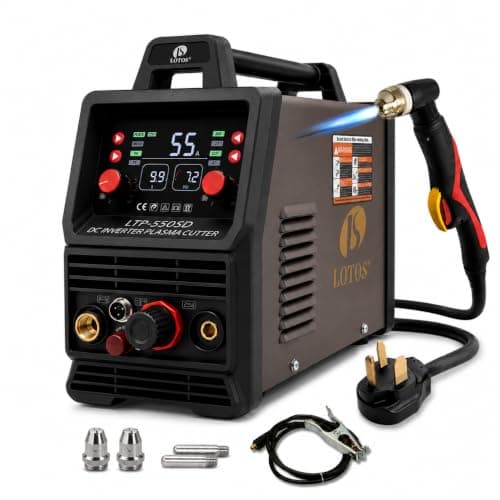 Lotos LTP5505DPublishes output, thickness and duty cycle for each supply voltage, and has the most capacity of the machines here that do, so you know what you are buying before you plug it in. | Most capacity among the machines that publish both voltages | |
| 2 | 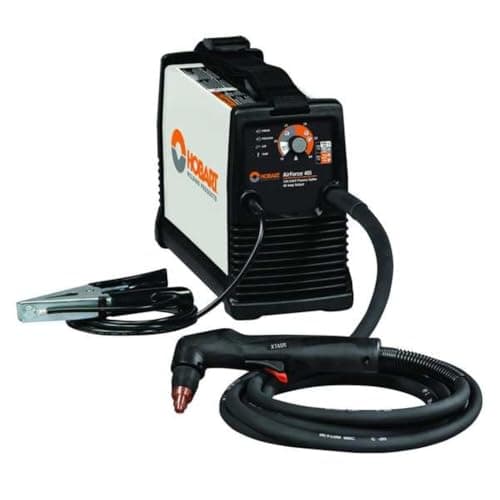 Hobart Airforce 40i40 A on either supply, behind a dealer network — which matters more on a plasma cutter than a welder, because consumables are a recurring purchase. | Best supported dual-voltage machine | $2,198.75 · View on Amazon #ad How this is funded · Price as of November 13, 2026 |
| 3 | 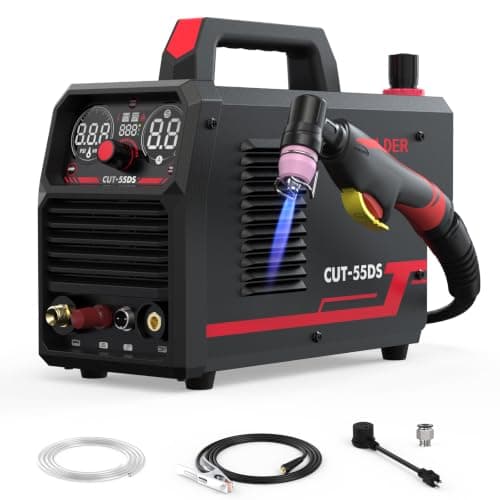 YESWELDER CUT-55DSPilot-arc start and dual voltage at the bottom of the market, where the usual answer is one or the other. | Cheapest dual voltage with a pilot arc |
The best dual voltage plasma cutter
The Lotos LTP5505D is the best dual voltage plasma cutter for most home shops: it publishes a complete specification for both supplies and has the most capacity of the machines here that do — 20–55 A and a 5/8 inch clean cut on 220/240 V, 20–35 A and a 3/8 inch clean cut on 110/120 V, with pilot-arc start. The Hobart Airforce 40i is the best-supported option and the YESWELDER CUT-55DS the cheapest with a pilot arc. All three need the same thing to work: clean, dry air — none of them carries its own compressor.
Dual voltage is the single most useful feature on a home-shop plasma cutter, and it is also the most routinely over-sold. "Dual voltage 50 A" almost never means 50 A on both voltages. It means 50 A on 240 V and something considerably less on 120 V, and the second number is the one you will be using on the day the machine arrives.
What you actually lose on 120 V
A plasma cutter's output amperage sets the thickness it will part cleanly, and amperage comes out of the supply. Halve the supply voltage and, broadly, you need twice the current to deliver the same power — which a household circuit cannot give you. So the machine limits itself instead.
The Lotos figures show the shape of it honestly: 55 A becomes 35 A, a 5/8 inch clean cut becomes 3/8 inch, and a 3/4 inch severance cut becomes 1/2 inch. That is roughly a third off the current and about 40% off the usable thickness. It is not a small penalty, and it is the right thing to plan around rather than discover.
The published figures, side by side
| Specification | Lotos LTP5505D | Hobart Airforce 40i | YESWELDER CUT-55DS |
|---|---|---|---|
| Input | 110/120 V or 220/240 V, auto-sensing | 120 V or 240 V | 110 V or 220 V |
| Output on the higher supply | 20–55 A | 40 A | 10–55 A |
| Output on 110/120 V | 20–35 A | Not published | 10–35 A |
| Clean cut | 5/8 in at 240 V; 3/8 in at 120 V | Not published | 1/2 in maximum; 3/8 in rated at 220 V, 5/16 in at 110 V |
| Severance cut | 3/4 in at 240 V; 1/2 in at 120 V | Not published | 3/4 in at 220 V; 9/16 in at 110 V |
| Arc start | Non-touch pilot arc | Not published in our registry | Non-touch pilot arc |
| Air supply | External compressor required | External compressor required | External compressor required |
| Weight | Not published | Not published | Not published |
Look at how many rows are blank in the two right-hand columns. On a dual-voltage machine, an unpublished 120 V figure is not a neutral omission — it is the number you most need. That is the whole reason the Lotos is first on this page despite not being the best machine in the field on any other axis.
Air is not optional, and it is where dual voltage gets misunderstood
Switching to a smaller supply reduces the current the machine draws. It does not reduce the air it needs. A plasma cutter at 35 A still wants a steady volume of dry air at pressure, and starving it produces exactly the symptoms people blame on the outlet: a sputtering arc, a cut that will not go through, and consumables that fail early.
Moisture is the other half. Compressed air carries water, water reaches the torch, and the electrode and nozzle erode in a fraction of their normal life. Plasma cutter air requirements goes through the CFM figure, the separator and the line sizing properly, and plasma cutter consumables explained covers what bad air costs you in parts.
Dual voltage still wants its own circuit
A dual-voltage machine on 120 V is drawing close to what a household circuit can supply. Sharing with a freezer, a dust extractor or the compressor that is feeding it causes trips that look exactly like machine faults. What size breaker for a welder applies to plasma cutters too, and how many amps a welder uses explains why input and output amps are different numbers.
Which one to buy
If you own a compressor: the Lotos LTP5505D. It tells you what it does on your outlet, and it does more on that outlet than anything else here that states a figure at all. The pilot arc suits real-world material.
If you do not own a compressor, the answer is not on this page. The internal-compressor machine we recommend, Lincoln's Tomahawk 30 AIR, is 230 V single phase with no 120 V option, so it cannot be a dual-voltage pick — plasma cutters with a built-in air compressor makes that case properly.
If consumable supply decides it: the Hobart Airforce 40i. 40 A is the sensible middle and the parts are on a shelf near you.
If the budget is fixed: the YESWELDER CUT-55DS, with the consumable bill understood as part of the price.
We have cut with none of these machines, and the ranking is built from published specifications and the gaps between them — how we pick sets out what that means. If thickness rather than voltage is your constraint, best plasma cutters for 1-inch steel is the right page.
For a head-to-head rather than a ranking, PrimeWeld CUT60 vs YESWELDER CUT-55DS compares two dual-voltage machines row by row — and the 110 V output figures do not go the way the prices do.
1. Most capacity among the machines that publish both voltages
Lotos LTP5505D
Publishes output, thickness and duty cycle for each supply voltage, and has the most capacity of the machines here that do, so you know what you are buying before you plug it in.
Lotos publishes 20 to 55 A on 220/240 V and 20 to 35 A on 110/120 V; a 5/8 inch clean cut on the higher supply and 3/8 inch on the lower; a 3/4 inch severance cut on the higher and 1/2 inch on the lower; a 60% duty cycle at 55 A with 100% at 43 A on the higher supply and 60% at 35 A on the lower; non-touch pilot-arc start; and an auto-sensing supply with a front-panel regulator and pressure gauge. An external compressor is required.
That table is the reason it leads this page. Every dual-voltage plasma cutter has a headline amperage, and on almost all of them the headline is the 240 V figure. Lotos splits the whole specification, which means you can decide whether a 3/8 inch clean cut on a garage outlet is enough for the work you have in front of you — rather than finding out afterwards.
Pilot arc is the second reason. A pilot-arc machine strikes without the torch touching the work, so painted, rusty and galvanized steel does not stall it. Most of what gets cut in a home shop is exactly that kind of material. HF vs non-HF plasma cutters covers which start type to want and why it matters near a CNC controller.
Two real costs. You must supply clean dry air — a small pancake compressor will not keep up, and wet air destroys consumables fast. And on 110 V you lose roughly a third of the output and close to half the clean-cut thickness.
What works
- Pilot arc means it will start on painted, rusty or galvanized material where a touch-start machine stalls
- 5/8 in clean cut on 240 V is more capacity than most home shops will ever use
- Publishes a complete specification on BOTH supplies — output, clean cut, severance and duty cycle — which most dual-voltage machines do not
What does not
- You must supply clean dry air. A small pancake compressor will not keep up, and wet air destroys consumables fast
- On a 110 V outlet the top end falls from 55 A to 35 A and the clean cut from 5/8 in to 3/8 in
- The output floor is 20 A rather than the 10 A some competing machines publish, so it throttles down less far for thin sheet
- Consumable life is noticeably shorter than Hypertherm's, and the running cost shows it
Who this is wrong for: Anyone who does not already own a real compressor. The machine is only cheap if the air is already there.
2. Best supported dual-voltage machine
Hobart Airforce 40i
40 A on either supply, behind a dealer network — which matters more on a plasma cutter than a welder, because consumables are a recurring purchase.
Hobart publishes 40 A output and 120 V or 240 V dual-voltage input. An external compressor is required.
40 A sits in the useful middle of this field: more capacity than a 30 A machine, less air demand than a 50 A one. For a shop whose compressor is adequate rather than generous, that is often the specification that decides it, because starving a plasma cutter for air produces a bad cut and eats consumables at the same time.
The dealer network is the real argument, and it is a different argument from the one you would make about a welder. A welder you buy once. Plasma consumables you buy forever, and a brand with a counter you can walk into means a tip and an electrode are a ten-minute errand rather than a three-day wait.
Two costs, stated plainly. It is priced above the budget 50 A machines while cutting less, and Hobart does not publish per-voltage output figures that we could confirm, so what you get on 120 V is not stated.
What works
- Backed by Hobart's dealer network, which matters more for a plasma cutter than a welder because consumables are a recurring purchase
- 40 A sits in the useful middle: more capacity than a 30 A machine, less air demand than a 50 A one
What does not
- Priced above the budget 50 A machines while cutting less
- Still needs a real compressor with a water separator
3. Cheapest dual voltage with a pilot arc
YESWELDER CUT-55DS
Pilot-arc start and dual voltage at the bottom of the market, where the usual answer is one or the other.
YESWELDER publishes a 55 A output rating, 110 V or 220 V input and non-touch pilot-arc start.
Pilot arc at this price used to mean paying roughly twice as much, and it is the feature worth having if your material is the usual home-shop mix of rusty angle, painted plate and galvanized sheet. A touch-start machine on that material spends half its life not starting.
Dual voltage is what gets you going without an electrician. Start on a 110 V outlet, learn the machine, and the same box takes advantage of a 240 V circuit later — 120V versus 240V welders covers what the upgrade is actually worth.
Two costs that matter here more than elsewhere. Consumables are the running cost and these do not last like the name brands, so the cheap machine is not cheap over three years. And owner feedback reports more variation between units than the established brands show.
What works
- Pilot arc at the bottom of the market, which used to mean paying twice as much
- Dual voltage, so a 110 V outlet gets you started
What does not
- Consumables are the running cost and they do not last like the name brands
- Owner feedback reports more variation between units than the established brands
Who this is wrong for: Anyone who cuts often. The consumable bill is where the saving goes, and at that point a Hobart or a Lincoln is the cheaper machine.
Questions people actually ask
What is the best dual voltage plasma cutter?
The Lotos LTP5505D. It publishes a complete specification on both supplies - 20 to 55 A and a 5/8 inch clean cut on 220/240 V, 20 to 35 A and a 3/8 inch clean cut on 110/120 V, with non-touch pilot-arc start - and it has the most capacity of the machines here that publish both. The YESWELDER CUT-55DS also publishes both supplies, at a lower rated thickness.
If you do not already own an air compressor, no machine on this page solves that. The internal-compressor machine we recommend, Lincoln's Tomahawk 30 AIR, is 230 V single phase with no 120 V option, so it is not a dual-voltage machine at all.
How much cutting capacity do you lose on a 120V outlet?
Roughly a third of the top-end output amperage and about 40% of the clean-cut thickness, judging by the machines here that publish both. The Lotos LTP5505D goes from 20-55 A to 20-35 A, and from a 5/8 inch clean cut to 3/8 inch.
Treat that as the shape of the penalty on any dual-voltage machine. Where a manufacturer does not publish a 120 V figure, assume a similar reduction rather than the headline number.
Does a dual voltage plasma cutter need less air on 120V?
No. Lowering the supply voltage reduces the current the machine draws from the wall; it does not reduce the compressed air the torch needs to form and cool the plasma jet.
Starving it for air gives you the same symptoms people blame on the outlet: a sputtering arc, cuts that do not go through, and consumables failing early. The compressor requirement is set by the machine, not by the circuit.
Is a built-in compressor better than a dual-voltage machine with an external one?
It is better for a first purchase and worse for capacity and for voltage flexibility. Lincoln's Tomahawk 30 AIR removes the compressor, the separator and the hose from the shopping list, but it is 230 V single phase, so it will not run on a household outlet at all.
What you give up is thickness - a recommended 5/16 inch cut at 22 ipm against the Lotos's 5/8 inch clean cut on 240 V - and its internal compressor has its own duty cycle, so long sessions need pauses or the external air connection it also accepts.
Can I plug a dual voltage plasma cutter into any outlet?
Electrically it will accept either supply, but it still wants a circuit of its own. On 120 V a plasma cutter draws close to what a household circuit can give, so sharing with a freezer, a dust extractor or the compressor feeding it causes trips that look like machine faults.
Check the adapter situation too: a machine supplied with a 240 V plug needs the matching receptacle, and that is an electrician's job rather than an adapter's.
Which dual voltage plasma cutters have a pilot arc?
The Lotos LTP5505D and the YESWELDER CUT-55DS both publish non-touch pilot-arc start. We could not confirm a published arc-start type for the Hobart Airforce 40i from a manufacturer source, so that row is left blank.
A pilot arc matters because it strikes without touching the work, so painted, rusty and galvanized material does not stall the machine - which is most of what a home shop cuts.
What happened to the Hypertherm Powermax30 AIR?
It used to be the no-compressor pick on this page. Its Amazon listing now reads "Currently unavailable" and there is no live listing for the machine, so we no longer link to it.
The internal-compressor machine we recommend instead is Lincoln's Tomahawk 30 AIR, and it is 230 V single phase rather than dual voltage, which is why it is not listed here. Our page on plasma cutters with a built-in air compressor covers it.
Sources
- Lotos Technology — LTP5505D published specifications: 20–55 A on 220/240 V and 20–35 A on 110/120 V; 5/8 in clean cut at 240 V and 3/8 in at 120 V; 3/4 in severance at 240 V and 1/2 in at 120 V; 60% duty cycle at 55 A and 100% at 43 A on 240 V, 60% at 35 A on 120 V; non-touch pilot arc; auto-sensing input; front-panel regulator and pressure gauge (re-read 2026-10-23)
- Hobart Welders — Airforce 40i published specifications: 40 A output, 120 V or 240 V dual voltage, external compressor required
- YESWELDER — CUT-55DS published specifications: 55 A rating, 110 V or 220 V input, non-touch pilot-arc start
Read next
- PrimeWeld CUT60 vs YESWELDER CUT-55DS
A 60 A pilot-arc plasma cutter against the cheapest dual-voltage one, compared on the five published rows that actually differ.
- The best plasma cutters for home use
Home-shop machines, why the compressor is the real purchase, and how to read cut-capacity numbers.
- Plasma cutter air requirements
How to read CFM and PSI, why tank size is not the answer, and what a compressor must sustain.
- Plasma Cutter Consumables Explained
The five torch parts, which two actually wear, what destroys them early, and why consumable cost decides which machine is cheaper to own.
- HF vs non-HF plasma cutters
High-frequency versus blowback arc starting, what each costs you, and why CNC users care.
- 120V vs 240V welders: which one do you actually need?
The decision that sets your ceiling: what each supply voltage welds, and what the circuit really costs.
- Level 4 · Plasma: cutting as accurately as you weld
The only rung on this ladder that is about shaping metal rather than joining it — and the one where the machine is the smaller half of the purchase.
Back to Level 4 · Plasma, or start over at Find Your Level.
Ryder M.
Ryder M. is the hands-on owner behind Magoo Media Group. He writes Arc & Bead's buying guides and picks every machine on the site. What every recommendation is based on — and what it is not based on — is set out on How We Pick.