Plasma Cutter Consumables Explained
The torch parts are the real price of owning a plasma cutter. Five pieces, two of them doing nearly all the work, and a short list of mistakes that destroy them in an afternoon.
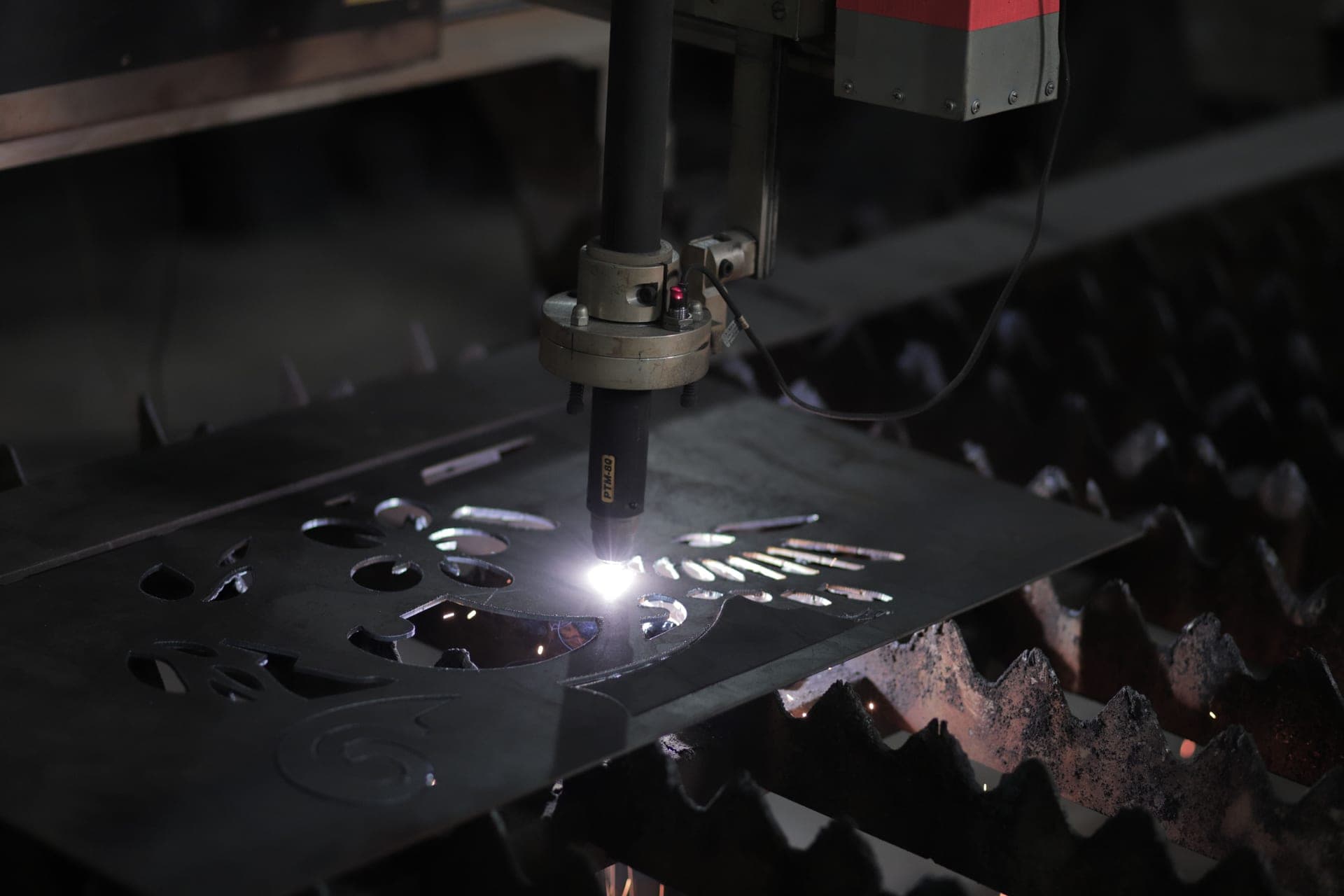
What are plasma cutter consumables?
Plasma cutter consumables are the torch-tip parts that wear out and get replaced: the electrode, the nozzle (also called the tip), the swirl ring, the retaining cap and the shield or drag cap. The electrode and nozzle do nearly all the wearing and are replaced most often; the other three last far longer but affect how fast the first two die. The three things that destroy consumables early are wet or dirty air, cutting at too great a standoff height and starting the arc more often than necessary.
A plasma cutter does not wear out. Its torch does, continuously, by design. Understanding which parts wear and what accelerates it is the difference between a machine that costs you a few parts a year and one that feels like a subscription.
The five parts, and what each one does
The electrode sits at the center of the torch and carries the arc. Its tip holds a small insert of hafnium, which emits the electrons that sustain the plasma. Every arc start consumes a little of that insert, and when the resulting pit gets too deep the arc wanders and the cut quality falls off. Electrodes wear by starts as much as by cutting time.
The nozzle, or tip, is the orifice the plasma jet squeezes through. That orifice is what makes a plasma cut narrow and square instead of a wide gouge. It erodes from the inside out, slowly going oval and oversized, and the symptom is a cut that gets wider, rougher and more bevelled until it stops going through.
The swirl ring spins the air into a vortex before it reaches the arc, which is what keeps the jet tight and centered. It rarely fails, and when it is fitted wrong or cracked it quietly shortens the life of both parts above.
The retaining cap holds the stack together at the right torque. Too loose and the gas path leaks; too tight and you distort the parts.
The shield or drag cap is the outer part that lets you rest the torch on the work. It takes the spatter and the heat so the nozzle does not, and it is the cheapest part on the list.
What actually kills consumables
| Cause | What it does | What it looks like |
|---|---|---|
| Wet or oily air | Moisture and oil reach the arc and erode the electrode insert and nozzle orifice far faster than dry air | Consumables failing in a fraction of their expected life; a spitting arc; dark streaks inside the nozzle |
| Insufficient air volume | The jet is not cooled or constricted properly, so heat goes into the nozzle instead of the cut | A cut that will not sever; the arc sputtering mid-cut; nozzle going oval quickly |
| Too much standoff height | The arc stretches, widens and attaches to the nozzle instead of the work | Double-arcing, a visibly blown-out nozzle orifice, heavy top dross |
| Unnecessary arc starts | Each start consumes electrode material, so many short cuts cost more than one long one | Short electrode life on a machine whose cut quality is otherwise fine |
| Piercing from zero height | Molten metal blows straight back up into the nozzle | Spatter welded to the nozzle face; a shield cap that will not come off |
| Cutting too slowly | The arc dwells, the kerf widens, and heat loads the nozzle | Excessive dross on the underside and a wide bevelled cut |
Two of those six are air quality. That is not an accident, and it is why plasma cutter air requirements is the page to read before you buy any consumables at all. A water separator and a drain habit are cheaper than one set of parts.
Why consumable cost changes which machine is cheaper
Plasma cutters are usually compared on purchase price and cut thickness. For anyone who cuts regularly, that is the wrong comparison, because the consumable bill is recurring and the purchase is not.
The pattern across this registry is consistent: Hypertherm consumables are stocked everywhere and last markedly longer than the budget equivalents, while the budget machines explicitly trade consumable life for purchase price — Lotos's own trade is described as a running cost that shows, and YESWELDER's as parts that do not last like the name brands. At 80 A, Lotos notes you get through consumables faster still.
So the arithmetic depends entirely on how much you cut. For a few hours a year, buy on price and keep spares. For regular work, the expensive machine is frequently the cheap one. Is a plasma cutter worth it is the honest version of that question.
Buy the kit with the machine
Consumables are machine-specific and torch-specific. A nozzle for a 50 A torch is not a nozzle for a 40 A torch, and the sizes are not interchangeable between brands. Order a spares kit at the same time as the cutter — a plasma cutter with no spare tip is a plasma cutter that stops mid-job, and the part is rarely next-day unless the brand has a counter near you. That is the practical argument for the dealer-supported machines.
When to change a part, rather than how often
Hours and cut counts are not useful numbers, because they depend on amperage, material, air quality and how many times you started the arc. Change by symptom instead.
Change the nozzle when the cut gets wider, more bevelled or leaves more dross than it did yesterday at the same settings, or when the orifice is visibly out of round. Change the electrode when the pit in the hafnium insert is noticeably deep, or when the arc starts hesitating. Change both together — a worn electrode destroys a fresh nozzle quickly, so pairing them is cheaper than it looks. Check the swirl ring for cracks and blocked holes every time you are in there, and replace the shield when spatter has built up on its face.
One habit worth forming: when a cut suddenly gets bad, check the consumables before you touch any setting. On a plasma cutter, the parts are the usual answer. Plasma cutting for beginners covers the settings side, and the cut thickness chart gives you the figure a healthy torch should be achieving.
What we would buy
Arc & Bead is an Amazon Associate. If you buy through a link on this page we may earn a commission, at no extra cost to you. We have not physically tested the machines on this page and we say so on How We Pick.
1. The machine that protects its own consumables
Lincoln Electric Tomahawk 30 AIR
Its own air supply, with the water separator built in — which is the single biggest thing that decides how long a nozzle lasts.
Lincoln publishes 15 to 30 A with 25 A at a 100 percent duty cycle, an internal air compressor needing no external air, an external air connection as standard, a 230 V single-phase input, a 5/16 inch recommended cut at 22 ipm, a 3/8 inch maximum at 14 ipm, a 1/2 inch severance cut at 5 ipm, 40 lb, and an LC30 hand torch.
On a page about consumables this is the machine that makes the argument. The fastest way to destroy a nozzle and electrode is wet air, and a machine that supplies its own air with the moisture handling built in removes the most common source of it. Lincoln ships a water separator as part of the package rather than as an accessory.
The second half is where the parts come from. LC30 consumables are a dealer-network item with a published part number rather than a seller-specific listing, which matters on a tool where a worn tip stops the job.
Honest limits: 30 A is a real ceiling, the 1/2 inch figure is a severance cut at 5 ipm rather than a working thickness, it needs a 240 V circuit because there is no 120 V option, and the internal compressor has its own duty cycle.
What works
- The compressor is inside the machine, so the hidden second purchase that sinks most first plasma buys does not exist
- It takes external air as standard as well, so a shop compressor can carry the long cuts the internal pump has to pause for
- 25 A at a 100% duty cycle is a genuinely continuous rating rather than a figure you have to work around
- Lincoln publishes three years on the machine and a dealer network behind a tool that eats consumables
What does not
- 230 V single phase only. There is no 120 V option, so a garage without a 240 V circuit cannot run it at all
- 40 lb, which is portable for a machine carrying its own compressor but not the under-30-lb class
- Costs multiples of a budget 50 A machine while cutting thinner material
- Buy on the 5/16 in recommended figure: 1/2 in is a severance limit at 5 ipm, not a working thickness
Who this is wrong for: Thick-plate work. No amount of consumable economy makes a 30 A machine the right tool for half-inch plate.
2. The consumable design that removes the mistake
Hypertherm Powermax65 SYNC
Single-piece cartridge consumables, so the five-part stack-up cannot be assembled slightly wrong — which is the quiet cause of most short consumable lives.
Hypertherm publishes 20 to 65 A, a 3/4 inch recommended cut and 1-1/4 inch severance, a 50% duty cycle at 65 A and 100% at 46 A, 200–480 V single-phase input, SpringStart rather than a high-frequency circuit, and 61.7 lb with the 25 ft torch.
It is on a consumables page because of one feature: the consumable is a single cartridge rather than a stack of five separate parts. Every conventional torch is assembled by hand each time it is serviced, and a swirl ring in backwards or a retaining cap a quarter-turn loose changes the gas flow in ways that quietly shorten the life of everything else. A cartridge removes that entire category of error.
SpringStart matters for a related reason — no high-frequency circuit means no electrical noise, so the machine can drive a CNC table without interfering with the controller. If a table is in your future, that decision is made here.
The costs are unambiguous. It is several times the price of an 80 A budget machine, it cuts thinner plate at its recommended setting, and it needs a 200 V minimum supply and the air volume to match. This is beyond what this site is built for, and it is here as the reference point rather than a recommendation.
What works
- Single-piece cartridge consumables, which removes the five-piece stack-up that gets assembled slightly wrong every time
- SpringStart means no high-frequency noise, so it can drive a CNC table without interfering with the controller
- Hypertherm consumable life is why professionals buy these: the running cost per cut is far below a budget machine's
What does not
- Costs several times an 80 A budget machine, and cuts thinner plate than one at its recommended setting
- 3/4 in is the recommended cut; 1-1/4 in is a severance cut, which is a slow rough parting cut, not a working thickness
- Needs a serious supply — 200 V minimum, and the air volume to match
Who this is wrong for: A home shop. The supply requirement alone puts it outside what a garage circuit can give, and the price only makes sense against a commercial parts bill.
3. The budget trade, stated honestly
Lotos LTP5505D
More cutting capacity per dollar than anything else here, with consumable life that is noticeably shorter — and a running cost that shows it.
Lotos publishes 20 to 55 A on 220/240 V and 20 to 35 A on 110/120 V, a 5/8 inch clean cut at the higher supply, a 3/4 inch severance cut, non-touch pilot-arc start, and a front-panel regulator with an external compressor required.
This is the machine most people actually buy, and the honest consumables note is that its parts do not last like Hypertherm's. That is not a reason to avoid it. It is a reason to buy a consumable kit with the machine and keep spares on the shelf, because the failure mode of a cheap consumable is not a gradual decline — it is a cut that stops working halfway through a job.
The pilot arc genuinely helps consumable life in one specific way: a non-touch start means the nozzle is not being dragged into the work to strike, which is a mechanical wear path that touch-start machines have and this does not.
The requirement that decides everything: clean dry air. A small pancake compressor will not keep up, and wet air destroys consumables fast on any machine — on a budget machine it is brutal.
What works
- Pilot arc means it will start on painted, rusty or galvanized material where a touch-start machine stalls
- 5/8 in clean cut on 240 V is more capacity than most home shops will ever use
- Publishes a complete specification on BOTH supplies — output, clean cut, severance and duty cycle — which most dual-voltage machines do not
What does not
- You must supply clean dry air. A small pancake compressor will not keep up, and wet air destroys consumables fast
- On a 110 V outlet the top end falls from 55 A to 35 A and the clean cut from 5/8 in to 3/8 in
- The output floor is 20 A rather than the 10 A some competing machines publish, so it throttles down less far for thin sheet
- Consumable life is noticeably shorter than Hypertherm's, and the running cost shows it
Questions people actually ask
What are the consumables on a plasma cutter?
Five torch parts: the electrode, the nozzle (or tip), the swirl ring, the retaining cap and the shield or drag cap.
The electrode and nozzle do nearly all the wearing and are what you replace most often. The swirl ring, retaining cap and shield last much longer, but a damaged or wrongly fitted swirl ring will shorten the life of the electrode and nozzle without being obvious.
How long do plasma cutter consumables last?
There is no honest hours figure, because life depends on amperage, material, air quality and how many times you started the arc rather than on elapsed time. We do not publish one for that reason.
Change by symptom instead. Replace the nozzle when the cut gets wider, more bevelled or leaves more dross at the same settings, and the electrode when the pit in its hafnium insert is visibly deep or the arc starts hesitating.
What is the fastest way to destroy plasma cutter consumables?
Wet or oily compressed air. Moisture reaching the arc erodes the electrode insert and the nozzle orifice far faster than dry air does, and it is the single most common reason consumables fail early in a home shop.
After that: insufficient air volume, cutting at too great a standoff height, and piercing from zero height so molten metal blows back into the nozzle. A water separator and a habit of draining the tank are cheaper than one set of parts.
Should I change the electrode and nozzle at the same time?
Generally yes. A worn electrode makes the arc wander, and a wandering arc attacks a fresh nozzle quickly, so fitting a new nozzle behind an old electrode often means buying the nozzle twice.
They are designed as a pair, which is why most spares kits are sold that way - and why Hypertherm's cartridge consumables on the Powermax65 SYNC replace the whole stack as one piece.
Are plasma cutter consumables interchangeable between brands?
No. Consumables are specific to the torch, and often to the amperage the torch is set up for - a 50 A nozzle is not a 40 A nozzle even on the same machine.
That makes consumable availability part of the buying decision. Hypertherm parts are stocked by every welding supplier; budget-brand parts are usually an online order, which is a problem on the day a job stops.
Do consumable costs make an expensive plasma cutter cheaper to own?
If you cut regularly, often yes. Hypertherm consumables are stocked widely and last markedly longer than budget equivalents, and over several years that difference is real money against a purchase-price gap that is paid once.
If you cut a few hours a year, the arithmetic flips and a budget machine with a spares kit is the sensible buy. The deciding variable is how much you cut, not which machine is better.
Sources
- Lincoln Electric — Tomahawk 30 AIR (K5457-1) published specifications: 15–30 A with 25 A at 100% duty cycle, internal air compressor with an external air connection standard, water separator included, 230 V 1-phase input, 5/16 in at 22 ipm, 1/2 in severance at 5 ipm, 40 lb, LC30 hand torch
- Hypertherm — Powermax65 SYNC published specifications: 20–65 A, 3/4 in recommended cut, 1-1/4 in severance, 50% duty cycle at 65 A, single-piece cartridge consumables, SpringStart arc ignition, 61.7 lb with 25 ft torch
- Lotos Technology — LTP5505D published specifications: 20–55 A on 220/240 V, 20–35 A on 110/120 V, 5/8 in clean cut, non-touch pilot arc, front-panel regulator and pressure gauge, external compressor required (re-read 2026-10-23)
Read next
- Plasma cutter air requirements
How to read CFM and PSI, why tank size is not the answer, and what a compressor must sustain.
- Best Dual Voltage Plasma Cutters
Dual-voltage plasma cutters ranked on published 120 V output, not the 240 V headline figure.
- Plasma cutting for beginners
Standoff, travel speed, drag cutting and piercing — everything from unboxing to a clean cut.
- Plasma cutter cut thickness chart
Recommended versus severance capacity by amperage, and what you lose on a 110V outlet.
- Is a plasma cutter worth it?
The honest break-even: what plasma does that nothing else does, and the costs beyond the machine.
- Level 4 · Plasma: cutting as accurately as you weld
The only rung on this ladder that is about shaping metal rather than joining it — and the one where the machine is the smaller half of the purchase.
Back to Level 4 · Plasma, or start over at Find Your Level.
Ryder M.
Ryder M. is the hands-on owner behind Magoo Media Group. He writes Arc & Bead's buying guides and picks every machine on the site. What every recommendation is based on — and what it is not based on — is set out on How We Pick.