HF vs non-HF plasma cutters
For hand cutting, this barely matters. For a CNC table, it is the specification that decides whether your controller survives.
Arc & Bead is an Amazon Associate. If you buy through a link on this page we may earn a commission, at no extra cost to you. We have not physically tested the machines on this page and we say so on How We Pick.
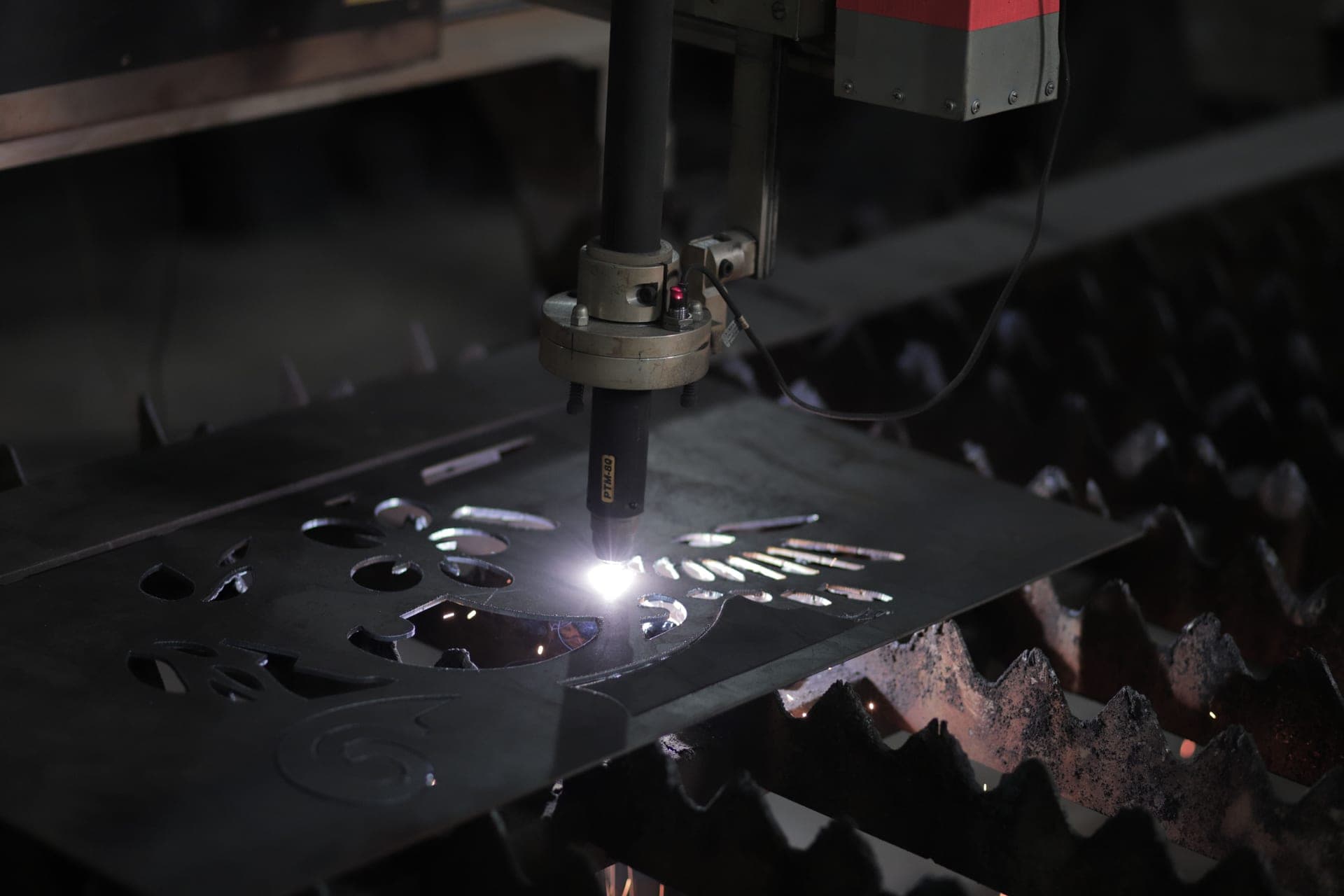
What is the difference between HF and non-HF plasma cutters?
An HF machine starts the arc with a high-voltage, high-frequency spark that ionizes the air in the torch. A non-HF machine uses blowback starting: a spring-loaded electrode that air pressure pushes back from the nozzle, drawing the arc mechanically. Both give a non-touch start. The difference that matters is electrical noise — HF machines emit it, and it can disrupt a PC-based CNC controller.
How each one actually starts the arc
High frequency. A high-voltage generator produces a discharge in the range of thousands of volts across the gap inside the torch. That ionizes the gas, a pilot arc forms, and it transfers to the work when you bring the torch close. It works regardless of paint, rust or galvanizing.
Blowback. The electrode sits against the nozzle at rest. When you pull the trigger, air pressure pushes the electrode back against a spring, and the separation itself draws an arc — no high voltage involved. Hypertherm developed this in the late 1980s and it became the standard for professional systems.
Both are non-touch as far as the operator is concerned. Neither is the "touch start" you should avoid, which is a third and much cheaper arrangement where the torch tip has to contact the metal.
Side by side
| HF start | Blowback (non-HF) | |
|---|---|---|
| Arc initiation | High-voltage spark ionizes the gas | Spring-loaded electrode separates mechanically |
| Electrical noise | Significant — can disrupt nearby electronics | Minimal |
| Safe with a PC-based CNC controller | No | Yes — this is why professional CNC systems use it |
| Starts on rust, paint, galvanizing | Yes | Yes |
| Torch consumables | Standard electrode and nozzle | Electrode is a moving part in the torch |
| Typical machines | Most affordable pilot-arc machines | Professional systems and Hypertherm's range |
Who genuinely needs to care
CNC table owners: this is your specification. High-frequency discharge radiates electrical noise, and a CNC table run from a PC or laptop is exactly the wrong thing to have nearby. It can produce erratic motion, lost steps, and in bad cases damaged electronics. This is documented behaviour, widely reported and widely warned about.
Hand cutters: you mostly do not. If you are cutting freehand or against a straight edge, HF starting is a perfectly good arrangement and it is what nearly every affordable pilot-arc machine uses. It works, it starts on dirty metal, and the noise goes nowhere important.
Shops with sensitive equipment nearby. A worth-thinking-about middle case. HF noise can upset nearby electronics generally, not only CNC controllers — worth knowing if the machine will live next to a bench full of test gear.
What it does not change
Cut quality. Neither starting method affects the cut once the arc is established — that is decided by amperage, air, travel speed, standoff and consumable condition.
Nor does it change whether you get a pilot arc. Both arrangements deliver non-touch starting. The specification to avoid is a touch-start machine with no pilot arc at all, which is a genuine compromise on every material a home shop cuts.
The verdict
Buy non-HF if a CNC table is in your plans now or later. It is the only specification on this page that cannot be worked around, and retrofitting is not a thing — you would be buying a second machine.
Buy HF without worrying if you are cutting by hand. It costs far less, works on everything, and the drawback does not apply to you.
If CNC is a maybe, that is worth weighing: the machines that make the best hand cutters at a budget are almost all HF, and the machines that drive a table well are almost all professional systems. Plasma cutter vs laser cutter covers where a table fits in the wider picture.
What we would buy
1. If a CNC table is the plan
Hypertherm Powermax65 SYNC
SpringStart — no high-frequency circuit, so it will not interfere with a PC-based controller.
Hypertherm publishes 20 to 65 amps, a recommended cut of 3/4 inch, a 1-1/4 inch severance cut, a 50% duty cycle at 65 amps and 100% at 46 amps, and SpringStart arc initiation with no high-frequency circuit.
Hypertherm developed blowback starting in the late 1980s, and it is the reason their machines became the default on CNC tables. Without a high-voltage, high-frequency discharge there is almost no electromagnetic interference for the controller to pick up.
For hand cutting, the practical benefit is subtler: a mechanical start is one fewer high-voltage circuit to fail, and starts are consistent rather than dependent on a spark gap staying in adjustment.
What works
- Single-piece cartridge consumables, which removes the five-piece stack-up that gets assembled slightly wrong every time
- SpringStart means no high-frequency noise, so it can drive a CNC table without interfering with the controller
- Hypertherm consumable life is why professionals buy these: the running cost per cut is far below a budget machine's
What does not
- Costs several times an 80 A budget machine, and cuts thinner plate than one at its recommended setting
- 3/4 in is the recommended cut; 1-1/4 in is a severance cut, which is a slow rough parting cut, not a working thickness
- Needs a serious supply — 200 V minimum, and the air volume to match
Who this is wrong for: Hand cutting in a home shop. This is a professional system, and the start method alone does not justify the price for a hand-cut user.
2. Non-HF in a home-shop machine
Hypertherm Powermax30 AIR
The same blowback starting in a machine that brings its own air.
Hypertherm publishes 30 amps with a built-in compressor, auto-voltage across 120 and 240 volts, a 5/16 inch recommended cut at 20 inches per minute and a 5/8 inch severance cut, in under 30 pounds.
This is the accessible end of blowback starting. If your objection to HF is the electronics in your shop — or a controller, a laptop or sensitive test gear near the bench — this machine solves it without professional-system money.
Thirty amps is a genuine ceiling, so this is not a machine for thick plate. It is the machine for someone who wants Hypertherm behaviour at a home-shop scale.
What works
- The internal compressor removes the hidden second purchase that sinks most first plasma buys
- Auto-Voltage means it works on a 120 V outlet today and a 240 V circuit later with no switch
- Hypertherm consumables are stocked everywhere and last markedly longer than budget equivalents
What does not
- Costs multiples of a budget 50 A machine while cutting thinner material
- 30 A is a genuine ceiling: 5/8 in severance is the limit, not a working thickness
- The internal compressor has a duty cycle of its own — sustained cutting needs pauses
3. HF pilot arc, and perfectly fine for hand cutting
Lotos LTP5000D
A non-touch pilot arc with HF start — the standard budget arrangement, and it works.
Lotos publishes 10 to 50 amps on 220/240 volts, a 5/8 inch clean cut, 3/4 inch severance and a non-touch pilot arc with a built-in pressure regulator.
Almost every affordable pilot-arc machine uses high-frequency starting, and for hand cutting that is a complete non-issue. The arc starts without touching the work, it starts on rusty and painted metal, and the tip lasts longer than a touch-start machine's.
The caveat is specific and worth respecting: do not pair it with a PC-controlled CNC table. That is a documented interference problem, not a theoretical one.
What works
- Pilot arc means it will start on painted, rusty or galvanized material where a touch-start machine stalls
- 5/8 in clean cut on 240 V is more capacity than most home shops will ever use
- Dual voltage with a switch rather than a different machine
What does not
- You must supply clean dry air. A small pancake compressor will not keep up, and wet air destroys consumables fast
- On a 110 V outlet you lose a third of the output and half the thickness
- Consumable life is noticeably shorter than Hypertherm's, and the running cost shows it
Who this is wrong for: Anyone planning a CNC table run from a PC or laptop controller. HF noise and PC-based controllers are a known bad combination.
Questions people actually ask
What does HF mean on a plasma cutter?
High frequency. The machine starts the arc with a high-voltage, high-frequency discharge inside the torch that ionizes the gas, so the torch never touches the work.
It is how most affordable pilot-arc machines start, and it works on rusty, painted and galvanized metal.
Is a non-HF plasma cutter better?
Only for a specific reason: it emits almost no electrical noise, so it can be used with a PC-based CNC controller. Hypertherm developed blowback starting in the late 1980s for exactly that reason.
For hand cutting, an HF machine performs identically and costs far less.
Can I use an HF plasma cutter with a CNC table?
It is strongly advised against when the table is controlled by a PC or laptop. The high-frequency discharge radiates electrical noise that can cause erratic motion and, in bad cases, damage electronics.
CNC plasma systems use blowback starting specifically to avoid this.
Does HF or non-HF affect cut quality?
No. The starting method only affects how the arc is initiated. Once it is established, cut quality is decided by amperage, air supply, travel speed, standoff distance and consumable condition.
Is HF start the same as a pilot arc?
They are related but not the same thing. A pilot arc means the machine starts without the torch touching the metal; HF is one way of achieving it and blowback is the other.
The arrangement to avoid is touch start, which has no pilot arc and stalls on coated or rusty material.
Sources
Read next
- Plasma cutting for beginners
Standoff, travel speed, drag cutting and piercing — everything from unboxing to a clean cut.
- Plasma cutter vs laser cutter
Thickness, tolerance, cost and ownership — where a laser beats plasma and where it does not.
- The best plasma cutters for the price
Value per dollar in plasma, counted properly — including the consumables and the compressor.
- The best plasma cutters for 1-inch steel
Clean cut versus severance cut at an inch of steel, and the machines that publish the figure that matters.
- Plasma cutter air requirements
How to read CFM and PSI, why tank size is not the answer, and what a compressor must sustain.
Back to Level 4 · Plasma, or start over at Find Your Level.
Ryder M.
Ryder M. is the hands-on owner behind Magoo Media Group. He writes Arc & Bead's buying guides and picks every machine on the site. What every recommendation is based on — and what it is not based on — is set out on How We Pick.