The best welding tables
A welding table is a work surface, a ground path and a fixture jig in one object. The specification that decides all three is the hole: 5/8 inch is the standard, and one of these tables is not on it.
Arc & Bead is an Amazon Associate. If you buy through a link on this page we may earn a commission, at no extra cost to you. We have not physically tested the machines on this page and we say so on How We Pick.
Quick picks
Tap any row to jump to the full write-up further down this page.
| # | Product | Best for | Price |
|---|---|---|---|
| 1 | 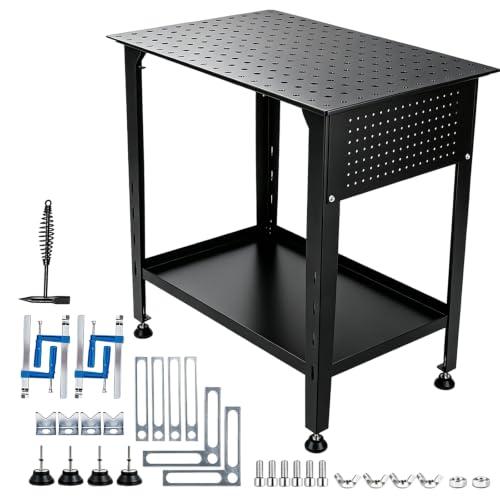 Cxforste SWT3624 steel welding tableThe only table here that publishes a top-plate thickness - 4 mm on a 2 mm frame - with 5/8 in holes in the top AND the sides. | Best overall | $196.99 · View on Amazon #ad How this is funded · Price as of November 28, 2026 |
| 2 | 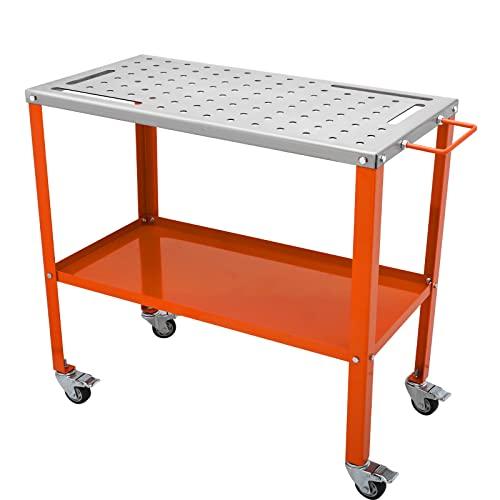 VEVOR Welding Table 36 x 18 in on castersThe cheapest table here and it still publishes 1,200 lb, on braking casters, with 94 holes at the 5/8 in standard. | Budget pick | $114.94 · View on Amazon #ad How this is funded · Price as of November 28, 2026 |
| 3 | 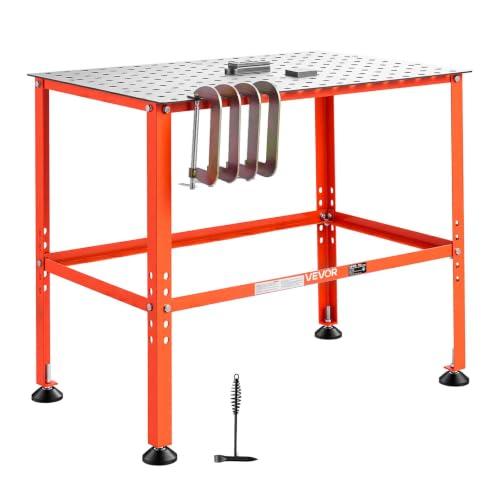 VEVOR Upgraded Welding Table 36 x 24 in36 x 24 in with a 17-piece fixture kit in the box and the densest published hole grid here - 0.63 in on 2 in spacing. | Best with the fixtures included | |
| 4 | 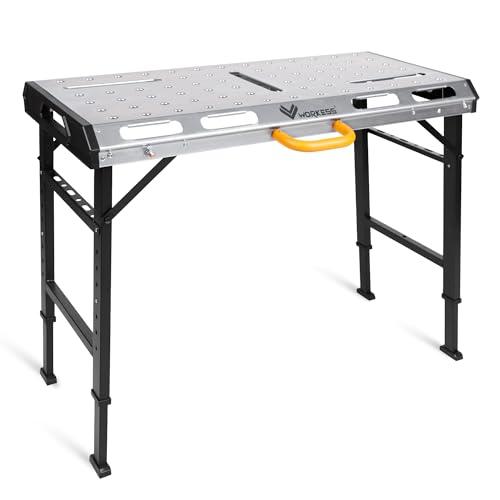 WORKESS WK-WB065 folding welding tableFolds to a published 3.7 in and stands on its own, with seven height settings - but its holes are 0.8 in, not the 5/8 in standard. | Best for a shared garage | $159.99 · View on Amazon #ad How this is funded · Price as of November 28, 2026 |
The short answer
A welding table does three jobs at once: it gives you a flat reference surface, it gives you a ground path through the work, and — if it has holes — it is a reconfigurable fixture jig. The specification that decides the third job is the hole size, and 5/8 in (16 mm) is the standard the whole fixture market is built around.
Our overall pick is the Cxforste SWT3624: 36 x 24 in, a published 4 mm top plate on a 2 mm frame, a 2,000 lb capacity and 5/8 in holes in the top and the sides. The budget pick is the VEVOR 36 x 18 in on casters, the cheapest table in our registry, which still publishes 1,200 lb and 94 holes at 5/8 in.
If you want the fixture kit included, the VEVOR 36 x 24 in ships with a 17-piece set. If the table has to be put away between jobs, the WORKESS WK-WB065 folds to 3.7 in — but check its 0.8 in holes against your clamps first, because they are not the standard size.
Prices in the table above are read from our live price feed when the page loads, each with its own "as of" date inside the buy button. All four tables returned a buyable offer in the refresh run on 2026-11-27, which is what qualified them for this page.
The criteria, in the order they decide the purchase
1. Hole size, which is a compatibility gate rather than a preference. 5/8 in (16 mm) is the fixture standard. Pins, stops, V-blocks, clamping squares and rapid-action clamps are all sold for it. A table with a different hole — the WORKESS 0.8 in, for instance — is a perfectly good table and a dead end for off-the-shelf fixturing. Decide this first, because it cannot be fixed later.
2. Hole spacing. Spacing decides how close to the weld you can place a clamp. A 2 in pitch holds small brackets properly; a wide pitch means you clamp near the part and hope.
3. Top plate thickness, where it is published. This is the honest weakness of the whole category: one of the four tables here publishes a thickness. Plate thickness is what resists warping from clamp load and from heat, and a table that has gone concave is worse than a flat bench with no holes.
4. Footprint against what you build. 36 x 18 in is a bracket-and-small-frame table. 36 x 24 in holds a gate section. 42 x 21 in takes long work. Measure the thing you are actually trying to build before you buy depth you will not use.
5. Fixed, rolling or folding. A fixed table is the most rigid. Casters make it liveable in a shared garage. Folding makes it possible in no garage at all. Each step away from fixed costs some rigidity.
6. Published load capacity. Last, deliberately. The figures here run from 800 to 2,000 lb and almost no home fabrication approaches any of them. Capacity is a proxy for how the frame is built rather than a limit you will meet.
We did not rank on flatness tolerance, because not one maker in this category publishes one, and we have measured nothing ourselves. Arc & Bead publishes no scores.
What each one publishes
| Table | Top size | Capacity | Fixture holes | Height | Mobility / weight |
|---|---|---|---|---|---|
| Cxforste SWT3624 | 36 x 24 in, 4 mm top on 2 mm frame | 2,000 lb | 5/8 in, top and sides | Not published (36 in size reference) | Fixed, adjustable feet; 68.34 lb |
| VEVOR 36 x 24 in | 36 x 24 in, thickened carbon steel | 800 lb | 0.63 in on 2 in spacing | 30.91 in | Fixed, non-slip pads; 69.23 lb |
| WORKESS WK-WB065 | 42 x 21 in, 14 ga galvanized top | 1,000 lb | 0.8 in plus slots (NOT 5/8 in) | 7 levels, 27.7-36.6 in | Folds to 3.7 in, handles; 41.85 lb |
| VEVOR 36 x 18 in | 36 x 18 in, treated carbon steel plate | 1,200 lb | 94 holes at 5/8 in, 4 tool slots | 35 in | Braking lockable casters; 57 lb |
5/8 inch is the hole standard. Check it before anything else.
The entire aftermarket — pins, V-blocks, stops, clamping squares, rapid clamps, magnetic fixtures — is built around a 5/8 in (16 mm) hole. Three of the four tables here are on it. The WORKESS uses 0.8 in holes, which is a genuinely useful slot-and-hole pattern for clamping with its own hardware and will not accept standard 16 mm fixturing.
Neither choice is wrong. Buying the wrong one for the clamps you already own, or already planned to buy, is.
Why a dedicated table changes the welding, not just the tidiness
Ground path. A steel table is a conductor. Clamp your work lead to the table and every part sitting on it is grounded, which removes the single most common cause of a wandering arc: a work clamp on painted or rusty stock. The arc gets noticeably more stable, and nothing about that is subtle.
Fit-up. Most bad welds are bad joints. A flat surface with a clamp grid means you can hold two pieces in the position you want while you tack, rather than holding them with one glove and tacking with the other. Our beginner welding mistakes page puts fit-up at the top of the list for exactly this reason.
Heat sinking. A heavy steel top pulls heat out of a small part. That is usually welcome on thin material and occasionally unhelpful on a thin tack, so it is worth knowing it is happening — flux-core burn through covers managing heat on thin stock.
Fire. You are not welding on a wooden bench with sparks falling onto sawdust. This is the mundane reason a table matters most, and is welding in a garage safe is the wider version of that conversation.
What a table does not include, and what it costs you next
Fixturing. Only two tables here include any. A starter set of pins, stops and a pair of clamping squares is the first follow-up order, and clamping squares are the single most useful item on the list because 90-degree joints are most of what gets built.
A grinder. You will dress the table surface, deburr the holes, and clean weld zones. Our best angle grinders for welding page covers that purchase.
Somewhere for the machine and the bottle. A table is not a cart. If the welder currently lives on the floor, the best welding carts is the partner purchase — the table holds the work, the cart holds the machine, the bottle and the leads.
Anti-spatter spray. Spatter welds itself into fixture holes, and a plugged hole is a lost clamping position. Spray the hole area before a messy flux-core job.
Which one is yours?
You want the most table and have the floor space: Cxforste SWT3624 — the published plate thickness and the side holes are genuinely useful.
Your garage still has to hold a car: VEVOR 36 x 18 in on casters.
You own no clamps yet: VEVOR 36 x 24 in, for the 17-piece kit.
You have no permanent space at all: WORKESS WK-WB065 — and buy its hardware, not 5/8 in hardware.
You have not bought the welder yet: buy that first. The best welders for hobbyists and the welding starter kit checklist put a table where it belongs in the order — after the machine, the helmet and the gloves.
You are kitting out the whole bench: the best welding safety gear and the best welding jackets are the protective half of the same shopping trip.
How we picked these
A published capacity and hole size, or not on the page. Every table here carries manufacturer-published figures for top size, load capacity and fixture holes, taken from the listing on 2026-11-27 when the entries were resolved. Where a maker publishes no figure — plate thickness on three of the four, overall height on one — the row is omitted and this page says so rather than filling it in.
Ranked on fixture compatibility first. The 5/8 in standard decides what you can ever clamp to the table, which outlasts every other consideration. That is why the folding table finishes last here despite being the most practical object on the page for a lot of readers.
Availability verified before featuring. All four returned a buyable offer with a live price in the refresh run on 2026-11-27.
No hands-on, no scores. We have welded on none of these tables and have measured no flatness. More on the method on how we pick.
1. Best overall
Cxforste SWT3624 steel welding table
The only table here that publishes a top-plate thickness - 4 mm on a 2 mm frame - with 5/8 in holes in the top AND the sides.
Cxforste publishes the SWT3624 as a 36 x 24 in steel table with a 4 mm thick steel top on a 2 mm frame, a 2,000 lb load capacity, 5/8 in fixture holes in the top and in the sides, a dual-layer storage board, four adjustable anti-slip pads for uneven floors, an accessory kit in the box, and a 68.34 lb shipping weight.
The published plate thickness is why this one leads, and it is the figure almost nobody in this category publishes. A welding table is only as useful as its flatness, and flatness comes from the top plate resisting both the clamp load you put on it and the heat you put into it. 4 mm is thin by fabrication-shop standards and generous by home-table standards — what matters is that it is a number rather than a silence.
Fixture holes in the sides are the second reason. Holes in the top let you clamp a part down; holes in the side let you clamp a part square to the top, which is how you hold an upright while you tack it. Nothing else here publishes side holes.
The adjustable feet matter more than they sound. A garage slab is never flat, and a table that rocks is not a reference surface — you end up chasing fit-up errors that are really floor errors.
Against it: it is the most expensive table on this page. There are no casters and no height adjustment, so where you put it is where it lives. Cxforste is not a brand with a dealer network or a spare-parts chain. And it publishes no overall height, only a 36 in size reference, so if bench-height matching matters to you, measure before you commit.
What works
- The only table of the four that publishes a top-plate thickness (4 mm), which is the figure that decides whether the surface stays flat
- 2,000 lb published capacity, double the folding table and more than twice the 36 x 24 VEVOR
- Fixture holes in the SIDES as well as the top, which is how you clamp a vertical piece square to the surface
- Adjustable feet — a table that rocks on a bad garage floor is not a reference surface
What does not
- Most expensive table here
- No casters and no height adjustment
- Cxforste is not a brand with a dealer network or a parts chain behind it
- Cxforste publishes no overall height figure, only a 36 in size reference
2. Budget pick
VEVOR Welding Table 36 x 18 in on casters
The cheapest table here and it still publishes 1,200 lb, on braking casters, with 94 holes at the 5/8 in standard.
VEVOR publishes this 36 x 18 in table with a 1,200 lb load capacity, a carbon-steel plate surface treated for wear and rust resistance, 94 fixture holes at 5/8 in, four tool slots, a tool tray, braking lockable casters, a 35 in height and a 57 lb weight.
It is the budget pick in the strict sense this site uses: the cheapest table in our registry that still does the job the page is about. It also has the best published capacity per dollar of the four, which is a slightly absurd statistic until you realize capacity on a table is mostly a function of how the frame is welded.
The casters are the real argument. Most home welding happens in a space that has to go back to being a garage, and a table that rolls out for a job and parks against a wall afterwards gets used. A table that permanently occupies the middle of the floor gets resented and then covered in boxes.
94 holes at 5/8 in is the other reason: 5/8 in (16 mm) is the fixture standard, so every off-the-shelf clamp, stop, pin and clamping square fits it. That compatibility is worth more than any single feature on this page.
Against it: 18 in deep is narrow, and a square frame will hang over both edges. The casters put the surface at 35 in, which is tall for cutting and low for standing welding. Wheels add flex a fixed-leg table does not have. And there is no fixture kit in the box, so budget for clamps.
What works
- Cheapest table here and still publishes 1,200 lb — the best published capacity per dollar of the four
- Braking casters mean it rolls out for a job and parks against a wall afterwards, which is the real constraint in a shared garage
- 94 fixture holes at 5/8 in is the standard fixture size, so off-the-shelf clamps, pins and squares fit
- 57 lb is light enough for one person to reposition without the casters
What does not
- 18 in deep is narrow — a square frame hangs off both sides
- Casters raise the work surface to 35 in, which is tall for cutting and short for standing welding
- Wheels add flex that a fixed-leg table does not have
- No fixture kit in the box
Who this is wrong for: Large flat assemblies. At 18 in deep, anything approaching a square panel overhangs on two sides and you end up supporting it on stands anyway.
3. Best with the fixtures included
VEVOR Upgraded Welding Table 36 x 24 in
36 x 24 in with a 17-piece fixture kit in the box and the densest published hole grid here - 0.63 in on 2 in spacing.
VEVOR publishes this table as 36 x 24 in with an 800 lb load capacity, a thickened carbon-steel top, multiple 0.63 in fixture holes on 2 in spacing, four legs with non-slip foot pads, a 30.91 in height, a 69.23 lb weight and a 17-piece welding tool kit included.
On a hole table, the fixtures are not an accessory — they are the feature. A table with no clamps is a bench with holes in it, and a 17-piece kit in the box is what turns the purchase into a working fixture system on day one. Buying pins, stops and clamping squares separately typically costs a meaningful fraction of the table again.
The 2 in hole spacing is the densest published grid of the four. Spacing decides how close to a weld you can place a clamp, and on small brackets a 2 in pitch is the difference between holding the part and holding near the part. The 0.63 in hole is 5/8 in by another name, so standard fixtures fit.
At 30.91 in it is also the lowest table here, which is the right height for sitting down to fine work and too low for comfortable standing stick welding. Know which one you do.
Against it: 800 lb is the lowest published capacity on this page — ample for fabrication, not for resting an engine on. No casters, no height adjustment. And VEVOR publishes no top-plate thickness figure for it, which is the one number this page would most like to compare.
What works
- The 17-piece fixture kit is in the box, which on a hole-table is the difference between a table and a workbench
- 0.63 in holes on 2 in spacing is a dense grid at this price — more clamping positions than the wider-pitch tables
- 36 x 24 in is the most common useful footprint for a home shop: big enough for a gate section, small enough to walk around
- Non-slip pads rather than bare steel legs, so it does not creep across a concrete floor
What does not
- 800 lb is the lowest published capacity of the tables we list — fine for fabrication, not for engine work
- No casters, so it stays where you build it
- Fixed height, with no adjustment
- VEVOR publishes no top-plate thickness figure, which is the number that decides how flat it stays
4. Best for a shared garage
WORKESS WK-WB065 folding welding table
Folds to a published 3.7 in and stands on its own, with seven height settings - but its holes are 0.8 in, not the 5/8 in standard.
WORKESS publishes the WK-WB065 as a 42 x 21 in folding table with a 1,000 lb load capacity, a 14 gauge galvanized metal top on a powder-coated frame, 0.8 in holes and multiple slots, seven height levels from 27.7 to 36.6 in, four separate locking hooks, carry handles, a folded thickness of 3.7 in standing on its own, and a 41.85 lb weight.
This is the table for a space that is not a shop. It folds flat, it stands up in a corner on its own, it weighs under 42 lb and it has handles. Nothing else here can be put away, and for a lot of people that single property decides whether a welding table is possible at all.
Seven height settings is the second genuine advantage, and height is underrated: 27.7 in is a seated working height and 36.6 in is a standing one, and being able to pick is worth more than most spec-sheet features. 42 in is also the widest top of the four, which is where a long piece actually needs support.
Two honest warnings, both from WORKESS's own published figures. The holes are 0.8 in, not 5/8 in, so the standard 16 mm fixture pins, stops and clamping squares that fit every other table on this page do not fit this one. And the top is galvanized — grind the coating off the weld zone before you strike an arc on it, because heating galvanizing produces zinc oxide fume.
Also against it: a folding frame flexes more than a welded fixed frame when you clamp hard, and the published 1,000 lb capacity assumes the locking hooks are fitted.
What works
- Folds to a published 3.7 in and stands up on its own, which is the only honest answer for a one-car garage
- Seven height settings from 27.7 to 36.6 in — the only adjustable-height table here, and height is what decides whether you weld sitting or standing
- 42 in is the widest top of the four, and the extra length is where a long piece actually needs support
- Lightest table here at 41.85 lb, with handles
What does not
- 0.8 in fixture holes are NOT the 5/8 in standard, so common 16 mm fixture pins and clamps do not fit
- A folding frame is less rigid than a welded fixed frame, and you feel it when you clamp hard
- Galvanized top: grind the coating off the weld zone, because galvanizing produces zinc oxide fume when it gets hot
- 1,000 lb published capacity assumes the locking hooks are fitted
Who this is wrong for: Anyone who wants to buy standard 5/8 in fixture hardware. The 0.8 in hole is the one incompatibility on this page, and no adapter makes it a 5/8 in table.
Questions people actually ask
What is the best welding table?
Of the tables in our registry, the Cxforste SWT3624. Cxforste publishes a 36 x 24 in top with a 4 mm steel plate on a 2 mm frame, a 2,000 lb load capacity, 5/8 in fixture holes in the top and the sides, and four adjustable anti-slip feet.
The budget pick is the VEVOR 36 x 18 in on casters, which publishes a 1,200 lb capacity and 94 holes at the 5/8 in standard.
What size holes does a welding table need?
5/8 inch, which is 16 mm. That is the size the fixture aftermarket is built around - pins, stops, V-blocks, clamping squares and rapid-action clamps are all sold for it.
Some tables use a different hole. The WORKESS folding table on this page uses 0.8 in holes, which work well with its own hardware but will not accept standard 16 mm fixturing.
Do I need a welding table or will a workbench do?
A steel table does two things a wooden bench cannot: it grounds every part sitting on it, which stabilizes the arc, and it will not catch fire.
The fixture holes are the third reason. Clamping a joint in position while you tack is what fixes most bad welds, and that is hard to do on a flat bench with no clamping grid.
How thick should a welding table top be?
Thicker resists warping from clamp load and from heat, and flatness is what you are really buying. The only table on this page that publishes a figure is the Cxforste, at 4 mm on a 2 mm frame.
That silence is the honest weakness of this category: most makers publish a load capacity instead, which is a proxy for frame construction rather than a measure of how flat the surface stays.
Can you weld on a galvanized welding table?
Grind the coating off the weld zone first. Heating galvanized steel produces zinc oxide fume, which causes a genuinely unpleasant flu-like illness.
The WORKESS table on this page publishes a 14 gauge galvanized top, so this applies to it specifically. Our welding respiratory protection page covers the fume side.
Is a folding welding table strong enough?
For home fabrication, generally yes - the WORKESS publishes a 1,000 lb capacity with its locking hooks fitted, which is far more than most projects weigh.
What you give up is rigidity under clamp load. A folding frame flexes slightly where a welded fixed frame does not, and you notice it when you clamp hard on a long piece.
What else do I need with a welding table?
Fixturing, unless the table includes it: pins, stops and at least one pair of clamping squares, because square joints are most of what gets built.
Also anti-spatter spray, because spatter welds itself into fixture holes and a plugged hole is a lost clamping position. A cart for the machine and bottle is a separate purchase from the table.
Sources
- Cxforste - SWT3624 published specifications: 36 x 24 in steel welding table, 4 mm thick steel top on a 2 mm frame, 2,000 lb load capacity, multiple 5/8 in fixture holes on the desktop and sides, dual-layer storage board, four adjustable anti-slip pads, accessory kit included, 68.34 lb (resolved by live Creators searchItems + getItems lookup 2026-11-27, ASIN B0FJX45XK4)
- VEVOR - Upgraded Welding Table 36 x 24 in published specifications: thickened carbon steel construction, 800 lb support, 36 x 24 in work surface, multiple 0.63 in fixture holes on 2 in spacing, four legs with non-slip foot pads, 30.91 in height, 69.23 lb, 17-piece welding tool kit included (resolved 2026-11-27, ASIN B0HGP8ZV7K)
- WORKESS - WK-WB065 published specifications: 42 x 21 in welding table top, 1,000 lb load capacity, 14 gauge galvanized metal top on a powder-coated frame, 0.8 in holes and multiple slots, seven height levels from 27.7 to 36.6 in, four separate locking hooks, folds to 3.7 in and stands on its own, carry handles, 41.85 lb (resolved 2026-11-27, ASIN B0D3DK2GXC)
- VEVOR - Welding Table 36 x 18 in published specifications: 1,200 lb load capacity, carbon steel frame and treated carbon steel plate surface, 94 fixture holes at 5/8 in, four tool slots, tool tray, braking lockable casters, 35 in height, 57 lb (resolved 2026-11-27, ASIN B0C5LSH5QK)
- Arc & Bead live price layer (lib/prices.ts) - a buyable offer and live price for all four tables confirmed against the price feed generated 2026-11-27; each buy button renders the live price with its own 'as of' date and no price on this page is hardcoded
Read next
- The best welding carts
Four welding carts ranked on cylinder security, storage and footprint, with static load ratings separated from what you can safely roll.
- The best angle grinders for welding
Four 4-1/2 inch grinders ranked on kickback protection, dust sealing and tool-free changes rather than on raw amperage, scoped to welding work.
- The welding starter kit checklist
Everything that is not the welder, ordered by how much each item changes your results.
- The best welding safety gear
The four protective items every home welder needs - helmet, gloves, jacket and respirator - ranked on published ratings, with the cheapest honest option named in each category.
- The best welding jackets
Five welding jackets ranked on construction and published flame-resistance standards, from full split cowhide to 9 oz FR cotton, with the cheapest standards-tested jacket named as the budget pick.
- Beginner welding mistakes, and how to fix them
Ten causes behind most bad first welds — including the two that look like machine faults.
Back to Find Your Level, or start over at Find Your Level.
Ryder M.
Ryder M. is the hands-on owner behind Magoo Media Group. He writes Arc & Bead's buying guides and picks every machine on the site. What every recommendation is based on — and what it is not based on — is set out on How We Pick.