Is Welding in a Garage Safe?
Yes, with four things dealt with. None of them is the arc. They are the air you share with the house, what else is stored in there, the floor, and the car.
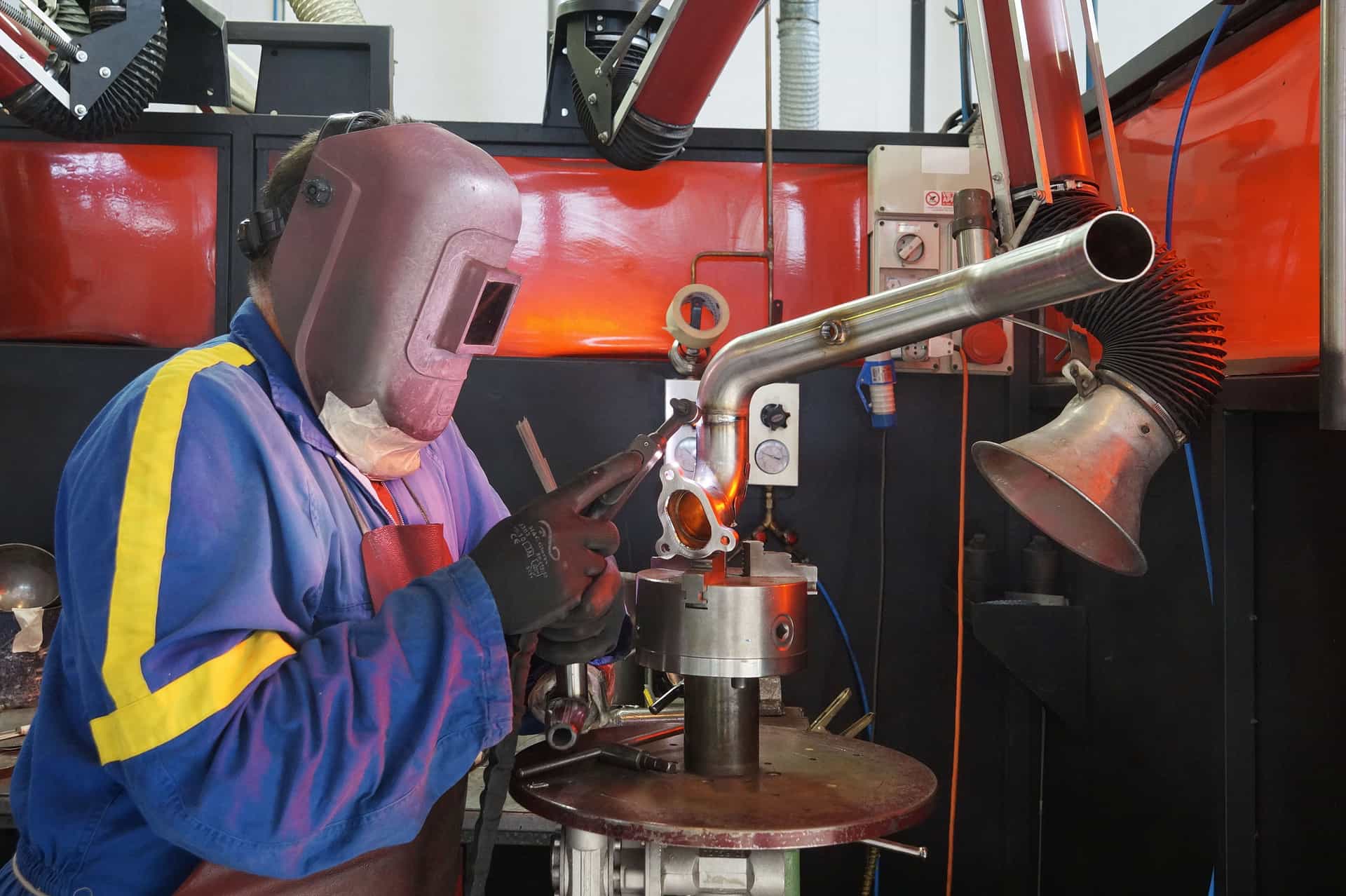
Is it safe to weld in a garage?
Yes, with four garage-specific things handled. 1. Air: a garage accumulates fume fast and an attached garage shares air with the house — open the door, put a fan blowing fume away from you and out, and wear a P100 respirator under the helmet. 2. Fire: clear a ten-foot zone, move fuel, solvents, paint, cardboard and sawdust out, keep an extinguisher within reach and stay for a fire watch after you stop. 3. The floor: do not weld directly over bare concrete — trapped moisture turns to steam and the surface spalls. 4. The car: move it out of the bay; it holds fuel, vapour, plastic and upholstery. The arc itself is the easy part — a helmet and a jacket cover it.
Most welding-safety advice is written for the arc: shade numbers, gloves, electrical basics. All of that applies in a garage and is covered on this site already. This page is about the four hazards that come from the room, which is what actually makes a garage different from a workshop.
Hazard one: you share air with the house
A detached shed vents itself. An attached garage with the door down is a sealed box that shares a wall, and often a door, with the space your family sleeps in.
Welding fume is metal oxide particulate plus gases, and the volume depends on the process: self-shielded flux-core produces considerably more than gas MIG, and welding over paint, primer, galvanizing or oil produces more still — galvanized steel in particular releases zinc oxide fume, which causes the flu-like illness welders call metal fume fever. Flux-core welding safety covers what is in the fume, and welding respiratory protection covers mask versus PAPR versus extraction.
The garage-specific fixes, in order of effect:
Open the main door, fully. Not a foot — all the way. This is the single biggest change available and it costs nothing.
Set up cross-flow, pointed the right way. A fan should pull fume away from your breathing zone and out of the building. A fan blowing at you pushes fume into your face and strips shielding gas off a gas-MIG puddle at the same time.
Close the door into the house. Obvious and routinely forgotten.
Wear the respirator anyway. Ventilation dilutes; a respirator filters at the source. They are not alternatives.
Hazard two: what else lives in a garage
Welding throws sparks several feet and spatter further, and the sparks are molten metal that stays hot after it lands. Make a list of what is within ten feet of where you intend to weld. In a typical garage it includes a fuel can, a mower with fuel in it, paint, solvent, brake cleaner, cardboard boxes, sawdust, rags, insulation and a chest freezer.
Every one of those is a fire. Three are explosions.
| Item | Why it is a problem | What to do |
|---|---|---|
| Fuel cans, mowers, trimmers | Petrol vapour is heavier than air and pools at floor level, where sparks land | Out of the garage entirely, not to the far corner |
| Aerosols, solvents, brake cleaner | Pressurised and flammable; some produce toxic gas in a UV arc field | Out of the garage. Chlorinated solvents especially |
| The car | Fuel, vapour, plastic trim, carpet and upholstery | Move it out of the bay, or a solid barrier plus a ten-foot clearance |
| Gas water heater or furnace | A standing pilot flame near flammable vapour; combustible dust intake | Never weld in the same airspace while it can cycle |
| Cardboard, sawdust, rags, insulation | Catches a spark and smoulders for hours before flaming | Clear ten feet, sweep the floor, then look up for sawdust on shelves |
| Wall and ceiling cavities | A spark through a gap smoulders out of sight | Cover gaps with a welding blanket; check after you stop |
| Floor drain or gap under the door | Sparks travel further than people expect and go where you cannot see | Block it with a blanket or sheet steel |
And the part everyone skips: the fire watch. Smouldering cardboard or sawdust can take half an hour to flame. Stay in the garage for at least thirty minutes after your last arc, with the extinguisher where you can reach it. More garage fires start after welding stops than during it.
The concrete spalling hazard
Do not strike an arc on, or let slag fall onto, a bare concrete slab. Concrete holds moisture in its pores; intense localised heat turns that water to steam faster than it can escape, and the surface fractures and throws fragments with real force. Weld over a steel bench, a steel plate or a welding blanket. This catches far more people than the arc ever does, because nothing about a concrete floor looks dangerous.
Hazard three and four: the floor and the car
A garage floor is almost always bare concrete, and almost always has an oil stain on it. Both matter: the spalling above, and the fact that an oil-soaked patch of concrete will catch.
The car is the hazard people most resist dealing with, because moving it is inconvenient. It holds fuel and fuel vapour, plastic trim, carpet and upholstery, and a spatter burn on paintwork is the cheapest possible outcome. Move it out of the bay. If that is genuinely impossible, put a solid non-combustible barrier between the car and the work and keep the full ten-foot clearance on the welding side.
The electrical and neighbour parts
Garage circuits are frequently shared and sometimes old. A welder on a circuit shared with a freezer causes nuisance trips, and a long undersized extension cord causes voltage drop that looks like a machine fault. Welder extension cords covers sizing one properly, and what size breaker for a welder covers the circuit itself. Circuit work belongs to a licensed electrician.
Two practical garage points that are not about you. An arc is bright enough to cause eye injury to a bystander, so if the door is open — and it should be — put a screen up or position yourself so the arc is not visible from the pavement, the house or the neighbour's window. And welding smoke drifting into an adjacent property is a genuine nuisance complaint; the fan direction that protects your lungs is also the one that decides where the smoke goes.
If you cannot do these things
Be honest about it rather than welding anyway. If your garage has no openable door, shares unventilated air with a bedroom, cannot be cleared of fuel and solvent, or has a gas appliance that cannot be isolated, the right answer is to weld outside — on a driveway or in a yard, which also suits self-shielded flux-core better than gas MIG anyway.
With the four hazards handled, a garage is a perfectly reasonable place to learn. The machines that suit the space are a separate question — best welders for a home garage covers that, and the welding starter kit checklist lists the PPE in buying order.
What we would buy
Arc & Bead is an Amazon Associate. If you buy through a link on this page we may earn a commission, at no extra cost to you. We have not physically tested the machines on this page and we say so on How We Pick.
1. The first purchase
3M 6000-series half-mask respirator with P100 filters
P100 particulate filtration in a low-profile shell that fits under a welding helmet without breaking the seal.
3M publishes a reusable half-facepiece respirator, P100 particulate filters (3M 2091 or equivalent), and NIOSH-approved particulate filtration.
In a garage, fume is the hazard that does the most harm and gets the least attention, because unlike a burn it does not announce itself. P100 filtration handles welding fume particulate, which is the actual exposure in a home garage.
The low-profile 6000-series shell is the practical reason this one works: it fits under most welding helmets without the hood pressing the mask off your face. A respirator that does not seal under the helmet you own is a respirator you will stop wearing.
Filters are cheap and universally stocked, which matters because the honest failure mode of respiratory protection is not buying one, it is not replacing the filters.
Three limits that must be stated. It needs a proper seal against clean-shaven skin — facial hair defeats it, and a defeated respirator protects nothing. Particulate filters do not remove gases such as ozone or carbon monoxide, so ventilation is still required. And it adds warmth and breathing resistance under a helmet.
What works
- P100 filtration handles welding fume particulate, which is the actual exposure in a home garage
- Low-profile 6000-series shell fits under most welding helmets without breaking the seal
- Filters are cheap and universally stocked
What does not
- Needs a proper seal against clean-shaven skin. Facial hair defeats it, and a defeated respirator protects nothing
- Particulate filters do not remove gases such as ozone or carbon monoxide — ventilation is still required
- Adds warmth and breathing resistance under a helmet
2. What stops a garage fire starting on you
Lincoln Electric split-leather sleeved welding jacket (K2986)
Split-leather sleeves on a flame-resistant cotton body with a high collar — the combination that matters when spatter falls rather than flies.
Lincoln publishes split-leather sleeves on a flame-resistant cotton body, with a snap front and collar.
Garage welding happens in awkward positions more than bench welding does — under a trailer, behind a mower, kneeling on a slab — and in those positions spatter falls onto you rather than away. Leather sleeves stop spatter that a cotton shirt merely delays, and the difference matters most overhead.
The high collar is the detail worth paying for. A spatter burn on the neck ruins a whole day and is entirely avoidable, and the neck is the gap a helmet does not cover.
The flame-resistant cotton body is the right compromise for a garage specifically: an all-leather jacket in a hot summer garage gets taken off, and PPE that gets taken off protects nobody.
Costs: still hot to wear, so expect shorter bursts in summer; and for heavy out-of-position stick work the all-leather jacket is the right one.
What works
- Leather sleeves stop spatter that a cotton shirt merely delays — the difference matters most overhead
- High collar protects the neck, which is where a burn ruins a whole day
- The cotton body is cooler and less restrictive than an all-leather jacket without giving up arm protection
What does not
- Still hot to wear. In a summer garage you will weld in shorter bursts
- The flame-resistant cotton body is not leather — for heavy out-of-position stick work the all-leather jacket is the right one
3. Basic protection that affects your welding
Lincoln Electric traditional MIG/stick welding gloves
Split leather with an insulated lining and a long cuff, thick enough that you stop flinching — which improves gun control more than any setting.
Lincoln publishes split leather with an insulated lining, intended for MIG, flux-core and stick.
The long cuff is the garage-relevant part. It protects the wrist gap where spatter finds you, and in a garage you are frequently reaching into or under something rather than working on a clear bench.
The less obvious benefit is on the welding itself: thick enough gloves mean you can rest a hand near the work without flinching, and a hand that is resting is a hand that is steady. That improves gun control more than any machine setting.
Two limits. They are far too thick for TIG — you cannot feel a filler rod through them — and they are stiff until broken in.
What works
- Thick enough that you can rest a hand near the work without flinching, which improves your gun control more than any setting
- Long cuff protects the wrist gap where spatter finds you
What does not
- Far too thick for TIG — you cannot feel a filler rod through them
- Stiff until broken in
Who this is wrong for: TIG work. If TIG is why you are in the garage, thin kidskin gloves are the right choice and these are not.
Questions people actually ask
Is it safe to weld in an attached garage?
With precautions, yes - and the precautions matter more than in a detached space, because an attached garage shares air with the house. Open the main door fully, set a fan to pull fume away from you and out of the building, close the door into the house, and wear a P100 respirator under your helmet.
Then deal with fire: clear ten feet, remove fuel, solvents, paint, cardboard and sawdust, keep an extinguisher within reach, and stay for a thirty-minute fire watch after you stop.
Do I need ventilation to weld in a garage?
Yes, always, and a respirator does not replace it. Particulate filters handle metal fume particulate but do not remove gases such as ozone or carbon monoxide, so the air still has to be changed.
The cheapest effective setup is the main door fully open with a fan positioned to draw fume away from your breathing zone and out. A fan blowing at you pushes fume into your face and strips shielding gas off a gas-MIG puddle at the same time.
Can you weld on a concrete floor?
Not directly on it. Concrete holds moisture in its pores, and intense localised heat turns that water to steam faster than it can escape - the surface fractures and throws fragments with real force.
Weld over a steel bench, a steel plate or a welding blanket. This hazard catches more people than the arc does, because nothing about a concrete floor looks dangerous.
What should I move out of the garage before welding?
Fuel cans, mowers, trimmers and anything else holding petrol - vapour is heavier than air and pools at floor level where sparks land. Then aerosols, solvents and brake cleaner, with chlorinated solvents especially, because some produce toxic gas in a UV arc field.
After that: cardboard, sawdust, rags and insulation within ten feet, and the car out of the bay. A gas water heater or furnace with a standing pilot should never be cycling in the same airspace.
Is flux-core safe to use in a garage?
It is usable with good ventilation, and it is the higher-fume choice. Self-shielded flux-core produces considerably more fume than gas MIG, because the shielding comes from flux burning at the arc.
In an open driveway that is manageable. In a closed garage - especially an attached one - it is the strongest argument for gas MIG for indoor work, and for keeping flux-core for the jobs you do outside.
How long should I stay in the garage after welding?
At least thirty minutes, with the extinguisher within reach. Smouldering cardboard, sawdust or an oil-soaked patch of concrete can take that long to flame, and more garage fires start after welding stops than during it.
Use the time to check the places a spark could have gone out of sight: wall and ceiling gaps, under shelving, the gap under the door and any floor drain.
Can welding in my garage hurt my neighbours?
In two ways worth managing. An arc is bright enough to cause eye injury to a bystander, so with the door open - which it should be - put up a screen or position yourself so the arc is not visible from the pavement, the house or a neighbour's window.
And welding smoke drifting into an adjacent property is a genuine nuisance. The fan direction that protects your lungs also decides where the smoke goes, so point it somewhere sensible.
Sources
- 3M — 6000-series half-facepiece respirator published specifications: reusable half facepiece, P100 particulate filters (3M 2091 or equivalent), NIOSH-approved particulate filtration, low-profile shell
- Lincoln Electric — K2986 split-leather sleeved welding jacket published specifications: split-leather sleeves on a flame-resistant cotton body, snap front with collar
- Lincoln Electric — traditional MIG/stick welding gloves published specifications: split leather with insulated lining, long cuff, intended for MIG, flux-core and stick
- ANSI Z49.1 — Safety in Welding, Cutting and Allied Processes, the US consensus standard covering ventilation, fire prevention and the fire watch
Read next
- Flux-core welding safety
Fume, eyes and fire — including the risks that show up hours after you stop welding.
- Welding respiratory protection: fume mask, PAPR or extraction
Half-mask, powered air or extraction — the three welding respiratory protection systems compared.
- Best Welders for a Home Garage
Welders chosen for garage constraints: the existing circuit, storage footprint, ventilation and fire risk.
- The welding starter kit checklist
Everything that is not the welder, ordered by how much each item changes your results.
- What size breaker do you need for a welder?
Read the rating plate, not the marketing. What decides the circuit, and what to tell your electrician.
- Find your level before you spend a penny
Most bad first welder purchases are not bad machines. They are the right machine bought by the wrong person, one level too early or one level too late.
Back to Find Your Level, or start over at Find Your Level.
Ryder M.
Ryder M. is the hands-on owner behind Magoo Media Group. He writes Arc & Bead's buying guides and picks every machine on the site. What every recommendation is based on — and what it is not based on — is set out on How We Pick.