The best welding carts
Nobody wants a welding cart. You buy one the week a gas cylinder arrives and there is nowhere safe to put it. Ranked on cylinder security, storage that is actually useful, and footprint - because a garage is also a parking space.
Arc & Bead is an Amazon Associate. If you buy through a link on this page we may earn a commission, at no extra cost to you. We have not physically tested the machines on this page and we say so on How We Pick.
Quick picks
Tap any row to jump to the full write-up further down this page.
| # | Product | Best for | Price |
|---|---|---|---|
| 1 | 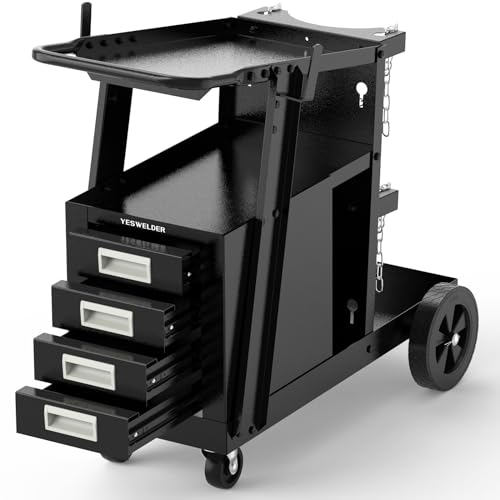 YESWELDER 2-tier welding cart with four drawersFour drawers, two chained cylinder slots and 245 lb of capacity - the cart for a shop where the consumables are currently in four different places. | Best for drawers and two bottles | |
| 2 | 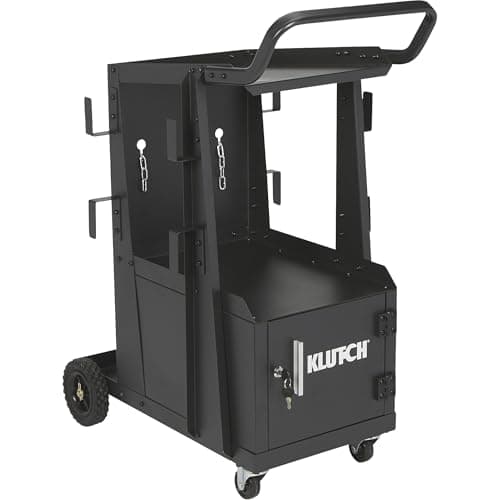 Klutch 2-tier welding cart with cabinetA locking cabinet instead of drawers, with the cylinder rack and four cable wrap sets - the pick if the shop is shared or unattended. | Best with a lockable cabinet | |
| 3 | 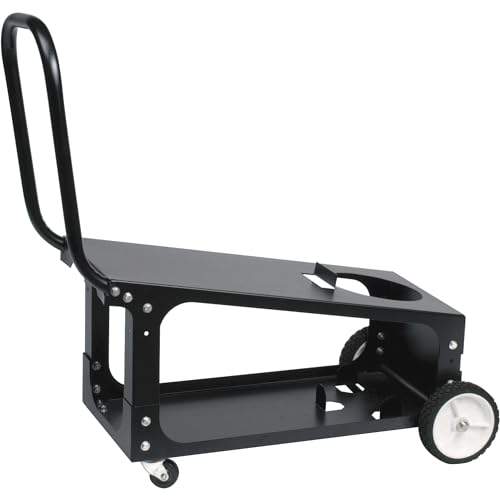 Lincoln Electric K2275-3 welding cartFourteen inches wide with an angled top shelf, built for an 80 cubic foot bottle and a compact wire feeder. The cart for a garage that is also a parking space. | Best small cart | $149.99 · View on Amazon #ad How this is funded · Price as of November 13, 2026 |
| 4 | 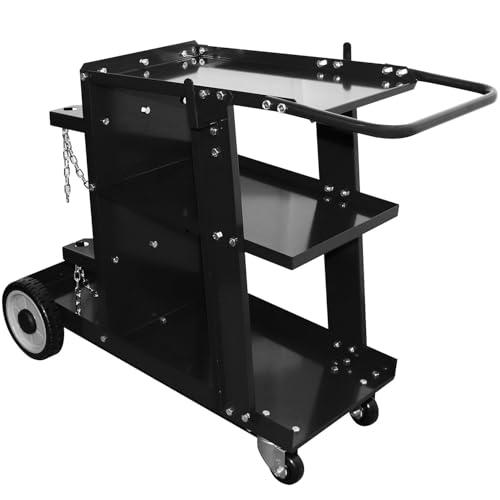 Weldpro 3-tier heavy duty welding cartFour hundred pounds static, a 125 cubic foot cylinder rating and a bottom tray big enough for the helmet - at the cost of a 40 inch footprint. | Best for a heavy machine |
The short answer
Buy the cart that secures the cylinder and fits the floor you have; the storage is the tiebreak. The YESWELDER four-drawer cart is the pick for most home shops — four drawers, two chained cylinder slots, 245 lb. The Klutch two-tier with cabinet swaps drawers for a locking cabinet and adds four cable wrap sets, at 100 lb. The Lincoln K2275-3 is the small-garage answer at 14 in wide with an angled top shelf, but publishes no load capacity. The Weldpro 3-tier is the one rated for a heavy machine at 400 lb static and a 125 cu ft bottle, and it is 40.5 in long.
A welding cart is not a purchase anyone looks forward to. It happens in a specific week: the gas bottle arrives, you stand it in the corner of the garage with a bungee cord around it, and about two days later you realize that a 5 ft steel cylinder of compressed gas resting against a wall in a space where a car reverses is not a plan.
That is the real function of a welding cart, and it is why this page sits under gas and power rather than in a tool list. A secured upright cylinder is the single most important physical safety change in a home shop once you own gas. Everything else a cart does — shelves, drawers, cable hooks — is a convenience built around that one job.
What we ranked on, in order
1. How the cylinder is secured, and which cylinders fit. A chain or a strap plus a rack that physically locates the bottle's base. Two numbers matter: the maximum diameter or cylinder size the rack takes, and whether there are one or two slots. A bottle that does not fit the rack is a bottle still leaning against a wall.
2. Load capacity, and whether it is a real figure. This separates these four more than anything else: 245 lb, 100 lb, 400 lb static, and one cart with no published figure at all. A static rating is what the cart holds standing still, not what you should roll across a threshold — see the note below.
3. Footprint, weighted heavily. Most home welders work in a garage that is also where a car lives, so 40 in of cart length is a bigger deal than 100 lb of extra capacity. We rank footprint above storage for that reason.
4. Storage that matches what welding actually generates. Welding produces two categories of clutter: lots of small consumables, and a few bulky items. Drawers solve the first; a cabinet solves the second and can be locked. A flat shelf solves neither, it just stacks them.
5. Cable management. The least glamorous item here and the one used most. A wire feeder has three leads, and on the floor they are a trip hazard and a liner that gets kinked. Hooks or wraps fix that for nothing.
6. Shelf dimensions against the machine you own. Published shelf sizes are the one figure that makes a cart simply not work. Measure your welder first — a 19 in deep machine on a 13 in shelf overhangs, and an overhanging machine on casters is how a cart tips.
A static load rating is not a rolling load rating.
Cart capacities are published as static figures: what the frame holds while standing still on level ground. Rolling a loaded cart over a garage lip, a door threshold or a gravel driveway loads it dynamically and loads it unevenly — and that is when a cart folds or tips. Treat the published number as a ceiling you stay well under, keep the heavy item as low as the design allows, and move a full cylinder slowly. None of the carts on this page publishes a dynamic rating, which is normal for the category and worth knowing.
The four, on the figures that actually differ
| Cart | Capacity | Cylinder provision | Storage | Footprint / overall | Wheels |
|---|---|---|---|---|---|
| YESWELDER 2-tier, 4 drawers | 245 lb | Two slots, bottles up to 10 in dia., two 29.5 in steel chains | 4 drawers at 11.22 x 8 in, two shelves, side hooks | Listed 32.68 x 15.55 x 27.57 in | 2 swivel casters, 2 rear |
| Klutch 2-tier with cabinet | 100 lb | One bottle up to 7 in dia. | Locking cabinet 19-1/2 x 14 x 12 in, two shelves, 4 cable wrap sets | 31.5 x 16.1 in | 2 in front swivel, 6 in rear |
| Lincoln Electric K2275-3 | Not published | One 80 cu ft cylinder | Angled top shelf, lower tool tray, cable wrap hook | 14 in W x 21 in H x 28 in D | Two wheels, tilt and roll |
| Weldpro 3-tier | 400 lb static | Cylinders up to 125 cu ft, two steel chains | Three trays, bottom 33.1 x 13.8 in, 4 brackets, 2 hooks | 40.5 x 18.2 x 30.7 in | 2 swivel, 2 fixed rear |
The useful way to read that table is right to left. Start with the footprint column against the floor you actually have, then the capacity column against your machine's weight, and only then look at the storage. A cart with perfect drawers that does not fit the garage is not a cart.
Does a welding cart need to hold the cylinder?
Yes, and this is the one place we will be blunt. A compressed gas cylinder standing unsecured is the hazard every welding safety document leads with, for an unglamorous reason: if a full cylinder falls and the valve breaks off, the bottle becomes a projectile driven by the entire contents escaping at once. It is rare. It is also not survivable in a closed garage, which is why every supplier chains their bottles and why your own should be chained or strapped whether it is on a cart or against a wall.
A cart is the practical version of that rule, because it solves securing and moving at the same time. A chained bottle in a corner is safe and useless; the point of gas is that the machine and the bottle go to the work together. The rest of the gas setup — which mix, which bottle, lease against exchange — is in what gas for MIG welding and welding gas cylinder sizes.
Two details the listings will not tell you. Cylinders are stored and used upright, valve up — that is a requirement for acetylene and good practice for everything else. And the valve cap goes back on whenever the regulator is off, because the cap is what protects the valve in a fall, which is the failure the whole rule exists for.
Drawers, cabinet or shelves — which you actually want
Welding generates two different storage problems and the three cart types each solve one of them.
Drawers are for the small-and-numerous problem: contact tips in two sizes, nozzles, diffusers, drive rollers, tungstens, collets, filler rod offcuts, magnets, soapstone. These are the items that stop a job when they go missing, they are individually tiny, and a shelf turns them into a pile. Four small drawers beat one big one here.
A locking cabinet is for the bulky-and-valuable problem: the helmet, the gloves, a spool of wire, a box of rod, the regulator when it is off the bottle. It also locks, which is the deciding factor in a shared garage, a rented unit or a house with children. A helmet left on a shelf gets a scratched lens; a helmet in a cabinet does not.
Shelves only is the right answer if your constraint is floor space and you already have a tool chest. The Lincoln is the clearest example on this page — it does the cylinder job and the machine job in 14 in of width, and it leaves storage to something else.
What none of them should hold is your consumable wire out in the open for months. MIG and flux-core wire rusts, and rusty wire welds badly — one more reason the cabinet carts earn their keep. The wire itself is covered in the welding wire size chart.
Before you order: three measurements
Your machine's footprint and weight. Both are in the manual and both decide the cart. A machine wider or deeper than the shelf will overhang, and an overhanging machine on casters is how a loaded cart goes over. Weight tells you which capacity column you are shopping in — and remember the cylinder adds to it.
Your cylinder's diameter. Racks are specified by diameter or by cylinder size, and this is the figure people skip. The Klutch takes a bottle up to 7 in across; a larger cylinder will not sit in it. If you have not chosen a bottle size yet, choose it before the cart.
The gap the cart has to live in and pass through. Not just where it parks — the doorway, the gap between the bench and the car, the lip at the garage door. A 40 in cart that cannot turn into the space it lives in is worse than a smaller one with less capacity.
And once the cart is loaded, the other half of a gas setup is the electrical side: what circuit the machine is on, and whether the cord reaches. What size breaker for a welder and welder extension cords cover that, and the best angle grinders for welding is the tool that ends up living on the cart's bottom shelf.
How we decided this
Published figures only. Every dimension and capacity on this page is the manufacturer's own published specification as carried on its product or retailer listing, read on the publication date. Lincoln publishes no load capacity for the K2275-3, so the table says so — we did not estimate one from the steel. We have assembled none of these carts and loaded none of them.
Static ratings are labeled static. Weldpro publishes 400 lb as a static load. Presenting that next to a 245 lb figure as though they were the same measurement would flatter it, so the table carries the word and the callout above explains why it matters.
Availability checked before publishing. All four carts were confirmed purchasable and title-matched to their registry entries on the publication date.
Footprint outranks features. The cart with the best published capacity is also the one that takes a parking space, and we said so on its own entry rather than only in a footnote. More on the method on how we pick.
1. Best for drawers and two bottles
YESWELDER 2-tier welding cart with four drawers
Four drawers, two chained cylinder slots and 245 lb of capacity - the cart for a shop where the consumables are currently in four different places.
YESWELDER publishes this cart as a 245 lb capacity two-tier with four drawers of 11.22 x 8 in, a top shelf of 11.3 x 17.7 in and a middle shelf of 11.3 x 17.8 in, two cylinder slots of 11.2 x 10.47 in taking bottles up to 10 in diameter, two stainless steel safety chains of 29.5 in, two 360-degree swivel casters with two heavy-duty rear wheels, a steel-plate frame with rust-resistant paint, and a listed overall size of 32.68 x 15.55 x 27.57 in.
The drawers are the reason it wins, and they are the thing a shelf-only cart cannot fake. Welding consumables are small and numerous — contact tips, nozzles, diffusers, tungstens, collets, filler rod, chipping hammer, wire brush, magnets — and in most home shops they live in a cardboard box, a drawer in the house and a coffee can. Four drawers on the machine means the part you need is where the machine is, which is the difference between a five-second tip change and a ten-minute search.
Two chained cylinder slots is the second real advantage. Most home shops end up with more than one bottle — a 75/25 argon-CO2 mix for MIG and straight argon for TIG — and the second bottle is the one that ends up leaning against a wall. Both travelling with the machine, chained, is the right outcome. Welding gas cylinder sizes covers which bottles those slots will take.
The honest limits: 11.22 x 8 in drawers are consumables drawers, not tool drawers, and nothing long fits. There is no lock, so this is organization rather than security. And 245 lb will not carry a 240 V transformer machine — check your welder's weight before you order.
What works
- Four drawers is the feature people are actually searching for, and it is the one thing a shelf-only cart cannot fake: tips, nozzles, tungstens and filler stop living in a drawer in the house
- Two chained cylinder slots mean a shielding gas bottle and an argon bottle travel with the machine instead of standing loose against a wall
- 245 lb capacity covers a 120 V wire feeder and a bottle with real margin
- Two swivel casters plus two fixed wheels is the layout that actually steers in a tight garage
What does not
- The drawers are small — 11.22 x 8 in is a consumables drawer, not a tool drawer, and nothing long fits
- No locking cabinet, so this is organization rather than security
- 245 lb is not a 240 V transformer-machine capacity. Check your welder's weight first
- Flat-pack assembly, and the published dimensions are the listing's rather than a measured footprint
2. Best with a lockable cabinet
Klutch 2-tier welding cart with cabinet
A locking cabinet instead of drawers, with the cylinder rack and four cable wrap sets - the pick if the shop is shared or unattended.
Klutch publishes this as a two-tier cart with a locking cabinet measuring 19-1/2 x 14 x 12 in behind an 11-1/2 x 10-1/4 in door, a top shelf of 18-3/4 x 13-3/4 in, a middle shelf of 19-1/2 x 13-3/4 in with 15-1/4 in of clearance beneath, a built-in cylinder rack for one bottle up to 7 in diameter, four sets of cable wraps, two 2 in front swivel casters with two 6 in rear wheels, steel construction with a powder-coat finish, a 31.5 x 16.1 in footprint and a 100 lb capacity.
The cabinet is the trade against the YESWELDER's drawers, and which is right depends on your shop rather than on the cart. A locking cabinet holds more in one space — a helmet, gloves, a spool of wire, a box of rod — and it locks, which matters in a shared garage, a rented space or anywhere children can reach. Drawers sort small parts better; a cabinet secures bulky ones.
The four cable wrap sets are the detail that gets overlooked and gets used daily. A wire feeder has a gun lead, a work lead and a power cord, and in most garages all three end up on the floor between jobs. Cables on hooks are a trip hazard removed and a lead that lasts longer, because the thing that kills a MIG gun liner is being walked on and kinked.
Where it stops: 100 lb is the lowest capacity here, and a 53 lb machine plus a bottle is most of it — this is not the cart for a 240 V transformer welder. The cylinder rack takes one bottle up to 7 in diameter, so a bigger cylinder or a second one does not fit. Assembly is fiddly. And it is 31.5 in long in a shop that probably has no spare footprint.
What works
- A secured cylinder is the single most important safety change in a home shop once you own gas
- Gets the machine and bottle moving together, which is what actually makes a gas setup usable in a garage
- The locking cabinet takes the consumables that otherwise live in four places
- Four sets of cable wraps, so the leads are not a trip hazard between jobs
What does not
- 100 lb capacity. A 53 lb machine plus a bottle is most of it, so this is not the cart for a 240 V transformer welder
- Assembly is fiddly and the hardware is not generous
- Adds footprint to a shop that probably has none to spare
3. Best small cart
Lincoln Electric K2275-3 welding cart
Fourteen inches wide with an angled top shelf, built for an 80 cubic foot bottle and a compact wire feeder. The cart for a garage that is also a parking space.
Lincoln publishes the K2275-3 as a heavy-duty steel cart measuring 14 in W x 21 in H x 28 in D, designed to store and transport a welder, an 80 cu ft gas cylinder, welding cables and accessories, with an angled top shelf for access to the controls, a lower tool tray, two wheels, a handle and a cable wrap hook, and a 12-month warranty. Lincoln states compatibility with its own wire feed and MIG machines including the 140HD, 180HD and LE31MP.
The angled top shelf is the feature worth paying for and the one most carts do not have. A welder sitting flat on a shelf at knee height has its dials facing the ceiling, so you adjust voltage and wire speed by crouching and guessing. Angled toward you, they are readable from standing — which matters because dialling a setting in is a loop of small adjustments, not a single decision. The settings themselves are in the MIG settings chart.
Fourteen inches wide and 28 in deep is the smallest footprint here by a wide margin, and in a single-car garage that is frequently the whole decision. The two-wheel tilt-and-roll layout helps for the same reason: it clears a garage lip or a threshold that stops a four-caster cart dead.
The honest gaps: Lincoln publishes no load capacity for this cart, so there is no figure to check a heavy machine against, and that is why it is not ranked higher. Tilt-and-roll is worse than casters for repositioning in place, especially with a full bottle on it. It is shelves only — no drawers, no cabinet, no lock. And it is sized for an 80 cu ft bottle and a compact 120 V machine; a 240 V welder is the wrong fit, which is covered in the best 240V welders for the home shop.
What works
- The angled top shelf is the detail worth paying for: the machine's dials face you instead of the ceiling, which is the difference between adjusting the voltage and guessing at it
- 14 in wide and 28 in deep is a genuinely small footprint for a garage that is also a parking space
- Two wheels and a handle means it tilts and rolls like a hand truck, so it clears a threshold or a garage lip that stops a four-caster cart
- Lincoln publishes which of its own machines this fits, so the fit question is answered before you order
What does not
- Lincoln publishes no load capacity for this cart, so there is no figure to check a heavy machine against
- Tilt-and-roll is less convenient than swivel casters for repositioning in place, and it is harder to move with a full bottle on it
- Shelves only. No drawers, no cabinet, no lock
- Sized for an 80 cu ft bottle and a compact wire feeder. A 240 V machine or a larger cylinder is the wrong fit
Who this is wrong for: A heavy machine. With no published capacity and a 14 in shelf, this is a cart for a compact wire feeder and an 80 cu ft bottle, not for a transformer welder.
4. Best for a heavy machine
Weldpro 3-tier heavy duty welding cart
Four hundred pounds static, a 125 cubic foot cylinder rating and a bottom tray big enough for the helmet - at the cost of a 40 inch footprint.
Weldpro publishes this cart as a 400 lb static load capacity three-tier in thickened steel plate with an anti-rust textured finish, with upper and middle trays of 20.9 x 13 in, a bottom tray of 33.1 x 13.8 in, two stainless steel safety chains rated for cylinders up to 125 cu ft, two 360-degree swivel wheels with two heavy-duty fixed rear wheels, four side-mounted brackets and two side hooks, overall dimensions of 40.5 x 18.2 x 30.7 in, and a published assembly time of 15 to 20 minutes.
This is the only cart on the page whose published figures comfortably cover a 240 V machine with a full-size bottle. A multiprocess inverter is light, but a transformer welder is not, and a full 125 cu ft cylinder is heavy on its own — the other three carts here are rated at 245 lb, 100 lb and not-published. If your machine is the heavy kind, this is the shortlist.
The bottom tray is the second reason to want it. At 33.1 x 13.8 in it takes the things that otherwise sit on the floor around a welder: the helmet, the gloves, a box of rod, a handful of clamps. A cart that absorbs the floor clutter is doing more for a small shop than one that just moves the machine.
The costs are real. Forty-and-a-half inches long is the cart that takes a parking space, and in a one-car garage that outweighs every spec above. There are no drawers and nothing lockable, so storage is trays and hooks only. The layout was designed around Weldpro's own machines, so the cable hooks and strapping points sit where theirs want them. And 400 lb is a static figure — a cart loaded to its static rating is not one you should be rolling over a threshold.
What works
- 400 lb static capacity and a 125 cu ft cylinder rating are the only figures on this page that comfortably cover a 240 V machine and a full-size bottle
- A 33.1 x 13.8 in bottom tray is big enough for the things that otherwise sit on the floor — helmet, gloves, rod, clamps
- The 20.9 x 13 in trays take a wider machine than either compact cart here
- Published figures throughout, including an assembly time, which is rarer than it should be in this category
What does not
- 40.5 in long. This is the cart that costs you a parking space, and in a one-car garage that is the whole decision
- No drawers and nothing lockable, so the organization is trays and hooks only
- The layout is optimized for Weldpro's own machines; it fits others, but the cable hooks and strapping points were placed for theirs
- 400 lb is a static figure. A cart loaded to its static rating is not a cart you should be rolling over a threshold
Who this is wrong for: A small garage. The published capacity is the best here and the 40.5 in footprint is the worst; if floor space is your constraint, the Lincoln is the honest answer.
Questions people actually ask
Do I need a welding cart?
You need one as soon as you own a gas cylinder. A compressed gas bottle has to be stored and used upright and secured, and a cart is the version of that which also lets the bottle travel with the machine - which is the whole point of having gas.
If you only run gasless flux-core, a cart is convenience rather than safety: it gets the machine and the cables off the floor and makes the welder easy to move. Useful, but not urgent.
What should I look for in a welding cart?
In order: a cylinder rack with a chain or strap that fits your bottle's diameter, a published load capacity above your machine plus cylinder weight, a footprint that fits the space you actually have, and shelf dimensions larger than your welder's base.
After that, storage is the tiebreak - drawers for consumables, a locking cabinet for bulky items, and cable hooks to keep the leads off the floor.
How much weight can a welding cart hold?
It varies enormously, and some manufacturers do not publish a figure at all. Of the four carts on this page, the published capacities are 100 lb, 245 lb and 400 lb static, and one cart has no published rating.
Check the figure against your machine's weight plus the cylinder, and treat it as a ceiling to stay under rather than a target. A static rating describes the cart standing still, not being rolled over a threshold.
Is a welding cart with drawers worth it?
For most home shops, yes - because the clutter welding generates is small and numerous. Contact tips, nozzles, diffusers, drive rollers, tungstens, collets and filler offcuts are the parts that stop a job when they go missing, and on an open shelf they become a pile.
The trade is that drawers are usually small. If what you need to store is bulky - a helmet, a spool of wire, a box of rod - a locking cabinet holds more and can be locked.
Can one welding cart hold two gas cylinders?
Some do. Of the carts on this page, the YESWELDER has two cylinder slots with a stainless chain for each, taking bottles up to 10 inches in diameter.
That matters more than it sounds once you weld more than one process: a 75/25 argon-CO2 mix for MIG and straight argon for TIG are two separate bottles, and the second one is usually the one that ends up leaning against a wall.
Does a welding cart have to be grounded?
No, and this is a common misunderstanding. The work clamp is the return path for the welding circuit and it goes directly on the workpiece, as close to the weld as you can get it. A cart is not part of that circuit.
What matters is that you do not use the cart as the return path by clamping to it - that routes current through the cart's joints and casters instead of through the metal you are welding, which makes for poor arc starts and unpredictable results.
Will a welding cart fit my welder?
Measure before you order. Compare your machine's width and depth against the cart's published shelf dimensions, and its weight plus your cylinder's weight against the published capacity.
Shelf depth is where this usually goes wrong: a 19 inch deep machine on a 13 inch shelf overhangs, and an overhanging machine on casters is how a loaded cart tips. Some manufacturers publish which of their own welders a cart is designed for, which answers the question outright.
Sources
- YESWELDER - 2-tier welding cart with 4 drawers and dual cylinder slots published specifications: 245 lb weight capacity, top layer 11.3 x 17.7 in, middle layer 11.3 x 17.8 in, drawer size 11.22 x 8 in, gas cylinder slots 11.2 x 10.47 in for cylinders up to 10 in, cylinder chain length 29.5 in, two stainless steel safety chains, two 360-degree swivel casters and two heavy-duty rear wheels, steel-plate frame with rust-resistant paint; published on its Amazon product listing, ASIN B0CD26VY6B (checked 2026-11-05)
- Klutch - 2-tier welding cart with cabinet published specifications: 100 lb capacity, 31.5 in L x 16.1 in W footprint, locking cabinet 19-1/2 x 14 x 12 in with an 11-1/2 x 10-1/4 in door opening, top shelf 18-3/4 x 13-3/4 in, middle shelf 19-1/2 x 13-3/4 in with 15-1/4 in clearance, cylinder rack for one bottle up to 7 in diameter, four cable wrap sets, two 2 in front swivel casters and two 6 in rear wheels, powder-coated steel; published on its Amazon product listing, ASIN B0B8QWDQ4D (checked 2026-11-05)
- Lincoln Electric - K2275-3 welding cart published specifications: stores and transports a welder, an 80 cu ft gas cylinder, welding cables and accessories; angled top shelf plus lower tool tray; two wheels; sturdy handle and cable wrap hook; heavy-duty steel; 14 in W x 21 in H x 28 in D; stated compatibility with Lincoln 140HD, 180HD and LE31MP; 12-month warranty; published on its Amazon product listing, ASIN B00NO0Z1J8 (checked 2026-11-05)
- Weldpro - 3-tier heavy duty welding cart (L25007) published specifications: 400 lb static load capacity, upper and middle trays 20.9 x 13 in, bottom tray 33.1 x 13.8 in, two stainless steel safety chains for cylinders up to 125 cu ft, two 360-degree swivel wheels and two heavy-duty fixed rear wheels, four side-mounted brackets and two side hooks, overall 40.5 x 18.2 x 30.7 in, thickened steel plate with anti-rust textured finish, published assembly time 15 to 20 minutes; published on its Amazon product listing, ASIN B08G5CW3DY (checked 2026-11-05)
Read next
- Welding gas cylinder sizes
What each common cylinder holds, how long it lasts at real flow rates, and lease versus buy.
- What gas do you need for MIG welding?
Which shielding gas for which metal, and the one combination that cannot work.
- The best angle grinders for welding
Four 4-1/2 inch grinders ranked on kickback protection, dust sealing and tool-free changes rather than on raw amperage, scoped to welding work.
- The best 240V welders for a home shop
The machines worth running a 240V circuit for, and how to size that circuit before you buy.
- Welder extension cords: how to size one properly
Voltage drop, gauge and length — why a thin cord makes a good machine weld badly.
- The welding starter kit checklist
Everything that is not the welder, ordered by how much each item changes your results.
Back to Gas & Power, or start over at Find Your Level.
Ryder M.
Ryder M. is the hands-on owner behind Magoo Media Group. He writes Arc & Bead's buying guides and picks every machine on the site. What every recommendation is based on — and what it is not based on — is set out on How We Pick.