The best welders for exhaust pipe
Exhaust tubing is thin, round and usually stainless or aluminized. All three of those push you toward a machine with a good low end rather than a big top end.
Arc & Bead is an Amazon Associate. If you buy through a link on this page we may earn a commission, at no extra cost to you. We have not physically tested the machines on this page and we say so on How We Pick.

Quick picks
Tap any row to jump to the full write-up further down this page.
| # | Product | Best for | Price |
|---|---|---|---|
| 1 | 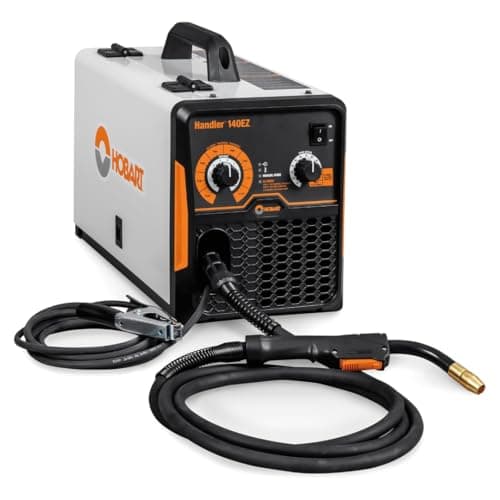 Hobart Handler 140EZA published 30 A minimum, which is the figure that decides whether you blow holes. | Best overall for exhaust | $720.00 · View on Amazon #ad How this is funded · Price as of November 13, 2026 |
| 2 | 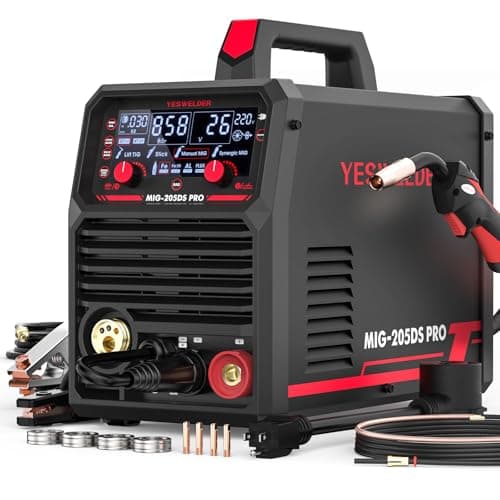 YESWELDER MIG-205DS PROSynergic MIG from 30 A up, with stick in the same box for rusted-on brackets. | Best for mixed exhaust and chassis work | |
| 3 | 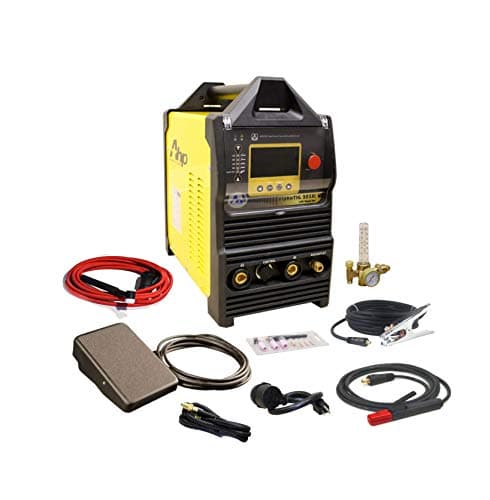 AHP AlphaTIG 200XAC/DC TIG from 10 A, which is the process a stainless system actually wants. | Best for stainless exhaust | $689.00 · View on Amazon #ad How this is funded · Price as of November 13, 2026 |
| 4 | 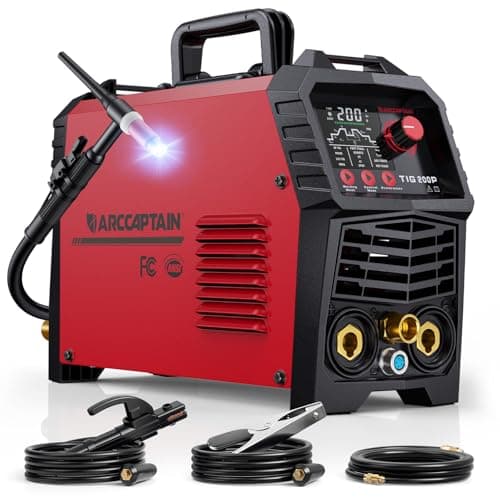 ARCCAPTAIN TIG200PHF-start DC TIG from 10 A in an 11.8 lb machine, for steel and stainless only. | Best portable TIG for exhaust | $249.99 · View on Amazon #ad How this is funded · Price as of November 13, 2026 |
What exhaust tube actually is
Most exhaust tubing is 16 gauge — 0.065 inch of wall — in either aluminized mild steel or 409 stainless, which is what the majority of modern cars leave the factory with. At that wall thickness the problem is never power, it is control: the best welder for exhaust pipe is the one with the lowest usable minimum amperage and the finest adjustment near it, not the one with the highest output.
| Hobart Handler 140EZ | YESWELDER MIG-205DS PRO | AHP AlphaTIG 200X | ARCCAPTAIN TIG200P | |
|---|---|---|---|---|
| Process for exhaust | Gas MIG | Gas MIG, or stick for rusty brackets | AC/DC TIG | DC TIG (HF start) |
| Published minimum | 25 A | 30 A MIG | 10 A TIG | 10 A TIG |
| Heat control mid-weld | Trigger only | Trigger, 2T/4T on the ARCCAPTAIN sibling | Foot pedal | Foot pedal (extra) |
| Input | 115 V, 20 A dedicated | 110 V or 220 V | 110 V or 220 V | 110 V or 220 V |
| Weight | Not published | 22.7 lb | 50 lb | 11.8 lb |
| Suits 409 / aluminized | Yes | Yes | Yes | Yes |
| Suits 304 stainless well | Workable with the right gas | Workable with the right gas | Yes | Yes |
Burn-through is the only real failure mode
On 0.065-inch wall, too much heat does not make an ugly weld. It makes a hole, and the hole is usually at the bottom of a joint you cannot see from where you are lying.
Three things control it, in order of how much they matter.
Wire diameter. Use 0.023 or 0.024 inch solid wire, not 0.030. A thinner wire carries less current at the same feed rate, which lowers the whole operating window into the range thin tube can survive. The wire size chart sets out the ranges.
Technique. Short stitches with pauses between, working around the tube in opposite quarters rather than continuously, so the heat never concentrates. A continuous bead right round a pipe will reliably drop through somewhere in the last quarter.
Fit-up. A gap you are bridging needs more heat than a joint that touches. On thin tube, time spent making the cut square and the fit tight is time you do not spend filling a hole. MIG welding sheet metal covers the same problem on flat panels.
Why flux-core is the wrong process here
It is worth being blunt about this, because a flux-core machine is what many people own.
Self-shielded flux-cored wire runs hotter than solid wire at equivalent settings and the smallest common diameter is 0.030 inch, which is already at the top of what 16-gauge tube tolerates. The combination makes burn-through the default outcome rather than a mistake.
It also leaves slag. On the outside of a joint that is an inconvenience; on the inside of an exhaust tube it is slag you will never reach, sitting in a gas path.
And the spatter is the part people underestimate. Flux-core throws a great deal of it, and on an exhaust job that means spatter on the underside of a car that is substantially more annoying to clean than the weld was to make.
If flux-core is genuinely all you have, the job is possible with 0.030 wire turned as low as the machine goes, very short stitches and generous cooling time. It is not the process you would choose. Flux-core versus MIG covers where each one genuinely wins.
Gas: aluminized and 409 want one mix, 304 wants another
Aluminized mild steel and 409 stainless both weld acceptably with the ordinary 75/25 argon/CO2 mix that is already on a home MIG machine. Aluminized tube has an aluminum-silicon coating that burns off in the arc, so grind the coating back at the joint before you weld and expect more fume than bare steel — work outside or with real extraction.
For 304 stainless MIG, 75/25 puts too much carbon into the weld. The common home-shop answer is a 98/2 argon/CO2 mix, which keeps enough CO2 for arc stability while keeping carbon pickup low.
For TIG, any of these metals wants 100% argon, and a stainless system you intend to keep wants argon purging the inside of the pipe as well. What gas for TIG welding covers that in full, and 75/25 against 100% argon covers why the mixes are not interchangeable.
Fume, position and the car above you
Exhaust work puts your head under a vehicle with a welding arc near your face and galvanizing, aluminizing or old undercoating burning off in front of it. A half-mask respirator under the helmet is not optional work here, the vehicle must be on stands and not a jack, and the fuel and brake lines running near the job are worth locating before you strike an arc rather than after. Respirators and fume safety covers the breathing side.
MIG or TIG, decided honestly
Choose MIG if the system is aluminized or 409, the job is a repair, you are working under the car, and you want it done this afternoon. A wire machine with a 25- or 30-amp minimum and 0.023 wire does this well, and the weld will outlast the rest of the pipe.
Choose TIG if the system is 304 stainless, you are building rather than repairing, and the appearance of the joints is part of the point. TIG also wins on anything where you need to add almost no filler — a tight butt joint on thin tube is a case where a wire machine always wants to add more metal than the joint needs.
MIG versus TIG is the general version of this decision, and the stainless TIG roundup goes deeper on the machines.
If the tube is structural rather than exhaust
Exhaust tube is thin and carries no load, which is why this page is relaxed about process. Frame tube is thin and carries a rider, and that changes the answer — welders for motorcycle frames covers why, including the chromoly heat-treatment issue that rules MIG out on a lot of modern tube.
1. Best overall for exhaust
Hobart Handler 140EZ
A published 30 A minimum, which is the figure that decides whether you blow holes.
Hobart publishes 30 to 140 amps on 120 volts, a 24-gauge to 3/16-inch single-pass capacity and infinite voltage control.
The number that matters for exhaust work is the 30, not the 140. Sixteen-gauge tube is 0.065 inch of wall, and the whole difficulty is putting enough heat in to fuse and not so much that you drop the bead through into the pipe. A machine whose published minimum is 30 amps gives you somewhere to work; one that starts at 60 does not.
The published 24-gauge bottom end matters just as much. Exhaust work wants 0.023 or 0.024 inch solid wire on thin wall, and a machine rated to fuse 24 gauge is a machine whose low settings were designed for that material rather than being the unused end of a range built for quarter-inch plate.
It runs self-shielded flux-cored wire too, but do not use it here. Flux-core on exhaust is the wrong process and the reasons are set out below.
What works
- The most documented 120 V MIG family there is — every settings question has already been answered somewhere
- Runs flux-core on day one and gas MIG the day you buy a bottle, so the machine survives the level change
- EZ Mode sets the machine from two turns of a knob, and infinite voltage control is still there when you want to override it
- Spool-gun ready, so aluminum is a gun purchase rather than a new machine
What does not
- 3/16 in is the published capacity. A trailer deck in one sitting is beyond it
- Single-voltage: it will never take advantage of a 240 V circuit if you later run one
- 53 lb is heavy for a 120 V machine — it wants a cart rather than a shelf
2. Best for mixed exhaust and chassis work
YESWELDER MIG-205DS PRO
Synergic MIG from 30 A up, with stick in the same box for rusted-on brackets.
YESWELDER publishes 30 to 160 amps MIG at 110 volts and 30 to 205 amps at 220 volts, wire feed from 58 to 858 inches per minute, a 22.7-pound machine, and gas MIG, flux-core, spool-gun MIG, lift TIG and stick.
Exhaust work under a car is rarely only exhaust work. The hanger brackets are rusted, the floor pan is thin, and the bolt you were going to undo has become a part you have to cut and re-weld. A machine that does stick as well as MIG handles the rusty half of that job, which gas MIG genuinely does not.
Synergic control earns its place on thin tube specifically. Burn-through on 16-gauge is usually a voltage-versus-wire-speed mismatch, and a machine that sets both from a thickness selection starts you somewhere survivable rather than somewhere you have to diagnose.
The wire feed range matters too. Thin material needs a slow, steady feed, and a published floor of 58 inches per minute is a usable one.
What works
- Synergic mode sets voltage and wire speed from the thickness you select, which removes the single hardest part of learning MIG
- Spool-gun capable, so aluminum is a gun purchase rather than a machine purchase
- 22.7 lb for a 205 A dual-voltage machine is remarkable
What does not
- Lift TIG is DC only and has no foot pedal, so it will not weld aluminum and is not a route to Level 3
- Five processes means five sets of consumables to stock
- Dealer support and warranty handling are not on the level of Hobart or Lincoln
3. Best for stainless exhaust
AHP AlphaTIG 200X
AC/DC TIG from 10 A, which is the process a stainless system actually wants.
AHP publishes AC/DC TIG and stick, 10 to 200 amps TIG, a 60% duty cycle at 200 amps, mild steel from 24 gauge to three-eighths of an inch, AC balance from 30 to 70%, and a 50-pound machine with a foot pedal.
If the system is 304 or 321 stainless and you care how it looks and how long it lasts, this is the right answer rather than a luxury. TIG puts in less total heat for the same fusion, the foot pedal lets you back off as the tube heats up mid-weld, and the filler rod is added by hand so you control exactly how much metal goes in.
Ten amps as a published minimum is what makes thin stainless tube workable at all. Combined with a pedal, it means the amperage at the start of a joint and the amperage thirty seconds in can be different — which is the real problem with welding a tube that keeps getting hotter.
Stainless exhaust also wants back purging with argon inside the pipe on anything you want to last, because an unpurged stainless root oxidizes into the gray, sugary surface that cracks later.
What works
- AC output is what makes aluminum possible at all — this is the cheapest widely supported machine that has it
- 60% duty cycle at 200 A is a genuinely high rating for the price
- Adjustable AC balance lets you trade cleaning action against penetration instead of accepting one compromise
What does not
- The bundled torch and consumables are the first thing most owners replace
- The manual is thin. Budget time for learning the machine as well as the process
- 50 lb and a foot pedal means it lives in one place
Who this is wrong for: Anyone fixing a mild-steel system quickly. TIG is a two-handed pedal-controlled process and takes far longer to become useful at than a wire machine, and 50 lb plus a pedal is not going under a car.
4. Best portable TIG for exhaust
ARCCAPTAIN TIG200P
HF-start DC TIG from 10 A in an 11.8 lb machine, for steel and stainless only.
ARCCAPTAIN publishes DC TIG with high-frequency start and stick, 10 to 200 amps TIG and 10 to 170 amps stick, a 60% duty cycle, dual voltage on 110 or 220 volts, and an 11.8-pound machine.
Exhaust work is almost never done on a bench. The relevant specification here is 11.8 pounds and a household plug, because the machine has to come to the car.
High-frequency start rather than scratch start matters on stainless specifically: scratching a tungsten on 16-gauge stainless to strike an arc contaminates both the electrode and the joint, and a non-contact start removes that on every single strike.
DC only, so it will never weld aluminum — which for exhaust is close to irrelevant, since aluminized steel is mild steel with a coating, not aluminum. A foot pedal is a separate purchase and worth budgeting for on thin tube.
What works
- High-frequency start rather than scratch start — the difference between a clean arc and a contaminated tungsten on every single strike
- 11.8 lb, so it goes to the work instead of the work coming to the bench
- Dual voltage, so it runs on a household outlet now and a 240 V circuit later
- The lowest price at which HF DC TIG is genuinely available from a supported brand
What does not
- DC only. No aluminum, now or ever, and no accessory changes that
- Still DC only, so the pulse that helps on thin stainless does nothing for aluminum
- A foot pedal and a better torch are extra, and both are worth budgeting for
Questions people actually ask
What is the best welder for exhaust pipe?
For most repairs, a gas MIG machine with a low published minimum amperage — the Hobart Handler 140EZ starts at 30 amps — running 0.023 or 0.024 inch solid wire. Exhaust tube is typically 16 gauge, 0.065 inch of wall, so control at the bottom of the range matters far more than maximum output.
For a 304 stainless system you are building rather than repairing, an AC/DC TIG machine with a foot pedal is the right tool.
Can you weld exhaust pipe with a flux core welder?
It is possible but it is the wrong process. Self-shielded flux-cored wire runs hotter than solid wire, the smallest common diameter is 0.030 inch, and 16-gauge tube does not tolerate that combination well — burn-through becomes the default rather than the mistake.
It also leaves slag inside the pipe where you cannot reach it, and throws spatter across the underside of the car.
What size wire should I use for exhaust?
0.023 or 0.024 inch solid wire. A thinner wire carries less current at the same feed rate, which brings the whole operating window down into the range 16-gauge tube can survive.
0.030 inch is usable on heavier tube and on patch plates, but it narrows your margin against burn-through considerably.
What gas do you use for welding exhaust?
For aluminized mild steel and 409 stainless, the ordinary 75/25 argon/CO2 mix already on a home MIG machine works well. For 304 stainless MIG, a 98/2 argon/CO2 mix keeps carbon pickup low while retaining arc stability.
For TIG on any of them, 100% argon — and a stainless system you want to last also wants argon purging the inside of the pipe.
Is TIG better than MIG for exhaust?
For stainless systems where appearance and longevity matter, yes — TIG puts less total heat into thin tube, the foot pedal lets you back off as the pipe warms, and you control filler by hand.
For an aluminized repair under a car this afternoon, MIG is the better answer. It is faster, the machine is lighter, and the weld will outlast the rest of the system.
Sources
- MagnaFlow — exhaust tubing material and gauge, 16-gauge 409 stainless as OEM standard
- JEGS — mandrel J-bend 16-gauge aluminized steel tubing, 0.065 in wall
- Hobart Welders — Handler 140EZ published output range and drive system
- AHP Welds — AlphaTIG 200X published specifications
- American Welding Society — A5.18 solid electrode classifications
Read next
- MIG welding sheet metal without burning through
Stitch welding, heat management and copper backing — the techniques thin sheet actually needs.
- The best MIG welders for auto body work
Thin panels need low controllable heat, not power. Which machines deliver it and which wire to run.
- The best TIG welders for stainless steel
Stainless is a DC job with a heat problem — the machines that control heat, and why you can skip AC.
- What gas for TIG welding?
100% argon covers almost everything. When helium or hydrogen blends help, and what will ruin a weld.
- Welding wire size chart
Which diameter for which thickness, and why the wrong wire looks like a machine fault.
- Level 2 · MIG: when the gas bottle is finally worth it
You can already lay a bead. This level is about what changes when you add a gas bottle — and about being honest that it is not only an upgrade.
Back to Level 2 · MIG, or start over at Find Your Level.
Ryder M.
Ryder M. is the hands-on owner behind Magoo Media Group. He writes Arc & Bead's buying guides and picks every machine on the site. What every recommendation is based on — and what it is not based on — is set out on How We Pick.