Best welders for thick steel
Past a quarter inch, single-pass capacity and duty cycle stop being spec-sheet trivia and start deciding whether the job gets finished.
Arc & Bead is an Amazon Associate. If you buy through a link on this page we may earn a commission, at no extra cost to you. We have not physically tested the machines on this page and we say so on How We Pick.
Quick picks
Tap any row to jump to the full write-up further down this page.
| # | Product | Best for | Price |
|---|---|---|---|
| 1 | 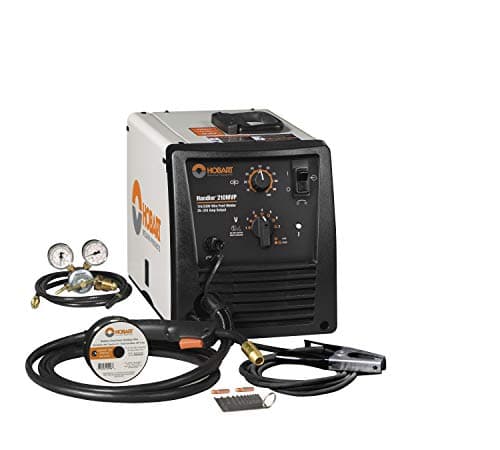 Hobart Handler 210 MVPA published 3/8 in single-pass capacity and a 30% duty cycle at 150 A — both stated, both working figures. | Best overall for thick steel | |
| 2 | 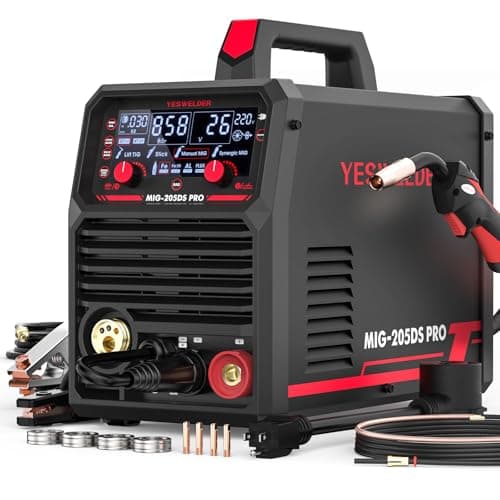 YESWELDER MIG-205DS PRO205 A of MIG and 205 A of stick on 220 V from a 22.7 lb machine — and stick is what thick, dirty steel actually wants. | Best for thick steel on a budget | |
| 3 | 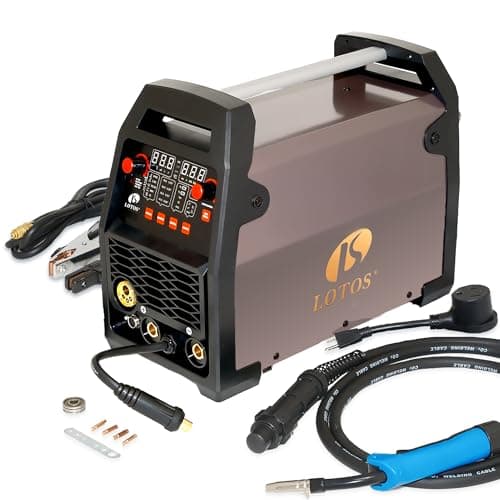 Lotos MIG180A 160 A stick rating and a 1/4 inch capacity at the lowest price on this page — on either voltage. | Cheapest published stick rating here | $359.98 · View on Amazon #ad How this is funded · Price as of November 13, 2026 |
| 4 | 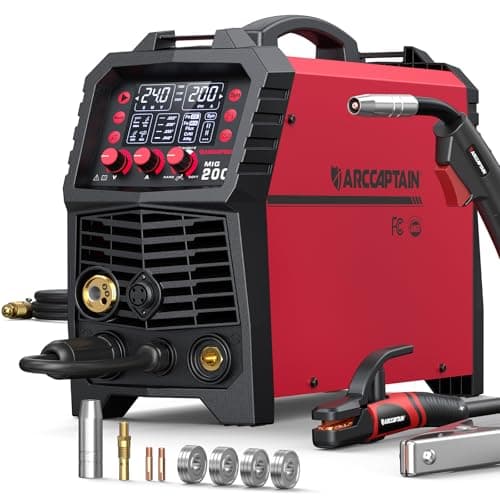 ARCCAPTAIN MIG200200 A on 220 V across six processes, including stick for dirty steel and spool-gun support for later. | Best if the work varies |
The short answer
For thick steel the best welder is the Hobart Handler 210 MVP: it publishes a 3/8 inch single-pass steel capacity and a 30% duty cycle at 150 A on a 230-volt supply. Above a quarter inch you need 240-volt output, a stated duty cycle, and the willingness to bevel and run multiple passes — amperage alone does not get you there.
This page starts where the best welders for 1/4 inch steel finishes. That page is about reaching a threshold: a quarter inch is the thickness at which a 120-volt machine stops being comfortable, and it ranks machines on whether they get there. This page is about what happens above it, and the answer involves technique as much as hardware.
Published capacities, side by side
| Machine | Supply | Output | Published steel capacity | Duty cycle |
|---|---|---|---|---|
| Hobart Handler 210 MVP | 115 V or 230 V | 25–210 A (140 A on 115 V) | 24 ga to 3/8 in single pass | 30% at 150 A |
| YESWELDER MIG-205DS PRO | 110 V or 220 V | 205 A MIG, 205 A stick on 220 V | Not published | Not published |
| Lotos MIG180 | 110–125 V or 210–250 V | 180 A MIG, 160 A stick on 240 V | Up to 1/4 in | Not published |
| ARCCAPTAIN MIG200 | 110 V or 220 V | 200 A maximum | Not published | Not published |
One machine on this page publishes a steel capacity. One publishes a duty cycle. They are the same machine, and that is most of the argument for it. On thick steel those two numbers are the whole question, and three of four manufacturers decline to answer either.
Single-pass capacity is not the same as maximum thickness
This distinction causes more disappointment than any other on the subject, so it is worth being precise.
A published single-pass capacity — Hobart's 3/8 inch — means the machine can fuse that thickness in one run down the joint, on a square butt or a fillet, with no bevel. That is the figure to buy on, because it is the one that describes a normal working day.
Maximum thickness is a different and much softer claim. With a bevelled joint and multiple passes, a modest machine will eventually join very thick material. It is genuinely how thick steel is welded in industry. It is also slow, it needs good interpass technique, and it is not what people mean when they ask whether a welder will "do half inch".
The three real limits on thick steel
Amperage sets how much metal you can melt per pass. Duty cycle sets how long you can keep doing it. And joint preparation sets whether the heat reaches the root at all. A machine fails on thick steel for whichever of the three runs out first — and for home welders it is usually the second or third, not the first.
Why stick keeps appearing on this page
Three of the four picks have stick capability, and that is deliberate rather than incidental.
Thick steel in a home shop is rarely new, clean, mill-finished stock. It is reclaimed plate, old trailer frame, scrap yard angle, farm equipment that has been outside since the 1990s. MIG and flux-core both want the surface prepared; stick tolerates rust, paint and mill scale far better, and it puts more heat into the joint per amp.
Stick also forgives fit-up, which thick stock tends to have less of because it does not bend to meet you. Stick versus MIG covers the trade-off properly, including what stick costs you in cleanup and appearance.
The 240 V circuit is part of the purchase
You cannot sensibly do regular thick-steel work on 120 volts. Every machine here that reaches 200 amps does it on a 220 or 230-volt supply, and on a household outlet their output drops by a quarter to a third where the figure is published at all.
That means the circuit is part of the budget, not an afterthought. What size breaker a welder needs covers how to arrive at an electrician's door with the right information, and what size wire a welder outlet needs covers why the conductor is a separate calculation.
How we ranked these
Published capacity first. A manufacturer stating a single-pass thickness is worth more than one quoting a bigger amperage without one.
Duty cycle second. Thick joints need more weld metal, so arc time is the constraint you hit. An unstated duty cycle is treated as unverified, not as fine.
Stick capability third, because of what thick steel in a home shop actually looks like when it arrives.
Honest ceilings throughout. The 120-volt pick is listed with its real limit rather than with a multi-pass claim. Our how we pick page sets out the method and what we have not tested.
1. Best overall for thick steel
Hobart Handler 210 MVP
A published 3/8 in single-pass capacity and a 30% duty cycle at 150 A — both stated, both working figures.
Hobart publishes 25 to 210 A of output (140 A on 115 V, 210 A on 230 V), a 30% duty cycle at 150 A and a steel capacity of 24 gauge to 3/8 inch single pass, with seven voltage settings on 230 V.
Two of those figures are the reason it leads. A published single-pass capacity is a manufacturer committing to a thickness, which is far more useful than a maximum amperage you have to interpret. And 30% at 150 A is roughly three minutes of arc in every ten — on thick steel, where each joint needs more weld metal, that is the difference between finishing a frame and waiting for a thermal cutout.
The multi-voltage plug matters here more than on a thin-material page, because thick steel is exactly the work that makes the 240 V circuit worth running. On 115 V this is a 140 A machine and you are back under a quarter inch.
Budget a cart — it is heavy — and understand that no spool gun is included, so aluminum is a separate purchase. Budget 240V welders covers where it sits on price.
What works
- The multi-voltage plug means you can buy it before you have run a 240 V circuit and get the full 210 A later
- 3/8 in single-pass capacity covers essentially every home fabrication job
- 30% duty cycle at 150 A is a real working duty cycle, not a demonstration figure
What does not
- Heavy enough that you will want a cart, which is another purchase
- On 115 V you get 140 A — no more than the Handler 140EZ, at a much higher price. The value only appears once you have the 240 V outlet
- No spool gun included, so aluminum is a further purchase
Who this is wrong for: Anyone without a 240 V circuit funded. On 115 V its capacity drops back to a Handler 140EZ's, at a much higher price.
2. Best for thick steel on a budget
YESWELDER MIG-205DS PRO
205 A of MIG and 205 A of stick on 220 V from a 22.7 lb machine — and stick is what thick, dirty steel actually wants.
YESWELDER publishes 30 to 205 A MIG, 20 to 205 A stick and 15 to 205 A lift TIG on 220 V, with 160 A MIG available on 110 V, in a machine weighing 22.7 lb.
The stick output is why this is the budget pick rather than the MIG figure. Thick steel in a home shop is usually reclaimed, rusty, painted or outdoors, and 205 A of stick handles all four better than any MIG arc does. It is also the process that forgives a less-than-perfect fit-up, which thick stock tends to have.
What it does not publish is a duty cycle, and on thick material that blank matters more than anywhere else. Treat it as unverified rather than as adequate.
The lift TIG is DC with no pedal, so there is no aluminum route here, and five processes means five sets of consumables.
What works
- Synergic mode sets voltage and wire speed from the thickness you select, which removes the single hardest part of learning MIG
- Spool-gun capable, so aluminum is a gun purchase rather than a machine purchase
- 22.7 lb for a 205 A dual-voltage machine is remarkable
What does not
- Lift TIG is DC only and has no foot pedal, so it will not weld aluminum and is not a route to Level 3
- Five processes means five sets of consumables to stock
- Dealer support and warranty handling are not on the level of Hobart or Lincoln
3. Cheapest published stick rating here
Lotos MIG180
A 160 A stick rating and a 1/4 inch capacity at the lowest price on this page — on either voltage.
Lotos publishes gas MIG, gasless flux-core, stick and DC lift TIG on 110–125 V or 210–250 V input, with MIG to 180 A, stick to 160 A and a 1/4 inch mild-steel capacity. It is here because stick is a genuine answer to a specific version of this question: you have thicker steel to join and you want the process that copes with it, at the lowest price on the page.
Stick electrodes put more heat into the joint per amp than a MIG wire does, and a 6011 or 7018 rod on a well-prepared joint will fuse material that a small MIG arc merely sits on top of. That is a real capability difference and not a marketing one.
Two honest gaps against the YESWELDER above. The 180 A and 160 A figures are the 240 V ratings and Lotos publishes no separate 120 V output, so on a household circuit you cannot plan around a number. And the published capacity is 1/4 inch — beyond that you are bevelling and running multiple passes, and there is a point where that becomes slow rather than clever.
What works
- Stick capability matters more than it sounds: rusty, painted or outdoor steel is where MIG struggles and stick does not
- A published 160 A stick rating is a real stick machine, not a token third process on the switch
- Synergistic MIG sets voltage and wire speed together, so the first hour goes on welding rather than on a settings chart
What does not
- The headline 180 A and 160 A figures are the 240 V ratings; Lotos does not publish a separate 120 V output
- TIG is lift-start DC with no high-frequency start, and the torch is a separate purchase — treat it as a bonus, not a feature you bought
- The spool gun is also sold separately, and DC lift TIG cannot weld aluminum whatever gun you fit
- Dealer support and warranty handling are not on the level of Hobart or Lincoln
Who this is wrong for: Anything approaching half-inch plate as a regular job. A published 1/4 inch capacity is a capacity, and multi-pass beyond it is a compromise.
4. Best if the work varies
ARCCAPTAIN MIG200
200 A on 220 V across six processes, including stick for dirty steel and spool-gun support for later.
ARCCAPTAIN publishes 200 A maximum output, dual 110 V and 220 V input, synergic control with 2T/4T and burn-back adjustment, and gas MIG, flux-core, stick, lift TIG, spot and spool-gun capability.
On a thick-steel page the value is the breadth. Heavy work tends to arrive mixed — some clean new tube that wants MIG, some reclaimed plate that wants stick, the occasional aluminum job that needs a spool gun. One machine that does all three honestly beats two that each do one well, when neither of the two is in your budget.
The duty cycle is unstated, which on thick steel is the specification you most want and least have. And 200 A is the 220 V figure — the 110 V output is not separately published.
What works
- Spool-gun support is built in rather than a model-specific accessory question, and that question is the whole aluminum decision on a MIG machine
- Synergic control sets voltage from wire speed, so the first hour is spent welding rather than reading a chart
- Dual voltage and six processes mean it stays useful well past the point most first machines stop
What does not
- The spool gun is a separate purchase, and not a small one
- 200 A is the 220 V figure. On a household outlet the usable output is much lower
- Dealer support is thin next to Hobart or Lincoln, which is what you notice when something breaks
Questions people actually ask
What is the best welder for thick steel?
The Hobart Handler 210 MVP, on published specifications: 25 to 210 A output, a 24 gauge to 3/8 inch single-pass steel capacity, and a 30% duty cycle at 150 A on a 230-volt supply.
It wins because it publishes both of the figures that decide thick-steel work. Three of the four machines on this page publish neither a steel capacity nor a duty cycle.
Can a 120V welder weld 1/2 inch steel?
Not in a single pass, and not as a sensible regular job. A 140 A machine on 120 volts is capped at roughly a quarter inch single pass.
With a bevelled joint and multiple passes you can eventually join thicker material - that is genuinely how thick steel is welded - but it is slow and it demands good interpass technique.
How many amps do you need to weld 1/2 inch steel?
More than a home machine's single-pass rating, which is why half-inch work is normally bevelled and done in multiple passes rather than in one.
The more useful question is duty cycle. Thicker joints need more weld metal, so the figure that stops you is usually how long you can hold an arc rather than how hot it is.
Is stick better than MIG for thick steel?
For the thick steel most home shops actually have, often yes. Stick tolerates rust, paint and mill scale far better than MIG, puts more heat into the joint per amp, and forgives imperfect fit-up.
MIG wins on speed, appearance and cleanup on clean new stock. Three of the four picks on this page have stick capability for exactly that reason.
Do I need a 240V circuit to weld thick steel?
For regular thick-steel work, yes. Every machine here that reaches 200 amps does it on a 220 or 230-volt supply, and on a household outlet the published output drops by roughly a quarter to a third.
Budget the circuit as part of the purchase, including the receptacle and - in most jurisdictions - a permit and inspection.
What is the difference between single-pass capacity and maximum thickness?
Single-pass capacity is the thickness a machine can fuse in one run down the joint with no bevel. It is a manufacturer committing to a number, and it is the figure to buy on.
Maximum thickness is a much softer claim that assumes a bevelled joint and multiple passes. Both are true statements; only the first describes a normal working day.
Sources
- Hobart Welders — Handler 210 MVP published specifications: 25–210 A, 24 ga to 3/8 in single pass, 30% duty cycle at 150 A, seven voltage settings on 230 V
- YESWELDER — MIG-205DS PRO published specifications: 205 A MIG and 205 A stick on 220 V, 160 A MIG on 110 V, 22.7 lb
- Lotos — MIG180 published specifications: gas MIG, gasless flux-core, stick, DC lift TIG, spot and spool-gun aluminum; 110–125 V or 210–250 V; MIG to 180 A, stick to 160 A; 1/4 in mild steel
- ARCCAPTAIN — MIG200 published specifications: 200 A maximum, dual 110/220 V, six processes, synergic control
Read next
- The best welders for 1/4 inch steel
Quarter-inch steel is where 120V machines run out. Four with the published capacity, ranked.
- What size welder do I need?
Amperage against thickness, duty cycle read honestly, and whether you need a bigger machine or a different circuit.
- The best 240V welders for a home shop
The machines worth running a 240V circuit for, and how to size that circuit before you buy.
- Stick vs MIG welding for a home shop
Stick handles rust, wind and thick plate; MIG is faster and cleaner. Why most shops want both.
- Best welders for small projects
Short welds and small parts reward low-end control and fast setup, not maximum amperage.
- Find your level before you spend a penny
Most bad first welder purchases are not bad machines. They are the right machine bought by the wrong person, one level too early or one level too late.
Back to Find Your Level, or start over at Find Your Level.
Ryder M.
Ryder M. is the hands-on owner behind Magoo Media Group. He writes Arc & Bead's buying guides and picks every machine on the site. What every recommendation is based on — and what it is not based on — is set out on How We Pick.