The best welding helmets under $200
Two hundred dollars is the band where published optical class and a real TIG rating start appearing on the spec sheet. Here is what the three helmets in our registry under $200 actually publish.
Arc & Bead is an Amazon Associate. If you buy through a link on this page we may earn a commission, at no extra cost to you. We have not physically tested the machines on this page and we say so on How We Pick.
Quick picks
Tap any row to jump to the full write-up further down this page.
| # | Product | Best for | Price |
|---|---|---|---|
| 1 | 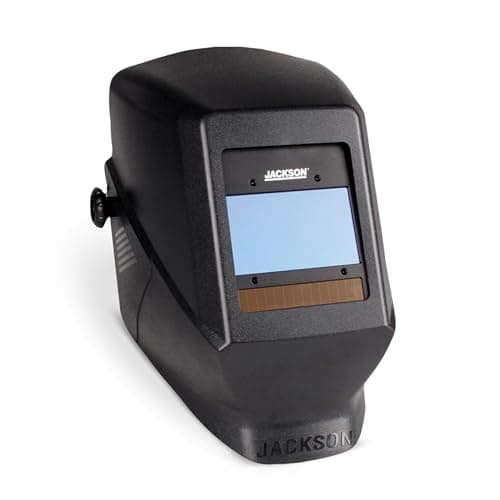 Jackson Safety Insight VariableThe only helmet under $200 here that publishes a 1/1/1/1 optical class and an ANSI Z87.1 rating, in a narrow shell built for long sessions. | Best overall | |
| 2 | 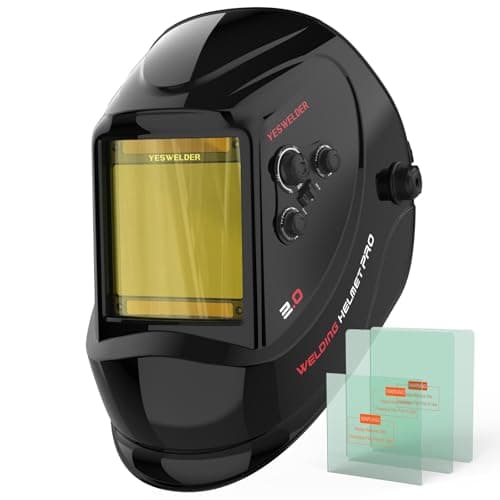 YESWELDER LYG-M800H large-view helmetA true-color panoramic window with a light-state grind mode, for roughly a quarter of the band's ceiling. | Budget pick | |
| 3 | 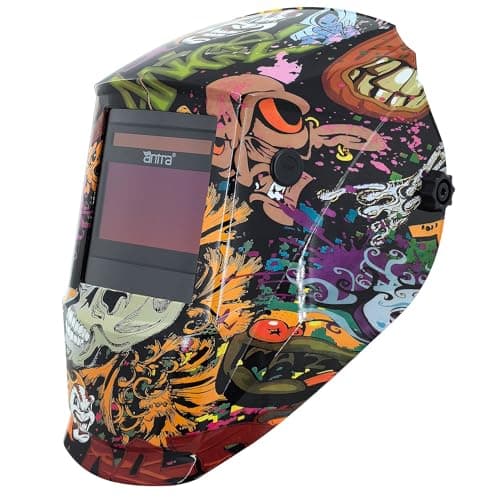 Antra DP3-6404Full digital control, a 3/5-13 shade range with shade lock, a published 2 A TIG rating and tack, weld and cut presets. | Best controls for the money | $69.95 · View on Amazon #ad How this is funded · Price as of November 28, 2026 |
The short answer
Our overall pick under $200 is the Jackson Safety Insight Variable: the only helmet in this band that publishes a 1/1/1/1 optical class and an ANSI Z87.1 rating, in a narrow shell with an extended front lip. The budget pick is the YESWELDER LYG-M800H, a true-color panoramic helmet with a light-state grind mode for a fraction of the band.
If you want the most published capability rather than the most published quality, the Antra DP3-6404: a 3/5–13 shade range, a 2 A DC TIG rating and three memory presets.
All three prices are read from our live price feed with an "as of" date on each buy button, and all three sat under $200 in the refresh generated 2026-11-20.
Either side of this band: under $100 is where you accept fewer published specifications, and under $300 is where four arc sensors and published switching speeds arrive.
What $200 buys that $100 does not
The honest answer is published specifications rather than a different welding experience. Below about $100, helmets are sold on a true-color lens and a shade range, and most of the numbers a careful buyer wants are simply not published.
In this band you start seeing three of them. An optical class, which tells you the lens is consistent across the window. A published minimum TIG rating, which tells you the lens will trigger on an arc that barely makes light. And a standards reference such as ANSI Z87.1, which tells you the shell has been tested to something.
What you still do not reliably get: four arc sensors, a published switching speed, a long warranty, or a replaceable-everything parts chain. Those arrive in the $300 band and above — see the best 4 sensor welding helmets for what that looks like.
What each one publishes
| Helmet | Optical class | Shade range | Published TIG rating | Viewing area |
|---|---|---|---|---|
| Jackson Safety Insight Variable | 1/1/1/1; ANSI Z87.1 | Variable 9-13, with weld, torch and grind modes | Not published | 3.94 x 2.36 in |
| Antra DP3-6404 | Not published | 3/5-13 with shade lock | Down to 2 A (DC) | Not published |
| YESWELDER LYG-M800H | Not published | Variable, with a light-state grind mode | Not published | Panoramic (no figure published) |
A cheap helmet is still a real helmet - test it anyway.
Every auto-darkening lens worth buying filters ultraviolet and infrared permanently, in both its light and dark states, so the shade change protects you from brightness rather than from radiation. What a budget helmet is more likely to get wrong is triggering reliably on a low arc.
Run the five-minute check in how to test an auto-darkening welding helmet the day it arrives, on every helmet at every price. A helmet that fails it goes back.
The four specifications worth comparing in this band
Optical class. Four digits, each 1 to 3, lowest is best. 1/1/1/1 is top grade. If it is not published, assume it is not 1/1/1/1.
Shade range, including the light state. A range written 3/5–13 means a shade 3 light state and a 5–13 dark range — the leading number is what you see walking around. A range starting at 9 cannot be used for plasma cutting.
Minimum TIG amperage. The lowest current at which the maker guarantees the lens darkens. Only one helmet here publishes it.
Grind mode, and where the button is. All three have a grind mode. An external button is better than a menu because you will use it every few minutes — the best welding helmets with grind mode ranks that axis alone.
Which one is yours?
Long sessions, and you want published lens quality: Jackson Safety Insight Variable.
First helmet, and you wear glasses: YESWELDER LYG-M800H, for the window.
You TIG weld thin material, or you plasma cut: Antra DP3-6404 — the 2 A rating and the 3/5–13 range are the two specifications those jobs need.
You weld out of position or inside frames: spend more. Four-sensor helmets start just above this band and the reason is safety, not comfort.
You are assembling a whole kit: the best welding safety gear covers the gloves, jacket and respirator that go with the helmet, and the best welding gloves under $50 is the next order.
How we picked these
Under $200 on a live price, or not on the page. Three helmets in our registry returned a buyable offer under $200 in the price feed generated 2026-11-20, and all three are here. We did not include a helmet that only fits the band on a sale price.
Ranked on what is published. The helmet with the most published specifications leads, because in this band the absence of a figure is the most reliable signal available.
No hands-on, no scores. We have worn none of these three. Blank cells in the table are figures the maker does not publish, left blank rather than estimated. More on the method on how we pick.
1. Best overall
Jackson Safety Insight Variable
The only helmet under $200 here that publishes a 1/1/1/1 optical class and an ANSI Z87.1 rating, in a narrow shell built for long sessions.
Jackson Safety publishes the Insight Variable with a 3.94 x 2.36 in viewing area, variable shade 9–13 with weld, torch and grind modes, a 1/1/1/1 optical class, a narrow HSL shell with an extended front lip, and an ANSI Z87.1 rating.
The optical class is why it leads. 1/1/1/1 is the top grade on all four axes — optical quality, diffusion of light, variation in luminous transmittance and angle dependence — and it is rare at this price. What it means in practice is that the joint looks the same at the edge of the window as in the center, which is most of what "clarity" means when people describe a good lens.
The narrow shell and extended lip are the long-session argument. A narrow helmet clears your shoulder when you turn your head inside a frame, and the lip keeps spatter off your throat when you weld upward. Jackson positions this as a lightweight mid-priced helmet for exactly that reason.
Against it: the smallest viewing area on this page, and by some distance. The shade range starts at 9, so it is not a plasma-cutting helmet — cutting wants shades 5–8 and you need a helmet with a cut mode for that. And Jackson publishes no minimum TIG trigger amperage for it, which is the figure a low-amp TIG welder most wants.
What works
- Light on the neck, which is the complaint that actually ends a long session
- Jackson's shells and headgear parts are easy to source separately
What does not
- Viewing area is small next to a VIKING 3350 or a panoramic helmet
- Not a low-amperage TIG helmet
Who this is wrong for: Plasma cutting and low-amperage TIG. A shade range starting at 9 covers neither, and no TIG trigger rating is published.
2. Budget pick
YESWELDER LYG-M800H large-view helmet
A true-color panoramic window with a light-state grind mode, for roughly a quarter of the band's ceiling.
YESWELDER publishes the LYG-M800H as a true-color panoramic helmet with a variable shade range including a light-state grind mode, powered by a solar cell with a replaceable battery.
It is the budget pick and it earns the slot on the window. A panoramic true-color lens at this price is a genuine change in how welding feels: the color cast of a conventional green lens flattens everything, and a true-color lens keeps enough color separation that you can see the puddle edge against the parent metal.
The large view also makes it the usual recommendation for anyone welding in prescription glasses, because more window means more of the joint visible through the part of your lenses you can actually focus through — welding helmets for glasses wearers covers that in full.
Against it: YESWELDER publishes neither an optical class nor a numeric shade range nor a TIG trigger rating for this helmet, which is three of the four specifications this page would like to compare. At this price that is the trade. Treat it as a good first helmet rather than a measured one, and test it on arrival.
What works
- Panoramic view at a fraction of a name-brand large-view helmet's price
- True-color lens makes the puddle and the weld pool edge much easier to read than a green lens
- Deep shell accommodates most prescription glasses without pressure on the temples
What does not
- Published optical-class figures are inconsistent between listings — treat unstated clarity as unverified
- Headgear adjustment is coarse compared with the X6 or Halo systems
3. Best controls for the money
Antra DP3-6404
Full digital control, a 3/5-13 shade range with shade lock, a published 2 A TIG rating and tack, weld and cut presets.
Antra publishes the DP3-6404 with a true-color lens under full digital control and display, a shade range of 3/5–13 with shade lock, a DC TIG rating down to 2 A, tack, weld and cut memory presets plus a grind/weld button, and solar power with battery assist.
The published 2 A TIG rating is the headline, and it is the best figure under $200 in our registry. That is the same published trigger rating as helmets costing three times as much, and it is the specification that decides whether the lens darkens on a thin-stainless TIG arc at all.
The shade range is the second argument. 3/5–13 covers plasma cutting at the light end and high-amp stick at the dark end, and the three memory presets mean switching between tacking, welding and cutting is a button rather than a menu crawl. Shade lock stops you nudging the setting mid-job.
Against it: Antra publishes no optical class, no viewing area and no switching speed for this helmet, so the three specifications that describe lens quality are all absent. Build quality at this price is not Lincoln or ESAB. And a digital panel on a budget helmet is one more thing that can fail.
What works
- A published 2 A TIG rating at the bottom of the market, where the usual answer is no rating at all
- Shade 5 low end covers plasma cutting, so one cheap helmet spans more than MIG
- Quick grind/weld button and shade lock — two things that are normally the first upgrade
- Cheap enough that starting here and upgrading later costs less than agonizing over it
What does not
- Antra does not publish a 1/1/1/1 optical class for it, and over a long session you can feel the difference
- Headgear is the weak point on budget helmets generally, and this one is no exception
- A small shell: next to a VIKING 3350 the view is noticeably tighter
Questions people actually ask
What is the best welding helmet under $200?
Of the helmets in our registry, the Jackson Safety Insight Variable. Jackson publishes a 1/1/1/1 optical class, an ANSI Z87.1 rating, a 3.94 x 2.36 in viewing area, variable shade 9-13 and weld, torch and grind modes.
The budget pick is the YESWELDER LYG-M800H, a true-color panoramic helmet with a light-state grind mode for a fraction of the band's ceiling.
Is a $200 welding helmet good enough?
For bench welding at a consistent amperage, yes. What you get in this band is a published optical class, a usable shade range and a grind mode, which covers most home welding.
What you do not reliably get is four arc sensors, a published switching speed or a long warranty. Those matter most if you weld out of position.
What should I look for in a welding helmet under $200?
Four things: a published optical class (1/1/1/1 is best), a shade range that covers your processes including the light state, a published minimum TIG trigger amperage if you TIG weld, and an external grind button.
In this band, a specification that is not published usually is not impressive. Treat silence as information.
Can you TIG weld with a cheap auto-darkening helmet?
Only if the lens triggers at low amperage. TIG at 20 A makes very little light, and a helmet with no published minimum TIG rating may not darken reliably.
The Antra DP3-6404 publishes a rating down to 2 A, which is why it is the TIG pick in this band.
Do I need a shade 3 light state?
It is a convenience rather than a requirement. A shade 3 light state is bright enough to walk around and set up in without lifting the hood; a shade 4 light state is noticeably darker.
The more important part of a shade range is whether the dark end covers your amperage and whether the light end goes low enough for plasma cutting.
Is it worth paying more than $200 for a welding helmet?
If you weld out of position, in frames or overhead, yes - that is where four arc sensors stop the lens flashing clear, and four-sensor helmets start just above this band.
If you weld on a bench at one amperage, the extra money buys comfort, warranty and parts availability rather than a safer helmet.
Sources
- Jackson Safety - Insight Variable (46129) published specifications: 3.94 x 2.36 in viewing area, variable shade 9-13 with weld, torch and grind modes, 1/1/1/1 optical class, narrow HSL shell with extended front lip, ANSI Z87.1 (registry entry, ASIN B01HTMLSGG)
- Antra - DP3-6404 published specifications: true-color lens with full digital control and display, shade range 3/5-13 with shade lock, DC TIG rating down to 2 A, tack / weld / cut memory presets plus grind-weld button, solar cell with battery assist (registry entry, ASIN B0CV9P2YLP)
- YESWELDER - LYG-M800H published specifications: true-color panoramic lens, variable shade range with a light-state grind mode, solar cell with replaceable battery (registry entry, ASIN B07M5WKCYX)
- Arc & Bead live price layer (lib/prices.ts) - all three helmets returned a buyable offer under $200 against the price feed generated 2026-11-20; each buy button renders the live price with its own 'as of' date and no price on this page is hardcoded
Read next
- The best welding helmets at the entry end of the market
What an entry-level helmet compromises, and the two specifications to insist on regardless.
- The best welding helmets under $300
Three welding helmets under $300 at current live prices, ranked on the single trade the band forces - a certified optical class against a published low-amperage TIG rating.
- The best 4 sensor welding helmets
The three helmets in our registry that publish four arc sensors, ranked on optical class, TIG rating and viewing area, with the cheapest four-sensor helmet named as the budget pick.
- The best welding helmets for beginners
The purchase that improves a beginner's welds fastest, and where spending more stops helping.
- How to Test an Auto-Darkening Welding Helmet
The test button, the sunlight check and the scrap-metal check — plus why the UV and IR protection does not depend on the lens darkening.
- The best welding safety gear
The four protective items every home welder needs - helmet, gloves, jacket and respirator - ranked on published ratings, with the cheapest honest option named in each category.
Back to Helmets & PPE, or start over at Find Your Level.
Ryder M.
Ryder M. is the hands-on owner behind Magoo Media Group. He writes Arc & Bead's buying guides and picks every machine on the site. What every recommendation is based on — and what it is not based on — is set out on How We Pick.