The best MIG welders for the money
There are two places on the MIG price curve where paying more stops helping. Knowing where they are is most of this decision.
Arc & Bead is an Amazon Associate. If you buy through a link on this page we may earn a commission, at no extra cost to you. We have not physically tested the machines on this page and we say so on How We Pick.
Quick picks
Tap any row to jump to the full write-up further down this page.
| # | Product | Best for | Price |
|---|---|---|---|
| 1 | 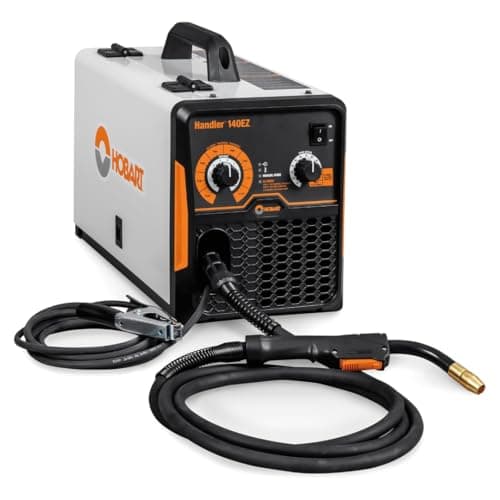 Hobart Handler 140EZ30–140 A on a household circuit with a 30% duty cycle at 90 A, and a dealer network behind it. | Best overall value | $720.00 · View on Amazon #ad How this is funded · Price as of November 13, 2026 |
| 2 | 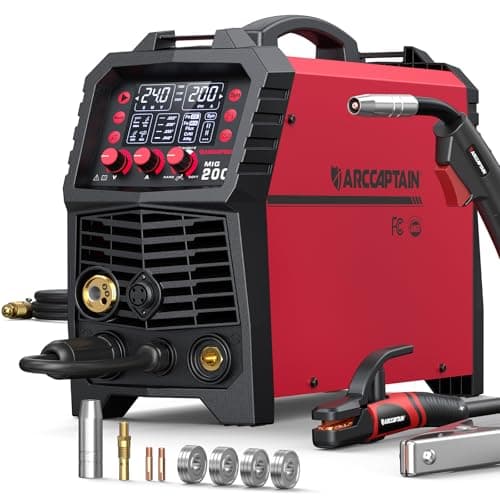 ARCCAPTAIN MIG200Synergic control, dual voltage, 200 A, and six processes for close to single-process money. | Most capability per dollar | |
| 3 | 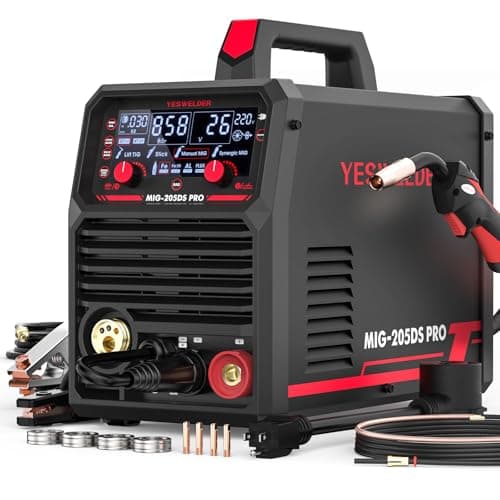 YESWELDER MIG-205DS PROFive processes at 22.7 lb, with published output figures stated separately for 110 V and 220 V. | Best if you are still deciding | |
| 4 | 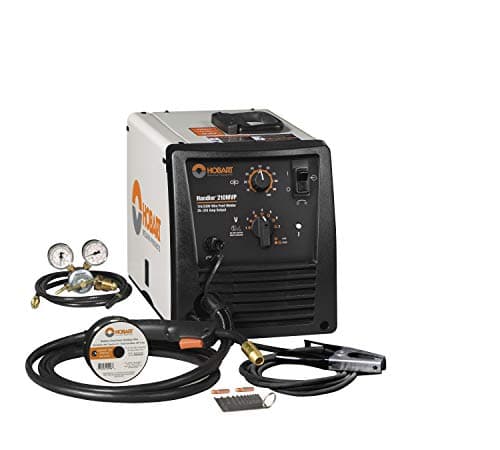 Hobart Handler 210 MVP25–210 A, 30% duty cycle at 150 A, and a published 3/8 in single-pass steel capacity. | Best value once you have 240 V |
What is the best MIG welder for the money?
The Hobart Handler 140EZ for most home shops — 30 to 140 amps on an ordinary 115 V circuit, a 30% duty cycle at 90 amps, and consumables stocked everywhere. If you have or can add a 240 V circuit, the Hobart Handler 210 MVP is the better value at the top of the useful range: 210 amps, a 30% duty cycle at 150 amps, and seven voltage taps instead of four.
"For the money" is a different question from "under $500". A price cap asks what the best machine is below a number; this page asks where on the curve the money stops converting into capability. On MIG there are two such points, and almost every sensible purchase is at one of them.
The first flattening is around a 140 amp, 120 V machine. Below it you are buying four-tap control and marginal duty cycle. At it you get a machine that will weld anything up to roughly 1/4 inch on a household outlet, which covers most home projects. Immediately above it, on 120 V, you are paying for features rather than output — because the circuit, not the welder, sets the ceiling.
The second flattening is around a 200 to 210 amp dual-voltage machine. Going from 140 to 210 amps buys real capability: thicker single-pass welds and finer voltage control. Going above 210 buys duty cycle, and duty cycle is the specification home welders over-buy most, because home welding is mostly fit-up and grinding with short bursts of arc time in between.
Everything on this page sits at one of those two points. Nothing between them is here, because the space between them is where you pay more for the same result.
How we ranked them
1. Output range, bottom end first. The minimum amperage is the figure that decides whether you can weld thin material, and it is the one headline specs ignore in favor of the maximum.
2. Duty cycle, read honestly. A percentage at a stated amperage over ten minutes. 30% at 90 amps means three minutes of arc in every ten. That is more than a home project asks for, which is why a bigger number is rarely worth a higher price.
3. Voltage granularity. Infinite control or a high tap count beats four fixed settings, and this is where a cheap machine actually costs you — not in maximum output but in never quite having the right setting.
4. Consumable and parts support. Tips, liners and drive rolls you can still buy in five years. This is the hidden half of value and it is where the dealer-network brands earn their premium over the direct-sales ones.
5. Dual voltage, as an option on the future. Not a reason to buy on its own, but the difference between a machine that grows with your shop and one you replace.
The published numbers, side by side
| Machine | Input | Output | Duty cycle | Processes | Steel capacity |
|---|---|---|---|---|---|
| Hobart Handler 140EZ | 115 V, 20 A circuit | 30–140 A | 30% at 90 A | Gas MIG, flux-core | — |
| ARCCAPTAIN MIG200 | 110 V or 220 V | 200 A max | — | MIG, flux-core, stick, lift TIG, spot, spool gun | — |
| YESWELDER MIG-205DS PRO | 110 V or 220 V | 30–160 A at 110 V; 30–205 A at 220 V | — | MIG, flux-core, spool gun, lift TIG, stick | — |
| Hobart Handler 210 MVP | 115 V or 230 V (MVP plug) | 25–210 A (140 A on 115 V) | 30% at 150 A; 20% at 90 A | Gas MIG, flux-core | 24 ga to 3/8 in single pass |
The cost nobody puts in the comparison
The machine is not the purchase. Gas MIG needs a bottle, a regulator and hose, and the bottle is either a rental with a recurring cost or an owned cylinder with a higher up-front one. On a first gas machine that is a meaningful fraction of the total and it is why do you need gas for MIG welding is one of the most-read pages on this site.
Then there is the circuit. A 140 amp machine wants a dedicated 20 amp 115 V circuit, which most garages have or can get cheaply. A 210 amp machine wants 240 V, which is an electrician and a breaker. How many amps a welder uses has the arithmetic.
Budget the whole thing, then choose the machine. A 210 MVP bought with no 240 V outlet is worse value than a Handler 140EZ bought with gas, a regulator and a working circuit — which is the single most common way people spend badly in this category.
Where cheap machines actually cost you
Not in maximum amperage. In the wire feed. The cheapest machines use a plastic drive assembly and a single drive roll, and the symptom is intermittent feeding — a bead that stutters, bird-nesting at the drive, and a pile of wasted wire. It reads as a technique problem for weeks before you work out it is not.
If you are comparing two machines on price alone, this is the thing to look for and it is almost never in the spec table. A metal drive assembly is worth more than twenty amps of headline output.
Which one to buy
Hobart Handler 140EZ for most people. It sits exactly at the first flattening of the curve, it runs on a circuit you probably already have, and the consumables will be on a shelf for as long as you own it.
ARCCAPTAIN MIG200 if you want the most specification per dollar and are comfortable buying support through the manufacturer rather than a counter.
YESWELDER MIG-205DS PRO if you are genuinely undecided about which process you want to end up on, and would rather pay once to find out.
Hobart Handler 210 MVP if the 240 V circuit exists or is budgeted. It is the top of the useful range for a home shop and the last point on the curve where more money is still buying you something you will use.
If a hard price cap is the real constraint rather than value, MIG welders under $500 and under $1,000 approach it that way instead.
Three narrower questions, each with its own page
Value is one axis, and three specific features decide more purchases than price does. If you do not have a 240 V circuit yet, the best dual voltage MIG welders ranks machines on whether they publish what they actually do on a household outlet. If aluminum is anywhere in your plans, the best MIG welders with spool gun capability sorts them by how much research the provision will cost you. And if the machine you keep comparing everything against is the Millermatic 211, Millermatic 211 alternatives states what Miller publishes about it and names what matches each of its strengths.
1. Best overall value
Hobart Handler 140EZ
30–140 A on a household circuit with a 30% duty cycle at 90 A, and a dealer network behind it.
Hobart publishes gas MIG and flux-core capability, a 115 V 20 A dedicated circuit requirement, an output range of 30 to 140 amps and a 30% duty cycle at 90 amps. That is the specification set the whole category is measured against, and it has been for years.
The number worth dwelling on is the 25 amp bottom end. Cheap machines compete on maximum output because it is the bigger number, but on a 120 V machine the ceiling is set by the circuit, not by the welder — everything in this class tops out around 140 amps. What separates them is how low they will go cleanly, because that is what decides whether you can weld thin material without blowing through it.
The 30% duty cycle at 90 amps is honest rather than generous, and honest is the useful property. It means three minutes of arc in every ten at that setting, which is more welding than a home project actually asks for — most of your time is fit-up, clamping and grinding, not arc time.
The reason this is the value pick and not merely the cheap pick is support. Consumables, drive rolls, liners and contact tips are stocked in welding-supply shops everywhere, and that keeps a machine working in year eight rather than turning it into scrap when a 40-dollar part is unobtainable.
What works
- The most documented 120 V MIG family there is — every settings question has already been answered somewhere
- Runs flux-core on day one and gas MIG the day you buy a bottle, so the machine survives the level change
- EZ Mode sets the machine from two turns of a knob, and infinite voltage control is still there when you want to override it
- Spool-gun ready, so aluminum is a gun purchase rather than a new machine
What does not
- 3/16 in is the published capacity. A trailer deck in one sitting is beyond it
- Single-voltage: it will never take advantage of a 240 V circuit if you later run one
- 53 lb is heavy for a 120 V machine — it wants a cart rather than a shelf
2. Most capability per dollar
ARCCAPTAIN MIG200
Synergic control, dual voltage, 200 A, and six processes for close to single-process money.
ARCCAPTAIN publishes gas MIG, flux-core, stick, lift TIG, spot and spool-gun capability, 110 V or 220 V dual-voltage input, a 200 amp maximum output, and synergic control with 2T/4T and burn-back adjustment.
Synergic is the feature that matters most to a beginner and gets explained least. On a conventional machine you set voltage and wire speed independently and the relationship between them is something you learn by burning wire. A synergic machine takes one input — material thickness or amperage — and sets the pair for you. It will not make you a welder, but it removes the single most common reason a first bead looks wrong.
Dual voltage is the other half of the value case. A 110 V machine is capped by the circuit; a machine that also takes 220 V gets 200 amps the day you run a proper outlet, instead of becoming a trade-in. 120 V versus 240 V covers what that ceiling actually costs you.
The honest caveat is the one that applies to the whole value end of this market: consumables and support come through the manufacturer rather than a local dealer counter. That is the trade you are making for the specification, and it is a reasonable one as long as you know you are making it.
What works
- Spool-gun support is built in rather than a model-specific accessory question, and that question is the whole aluminum decision on a MIG machine
- Synergic control sets voltage from wire speed, so the first hour is spent welding rather than reading a chart
- Dual voltage and six processes mean it stays useful well past the point most first machines stop
What does not
- The spool gun is a separate purchase, and not a small one
- 200 A is the 220 V figure. On a household outlet the usable output is much lower
- Dealer support is thin next to Hobart or Lincoln, which is what you notice when something breaks
3. Best if you are still deciding
YESWELDER MIG-205DS PRO
Five processes at 22.7 lb, with published output figures stated separately for 110 V and 220 V.
Gas MIG, flux-core, spool-gun MIG, lift TIG and stick; 110 V or 220 V input; MIG output of 30 to 160 amps at 110 V and 30 to 205 amps at 220 V; wire feed from 58 to 858 inches per minute; 22.7 pounds.
Publishing output separately for each input voltage is a small thing that tells you a lot. Plenty of dual-voltage machines advertise one headline figure that is only achievable on 220 V and leave you to discover the 110 V reality. Stating both is the behavior of a manufacturer that expects you to check.
The value argument here is different from the two machines above: it is optionality. If you do not yet know whether you want to end up doing TIG or stick or stay on wire, this machine lets you find out without buying three welders. Lift TIG is not real HF-start TIG and we say so everywhere on this site — but it is enough to learn whether the process suits you.
At 22.7 pounds it is also the one machine here you would genuinely carry to the work rather than bringing the work to it.
What works
- Synergic mode sets voltage and wire speed from the thickness you select, which removes the single hardest part of learning MIG
- Spool-gun capable, so aluminum is a gun purchase rather than a machine purchase
- 22.7 lb for a 205 A dual-voltage machine is remarkable
What does not
- Lift TIG is DC only and has no foot pedal, so it will not weld aluminum and is not a route to Level 3
- Five processes means five sets of consumables to stock
- Dealer support and warranty handling are not on the level of Hobart or Lincoln
Who this is wrong for: Anyone who already knows they want serious TIG. Lift start is a learning tool, not a substitute for high-frequency start.
4. Best value once you have 240 V
Hobart Handler 210 MVP
25–210 A, 30% duty cycle at 150 A, and a published 3/8 in single-pass steel capacity.
Hobart publishes 115 V or 230 V input via the multi-voltage plug, 25 to 210 amps output (140 amps on 115 V, 210 amps on 230 V), a 30% duty cycle at 150 amps and 20% at 90 amps, a 24-gauge to 3/8-inch single-pass steel capacity, and seven voltage settings on 230 V against four on 115 V.
This is where the second flattening of the price curve is. Below it, more money buys capability. Above it, more money mostly buys duty cycle you will not use at home. The 210 MVP sits at the top of the useful range for a home shop and that is why it is the last pick rather than the first.
The specification that justifies the step up is voltage settings: seven on 230 V against four on 115 V. More taps means a finer setting at any given thickness, which is the difference between dialling in a weld and choosing the nearest acceptable compromise. The 3/8-inch single-pass figure is the headline, but the granularity is what you feel every time you use it.
Do not buy this on 115 V and plan to upgrade the circuit later. On 115 V it is a 140 amp machine with the Handler 140EZ's output at a higher price. Buy it when the outlet exists or is budgeted — what size breaker for a welder covers what that costs.
What works
- The multi-voltage plug means you can buy it before you have run a 240 V circuit and get the full 210 A later
- 3/8 in single-pass capacity covers essentially every home fabrication job
- 30% duty cycle at 150 A is a real working duty cycle, not a demonstration figure
What does not
- Heavy enough that you will want a cart, which is another purchase
- On 115 V you get 140 A — no more than the Handler 140EZ, at a much higher price. The value only appears once you have the 240 V outlet
- No spool gun included, so aluminum is a further purchase
Who this is wrong for: A shop with no 240 V circuit and no plan to add one. On 115 V you are paying for capability you cannot reach.
Questions people actually ask
What is the best MIG welder for the money?
The Hobart Handler 140EZ for most home shops: 30 to 140 amps on an ordinary 115 V circuit, a 30% duty cycle at 90 amps, and consumables stocked in welding-supply shops everywhere.
If you have or can add a 240 V circuit, the Hobart Handler 210 MVP is better value at the top of the useful range - 210 amps, 30% duty cycle at 150 amps, and seven voltage taps rather than four.
How much should I spend on a MIG welder?
Enough to reach one of the two points where the price curve flattens: a 140 amp 120 V machine, or a 200 to 210 amp dual-voltage one. Between them you pay more for the same result.
Above 210 amps you are mostly buying duty cycle, which is the specification home welders over-buy most, because home welding is mostly fit-up and grinding with short bursts of arc time.
Is a 140 amp MIG welder enough?
For most home projects, yes. A 140 amp 120 V machine will weld up to roughly 1/4 inch of mild steel, which covers repairs, brackets, furniture, carts and light fabrication.
It is not enough for repeated 3/8 inch single-pass work or for long continuous beads, both of which want a 240 V machine with a higher duty cycle.
What does duty cycle mean on a MIG welder?
The percentage of a ten-minute period the machine can weld at a stated amperage before it needs to cool. 30% at 90 amps means three minutes of arc in every ten.
That is more welding than a home project usually asks for, which is why a higher duty cycle is rarely worth a higher price unless you are running long continuous beads.
Should I buy a dual-voltage MIG welder?
It is worth having if there is any chance of a 240 V circuit later, because it means the machine grows with the shop instead of being traded in.
Do not buy a 210 amp dual-voltage machine and run it on 115 V, though. On 115 V it is a 140 amp machine with fewer taps than the cheaper option, so you are paying for capability you cannot reach.
Sources
- Hobart — Handler 140EZ published specifications: 115 V, 30–140 A, 30% duty cycle at 90 A
- Hobart — Handler 210 MVP published specifications: 115/230 V, 25–210 A, 30% at 150 A, 3/8 in single pass
- ARCCAPTAIN — MIG200 published specifications: dual voltage, 200 A, synergic control
- YESWELDER — MIG-205DS PRO published specifications: five processes, per-voltage output figures, 22.7 lb
- American Welding Society — duty cycle definition and measurement convention
Read next
- The best MIG welders for beginners
Gas-capable machines for a home shop, and the one specification that makes learning MIG easier.
- The best MIG welders under $500
What $500 buys in gas MIG, what it leaves out, and the machines that fit inside the cap.
- The best MIG welders under $1,000
What $1,000 buys in a gas MIG machine, and the one worth knowing sits just above the cap.
- 120V vs 240V welders: which one do you actually need?
The decision that sets your ceiling: what each supply voltage welds, and what the circuit really costs.
- Do you need gas for MIG welding?
When shielding gas is genuinely required and when flux-cored wire is the better answer.
- Level 2 · MIG: when the gas bottle is finally worth it
You can already lay a bead. This level is about what changes when you add a gas bottle — and about being honest that it is not only an upgrade.
- YESWELDER MIG-205DS PRO vs ARCCAPTAIN MIG200
The two budget dual-voltage multiprocess machines compared on what each manufacturer actually publishes.
Back to Level 2 · MIG, or start over at Find Your Level.
Ryder M.
Ryder M. is the hands-on owner behind Magoo Media Group. He writes Arc & Bead's buying guides and picks every machine on the site. What every recommendation is based on — and what it is not based on — is set out on How We Pick.