Millermatic 211 alternatives
The 211 is a genuinely good machine, which is why it is the one everybody compares against. Here is what it is known for, and four machines that match a specific part of it for less.
Arc & Bead is an Amazon Associate. If you buy through a link on this page we may earn a commission, at no extra cost to you. We have not physically tested the machines on this page and we say so on How We Pick.
Quick picks
Tap any row to jump to the full write-up further down this page.
| # | Product | Best for | Price |
|---|---|---|---|
| 1 | 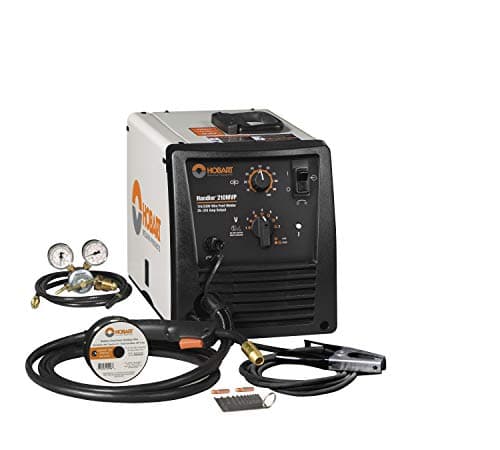 Hobart Handler 210 MVPThe same multi-voltage idea and the same published 24 gauge to 3/8 in single-pass capacity, with a dealer network behind it. | Closest match | |
| 2 | 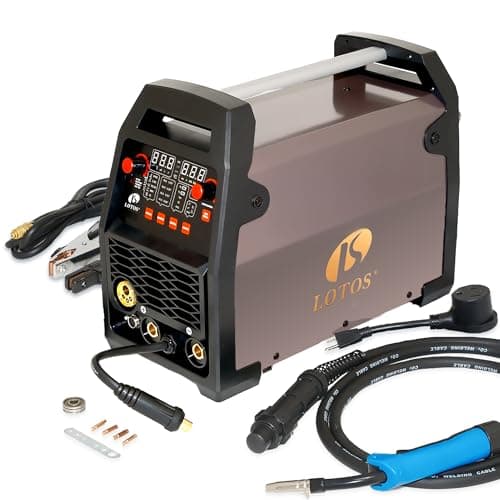 Lotos MIG180The cheapest dual-voltage machine in our registry, and it adds a published 160 A stick arc the 211 does not have. | Budget pick | $359.98 · View on Amazon #ad How this is funded · Price as of November 13, 2026 |
| 3 | 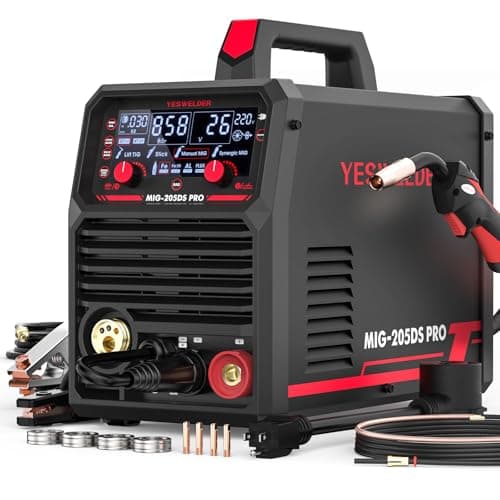 YESWELDER MIG-205DS PROPrints a separate 110 V and 220 V figure for every process, which is more detail than most machines in this class publish at all. | Most published transparency | |
| 4 | 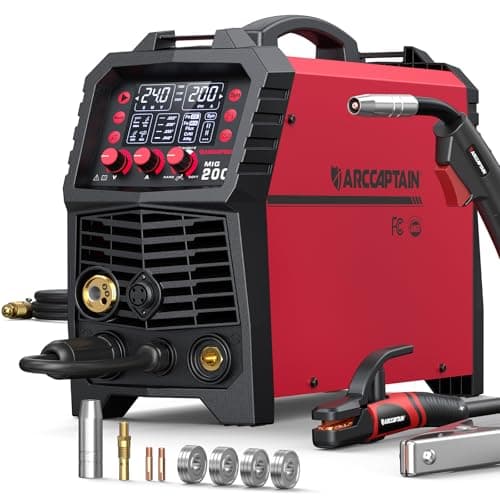 ARCCAPTAIN MIG200Synergic control plus built-in spool-gun provision - the two things that make a first gas MIG machine feel easy, at a fraction of the price. | Closest on ease of setup |
The short answer
Miller publishes the Millermatic 211 as a 120 V / 240 V MIG welder with MVP adapter plugs for both supplies, Auto-Set parameter setting, and a published single-pass capacity of 24 gauge to 3/8 in steel. Its 2024 specification sheet gives 115 A at 19.8 V with a 20% duty cycle on 120 V and 150 A at 21.5 V with a 40% duty cycle on 240 V. It is a well-regarded machine and nothing on this page suggests otherwise.
The closest alternative in our registry is the Hobart Handler 210 MVP, which matches it on the multi-voltage plug and on the published 24 gauge to 3/8 in single-pass capacity. The budget alternative is the Lotos MIG180, which costs far less and adds a published 160 A stick arc the 211 does not have, at the cost of 1/4 in rather than 3/8 in capacity.
Every price in the table is read live when the page loads, with its own "as of" date in the buy button. The Millermatic 211 itself is not in our registry, so there is no price or buy link for it here — this page compares against its published specification, not its listing.
What the Millermatic 211 is known for
Three things, in the order owners usually mention them.
The multi-voltage plug. Miller ships it with MVP adapter plugs for 120 V and 240 V on a 6.5 ft cord, so one machine covers a household outlet and a proper shop circuit without rewiring anything.
Auto-Set. You select the wire diameter and material thickness and the machine sets voltage and wire feed speed. On a first gas MIG machine that is the difference between an afternoon of welding and an afternoon with a settings chart.
Single-pass capacity. Miller publishes 24 gauge to 3/8 in in a single pass, which covers essentially every home fabrication job including trailer frames and hitch work.
One caveat worth knowing before you compare numbers: there are two revisions in circulation. Miller's 2024 sheet for the original 211 (part 907614 / 951670) gives 115 A at 20% on 120 V and 150 A at 40% on 240 V, while the current 211 PRO (907839) is listed at 110 A at 60% on 120 V and 160 A at 60% on 240 V. If you are comparing duty cycles, check which revision the listing in front of you is.
| Machine | Supplies | Published output | Single-pass steel | Stick? |
|---|---|---|---|---|
| Millermatic 211 (for reference) | 120 V / 240 V, MVP plugs | 115 A at 20% (120 V); 150 A at 40% (240 V) - 2024 sheet | 24 ga to 3/8 in | No - MIG and flux-cored wire |
| Hobart Handler 210 MVP | 115 V / 230 V, MVP plug | 140 A (115 V); 210 A (230 V); 30% at 150 A | 24 ga to 3/8 in | No - MIG and flux-core |
| Lotos MIG180 | 110-125 V / 210-250 V | MIG to 180 A; stick to 160 A (240 V figures) | To 1/4 in | Yes - 160 A published |
| YESWELDER MIG-205DS PRO | 110 V / 220 V | MIG 30-160 A (110 V); 30-205 A (220 V) | Not published | Yes - 20-205 A published |
| ARCCAPTAIN MIG200 | 110 V / 220 V | 200 A maximum (220 V figure) | Not published | Yes - listed as a process |
Where none of these is the answer.
If the appeal of the 211 is that it is a Miller — the dealer, the resale value, the parts counter in your town — then no cheaper machine replaces it, and this page is not trying to. Buy the 211. The alternatives here match it on a specific published strength or cost much less; they do not replace a service network.
Which strength are you actually buying?
The useful way to use this page is to name the one thing you wanted from the 211, then take the machine that matches it.
If it was the multi-voltage plug: Hobart Handler 210 MVP. Same mechanism, same published capacity.
If it was Auto-Set: any synergic machine. The ARCCAPTAIN MIG200 and the YESWELDER MIG-205DS PRO both publish synergic control, which is the same idea — what is synergic MIG welding explains the mechanism and its limits.
If it was 3/8 in single pass: Hobart Handler 210 MVP, or step up to a dedicated 240 V machine. The budget machines here do not reach it.
If it was one machine for everything: look at the multiprocess route instead. The 211 is a wire machine; the Lotos, YESWELDER and ARCCAPTAIN all add stick and a lift-TIG arc. The best multiprocess welders for beginners is that page.
If it was aluminum: none of these includes a spool gun, and neither does the 211. The best MIG welders with spool gun capability ranks the machines on that provision specifically.
How we chose these alternatives
Each one matches a stated strength or a lower price. We did not assemble a list of machines that are vaguely similar. Every pick above names the specific published specification it matches, or states plainly that it is the cheaper answer and what it gives up.
Facts about the 211 are Miller's own. We have not welded with a Millermatic 211 and it is not in our product registry. Every figure attributed to it is from Miller's published specification sheet or current product listing, read on the date in the sources below, and the two-revision caveat is stated rather than smoothed over.
Nothing here is a criticism of the machine. It is a well-made welder with a service network behind it. The question this page answers is narrower: if you want one particular thing the 211 does, what else does it. How we pick has the full method.
1. Closest match
Hobart Handler 210 MVP
The same multi-voltage idea and the same published 24 gauge to 3/8 in single-pass capacity, with a dealer network behind it.
If the reason you are looking at the 211 is the combination of a plug you can change and 3/8 in single-pass steel, this is the machine that matches it most directly. Hobart publishes the Handler 210 MVP at 25–210 A on 115 V or 230 V through its multi-voltage plug — 140 A on 115 V, 210 A on 230 V — with a 30% duty cycle at 150 A, 20% at 90 A, a 24 gauge to 3/8 in single-pass steel capacity, and seven voltage settings on 230 V against four on 115 V.
Both machines solve the same problem in the same way: swap the plug end rather than buy a different welder. Miller publishes the 211 with its MVP adapter plugs for 120 V and 240 V and a 24 gauge to 3/8 in single-pass capacity, so on those two headline specifications the machines land in the same place.
Who it is for: someone who wanted the 211 for exactly those reasons and would rather spend the difference on gas, a cart and a good helmet. Against it: on 115 V you get 140 A, no spool gun is included, and its listing price has been running above the usual street price — check the live figure in the table.
What works
- The multi-voltage plug means you can buy it before you have run a 240 V circuit and get the full 210 A later
- 3/8 in single-pass capacity covers essentially every home fabrication job
- 30% duty cycle at 150 A is a real working duty cycle, not a demonstration figure
What does not
- Heavy enough that you will want a cart, which is another purchase
- On 115 V you get 140 A — no more than the Handler 140EZ, at a much higher price. The value only appears once you have the 240 V outlet
- No spool gun included, so aluminum is a further purchase
2. Budget pick
Lotos MIG180
The cheapest dual-voltage machine in our registry, and it adds a published 160 A stick arc the 211 does not have.
The budget alternative, and the one that changes what you can do rather than just what you pay. Lotos publishes the MIG180 for 110–125 V or 210–250 V with MIG to 180 A, DC lift TIG to 180 A, stick to 160 A, 1/4 in mild steel capacity, 0.023–0.040 in wire and synergistic MIG with voltage fine tuning.
Where it beats the 211 on capability rather than price: Miller publishes the Millermatic 211 as a MIG machine — gas MIG and flux-cored wire. It is not a stick welder. The Lotos publishes a 160 A stick rating, and stick is what you reach for on rusty, painted or outdoor steel where wire welding struggles. For farm and trailer repairs that is a real difference.
Where it loses: 1/4 in against the 211's published 3/8 in single pass, no separate 120 V output figure, no Auto-Set equivalent of Miller's depth, and support that is not in the same league. It is the honest cheap answer, not the equal one.
What works
- Stick capability matters more than it sounds: rusty, painted or outdoor steel is where MIG struggles and stick does not
- A published 160 A stick rating is a real stick machine, not a token third process on the switch
- Synergistic MIG sets voltage and wire speed together, so the first hour goes on welding rather than on a settings chart
What does not
- The headline 180 A and 160 A figures are the 240 V ratings; Lotos does not publish a separate 120 V output
- TIG is lift-start DC with no high-frequency start, and the torch is a separate purchase — treat it as a bonus, not a feature you bought
- The spool gun is also sold separately, and DC lift TIG cannot weld aluminum whatever gun you fit
- Dealer support and warranty handling are not on the level of Hobart or Lincoln
Who this is wrong for: Anyone who needs single-pass 3/8 in steel. Lotos publishes 1/4 in, and that gap is exactly what the 211's extra output is for.
3. Most published transparency
YESWELDER MIG-205DS PRO
Prints a separate 110 V and 220 V figure for every process, which is more detail than most machines in this class publish at all.
YESWELDER publishes MIG 30–160 A at 110 V and 30–205 A at 220 V, stick 20–140 A and 20–205 A, lift TIG 15–140 A and 15–205 A, a wire feed range of 58–858 in/min, and 22.7 lb.
The reason this is an alternative worth naming: anyone shopping the 211 is shopping multi-voltage, and the usual frustration is working out what a machine does on the lower supply. This one tells you, for all three processes. At 22.7 lb it is also light enough to carry, which a 211 on a cart is not.
It is spool-gun capable, so aluminum stays a gun purchase. Against it: the lift TIG is DC only, five processes means five sets of consumables, and the dealer support gap is real.
What works
- Synergic mode sets voltage and wire speed from the thickness you select, which removes the single hardest part of learning MIG
- Spool-gun capable, so aluminum is a gun purchase rather than a machine purchase
- 22.7 lb for a 205 A dual-voltage machine is remarkable
What does not
- Lift TIG is DC only and has no foot pedal, so it will not weld aluminum and is not a route to Level 3
- Five processes means five sets of consumables to stock
- Dealer support and warranty handling are not on the level of Hobart or Lincoln
4. Closest on ease of setup
ARCCAPTAIN MIG200
Synergic control plus built-in spool-gun provision - the two things that make a first gas MIG machine feel easy, at a fraction of the price.
ARCCAPTAIN publishes the MIG200 as gas MIG, flux-core, stick, lift TIG, spot and spool gun on 110 V or 220 V, 200 A maximum, with synergic control, 2T/4T and burn-back adjustment.
Miller's Auto-Set is the feature most 211 owners mention first: you tell the machine the wire and the thickness and it sets the parameters. Synergic control is the same idea under a different name, and it is the single thing that shortens the first hour with a wire machine from a settings chart to a weld. If that is what drew you to the 211, this is where to look.
The spool-gun provision published as part of the machine is the second reason: on the 211, aluminum means buying Miller's spool gun separately too, so neither machine includes it — but here the provision is not a model-compatibility question.
Against it: the 200 A is the 220 V figure with no published 110 V number, the gun is a separate purchase, and thin dealer support is what you notice when something breaks.
What works
- Spool-gun support is built in rather than a model-specific accessory question, and that question is the whole aluminum decision on a MIG machine
- Synergic control sets voltage from wire speed, so the first hour is spent welding rather than reading a chart
- Dual voltage and six processes mean it stays useful well past the point most first machines stop
What does not
- The spool gun is a separate purchase, and not a small one
- 200 A is the 220 V figure. On a household outlet the usable output is much lower
- Dealer support is thin next to Hobart or Lincoln, which is what you notice when something breaks
Questions people actually ask
What is comparable to a Millermatic 211?
The closest machine in our registry is the Hobart Handler 210 MVP, which matches the 211 on two headline specifications: a swappable multi-voltage plug for 115 V and 230 V, and a published single-pass steel capacity of 24 gauge to 3/8 inch.
For much less money, the Lotos MIG180 and YESWELDER MIG-205DS PRO cover dual-voltage wire welding and add stick, at a lower published steel capacity.
Is the Millermatic 211 worth the money?
If you value the dealer network, the parts availability and the resale value, yes - those are real things and no budget machine provides them. Miller publishes it with MVP plugs for both supplies, Auto-Set and a 24 gauge to 3/8 inch single-pass capacity.
If what you want is the capability rather than the badge, the alternatives on this page deliver specific parts of it for considerably less.
What is the cheapest alternative to a Millermatic 211?
In our registry it is the Lotos MIG180, the least expensive dual-voltage machine we list. It publishes MIG to 180 A, stick to 160 A and DC lift TIG on 110-125 V or 210-250 V input.
The trade is capacity: Lotos publishes 1/4 inch mild steel against Miller's 3/8 inch single pass, and it does not break out a separate 120 V output figure.
Does the Millermatic 211 weld aluminum?
Only with a spool gun, which Miller sells separately - the machine does not include one. That is the same arrangement as every alternative on this page.
Aluminum wire is too soft to feed down a standard liner, so the gun is the mechanism rather than an upgrade. You will also need 100 percent argon rather than a steel MIG mix.
What is the difference between the Millermatic 211 and the 211 PRO?
They are two revisions with different published ratings, which matters when you compare duty cycles. Miller's 2024 sheet for the original 211 gives 115 A at 19.8 V with a 20 percent duty cycle on 120 V and 150 A at 21.5 V with 40 percent on 240 V.
The 211 PRO is listed at 110 A at 19.5 V with 60 percent on 120 V and 160 A at 22.0 V with 60 percent on 240 V. Check which revision a listing is before comparing numbers.
Do I need a 240 volt circuit for a Millermatic 211 alternative?
Not to start. Every alternative on this page runs on a 120-volt household outlet, and so does the 211. What changes is the output: where makers publish both figures, the 120-volt number is roughly 60 to 70 percent of the 240-volt one.
If you want single-pass 3/8 inch steel, you need the 240-volt circuit on any of these machines.
Sources
- Miller Electric - Millermatic 211 2024 specification sheet (MIL-Millermatic211-2024): 120 V 115 A at 19.8 VDC 20% duty cycle; 240 V 150 A at 21.5 VDC 40% duty cycle; input 120 V 20 A and 240 V 25 A, 60 Hz single phase (read 2026-11-10)
- Miller Electric - Millermatic 211 PRO product page: 120 V 110 A at 19.5 VDC 60% duty cycle; 240 V 160 A at 22.0 VDC 60% duty cycle; 6.5 ft power cord with MVP adapter plugs for 120 V and 240 V; welds up to 3/8 in (read 2026-11-10)
- Hobart - Handler 210 MVP published specifications: 115 V or 230 V via the multi-voltage plug, 25-210 A (140 A on 115 V, 210 A on 230 V), 30% duty cycle at 150 A and 20% at 90 A, 24 gauge to 3/8 in single pass, seven voltage settings on 230 V and four on 115 V (as recorded in this site's product registry, ASIN B004USV5UC)
- Lotos - MIG180 published specifications: 110-125 V or 210-250 V, MIG to 180 A, DC lift TIG to 180 A, stick to 160 A, mild steel to 1/4 in, 0.023-0.040 in wire, synergistic MIG (read 2026-10-19, recorded in this site's product registry, ASIN B0FDZ15SD4)
- YESWELDER - MIG-205DS PRO published specifications: MIG 30-160 A at 110 V and 30-205 A at 220 V, stick 20-140 A and 20-205 A, lift TIG 15-140 A and 15-205 A, wire feed 58-858 in/min, 22.7 lb (as recorded in this site's product registry, ASIN B07TVCWDGW)
- ARCCAPTAIN - MIG200 published specifications: gas MIG, flux-core, stick, lift TIG, spot and spool gun, 110 V or 220 V, 200 A maximum, synergic control (as recorded in this site's product registry, ASIN B0B1TGZ8XN)
Read next
- The best dual voltage MIG welders
Four 120/240 V MIG welders ranked on whether they publish real output on both supplies, with the cheapest dual-voltage machine in our registry named as the budget pick.
- The best 240V welders for a home shop
The machines worth running a 240V circuit for, and how to size that circuit before you buy.
- The best multiprocess welders for beginners
When a multiprocess machine is genuinely right, and which of the extra modes are real.
- What Is Synergic MIG Welding?
Synergic control explained: what the machine decides for you, what it still cannot know, and when to take it off.
- The best MIG welders with spool gun capability
Five picks ranked on spool-gun provision - which machines have it built in, which need a model-specific gun, and the cheapest machine in our registry that supports one.
- The best MIG welders for the money
Where the MIG price curve flattens, what the extra money buys, and four machines at the good points.
Back to Level 2 · MIG, or start over at Find Your Level.
Ryder M.
Ryder M. is the hands-on owner behind Magoo Media Group. He writes Arc & Bead's buying guides and picks every machine on the site. What every recommendation is based on — and what it is not based on — is set out on How We Pick.