The best MIG welders under $1,000
This is the band where a gas-capable machine from a brand with a dealer network becomes affordable. It is also where dual voltage stops being a compromise.
Arc & Bead is an Amazon Associate. If you buy through a link on this page we may earn a commission, at no extra cost to you. We have not physically tested the machines on this page and we say so on How We Pick.
Quick picks
Tap any row to jump to the full write-up further down this page.
| # | Product | Best for | Price |
|---|---|---|---|
| 1 | 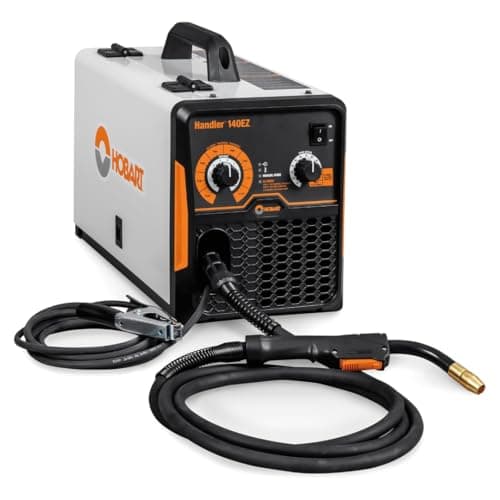 Hobart Handler 140EZThe most documented 120 V gas MIG machine there is, comfortably inside $1,000. | Best overall inside the cap | $720.00 · View on Amazon #ad How this is funded · Price as of November 13, 2026 |
| 2 | 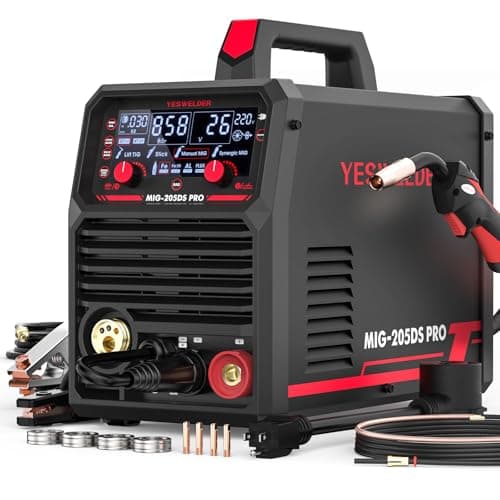 YESWELDER MIG-205DS PROFive processes, 205 A on 220 V and synergic control, at a fraction of the budget. | Most capability inside the cap | |
| 3 | 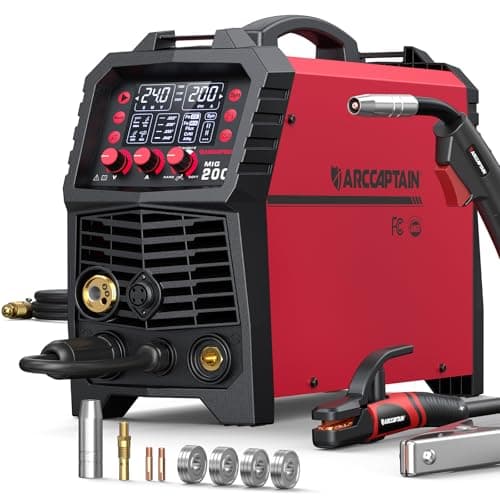 ARCCAPTAIN MIG200Spool-gun support built in rather than a model-specific accessory question. | Best aluminum path inside the cap | |
| 4 | 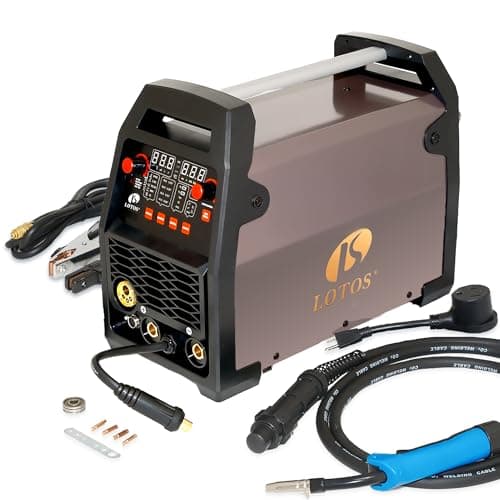 Lotos MIG180Six processes including a 160 A stick rating, well inside this cap. | Best if you also want stick | $359.98 · View on Amazon #ad How this is funded · Price as of November 13, 2026 |
What a thousand dollars actually buys
Under $1,000 the best all-round gas MIG machine for a home shop is the Hobart Handler 140 — 30 to 140 amps on a 115-volt circuit — because at this price the dealer network and the depth of published settings advice matter more than the spec sheet. If capability per dollar is the goal instead, the YESWELDER MIG-205DS PRO delivers five processes and 205 amps on 220 volts for roughly half as much.
How this differs from the under-$500 page
Two things change when the cap doubles, and neither is raw amperage.
The first is that a name-brand machine becomes reachable. Under $500 the entire field is imports, and the under-$500 roundup has to list the Hobart Handler 140EZ as the machine worth stretching above the cap for. Here it is simply the top pick.
The second is that the budget stops being only the machine. A thousand dollars can be a machine from the bottom of this field plus a cylinder, a regulator, a cart and a decent helmet — a complete working setup — or a machine from the top of it and nothing else. For most people the first package welds better, and that is the genuine decision on this page.
| Hobart Handler 140EZ | YESWELDER MIG-205DS PRO | ARCCAPTAIN MIG200 | Lotos MIG180 | |
|---|---|---|---|---|
| Processes | Gas MIG, flux-core | MIG, flux-core, spool gun, lift TIG, stick | MIG, flux-core, stick, lift TIG, spot, spool gun | MIG, flux-core, stick, lift TIG, spot, spool gun |
| Input | 115 V, 20 A dedicated | 110 V or 220 V | 110 V or 220 V | 110–125 V or 210–250 V |
| Output | 30–140 A | 30–160 A at 110 V; 30–205 A at 220 V | Up to 200 A | MIG to 180 A; stick to 160 A |
| Duty cycle | 30% at 90 A | Not published per amperage | Not published per amperage | Not published per amperage |
| Synergic control | No | Yes | Yes | Yes |
| Spool gun (aluminum) | No | Yes | Yes | Yes |
| Weight | Not published | 22.7 lb | Not published | Not published |
The machine worth knowing sits just above the cap
The Hobart Handler 210 MVP was price-checked on 2 October 2026 across several US welding retailers and came in above this cap at every one of them. It is therefore not a pick on this page, but it is the obvious next question so it deserves a straight answer.
What it adds is published: 25 to 210 amps — 140 on 115 volts, 210 on 230 volts — a 30% duty cycle at 150 amps, and a single-pass capacity from 24 gauge to three-eighths of an inch.
Whether that is worth the extra depends entirely on one thing. On 115 volts it gives 140 amps, exactly like the Handler 140EZ at half the price. Everything you are paying for appears when a 240-volt circuit does, and not before. The 240-volt roundup is where that machine properly belongs.
Budget the gas setup, not just the machine
A gas MIG setup is four things beyond the welder, and only the first is obvious.
A cylinder, which most US suppliers lease rather than sell — so there is a deposit or lease charge plus a refill each time, and the lease terms often matter more to your running cost than the bottle size does. A regulator matching the cylinder valve, CGA-580 for argon and argon/CO2 mixes. A cart, because a cylinder has to be secured upright and now travels with the machine. And solid wire, typically ER70S-6 rather than flux-cored.
Cylinder sizes covers how big to go, and what gas for MIG welding covers which mix. On a $1,000 total budget this is the part people forget, and it is the part that decides whether the machine gets used.
Where the prices on this page come from
Arc & Bead never writes a price into the text of a page. A figure typed into prose goes stale the week after it is written, and a stale price on a buying page is worse than no price. The number inside each button is Amazon's own, read once a day and stamped with the date it was read.
The cap is a selection decision rather than a published price. Each machine here was checked against US welding retailers on 2 October 2026 purely to decide whether it qualified, and the sources below name the listings used. What this page publishes is the decision, not the number behind it, because the number moves and the decision is what you came for. Every buy button goes to the current Amazon listing, which is the only price that is true at the moment you read it — confirm there, because a machine can cross this cap in either direction between our check and your click. How we pick sets out the whole method.
Check the circuit before the budget
Three of the four machines here will run on a household outlet and two of them want a dedicated 20-amp circuit to do it properly. Sharing with a freezer and shop lights will trip the breaker at higher settings, and it looks exactly like an underpowered machine. What size breaker a welder needs covers what to ask for. Circuit work belongs to a licensed electrician.
1. Best overall inside the cap
Hobart Handler 140EZ
The most documented 120 V gas MIG machine there is, comfortably inside $1,000.
Hobart publishes 30 to 140 amps, a 30% duty cycle at 90 amps, 120-volt input, a 24-gauge to 3/16-inch single-pass capacity and infinite voltage control. Checked against US welding retailers on 2 October 2026 and comfortably inside the cap, with enough left over for a bottle and a regulator.
At this price the argument for Hobart is not the spec sheet, which a cheaper import beats on paper. It is everything around it: a dealer network, consumables on the shelf at any welding supplier, and the deepest body of published settings advice of any 120-volt wire machine. When a bead goes wrong at 9pm, somebody has already asked your exact question.
It runs self-shielded flux-cored wire out of the box and takes a gas bottle whenever you are ready, so the machine does not force the gas decision at purchase time.
The limits are real. Thirty percent at 90 amps is roughly three minutes of arc time in ten, and it is single-voltage — a 240-volt circuit later buys it nothing.
What works
- The most documented 120 V MIG family there is — every settings question has already been answered somewhere
- Runs flux-core on day one and gas MIG the day you buy a bottle, so the machine survives the level change
- EZ Mode sets the machine from two turns of a knob, and infinite voltage control is still there when you want to override it
- Spool-gun ready, so aluminum is a gun purchase rather than a new machine
What does not
- 3/16 in is the published capacity. A trailer deck in one sitting is beyond it
- Single-voltage: it will never take advantage of a 240 V circuit if you later run one
- 53 lb is heavy for a 120 V machine — it wants a cart rather than a shelf
2. Most capability inside the cap
YESWELDER MIG-205DS PRO
Five processes, 205 A on 220 V and synergic control, at a fraction of the budget.
YESWELDER publishes gas MIG, flux-core, spool-gun MIG, lift TIG and stick, on 110 or 220 volts, at 30 to 160 amps MIG at 110 volts and 30 to 205 amps at 220 volts, with wire feed from 58 to 858 inches per minute and a 22.7-pound machine.
Measured purely on what you get per dollar inside this cap, nothing here is close. It sits near the bottom of the range rather than near the top, which leaves most of the budget for a bottle, a regulator, a cart and a helmet — and that package welds better than a more expensive machine with no gas setup behind it.
Synergic control is the feature that matters most here: pick the material thickness and the machine sets voltage and wire speed from a published table, which removes the single hardest part of learning MIG.
Two honest caveats. The lift TIG is DC only with no pedal, so it is not a route into Level 3. And dealer support and warranty handling are not in Hobart's class, which is precisely what the price difference represents.
What works
- Synergic mode sets voltage and wire speed from the thickness you select, which removes the single hardest part of learning MIG
- Spool-gun capable, so aluminum is a gun purchase rather than a machine purchase
- 22.7 lb for a 205 A dual-voltage machine is remarkable
What does not
- Lift TIG is DC only and has no foot pedal, so it will not weld aluminum and is not a route to Level 3
- Five processes means five sets of consumables to stock
- Dealer support and warranty handling are not on the level of Hobart or Lincoln
3. Best aluminum path inside the cap
ARCCAPTAIN MIG200
Spool-gun support built in rather than a model-specific accessory question.
ARCCAPTAIN publishes gas MIG, flux-core, stick, lift TIG, spot and spool-gun modes, on 110 or 220 volts, at up to 200 amps, with synergic control plus 2T/4T and burn-back adjustment. It sits in the lower part of this cap rather than near the top.
Aluminum is the most common reason a Level 2 machine gets replaced inside a year, and the reason is almost always that spool-gun provision turned out to be model-specific. Buying a machine where spool-gun support is designed in rather than looked up removes the single most expensive surprise in this price band.
Synergic control sets voltage from wire speed, so the first hour is spent welding rather than reading a chart.
Be clear that 200 amps is the 220-volt figure. On a household outlet the usable output is substantially lower, and the spool gun itself is a separate purchase that is not small.
What works
- Spool-gun support is built in rather than a model-specific accessory question, and that question is the whole aluminum decision on a MIG machine
- Synergic control sets voltage from wire speed, so the first hour is spent welding rather than reading a chart
- Dual voltage and six processes mean it stays useful well past the point most first machines stop
What does not
- The spool gun is a separate purchase, and not a small one
- 200 A is the 220 V figure. On a household outlet the usable output is much lower
- Dealer support is thin next to Hobart or Lincoln, which is what you notice when something breaks
4. Best if you also want stick
Lotos MIG180
Six processes including a 160 A stick rating, well inside this cap.
Lotos rates this at 180 amps MIG and 160 amps stick across gas MIG, gasless flux-core, stick, DC lift TIG, spot and spool-gun aluminum. It was checked in October 2026 and sits a long way inside this cap.
Stick matters more in a home shop than its reputation suggests. Rusty, painted and outdoor steel is exactly where gas MIG struggles and stick does not care, so having both means you stop choosing between a clean weld and a weld that will actually happen.
Synergistic MIG is the other argument. The machine sets voltage against wire feed speed for you and leaves a fine-tune control on top, which is the version of a multiprocess front panel a first-time owner can actually use.
What works
- Stick capability matters more than it sounds: rusty, painted or outdoor steel is where MIG struggles and stick does not
- A published 160 A stick rating is a real stick machine, not a token third process on the switch
- Synergistic MIG sets voltage and wire speed together, so the first hour goes on welding rather than on a settings chart
What does not
- The headline 180 A and 160 A figures are the 240 V ratings; Lotos does not publish a separate 120 V output
- TIG is lift-start DC with no high-frequency start, and the torch is a separate purchase — treat it as a bonus, not a feature you bought
- The spool gun is also sold separately, and DC lift TIG cannot weld aluminum whatever gun you fit
- Dealer support and warranty handling are not on the level of Hobart or Lincoln
Who this is wrong for: Anyone who wants aluminum without a second purchase. The spool gun is sold separately, and the DC lift TIG cannot weld aluminum at all.
Questions people actually ask
What is the best MIG welder under $1,000?
For most home shops, the Hobart Handler 140EZ — 30 to 140 amps on a 115-volt circuit, checked against US retailers in October 2026 and comfortably inside the cap. At this price the dealer network, shelf availability of consumables and the depth of published settings advice matter more than the spec sheet.
If capability per dollar is the goal instead, the YESWELDER MIG-205DS PRO gives five processes and 205 amps on 220 volts for roughly half the money.
Can you get a 240V MIG welder for under $1,000?
Yes — several dual-voltage machines sit well inside the cap, including the YESWELDER MIG-205DS PRO at 205 amps on 220 volts and the ARCCAPTAIN MIG200 at up to 200 amps.
What you generally cannot get inside $1,000 is a 240-volt machine from a major US brand with a full dealer network. The Hobart Handler 210 MVP, the obvious example, was checked across several US retailers in October 2026 and sat above the cap at every one.
Is a $1,000 MIG welder enough for a home shop?
For almost all home fabrication, comfortably. A 140-amp 120-volt machine covers steel up to roughly a quarter inch with joint preparation, and a dual-voltage machine inside this cap reaches further once a 240-volt circuit exists.
The limit you hit first is usually duty cycle on long continuous seams, not maximum thickness.
Should I spend the whole budget on the machine?
Usually not. A gas MIG setup needs a cylinder, a regulator and a cart beyond the welder, plus an auto-darkening helmet, and those are what turn a machine into a working setup.
A machine from the bottom of this field with a complete gas setup and a good helmet behind it welds better than one from the top of it with nothing.
Does a MIG welder under $1,000 weld aluminum?
Only with a spool gun, and only if the machine supports one. Aluminum wire is soft and crumples travelling through a long gun liner, so it needs a short wire path at the gun itself.
Of the machines here, the YESWELDER MIG-205DS PRO, the ARCCAPTAIN MIG200 and the Lotos MIG180 publish spool-gun support; the Hobart Handler 140EZ does not. Aluminum also needs 100% argon rather than a 75/25 mix.
Sources
- Hobart Welders — Handler 140EZ and Handler 210 MVP published specifications
- Cyberweld — Hobart Handler 140EZ (500559) listing, price checked 2 October 2026
- Cyberweld — Hobart Handler 210 MVP (500553) listing, price checked 2 October 2026
- YESWELDER — MIG-205DS PRO published specifications
- Lotos — MIG180 published specifications: six modes, 110–125 V or 210–250 V, MIG to 180 A, stick to 160 A, 1/4 in mild steel
Read next
- The best MIG welders under $500
What $500 buys in gas MIG, what it leaves out, and the machines that fit inside the cap.
- The best MIG welders for beginners
Gas-capable machines for a home shop, and the one specification that makes learning MIG easier.
- The best 240V welders for a home shop
The machines worth running a 240V circuit for, and how to size that circuit before you buy.
- What gas do you need for MIG welding?
Which shielding gas for which metal, and the one combination that cannot work.
- The best multiprocess welders for beginners
When a multiprocess machine is genuinely right, and which of the extra modes are real.
- Level 2 · MIG: when the gas bottle is finally worth it
You can already lay a bead. This level is about what changes when you add a gas bottle — and about being honest that it is not only an upgrade.
Back to Level 2 · MIG, or start over at Find Your Level.
Ryder M.
Ryder M. is the hands-on owner behind Magoo Media Group. He writes Arc & Bead's buying guides and picks every machine on the site. What every recommendation is based on — and what it is not based on — is set out on How We Pick.