The best dual voltage MIG welders
A dual-voltage machine lets you start on a household outlet and get the whole welder later. The catch is that most of them print one amperage figure and let you assume it applies to both.
Arc & Bead is an Amazon Associate. If you buy through a link on this page we may earn a commission, at no extra cost to you. We have not physically tested the machines on this page and we say so on How We Pick.
Quick picks
Tap any row to jump to the full write-up further down this page.
| # | Product | Best for | Price |
|---|---|---|---|
| 1 | 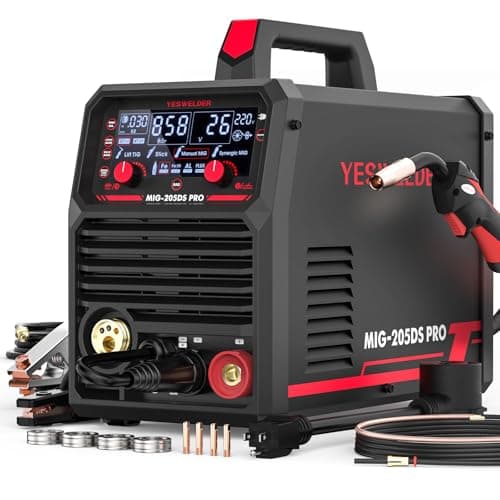 YESWELDER MIG-205DS PROThe only machine here that publishes a separate 110 V and 220 V figure for every process it offers, so nothing about the circuit is a surprise. | Best overall | |
| 2 | 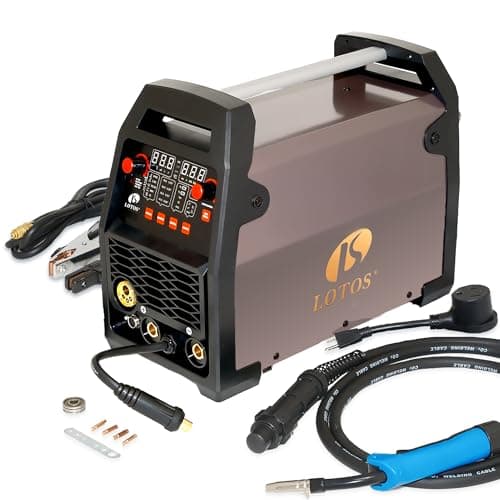 Lotos MIG180The cheapest dual-voltage machine in our registry, and the only one here with a real published stick rating. | Budget pick | $359.98 · View on Amazon #ad How this is funded · Price as of November 13, 2026 |
| 3 | 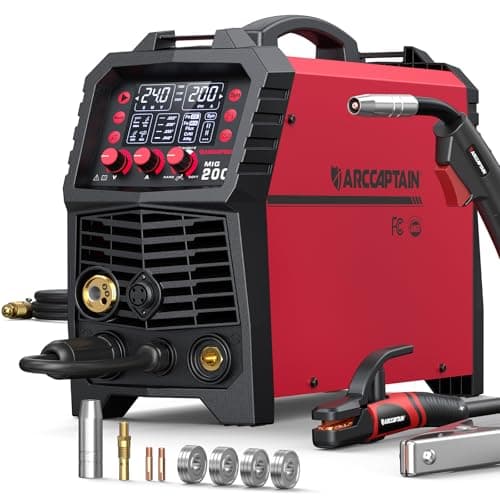 ARCCAPTAIN MIG200Dual voltage with spool-gun provision built in, so the aluminum question is a gun purchase instead of a second welder. | Best for aluminum later | |
| 4 | 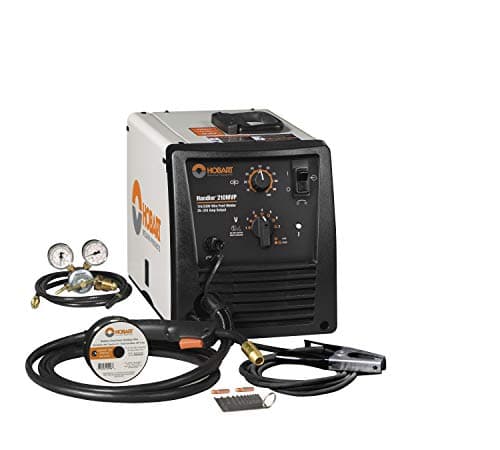 Hobart Handler 210 MVPThe multi-voltage plug is the cleanest implementation of the idea, and Hobart publishes both output figures and a real working duty cycle. | Best dealer support |
The short answer
A dual voltage MIG welder runs on both a standard 120 V household outlet and a 240 V circuit, usually at roughly two thirds of its rated output on the lower supply. It lets you start welding before an electrician has been, then recover the full machine later without buying a second one.
Our overall pick is the YESWELDER MIG-205DS PRO, because it is the only machine here that publishes a separate 110 V and 220 V output figure for every process it offers. The budget pick is the Lotos MIG180, the cheapest dual-voltage machine in our registry and the only one with a real 160 A published stick rating.
Prices in the table are read from the live feed when the page loads and each carries its own "as of" date in the buy button. We do not type numbers into this copy.
The specification that matters is the one most machines do not print
"Dual voltage" is sold as a convenience feature and bought as an insurance policy. The useful question is not whether a machine accepts 120 V — nearly all of these do — but what it actually produces there. The gap is large and consistent: where a maker publishes both figures, the 120 V number is typically 60 to 70 percent of the 240 V one.
That matters because MIG output translates directly into steel thickness. Roughly 140 A is where single-pass 1/4 in becomes comfortable, and 3/8 in needs more than 200 A. A machine delivering 140 A on a household circuit is a 1/4 in machine until the circuit changes, no matter what the box says. If the plan is to stay on 120 V for a while, the 110 V MIG welders with gas is the page scoped to that constraint, and 120 V vs 240 V welders explains what each supply can and cannot do.
| Machine | 120 V output | 240 V output | Duty cycle | Steel capacity |
|---|---|---|---|---|
| YESWELDER MIG-205DS PRO | MIG 30-160 A | MIG 30-205 A | Not published | Not published |
| Lotos MIG180 | Not published separately | MIG to 180 A; stick to 160 A | Not published | To 1/4 in |
| ARCCAPTAIN MIG200 | Not published separately | 200 A maximum | Not published | Not published |
| Hobart Handler 210 MVP | 140 A | 210 A (25-210 A range) | 30% at 150 A; 20% at 90 A | 24 gauge to 3/8 in single pass |
Read the "not published separately" cells as the real finding of this page. Three of these four machines print one amperage and let you assume it applies on both supplies. It does not, and the manufacturer has not told you by how much.
Dual voltage is not the same as a multi-voltage plug.
Hobart's MVP system means the machine ships with two plug ends you swap by hand. Other machines auto-sense the supply, and some need an adapter you buy separately. All three are sold as "dual voltage". Check which one you are getting, because an adapter you have to source is a delay between delivery and your first weld.
What to run on the 120 V side, honestly
A 120 V circuit is a 20 A circuit in most garages, and a MIG machine at 140 A draws close to all of it. Two practical consequences follow. First, a 15 A lighting circuit will trip at the higher settings — you need a dedicated 20 A outlet. Second, extension cords are where most 120 V welding problems actually come from: voltage drop on a long thin cord shows up as an unstable arc that reads like a machine fault. Welder extension cords has the gauge-and-length numbers.
When you do run the 240 V circuit, the two figures an electrician will ask for are the breaker size and the wire gauge: what size breaker for a welder and what size wire for a welder outlet. Budget that work as part of the machine, because it usually costs more than the difference between two welders.
How we picked these
Both supplies, or it is not on the page. Every machine here is published by its maker for 120 V and 240 V operation. Single-voltage machines were excluded regardless of value.
Ranked on published transparency first. On a dual-voltage page, a machine that tells you what it does on each supply is more useful than one with a bigger headline number and no breakdown. That is the axis, and it is why the most expensive machine here is not the winner.
Published figures only. We have not welded with any of these. Where a manufacturer does not publish a figure, the table says so. More on the method on how we pick.
1. Best overall
YESWELDER MIG-205DS PRO
The only machine here that publishes a separate 110 V and 220 V figure for every process it offers, so nothing about the circuit is a surprise.
YESWELDER publishes this machine at MIG 30–160 A on 110 V and 30–205 A on 220 V, stick 20–140 A on 110 V and 20–205 A on 220 V, and lift TIG 15–140 A on 110 V and 15–205 A on 220 V, with a wire feed speed range of 58–858 in/min, at 22.7 lb.
That is the reason it wins a dual-voltage page. Almost every machine in this class advertises one big number — and that number is the 240 V figure. Printing both turns "dual voltage" from a marketing word into a planning tool: you can see that a household outlet gets you 160 A of MIG, decide whether that covers your work, and run the 240 V circuit when it does not.
Who it is for: someone buying their first gas MIG machine in a garage with no 240 V outlet yet, who does not want to buy twice. Synergic mode sets voltage and wire speed from the thickness you select, which removes the single hardest part of learning MIG, and it is spool-gun capable, so aluminum stays a gun purchase rather than a machine purchase.
Against it: the lift TIG is DC only with no foot pedal, so it is not a route to Level 3; five processes means five sets of consumables; and dealer support is not on Hobart's or Lincoln's level, which is what you notice when something breaks.
What works
- Synergic mode sets voltage and wire speed from the thickness you select, which removes the single hardest part of learning MIG
- Spool-gun capable, so aluminum is a gun purchase rather than a machine purchase
- 22.7 lb for a 205 A dual-voltage machine is remarkable
What does not
- Lift TIG is DC only and has no foot pedal, so it will not weld aluminum and is not a route to Level 3
- Five processes means five sets of consumables to stock
- Dealer support and warranty handling are not on the level of Hobart or Lincoln
2. Budget pick
Lotos MIG180
The cheapest dual-voltage machine in our registry, and the only one here with a real published stick rating.
The budget pick in the strict sense: the least expensive product we list that does this page's job. Lotos publishes the MIG180 for 110–125 V or 210–250 V input, with MIG to 180 A, DC TIG to 180 A and stick to 160 A, a mild steel capacity of 1/4 in, 0.023–0.040 in wire, and synergistic MIG with voltage fine tuning.
Who it is for: someone who wants gas MIG, gasless flux-core and a genuine stick arc on either supply for the least money. The 160 A stick rating is the part worth paying attention to — rusty, painted or outdoor steel is exactly where MIG struggles and stick does not, and a published 160 A is a real stick machine rather than a third process on a switch.
The honest limitation is the one this page exists to flag: the 180 A and 160 A headline figures are the 240 V ratings, and Lotos does not publish a separate 120 V output. If your plan is to run it on a household circuit for a year first, you are buying a machine whose household performance is not stated. Treat that as the price of the price.
What works
- Stick capability matters more than it sounds: rusty, painted or outdoor steel is where MIG struggles and stick does not
- A published 160 A stick rating is a real stick machine, not a token third process on the switch
- Synergistic MIG sets voltage and wire speed together, so the first hour goes on welding rather than on a settings chart
What does not
- The headline 180 A and 160 A figures are the 240 V ratings; Lotos does not publish a separate 120 V output
- TIG is lift-start DC with no high-frequency start, and the torch is a separate purchase — treat it as a bonus, not a feature you bought
- The spool gun is also sold separately, and DC lift TIG cannot weld aluminum whatever gun you fit
- Dealer support and warranty handling are not on the level of Hobart or Lincoln
Who this is wrong for: Anyone who needs to know exactly what the machine does on a 120 V outlet before buying. Lotos does not publish that figure, and on this page that is the one thing we rank on.
3. Best for aluminum later
ARCCAPTAIN MIG200
Dual voltage with spool-gun provision built in, so the aluminum question is a gun purchase instead of a second welder.
ARCCAPTAIN publishes the MIG200 as gas MIG, flux-core, stick, lift TIG, spot and spool gun on 110 V or 220 V, with a 200 A maximum output, synergic control, 2T/4T operation and burn-back adjustment.
The spool-gun provision is why it is here rather than further down. On a MIG machine, aluminum is not a settings question — it is a feeding question, because aluminum wire is too soft to push down a long liner. A spool gun puts a small spool at the handle, and whether your machine supports one is usually the entire aluminum decision. Having it built in rather than model-specific removes the most common buy-then-discover problem in this category.
Against it: the spool gun is a separate and not small purchase, the 200 A is the 220 V figure with no published 110 V number, and dealer support is thin next to Hobart or Lincoln.
What works
- Spool-gun support is built in rather than a model-specific accessory question, and that question is the whole aluminum decision on a MIG machine
- Synergic control sets voltage from wire speed, so the first hour is spent welding rather than reading a chart
- Dual voltage and six processes mean it stays useful well past the point most first machines stop
What does not
- The spool gun is a separate purchase, and not a small one
- 200 A is the 220 V figure. On a household outlet the usable output is much lower
- Dealer support is thin next to Hobart or Lincoln, which is what you notice when something breaks
4. Best dealer support
Hobart Handler 210 MVP
The multi-voltage plug is the cleanest implementation of the idea, and Hobart publishes both output figures and a real working duty cycle.
Hobart publishes the Handler 210 MVP as gas MIG and flux-core on 115 V or 230 V through a multi-voltage plug, 25–210 A output (140 A on 115 V, 210 A on 230 V), a 30% duty cycle at 150 A and 20% at 90 A, a single-pass steel capacity of 24 gauge to 3/8 in, and seven voltage settings on 230 V against four on 115 V.
The MVP plug is the most literal answer to the dual-voltage problem: you change the plug end rather than the machine, which means you can buy it before the 240 V circuit exists and get the full 210 A the day it does. The 30% duty cycle at 150 A is a real working rating rather than a demonstration figure, and 3/8 in single pass covers essentially every home fabrication job.
Against it, and this is the dual-voltage caveat specifically: on 115 V you get 140 A — no more than a 140-class machine, at a much higher price. The value only appears once the 240 V outlet exists. It is also heavy enough to want a cart, and no spool gun is included. Its listing price has also been running above its usual street price, so check the live number in the table before you commit.
What works
- The multi-voltage plug means you can buy it before you have run a 240 V circuit and get the full 210 A later
- 3/8 in single-pass capacity covers essentially every home fabrication job
- 30% duty cycle at 150 A is a real working duty cycle, not a demonstration figure
What does not
- Heavy enough that you will want a cart, which is another purchase
- On 115 V you get 140 A — no more than the Handler 140EZ, at a much higher price. The value only appears once you have the 240 V outlet
- No spool gun included, so aluminum is a further purchase
Questions people actually ask
What does dual voltage mean on a MIG welder?
It means the machine is built to run on either a standard 120-volt household outlet or a 240-volt circuit. Some models auto-sense the supply, some ship with a swappable multi-voltage plug, and a few need an adapter you buy separately.
The important part is that output is not the same on both. Where manufacturers publish both figures, the 120-volt number is typically 60 to 70 percent of the 240-volt one.
Is a dual voltage welder worth it?
Usually yes, if you do not already have a 240-volt circuit in the shop. It lets you start welding immediately on a household outlet and recover the full machine later, instead of buying a small welder now and a bigger one in two years.
It is not worth paying much extra for if you already have the 240-volt outlet, because then you are paying for flexibility you will never use.
How thick can a dual voltage MIG welder weld on 120 volts?
As a practical guide, about 1/4 inch in a single pass at the top of the 120-volt range, which is roughly 140 amps on the machines here that publish the figure.
Thicker steel is possible with multiple passes and joint preparation, but single-pass 3/8 inch needs more than 200 amps, and that is a 240-volt figure on every machine we list.
Do I need a dedicated circuit for a 120 volt MIG welder?
Yes, a 20-amp circuit at minimum. A MIG machine running at the top of its 120-volt range draws close to the whole circuit, and a 15-amp garage lighting circuit will trip at the higher settings.
Avoid long thin extension cords too. Voltage drop on an undersized cord produces an unstable arc that is easy to mistake for a machine fault.
Can a dual voltage MIG welder weld aluminum?
Only with a spool gun and 100 percent argon, and only if the machine has spool-gun provision. The ARCCAPTAIN MIG200 and YESWELDER MIG-205DS PRO on this page both publish spool-gun capability; the Hobart Handler 210 MVP accepts Hobart's SpoolRunner 100 as a separate purchase.
Aluminum wire is too soft to push down a long liner, which is why the gun exists rather than it being a settings change.
Which is better, auto-sensing or a multi-voltage plug?
Neither is better in output terms - it is about how you change supplies. Auto-sensing means you plug in and the machine works it out. A multi-voltage plug like Hobart's MVP means you swap the plug end by hand, which takes a minute and needs no tools.
The arrangement to watch for is the third one: a machine that needs an adapter you have to buy separately, which delays your first weld.
Sources
- YESWELDER - MIG-205DS PRO published specifications: gas MIG, flux-core, spool-gun MIG, lift TIG and stick, 110 V or 220 V 50/60 Hz, MIG 30-160 A at 110 V and 30-205 A at 220 V, stick 20-140 A at 110 V and 20-205 A at 220 V, TIG 15-140 A at 110 V and 15-205 A at 220 V, wire feed 58-858 in/min, 22.7 lb (as recorded in this site's product registry, ASIN B07TVCWDGW)
- Lotos - MIG180 published specifications: gas MIG, gasless flux-core, stick, DC lift TIG, spot and spool-gun aluminum, 110-125 V or 210-250 V input, MIG to 180 A, DC TIG to 180 A, stick to 160 A, mild steel to 1/4 in, 0.023-0.040 in wire, synergistic MIG with voltage fine tuning (read 2026-10-19, recorded in this site's product registry, ASIN B0FDZ15SD4)
- ARCCAPTAIN - MIG200 published specifications: gas MIG, flux-core, stick, lift TIG, spot and spool gun, 110 V or 220 V dual voltage, 200 A maximum output, synergic control with 2T/4T and burn-back adjustment (as recorded in this site's product registry, ASIN B0B1TGZ8XN)
- Hobart - Handler 210 MVP published specifications: gas MIG and flux-core, 115 V or 230 V via the multi-voltage plug, 25-210 A output (140 A on 115 V, 210 A on 230 V), duty cycle 30% at 150 A and 20% at 90 A, 24 gauge to 3/8 in single pass, seven voltage settings on 230 V and four on 115 V (as recorded in this site's product registry, ASIN B004USV5UC)
- American Welding Society - gas metal arc welding process fundamentals and amperage-to-thickness relationships
Read next
- Best 110V MIG welders with gas
Household-outlet MIG machines that are genuinely built to take a bottle, with the real cost of the gas.
- 120V vs 240V welders: which one do you actually need?
The decision that sets your ceiling: what each supply voltage welds, and what the circuit really costs.
- The best MIG welders with spool gun capability
Five picks ranked on spool-gun provision - which machines have it built in, which need a model-specific gun, and the cheapest machine in our registry that supports one.
- The best 240V welders for a home shop
The machines worth running a 240V circuit for, and how to size that circuit before you buy.
- What size breaker do you need for a welder?
Read the rating plate, not the marketing. What decides the circuit, and what to tell your electrician.
- The best MIG welders for the money
Where the MIG price curve flattens, what the extra money buys, and four machines at the good points.
Back to Level 2 · MIG, or start over at Find Your Level.
Ryder M.
Ryder M. is the hands-on owner behind Magoo Media Group. He writes Arc & Bead's buying guides and picks every machine on the site. What every recommendation is based on — and what it is not based on — is set out on How We Pick.