Best Welders for a Home Garage
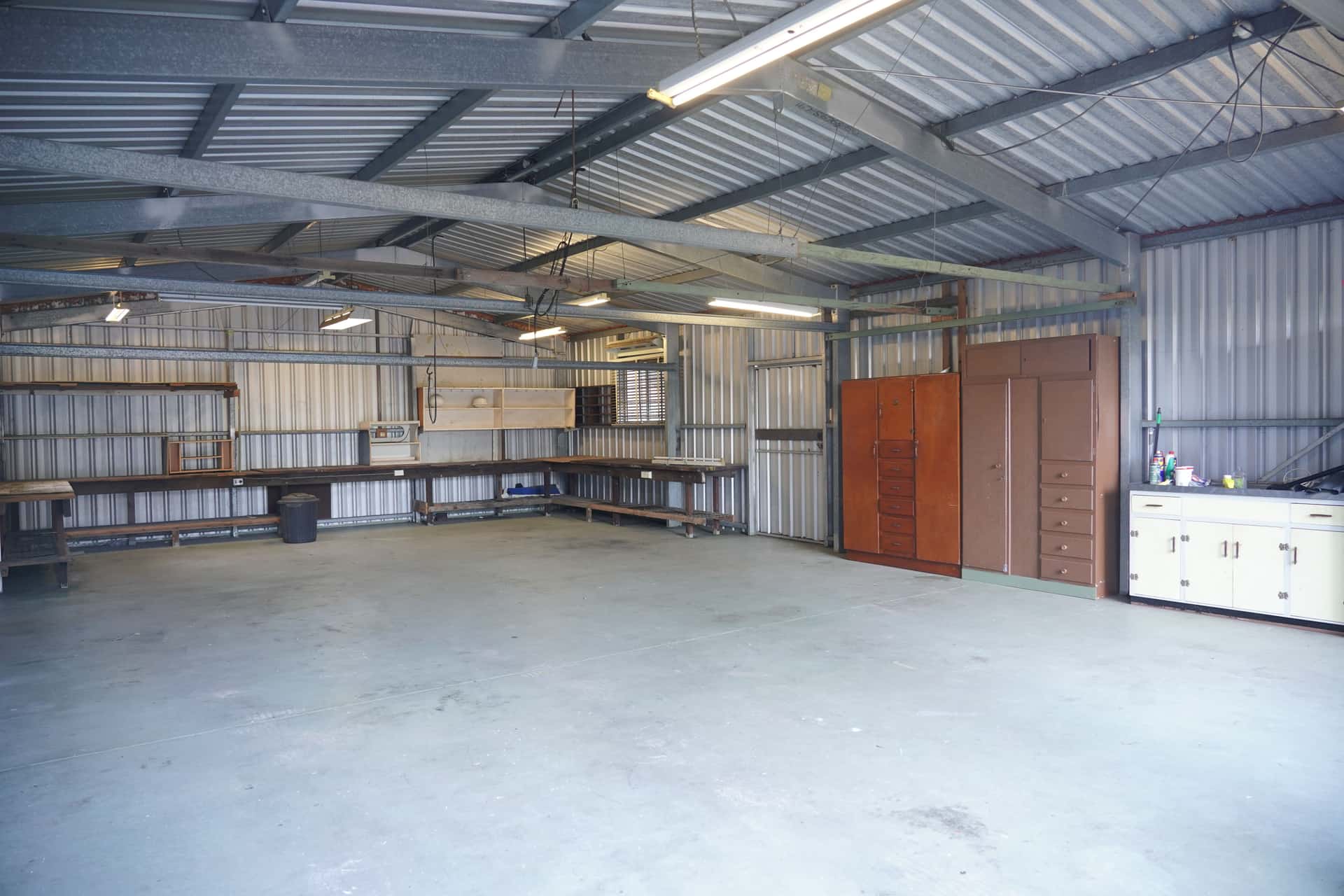
A garage is a 20-amp circuit, a car, a water heater and nowhere to put anything. The machine that suits it is not always the machine with the best specifications.
Arc & Bead is an Amazon Associate. If you buy through a link on this page we may earn a commission, at no extra cost to you. We have not physically tested the machines on this page and we say so on How We Pick.
Quick picks
Tap any row to jump to the full write-up further down this page.
| # | Product | Best for | Price |
|---|---|---|---|
| 1 | 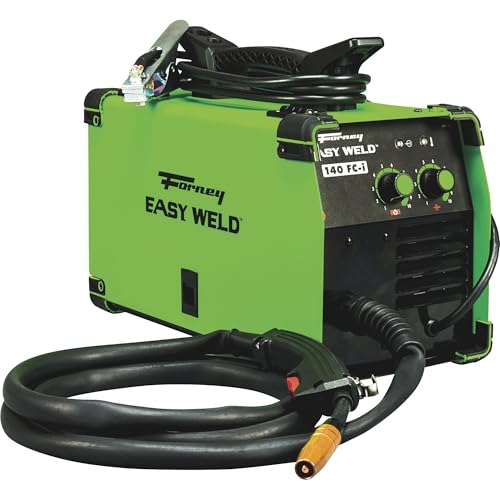 Forney Easy Weld 261 140 FC-i140 A and 1/4 inch steel from a household outlet, 19 lb to put on a shelf, and no gas cylinder to store in a space with a car in it. | Best overall for a garage | $337.99 · View on Amazon #ad How this is funded · Price as of November 13, 2026 |
| 2 | 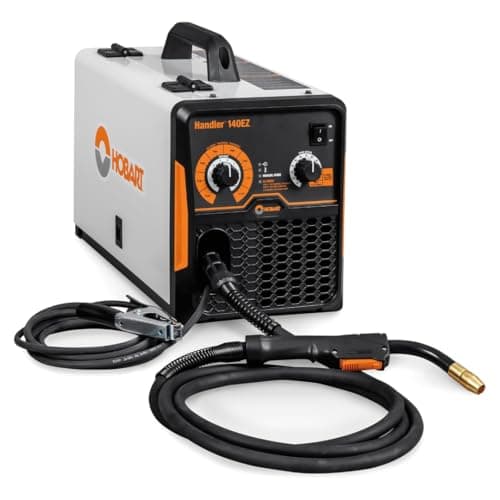 Hobart Handler 140EZGas MIG on a 120 V outlet with a 24 gauge to 3/16 inch range, which is the span most garage projects actually live in. | Best if the garage work is car work | $720.00 · View on Amazon #ad How this is funded · Price as of November 13, 2026 |
| 3 | 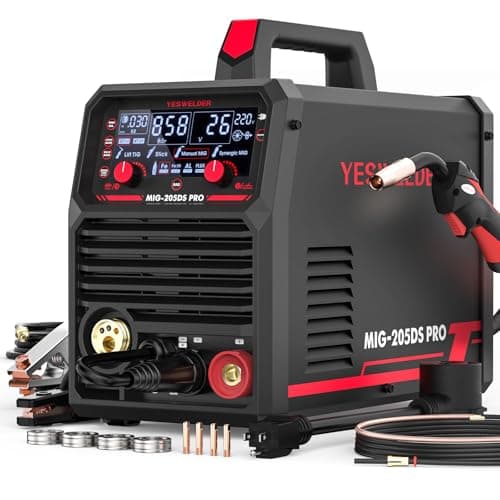 YESWELDER MIG-205DS PRO22.7 lb for a dual-voltage 205 A machine covering five processes, so one small box handles everything the garage throws at it. | Best if space is the binding constraint | |
| 4 | 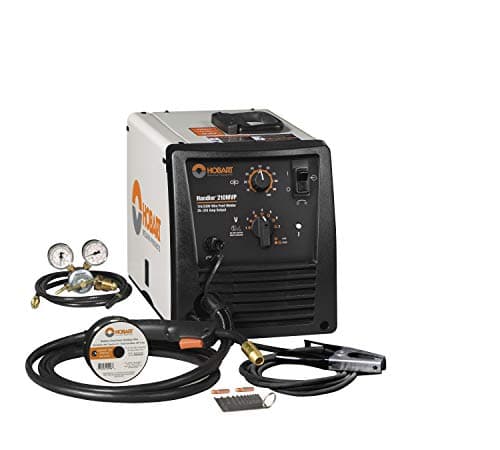 Hobart Handler 210 MVP25 to 210 A with 140 A on 115 V and 210 A on 230 V, a 30% duty cycle at 150 A, and 3/8 inch single-pass capacity. | Best if you have run a 240 V circuit |
The best welder for a home garage
The Forney Easy Weld 261 140 FC-i is the best welder for most home garages: 140 A and 1/4 inch steel capacity from an ordinary 120 V outlet, 19 lb so it stores on a shelf, and no gas cylinder to keep in a space that also holds a car. If your garage projects involve vehicle panels, the Hobart Handler 140EZ adds gas MIG and a 24 gauge low end on the same circuit. If floor space is the problem, the YESWELDER MIG-205DS PRO does five processes in 22.7 lb. If you have run a 240 V circuit, the Hobart Handler 210 MVP is the machine that uses it.
Most welder roundups rank machines on output and price. A garage imposes four other constraints first, and they knock out more machines than any specification does.
The four constraints a garage actually imposes
One: the circuit you already have. A typical attached garage has one or two 15 or 20 amp 120 V circuits, often shared with outside lights or a freezer. That sets a hard ceiling on output until an electrician changes it, and it is the reason this page leads with 120 V machines. Note that even a 120 V welder usually wants a dedicated 20 A circuit — sharing causes trips that look like machine faults. How many amps does a welder use explains why the input figure is not the output figure.
Two: where the machine lives when you are not welding. A garage is storage first and workshop second. A 19 lb machine goes on a shelf. A 53 lb machine needs a cart, and a cart plus a gas bottle is roughly a square metre of floor you no longer have. This is why weight belongs in a garage buying decision in a way it does not for a dedicated shop.
Three: ventilation. A closed garage accumulates fume quickly, and an attached garage shares air with the house. That is a genuine argument for gas MIG over flux-core if you weld indoors regularly, and an absolute argument for opening the door and wearing a respirator either way — is welding in a garage safe goes through it properly.
Four: what else is in there. A car with fuel in it, a water heater with a pilot light, paint, solvents, cardboard, sawdust, a chest freezer. Welding sprays sparks several feet and spatter further than people expect, and those are the conditions a garage fire starts in.
What that rules out
| Garage constraint | What it rules out | What it points to |
|---|---|---|
| 120 V, 20 A circuit only | 240 V-only machines; the full output of any dual-voltage machine | A 120 V machine, or a dual-voltage machine bought before the circuit |
| No floor space | A heavy machine plus a cart plus a cylinder | A light gasless machine on a shelf |
| Attached to the house | Routine indoor flux-core with the door shut | Gas MIG for indoor work, flux-core for the driveway |
| Car, water heater, solvents present | Welding where you stand rather than where it is safe | A clear ten-foot zone, a fire extinguisher, a fire watch |
| Concrete floor | Welding directly over bare concrete | A steel bench or a sheet over the slab |
| Shared with other hobbies | A permanent single-purpose setup | A machine that packs away in one trip |
The concrete floor detail nobody mentions
Do not strike an arc or let hot slag land directly on a bare concrete slab. Concrete holds moisture in its pores, and intense localised heat turns that water to steam faster than it can escape — the surface spalls and throws fragments. Weld over a steel bench, a steel plate or a welding blanket. This is the garage-specific hazard that surprises people most.
Which one to buy
For general garage fabrication: the Forney Easy Weld 261 140 FC-i. It fits the circuit, the shelf and the budget, and 1/4 inch covers the work.
If the projects are vehicles: the Hobart Handler 140EZ. You need the 24 gauge end of the range, and gas MIG is the lower-fume choice indoors.
If space is the real problem: the YESWELDER MIG-205DS PRO. 22.7 lb, five processes, one footprint.
If the 240 V circuit exists: the Hobart Handler 210 MVP. 3/8 inch single pass and a 30% duty cycle at 150 A.
We have welded with none of these machines; the ranking is built from published specifications weighed against garage constraints — how we pick sets out what that means. If you are not sure which rung you are on, what size welder do I need is the page before this one.
1. Best overall for a garage
Forney Easy Weld 261 140 FC-i
140 A and 1/4 inch steel from a household outlet, 19 lb to put on a shelf, and no gas cylinder to store in a space with a car in it.
Forney publishes flux-core (gasless) only; 120 V input on a 20 A circuit minimum; 140 A maximum output; a 30% duty cycle at 90 A; 0.030 inch wire in 2 lb and 10 lb rolls; capacity up to 1/4 inch steel; and 19 lb.
Three garage constraints, three answers. It runs on the circuit you already have. At 19 lb it lives on a shelf rather than owning floor space you do not have. And it needs no gas cylinder, which in a garage is not just a storage question — a cylinder in a space that also holds a car, a water heater and a lawnmower is a hazard that has to be secured and kept away from heat.
A quarter inch of steel capacity from a wall socket is also more than most garage jobs need. Brackets, frames, stands, trailer repairs and gates all sit inside it.
The garage-specific costs are real. It needs a 20 A circuit — a 15 A lighting circuit will trip at higher settings. And self-shielded wire produces considerably more fume than gas MIG, which in a closed garage means the door open and a respirator on.
What works
- 30% duty cycle at 90 A is unusually generous for a 120 V machine in this class
- Infinite voltage and wire-speed control rather than four fixed taps, so you can actually dial a setting in
- 19 lb — genuinely carryable to the job instead of the job coming to it
- No gas bottle, no regulator, no second purchase before your first weld
What does not
- Flux-core only. It will never run gas, so it cannot become your Level 2 machine
- Every weld leaves slag that has to be chipped and wire-brushed off
- Needs a 20 A circuit — a 15 A garage lighting circuit will trip at higher settings
Who this is wrong for: Thin sheet and bodywork. Flux-core's deep penetration is the wrong tool for panel steel, and a garage full of car projects is exactly where that comes up.
2. Best if the garage work is car work
Hobart Handler 140EZ
Gas MIG on a 120 V outlet with a 24 gauge to 3/16 inch range, which is the span most garage projects actually live in.
Hobart publishes gas MIG and flux-core; 120 V input; 30 to 140 A output; a 30% duty cycle at 90 A; 24 gauge to 3/16 inch steel capacity; infinite voltage control with a two-turn EZ Mode setup; and 53 lb.
The 24 gauge low end is why this is the garage machine for anyone whose projects involve a vehicle. Flux-core cannot do thin panel; this can, and it still runs flux-cored wire the day you need to weld something rusty in the driveway.
Gas MIG is also the lower-fume option, which matters more in a garage than in a yard. Less smoke means less of it reaching the house through a shared wall or a door into the kitchen.
Two garage costs. A bottle has to live somewhere — upright, secured, away from the water heater — so budget a cart with it. And 53 lb is heavy for a 120 V machine, so it wants that cart anyway rather than a shelf. Do you need gas for MIG welding is worth reading before you commit to the bottle.
What works
- The most documented 120 V MIG family there is — every settings question has already been answered somewhere
- Runs flux-core on day one and gas MIG the day you buy a bottle, so the machine survives the level change
- EZ Mode sets the machine from two turns of a knob, and infinite voltage control is still there when you want to override it
- Spool-gun ready, so aluminum is a gun purchase rather than a new machine
What does not
- 3/16 in is the published capacity. A trailer deck in one sitting is beyond it
- Single-voltage: it will never take advantage of a 240 V circuit if you later run one
- 53 lb is heavy for a 120 V machine — it wants a cart rather than a shelf
3. Best if space is the binding constraint
YESWELDER MIG-205DS PRO
22.7 lb for a dual-voltage 205 A machine covering five processes, so one small box handles everything the garage throws at it.
YESWELDER publishes gas MIG, flux-core, spool-gun MIG, lift TIG and stick; 110 V or 220 V input; 30 to 160 A MIG at 110 V and 30 to 205 A at 220 V; 20 to 140 A stick at 110 V and 20 to 205 A at 220 V; wire feed from 58 to 858 in/min; and 22.7 lb.
In a garage, 22.7 lb for that capability is the headline. It is a machine you can store on a shelf and carry out to the driveway, and the published 160 A MIG figure on 110 V means you know what you are getting from the outlet you have rather than guessing.
Five processes in one box is also a storage argument rather than a capability one. One machine means one footprint, one set of leads and one place to put it — which in a shared garage is frequently the decisive factor.
Stick deserves a mention for garage use specifically: it is the process that works on rusty, painted outdoor steel without gas, so the same machine handles the fence post and the bench bracket.
Costs: lift TIG is DC only with no pedal, so it is not a path to real TIG; five processes means five consumable sets to store; and dealer support is thinner than Hobart's or Lincoln's.
What works
- Synergic mode sets voltage and wire speed from the thickness you select, which removes the single hardest part of learning MIG
- Spool-gun capable, so aluminum is a gun purchase rather than a machine purchase
- 22.7 lb for a 205 A dual-voltage machine is remarkable
What does not
- Lift TIG is DC only and has no foot pedal, so it will not weld aluminum and is not a route to Level 3
- Five processes means five sets of consumables to stock
- Dealer support and warranty handling are not on the level of Hobart or Lincoln
4. Best if you have run a 240 V circuit
Hobart Handler 210 MVP
25 to 210 A with 140 A on 115 V and 210 A on 230 V, a 30% duty cycle at 150 A, and 3/8 inch single-pass capacity.
Hobart publishes gas MIG and flux-core; 115 V or 230 V via the multi-voltage plug; 25 to 210 A (140 A on 115 V, 210 A on 230 V); a 30% duty cycle at 150 A and 20% at 90 A; 24 gauge to 3/8 inch single-pass capacity; and seven voltage settings on 230 V.
The multi-voltage plug is the garage-friendly part: buy it before you have run the 240 V circuit, use it at 140 A in the meantime, and get the full 210 A when the electrician has been. That ordering matters because a 240 V circuit in a garage is a real job — what size wire for a welder outlet covers what it involves.
3/8 inch single pass covers essentially every home fabrication job, and the 30% duty cycle at 150 A is a real working figure rather than a demonstration one.
Garage costs: on 115 V you get 140 A, no more than the far cheaper Handler 140EZ, so the value only appears once the circuit exists. It is heavy enough to need a cart, and no spool gun is included.
What works
- The multi-voltage plug means you can buy it before you have run a 240 V circuit and get the full 210 A later
- 3/8 in single-pass capacity covers essentially every home fabrication job
- 30% duty cycle at 150 A is a real working duty cycle, not a demonstration figure
What does not
- Heavy enough that you will want a cart, which is another purchase
- On 115 V you get 140 A — no more than the Handler 140EZ, at a much higher price. The value only appears once you have the 240 V outlet
- No spool gun included, so aluminum is a further purchase
Who this is wrong for: A garage with no prospect of a 240 V circuit. You would be paying for output you cannot reach.
Questions people actually ask
What is the best welder for a home garage?
For most garages, the Forney Easy Weld 261 140 FC-i: 140 A and 1/4 inch steel capacity from an ordinary 120 V outlet, 19 lb so it stores on a shelf, and no gas cylinder to keep in a space that also holds a car.
If your projects involve vehicle panels, the Hobart Handler 140EZ adds gas MIG and a 24 gauge low end on the same circuit. If floor space is the constraint, the YESWELDER MIG-205DS PRO does five processes in 22.7 lb.
Can you run a welder on a normal garage outlet?
Yes, within limits. Every 120 V machine on this page runs on a household outlet, and the Forney specifies a 20 A circuit as its minimum - a 15 A lighting circuit will trip at higher settings.
Even a 120 V welder generally wants a dedicated circuit. Sharing with a freezer, a compressor or outside lights causes trips that feel like machine faults but are really a loaded circuit.
Is flux-core or gas MIG better in a garage?
Gas MIG for regular indoor welding, flux-core for everything else. Self-shielded flux-core produces considerably more fume, and a closed garage - especially one attached to the house - accumulates it quickly.
Flux-core wins back on storage and on the driveway: no cylinder to secure, and it works in a draft with the door open. Many garage owners end up with a machine that runs both, which is why the Hobart Handler 140EZ is on this page.
Do I need a 240V circuit in my garage to weld?
No, and plenty of serious work gets done without one. A 140 A machine on 120 V publishes up to 1/4 inch steel capacity, which covers brackets, frames, stands, gates and most trailer repairs.
You need 240 V when you want 3/8 inch single-pass capacity, a higher duty cycle, or AC TIG for aluminum. If that is likely, the Hobart Handler 210 MVP's multi-voltage plug lets you buy the machine before the circuit.
Is it safe to weld in a garage with a car in it?
Not in the same bay, and not without moving things. A vehicle holds fuel and fuel vapour, plastic trim, carpet and upholstery, and welding throws sparks several feet with spatter travelling further.
Move the car out, or at minimum put a solid barrier between it and the work and keep a clear ten-foot zone around the arc. Our garage safety guide covers the water heater, the solvents and the fire watch as well.
Where should I store a gas cylinder in a garage?
Upright and secured - chained to a wall bracket or strapped into a welding cart - away from any heat source, and away from where a car door could hit it. A cylinder that falls with a regulator fitted can shear the valve, and a cylinder at over 2,000 psi with a sheared valve is a projectile.
If your garage has nowhere that satisfies all of that, that is a genuine reason to choose a gasless machine instead.
Sources
- Forney Industries — Easy Weld 261 140 FC-i published specifications: flux-core only, 120 V on a 20 A circuit minimum, 140 A maximum, 30% duty cycle at 90 A, up to 1/4 in steel, 19 lb
- Hobart Welders — Handler 140EZ published specifications: gas MIG and flux-core, 120 V, 30–140 A, 30% duty cycle at 90 A, 24 gauge to 3/16 in, 53 lb
- YESWELDER — MIG-205DS PRO published specifications: five processes, 110 V or 220 V, 30–160 A MIG at 110 V and 30–205 A at 220 V, 58–858 in/min wire feed, 22.7 lb
- Hobart Welders — Handler 210 MVP published specifications: 115 V or 230 V multi-voltage plug, 25–210 A (140 A on 115 V, 210 A on 230 V), 30% duty cycle at 150 A, 24 gauge to 3/8 in single pass
Read next
- The best welders for hobbyists
Machines for a few hours a month, and the three specifications that still matter at that rate.
- What size welder do I need?
Amperage against thickness, duty cycle read honestly, and whether you need a bigger machine or a different circuit.
- Is Welding in a Garage Safe?
The garage-specific hazards - shared air, stored fuel, concrete spalling, the car - and what to do about each.
- The best 120V welders for beginners
Machines that run on an ordinary household circuit, and what that ceiling means for what you can build.
- What size breaker do you need for a welder?
Read the rating plate, not the marketing. What decides the circuit, and what to tell your electrician.
- Find your level before you spend a penny
Most bad first welder purchases are not bad machines. They are the right machine bought by the wrong person, one level too early or one level too late.
Back to Find Your Level, or start over at Find Your Level.
Ryder M.
Ryder M. is the hands-on owner behind Magoo Media Group. He writes Arc & Bead's buying guides and picks every machine on the site. What every recommendation is based on — and what it is not based on — is set out on How We Pick.