What size wire for a welder outlet?
The breaker and the conductor are two separate calculations — and for a welder, the usual household wire chart is the wrong chart.
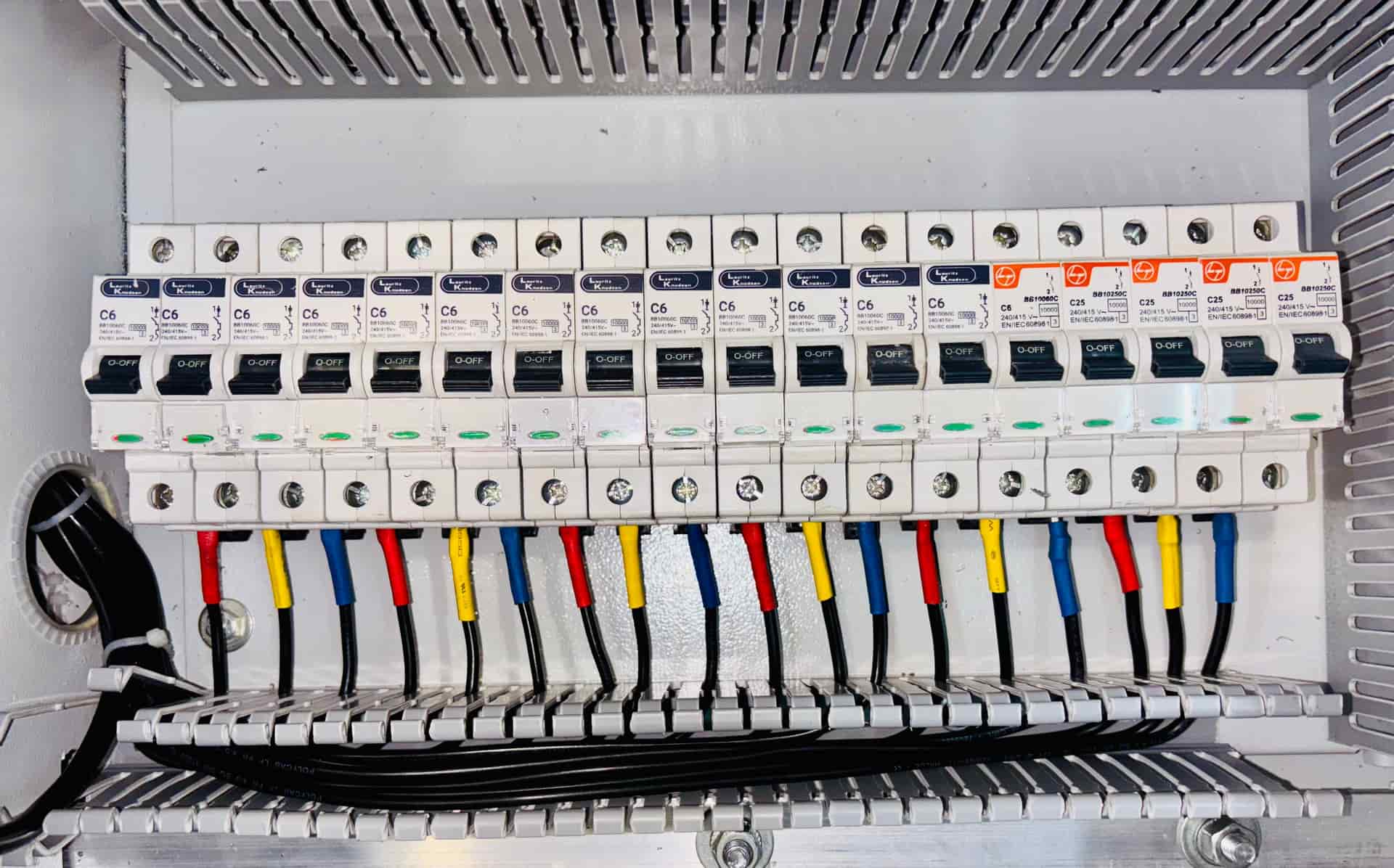
The direct answer
There is no single gauge. Conductor size for a welder outlet is set by the circuit rating, the conductor material and insulation temperature rating, the terminal temperature limit, the length of the run, the ambient temperature, and — for a welder specifically — the duty-cycle provisions of NEC Article 630. A licensed electrician does that calculation. What you supply is the machine's rated input, its plug type and the measured distance from the panel.
That is a less satisfying answer than a number, and it is the honest one. The reason is worth understanding, because it explains why the wire chart you found is probably being misapplied rather than being wrong.
The breaker and the conductor are different questions
What size breaker a welder needs answers a question with a defined answer: the machine's rating plate states its rated input amperage, and the overcurrent device follows from that.
Conductor size is a different kind of question. The breaker protects the conductor, so the conductor has to carry current safely up to the point the breaker opens — and "safely" depends on where the wire is, what it is made of, how hot it is allowed to get, how hot the surrounding air is, how many other current-carrying conductors share the same raceway, and what the terminals at each end are rated for. Those are properties of your installation, not of your welder.
This is why two people with the same machine on the same breaker legitimately end up with different conductors. One has a fifteen-foot run in free air; the other has seventy feet through a hot attic alongside four other circuits.
What Article 630 changes about welders
Here is the part most household wire charts do not account for. The usual chart is built on continuous-load thinking, which is correct for a kitchen circuit and is not how a welder behaves. A welder is an intermittent load by design: it draws heavily while the trigger is pulled and almost nothing in between, which is exactly what a duty cycle describes.
NEC Article 630 covers electric welders specifically, and it contains ampacity provisions for arc welder supply conductors based on the machine's rated primary current together with its duty cycle. The practical consequence is that a welder's supply conductors are sized by a method that does not appear on a general-purpose wire chart at all, and applying the general chart can land you on the wrong side of the result in either direction.
Why we do not publish a gauge table here
A conductor-size table for welders needs eight inputs to be correct, and would be wrong for most readers with any of them omitted. Publishing one would make this page look more useful and make a reader's installation less safe. The editorial policy covers where we draw that line.
The inputs that actually decide it
| Input | Where it comes from | Why it moves the answer |
|---|---|---|
| Rated primary input current | The machine's rating plate, often shown as I1max | The starting point for the Article 630 ampacity calculation |
| Duty cycle | The rating plate, stated with its output | Article 630 allows the intermittent nature of a welder to be taken into account |
| Conductor material and insulation rating | The wire itself — copper or aluminum, 60/75/90 °C | Ampacity differs by material and by insulation temperature rating |
| Terminal temperature rating | The breaker and receptacle markings | The lowest-rated component in the path caps the usable ampacity column |
| Run length | Measured panel to outlet, following the real route | Voltage drop over distance is corrected by increasing conductor size |
| Ambient temperature and bundling | Where the cable runs, and what it runs with | Heat derates ampacity, and so does sharing a raceway with other circuits |
| Wiring method | Cable in free air, in conduit, buried, or in an attic | Each method carries its own correction factors |
| Local amendments | Your jurisdiction's adopted code and inspector | Local rules can be stricter than the national code, and they govern |
Run length is the one people underestimate
Of all eight inputs, distance is the one that most often changes a conductor size after the fact — and it is the one homeowners guess at.
Voltage drop is not so much a code violation as a performance problem that becomes an electrical one. A welder on a long, marginally sized run sees lower voltage at the machine, and an inverter responding to lower input voltage draws more current to deliver the same output. The weld gets worse and the conductors get hotter at the same time. The cure is a larger conductor, never a larger breaker — a larger breaker on the same wire removes the protection and keeps the problem.
Measure the route, not the straight line. The cable goes up the wall, along a joist bay, across the shop and back down, which is routinely twice the distance people quote.
What to hand your electrician
Five things, and the quote will be right the first time.
Make and model. They can look up the rest if they have this.
Rated input voltage and rated input amperage from the plate, with the output it is quoted at — for example 20 A at 90 A output.
Duty cycle as published, because Article 630 can use it.
The plug type the machine ships with. A NEMA 6-50P is common on 240-volt welders, and naming it gets the matching receptacle fitted without a conversation.
Where the machine will live, and the measured route from the panel to that spot.
It is also worth asking whether the panel has spare capacity, because that is where a straightforward job becomes a subpanel. If the answer is no, 120 V versus 240 V is worth re-reading before you commit to the upgrade at all.
The part that is not optional
Everything above is preparation, not permission. Conductor and overcurrent sizing is work for a licensed electrician under NFPA 70 and your local amendments, and in most jurisdictions a new welder circuit needs a permit and an inspection. Your machine's own manual governs its electrical requirements, and where this page and that manual disagree, the manual is right.
What we would buy
Arc & Bead is an Amazon Associate. If you buy through a link on this page we may earn a commission, at no extra cost to you. We have not physically tested the machines on this page and we say so on How We Pick.
1. For measuring instead of assuming
Klein Tools CL390 digital clamp meter
Reads actual input current while you weld, and voltage at the outlet under load — the two numbers this whole question turns on.
Every estimate on this page stays an estimate until something measures it. Clamp the meter around one supply conductor, weld at the settings you genuinely use, and read the input current. That is your machine's real demand at your real settings, rather than a rating-plate maximum you may never reach.
The second reading matters just as much: voltage at the receptacle under load. A circuit that reads a healthy 240 V idle and sags the moment you pull the trigger is telling you the conductors are working too hard for the run length — which is the diagnosis in welder extension cords.
What it cannot do is make anything compliant. A measurement informs the electrician; it does not overrule the code, and no reading on this meter justifies running a machine on an undersized circuit.
What works
- Lets you measure real input current at real settings, which is the only way to know whether a breaker is marginal or fine
- Reads voltage drop at the outlet under load — the actual diagnosis when a machine underperforms on a long run
What does not
- It tells you what is happening; it does not make anything safe. Circuit work still belongs to a licensed electrician
- More tool than you need if you only ever plug into one known-good outlet
Who this is wrong for: Anyone looking for a number that lets them skip the electrician. This tool diagnoses; it does not authorize.
2. A worked example
Hobart Handler 210 MVP
Ships with both a 115 V and a 230 V plug, which is the single most useful thing you can tell an electrician.
Hobart publishes 25 to 210 A output, 140 A on 115 V and 210 A on 230 V, and supplies the machine with both a 5-15P and a 6-50P plug. That last detail is what prevents a second visit: naming the plug tells the electrician exactly which receptacle to fit, with no interpretation required.
It is also a clean illustration of why duty cycle enters a conductor calculation at all. Hobart states 30% at 150 A — the machine is designed to work intermittently, and the code has specific provisions for exactly that pattern.
What works
- The multi-voltage plug means you can buy it before you have run a 240 V circuit and get the full 210 A later
- 3/8 in single-pass capacity covers essentially every home fabrication job
- 30% duty cycle at 150 A is a real working duty cycle, not a demonstration figure
What does not
- Heavy enough that you will want a cart, which is another purchase
- On 115 V you get 140 A — no more than the Handler 140EZ, at a much higher price. The value only appears once you have the 240 V outlet
- No spool gun included, so aluminum is a further purchase
Questions people actually ask
What size wire do I need for a welder outlet?
There is no single answer, because the calculation depends on the circuit rating, conductor material and insulation rating, terminal temperature ratings, run length, ambient temperature, bundling, wiring method and the duty-cycle provisions of NEC Article 630.
What you can do is gather the inputs: the machine's rated input amperage and voltage from the rating plate, its published duty cycle, its plug type, and the measured route from the panel. A licensed electrician sizes the conductor from those.
Why can't I just use a standard wire size chart?
Because most charts assume a continuous load, and a welder is an intermittent load by design. NEC Article 630 covers electric welders specifically and includes ampacity provisions based on rated primary current together with duty cycle.
A general household chart also assumes default conditions for ambient temperature, bundling and terminal ratings. Change any of those and the correct conductor changes with it.
Does the wire size depend on the breaker or on the welder?
Both, and they are separate calculations. The breaker is sized from the machine's rated input amperage; the conductor must carry current safely up to the point the breaker opens, under your installation's actual conditions.
That is why two people with the same welder on the same breaker can correctly end up with different conductors.
Does a longer run need thicker wire?
Yes. Voltage drop over distance is corrected by increasing conductor size, not by increasing the breaker. The breaker protects the wire, so raising it without raising conductor size removes the protection.
Measure the actual cable route rather than the straight-line distance. Up the wall, along the joists and back down again is often twice what people estimate.
Can I use aluminum wire for a welder circuit?
Aluminum conductors are permitted in many installations, but they have different ampacity for the same gauge and different termination requirements, including the connector and antioxidant provisions your jurisdiction enforces.
This is squarely an electrician's decision rather than a homeowner's substitution, because the termination details are where aluminum installations fail.
How do I find my welder's rated input amperage?
It is on the rating plate, usually on the back or underside of the machine, often labelled as input amps at rated output or as I1max. It is normally quoted alongside the output it corresponds to.
If the plate is unreadable, the same table is in the manual, and manufacturers publish manuals online for essentially every current machine.
Sources
- NFPA 70, National Electrical Code — Article 310 conductor ampacity and correction factors; Article 630 electric welders; Article 110 terminal temperature limitations
- Hobart Welders — Handler 210 MVP published input requirements, duty cycle and supplied plug types (5-15P and 6-50P)
- Klein Tools — CL390 published specifications: true RMS AC/DC current and voltage measurement
- Your machine's own manual and rating plate, which govern its electrical requirements
Read next
- What size breaker do you need for a welder?
Read the rating plate, not the marketing. What decides the circuit, and what to tell your electrician.
- How many amps does a welder use?
Input amps by machine type and voltage, and why it is a completely different number from the output on the box.
- Welder extension cords: how to size one properly
Voltage drop, gauge and length — why a thin cord makes a good machine weld badly.
- 120V vs 240V welders: which one do you actually need?
The decision that sets your ceiling: what each supply voltage welds, and what the circuit really costs.
- Best budget 240V welders
The cheapest honest routes to real 240-volt output, ranked by total cost including the circuit.
- Gas and power: the two things that decide what you can actually run
A machine you cannot plug in is a machine you do not own yet. This is the hub for the two questions that quietly decide every purchase on this site.
Back to Gas & Power, or start over at Find Your Level.
Ryder M.
Ryder M. is the hands-on owner behind Magoo Media Group. He writes Arc & Bead's buying guides and picks every machine on the site. What every recommendation is based on — and what it is not based on — is set out on How We Pick.