Best budget 240V welders
Four machines that reach genuine 240-volt output without a professional budget — ranked by the total cost of getting there, not by the sticker on the box.
Arc & Bead is an Amazon Associate. If you buy through a link on this page we may earn a commission, at no extra cost to you. We have not physically tested the machines on this page and we say so on How We Pick.
Quick picks
Tap any row to jump to the full write-up further down this page.
| # | Product | Best for | Price |
|---|---|---|---|
| 1 | 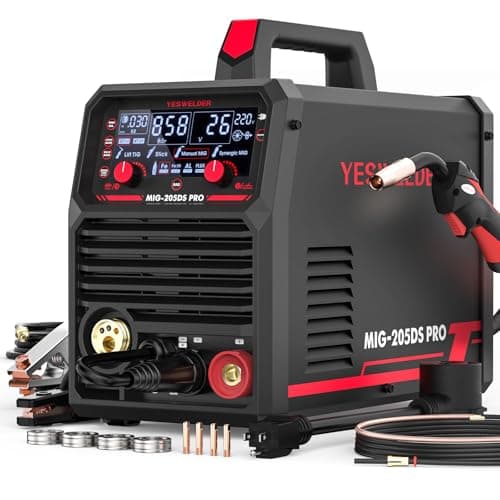 YESWELDER MIG-205DS PRO205 A of MIG on 220 V from a 22.7 lb machine that also welds on a household outlet while you save for the circuit. | Best overall on budget | |
| 2 | 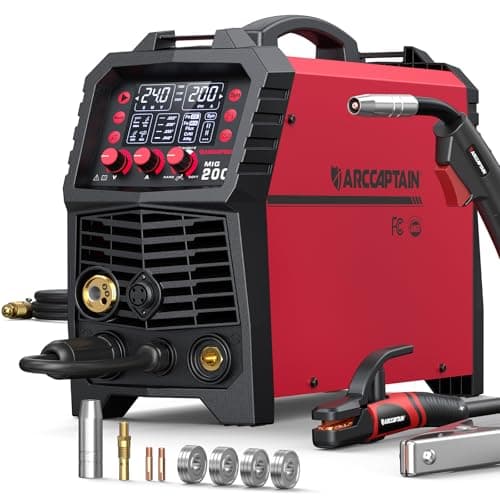 ARCCAPTAIN MIG200200 A on 220 V with spool-gun support designed in, so aluminum becomes a gun purchase rather than a second welder. | Best if aluminum is coming later | |
| 3 | 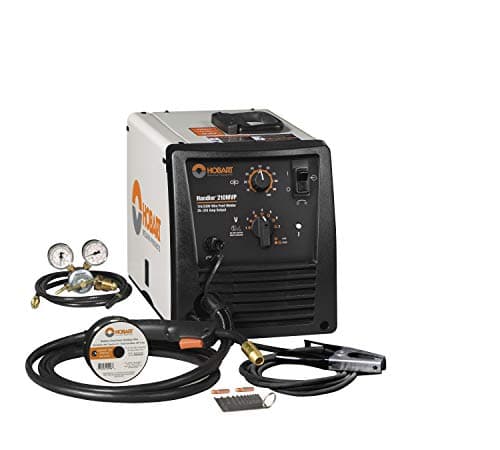 Hobart Handler 210 MVP210 A and a published 3/8 in single-pass capacity, with a 30% duty cycle at 150 A that is a working figure rather than a demonstration. | The one to stretch for | |
| 4 | 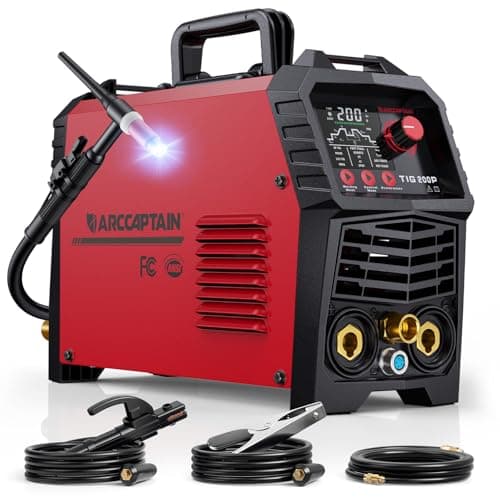 ARCCAPTAIN TIG200PGenuine high-frequency DC TIG to 200 A at 11.8 lb, dual voltage, 60% duty cycle — if you will never weld aluminum. | Cheapest 240 V TIG | $249.99 · View on Amazon #ad How this is funded · Price as of November 13, 2026 |
The cheapest honest route to 240 V output
The best budget 240-volt welder is the YESWELDER MIG-205DS PRO: a dual-voltage machine publishing 205 A of MIG output on 220 V and 160 A on a household 110 V outlet, so it welds before the 240-volt circuit exists and reaches full output after. Buy dual voltage rather than 240-volt-only — the circuit is often the larger of the two costs.
Every machine on this page is dual voltage, and that is the whole argument. A 240-volt-only welder does nothing until an electrician has been, and the circuit routinely costs a meaningful fraction of a budget machine. A dual-voltage machine inverts the sequence: you weld on the outlet you already own, learn the process, and spend the circuit money when you have actually hit the limit rather than when a spec sheet told you that you would.
That is also why the ranking here differs from the best 240V welders for a home shop. That page assumes the circuit exists and ranks the best machine to plug into it. This page assumes it does not, and ranks by what the whole arrangement costs.
Published specifications, side by side
| Machine | Processes | Output on 220/230 V | Output on 110/115 V | Duty cycle |
|---|---|---|---|---|
| YESWELDER MIG-205DS PRO | MIG, flux-core, spool-gun MIG, lift TIG, stick | 205 A MIG | 160 A MIG | Not published |
| ARCCAPTAIN MIG200 | MIG, flux-core, stick, lift TIG, spot, spool gun | 200 A maximum | Lower; not separately published | Not published |
| Hobart Handler 210 MVP | Gas MIG, flux-core | 210 A | 140 A | 30% at 150 A |
| ARCCAPTAIN TIG200P | DC TIG (HF start), stick | 200 A TIG / 170 A stick | Lower; not separately published | 60% |
Two of the four leave the duty cycle blank, and that is worth noticing rather than overlooking. Duty cycle decides whether you finish a job in one sitting, and an unstated figure reads as neutral when it should read as unverified. The Hobart and the ARCCAPTAIN TIG both publish theirs; the two synergic MIG machines do not.
What "budget" has to mean on a 240 V page
On a 120-volt page, budget means the price of the machine. On a 240-volt page it cannot, because the machine is not the only purchase. Four costs arrive together.
The circuit. A 240-volt welder needs a correctly sized circuit, a matching receptacle and, in most jurisdictions, a permit and an inspection. What size breaker a welder needs covers how to arrive at an electrician's door with the right information, and what size wire a welder outlet needs covers why the conductor is a separate calculation from the breaker.
The gas. Gas MIG means a cylinder, a regulator and a hose. Cylinder sizes covers what each size actually holds, and the smallest bottle is almost never the cheapest per cubic foot.
Consumables, per process. A six-process machine is six sets of tips, nozzles, liners, electrodes and collets. This is the cost that surprises people.
The upgrade you have not priced. A spool gun for aluminum. A foot pedal and a decent torch for TIG. Neither is optional once you want the capability, and neither is included.
One honest warning about 240 V output
More amperage does not make a better weld. It raises the ceiling on thickness. If everything you build is under a quarter inch, the 240-volt circuit buys you duty cycle and nothing else — and a good 120 V machine is the cheaper answer. What size welder you need is the page to settle that with before you spend anything.
How we ranked these four
Total cost to a working arc, not machine price. A machine that welds on 120 V today and 240 V later defers the circuit cost instead of forcing it, which is why both dual-voltage MIG machines sit above the Hobart.
Published numbers over claimed capability. Where a manufacturer states a duty cycle, an output range per voltage or a steel capacity, we used it. Where they do not, the table says so.
What the next purchase will be. Spool-gun support is the difference between aluminum costing a gun and aluminum costing a welder. That is worth more than twenty amps.
Who each one is wrong for. Every pick here carries a stated reason to skip it, because on a budget page the machine that is wrong for you is the expensive mistake, not the one that is merely second best. Our how we pick page sets out the whole method, including what we have not tested.
1. Best overall on budget
YESWELDER MIG-205DS PRO
205 A of MIG on 220 V from a 22.7 lb machine that also welds on a household outlet while you save for the circuit.
YESWELDER publishes 30 to 205 A of MIG output on 220 V, 20 to 205 A on stick and 15 to 205 A on lift TIG, from a machine weighing 22.7 lb. On 110 V the same machine gives 160 A of MIG. That second figure is the one that makes it the budget answer: you can buy it, weld on the outlet you already have, and unlock the other 45 amps the day an electrician finishes the 240 V circuit.
Synergic mode matters more on a budget machine than on an expensive one. You select the material thickness and the machine sets voltage and wire speed together, which removes the single hardest part of learning gas MIG — and removes the temptation to buy a more expensive machine because the cheap one felt unpredictable. It was never the machine.
Read the lift TIG honestly. It is DC only with no foot pedal, so it will not weld aluminum and it is not a route to Level 3. It is a useful extra on steel and stainless, nothing more. If aluminum is the plan, an AC/DC machine is the purchase, not this one.
Five processes also means five sets of consumables, and YESWELDER's dealer support is not Hobart's. Both are real costs. Neither changes the arithmetic at this price.
What works
- Synergic mode sets voltage and wire speed from the thickness you select, which removes the single hardest part of learning MIG
- Spool-gun capable, so aluminum is a gun purchase rather than a machine purchase
- 22.7 lb for a 205 A dual-voltage machine is remarkable
What does not
- Lift TIG is DC only and has no foot pedal, so it will not weld aluminum and is not a route to Level 3
- Five processes means five sets of consumables to stock
- Dealer support and warranty handling are not on the level of Hobart or Lincoln
Who this is wrong for: Anyone who wants aluminum. The lift TIG is DC and the machine is not spool-gun capable, so aluminum means a different purchase entirely.
2. Best if aluminum is coming later
ARCCAPTAIN MIG200
200 A on 220 V with spool-gun support designed in, so aluminum becomes a gun purchase rather than a second welder.
ARCCAPTAIN publishes 200 A maximum output, dual 110 V and 220 V input, synergic control with 2T/4T and burn-back adjustment, and gas MIG, flux-core, stick, lift TIG, spot and spool-gun capability. The spool gun is the reason this one sits second rather than further down.
On most budget MIG machines, whether a spool gun is supported is a model-specific question with a disappointing answer — and that single question is the entire aluminum decision on a MIG machine. Built-in support means the aluminum upgrade later costs a gun and a bottle of argon rather than a whole second welder. See what gas aluminum MIG actually needs.
The honest caveat is that 200 A is the 220 V figure. On a household outlet the usable output is materially lower, which is true of every dual-voltage machine on this page and is why 120 V versus 240 V is the decision sitting underneath this whole page.
What works
- Spool-gun support is built in rather than a model-specific accessory question, and that question is the whole aluminum decision on a MIG machine
- Synergic control sets voltage from wire speed, so the first hour is spent welding rather than reading a chart
- Dual voltage and six processes mean it stays useful well past the point most first machines stop
What does not
- The spool gun is a separate purchase, and not a small one
- 200 A is the 220 V figure. On a household outlet the usable output is much lower
- Dealer support is thin next to Hobart or Lincoln, which is what you notice when something breaks
3. The one to stretch for
Hobart Handler 210 MVP
210 A and a published 3/8 in single-pass capacity, with a 30% duty cycle at 150 A that is a working figure rather than a demonstration.
Hobart publishes 25 to 210 A output — 140 A on 115 V, 210 A on 230 V — a 30% duty cycle at 150 A, 24 gauge to 3/8 in single-pass steel capacity, and seven voltage settings on 230 V against four on 115 V. The multi-voltage plug means the machine arrives usable and gets better when the circuit does.
It is third rather than first because of what it costs relative to its own low setting. On 115 V you get 140 A — no more than a Handler 140EZ — at a much higher price. Every dollar of that premium is sitting in a circuit you may not have run yet, which is exactly the wrong order for a budget buyer.
Once the circuit exists, it is the best machine on this page and the arithmetic flips. The 30% duty cycle at 150 A is the specification that separates it: roughly three minutes of arc in every ten, which is a real working rate rather than a figure quoted at an amperage nobody uses.
Budget two further things — a cart, because it is heavy enough that you will want one, and a spool gun, because none is included and aluminum is otherwise out.
What works
- The multi-voltage plug means you can buy it before you have run a 240 V circuit and get the full 210 A later
- 3/8 in single-pass capacity covers essentially every home fabrication job
- 30% duty cycle at 150 A is a real working duty cycle, not a demonstration figure
What does not
- Heavy enough that you will want a cart, which is another purchase
- On 115 V you get 140 A — no more than the Handler 140EZ, at a much higher price. The value only appears once you have the 240 V outlet
- No spool gun included, so aluminum is a further purchase
Who this is wrong for: Anyone buying before the 240 V circuit is funded. On 115 V it is a 140 A machine at a 210 A price.
4. Cheapest 240 V TIG
ARCCAPTAIN TIG200P
Genuine high-frequency DC TIG to 200 A at 11.8 lb, dual voltage, 60% duty cycle — if you will never weld aluminum.
ARCCAPTAIN publishes TIG output of 10 to 200 A, stick of 10 to 170 A, high-frequency non-contact arc start, a 60% duty cycle and dual 110 V or 220 V input, in an 11.8 lb machine. It belongs on a budget 240 V page because high-frequency start at this price is genuinely unusual, and because scratch start is not a cheaper version of the same thing — it is a contaminated tungsten on every strike.
The condition attached is absolute: DC only. No aluminum, now or ever, and no accessory changes it. If that is a constraint you can live with — steel and stainless frames, brackets, exhaust, chassis work — this is the cheapest way into real TIG on a 240 V circuit. AC versus DC TIG is the page to read before you commit, because the mistake is expensive in exactly one direction.
Pulse and spot TIG are included, which takes some of the heat control on thin stainless off your hand. Budget a foot pedal and a better torch; both are worth it and neither is in the box.
What works
- High-frequency start rather than scratch start — the difference between a clean arc and a contaminated tungsten on every single strike
- 11.8 lb, so it goes to the work instead of the work coming to the bench
- Dual voltage, so it runs on a household outlet now and a 240 V circuit later
- The lowest price at which HF DC TIG is genuinely available from a supported brand
What does not
- DC only. No aluminum, now or ever, and no accessory changes that
- Still DC only, so the pulse that helps on thin stainless does nothing for aluminum
- A foot pedal and a better torch are extra, and both are worth budgeting for
Who this is wrong for: Aluminum of any kind, and anyone who thinks they might want it within a year. Buying DC and then wanting AC means buying twice.
Questions people actually ask
What is the best budget 240V welder?
The YESWELDER MIG-205DS PRO, on published specifications: 205 A of MIG output on 220 V and 160 A on a household 110 V outlet, in a 22.7 lb machine that also runs flux-core, stick and DC lift TIG.
It wins on a budget page specifically because it is dual voltage. You can weld on the outlet you already have and unlock the rest when the 240-volt circuit is funded.
Is a 240V welder worth it for a home shop?
It is worth it if you regularly weld above about a quarter inch, or if you keep running out of duty cycle part-way through a job. Below that, a 240-volt circuit buys arc time rather than capability.
The honest test is what has actually stopped you. If no job has ended because the machine got too hot or hit its ceiling, the circuit money is better spent on gas and consumables.
Can I buy a 240V welder before I have the circuit?
Buy a dual-voltage machine and yes. Every pick on this page runs on a household 110 or 115-volt outlet at reduced output, so the machine is usable from the day it arrives.
A 240-volt-only machine is a different story: it does nothing at all until the circuit, the receptacle and in most places the inspection are finished.
How much output do you lose running a dual-voltage welder on 120V?
Where manufacturers publish both figures, roughly a quarter to a third. Hobart states 210 A on 230 V against 140 A on 115 V for the Handler 210 MVP; YESWELDER states 205 A against 160 A for the MIG-205DS PRO.
ARCCAPTAIN publishes only the 220-volt figure for its machines, so the 110-volt output there is unstated rather than known.
Do any of these weld aluminum?
Only the ARCCAPTAIN MIG200, and only with a spool gun and 100% argon added. Its spool-gun support is built in rather than being a model-specific accessory question, which is the whole aluminum decision on a MIG machine.
The YESWELDER's lift TIG is DC, and the ARCCAPTAIN TIG200P is DC only, so neither will weld aluminum at any setting.
Is a cheap 240V welder a false economy?
Not on output. All four machines here publish 200 A or more on 220 V, and that is genuinely enough for home fabrication.
Where the budget shows is in dealer support, consumable quality and unstated specifications. Two of the four do not publish a duty cycle at all, and that blank is the real difference from a Hobart or a Lincoln.
Sources
- YESWELDER — MIG-205DS PRO published specifications: 205 A on 220 V, 160 A on 110 V, 58–858 in/min wire feed, 22.7 lb
- ARCCAPTAIN — MIG200 published specifications: 200 A maximum, dual 110/220 V, synergic with 2T/4T and burn-back adjustment, spool-gun capable
- ARCCAPTAIN — TIG200P published specifications: 10–200 A TIG, 10–170 A stick, HF start, 60% duty cycle, 11.8 lb
- Hobart Welders — Handler 210 MVP published specifications: 25–210 A, 30% duty cycle at 150 A, 24 ga to 3/8 in, multi-voltage plug
- NFPA 70, National Electrical Code — branch circuits and receptacle configurations
Read next
- The best 240V welders for a home shop
The machines worth running a 240V circuit for, and how to size that circuit before you buy.
- 120V vs 240V welders: which one do you actually need?
The decision that sets your ceiling: what each supply voltage welds, and what the circuit really costs.
- What size breaker do you need for a welder?
Read the rating plate, not the marketing. What decides the circuit, and what to tell your electrician.
- What size wire for a welder outlet?
Why a welder circuit is sized differently from a household one, and what your electrician needs from you.
- What size welder do I need?
Amperage against thickness, duty cycle read honestly, and whether you need a bigger machine or a different circuit.
- Gas and power: the two things that decide what you can actually run
A machine you cannot plug in is a machine you do not own yet. This is the hub for the two questions that quietly decide every purchase on this site.
Back to Gas & Power, or start over at Find Your Level.
Ryder M.
Ryder M. is the hands-on owner behind Magoo Media Group. He writes Arc & Bead's buying guides and picks every machine on the site. What every recommendation is based on — and what it is not based on — is set out on How We Pick.