The best professional grade auto-darkening welding helmets
Professional grade is not a marketing tier. It is four published numbers — and the helmets that print all four are a short list.
Arc & Bead is an Amazon Associate. If you buy through a link on this page we may earn a commission, at no extra cost to you. We have not physically tested the machines on this page and we say so on How We Pick.
Quick picks
Tap any row to jump to the full write-up further down this page.
| # | Product | Best for | Price |
|---|---|---|---|
| 1 | 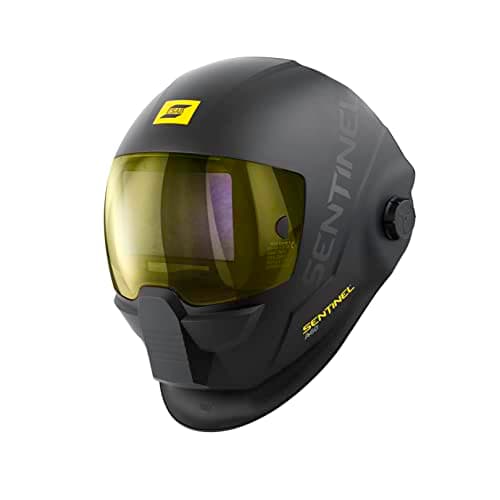 ESAB Sentinel A60The only helmet here that publishes every one of the four numbers at its best available value. | Best overall | |
| 2 | 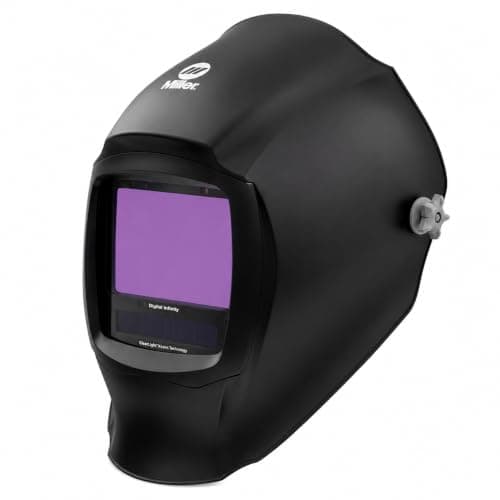 Miller Digital Infinity13.4 sq in and X-Mode, which holds the lens dark on the arc's electromagnetic signature rather than its light. | Largest viewing area | |
| 3 | 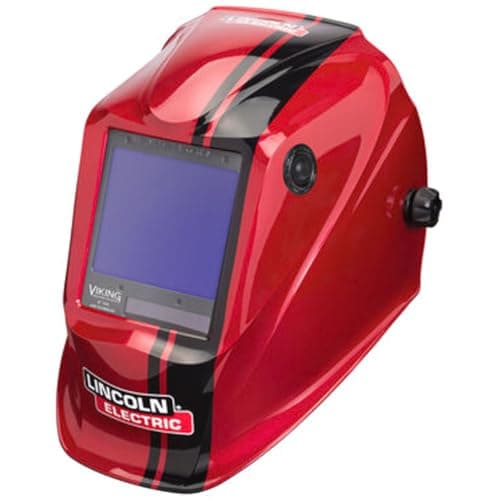 Lincoln Electric VIKING 3350Rated to 2 A on AC and DC, shade 5 at the light end, and the one helmet that spans all four levels of this site. | Best across every process | $556.55 · View on Amazon #ad How this is funded · Price as of November 13, 2026 |
What makes a welding helmet professional grade
Four published specifications, all four stated by the manufacturer: a 1/1/1/1 optical class, a viewing area of roughly 12 square inches or more, four arc sensors, and a stated minimum TIG amperage. A helmet that publishes all four is professional grade. A helmet that leaves any of them blank is a consumer helmet, whatever it costs.
"Professional grade" is a phrase manufacturers are free to print on a box, so it is worth reducing it to things that can be checked. On helmets it reduces cleanly, because the four specifications above are either published or they are not, and the blanks are where the tiers actually divide.
A good budget helmet is rarely dishonest. It simply does not state an optical class or a TIG amperage, and an absent figure reads as neutral when it should read as a warning. Our value pick page exists for exactly that market and we stand behind it there. This page is the other end: the helmets that print every number, and what each number buys you once you are using a helmet for a working day rather than an evening.
The four specifications, in order of how much they matter
1. Optical class — the four-digit rating. Optical class, diffusion of light, variation in luminous transmittance, and angle dependence, each scored 1 to 3 with 1 best. 1/1/1/1 is the top grade in all four. This is first because it is the specification you cannot adapt to: haze and distortion that a hobbyist never notices in a thirty-second bead becomes measurable fatigue across a six-hour day.
2. Viewing area. Roughly 12 square inches and up. The practical difference is peripheral awareness — seeing where the joint runs ahead of the puddle without moving your head. The spread on this page is 12.5 to 13.4 square inches; a budget helmet is typically under 10.
3. Four arc sensors. Two is enough for bench work in the open. Four matters when the arc is partly obscured — overhead, inside a frame, or with your own hand between the arc and the front of the hood. Professional work is mostly the awkward positions.
4. A published minimum TIG amperage. Commonly 2 A or 5 A. It decides whether the lens triggers at all on a low-current arc, and it is the figure budget helmets omit most often. Our TIG helmet page is organized entirely around it.
Two things are deliberately not on that list. Switching speed, because every helmet here is faster than the eye and the differences are marketing. And weight, because the number on the spec sheet predicts comfort far less well than the headgear design does.
The published numbers, side by side
| Helmet | Viewing area | Optical class | Sensors | Min. TIG rating | Shade range |
|---|---|---|---|---|---|
| ESAB Sentinel A60 | 13.02 sq in | 1/1/1/1 | 4 | 2 A (DC) | 3/5–13, half steps |
| Miller Digital Infinity | 13.4 sq in | Not published | 4 | 5 A (DC) | Weld 8–13, cut 5–8 |
| Lincoln VIKING 3350 | 12.5 sq in | 1/1/1/1 | 4 | 2 A (AC and DC) | 5–13 |
| Lincoln VIKING 1840 | 7.0 sq in | 1/1/1/1 | — | 2 A (DC) | 7–13 |
| Antra DP3-6404 | Not published | Not published | Not published | 2 A (DC) | 3/5–13 |
Where the money actually goes
Three places, in roughly this order.
The cartridge. A 1/1/1/1 lens with four sensors and a low published TIG rating is a genuinely more expensive component than a two-sensor lens with no stated optical class. This is most of the price difference and all of the performance difference.
The headgear. Lincoln's X6 and ESAB's adjustable Halo exist because a helmet that is comfortable for twenty minutes and intolerable for four hours is a hobby helmet regardless of its optics. This is the part of a professional helmet that is hardest to judge from a spec sheet and easiest to judge in the first week of owning one.
Consumables and parts support. Cover lenses, sweatbands, headgear and batteries that you can still buy in five years. A helmet whose cover lens is a proprietary shape with no stocked replacement is a disposable helmet with a good lens in it.
Before you upgrade, check two settings on the helmet you own
Sensitivity decides how much light triggers the lens. If your current helmet fails to darken on low-amperage work, turn it up before concluding the helmet is inadequate — this is the control most owners never touch, and it accounts for a surprising share of what gets diagnosed as a hardware fault.
Delay decides how long the lens stays dark after the arc stops. Too short and you get a flash of hot metal glare at the end of every bead; too long and tacking feels like welding blindfolded. Neither costs anything to fix.
Who should not buy one of these
If you weld a few hours a month, a professional-grade helmet will not make your welds better. The specifications on this page buy endurance and edge-case reliability, and at hobby hours you will not reach either limit. The honest recommendation at that rate is on the beginner helmet page, and the money is better spent on gas, wire, or a respirator — which protects something a helmet does nothing about.
If you weld most weeks, the calculus reverses. The specification that will change your experience first is not the one you expect: it is the optical class, because it is the one you cannot work around by adjusting a dial or moving your head.
Which one to buy
ESAB Sentinel A60 if you want the strongest set of published numbers in one helmet — 13.02 square inches at 1/1/1/1, a 2 amp DC rating, and half-shade steps that nothing else here offers.
Miller Digital Infinity if viewing area is the thing you notice most, or if your work is out of position often enough that X-Mode's electromagnetic hold is worth more to you than two amps of trigger margin.
Lincoln VIKING 3350 if one helmet has to cover everything — the AC and DC TIG rating plus a shade 5 low end makes it the only pick here that reaches from flux-core to plasma cutting without a second purchase.
If your shortlist is already down to the Lincoln and the ESAB, VIKING 3350 vs Sentinel A60 compares the two row by row — including the TIG rating most buyers assume separates them and does not.
1. Best overall
ESAB Sentinel A60
The only helmet here that publishes every one of the four numbers at its best available value.
ESAB publishes a 13.02 square inch window (4.65 by 2.80 inches), a full 1/1/1/1 optical class, a DC TIG rating down to 2 amps, four arc sensors and a 0.08 millisecond switching speed. Work down the four-specification checklist further up this page and the A60 is the one helmet that scores at the top of all four rather than trading one off against another.
The shade range is 3/5 to 13 in half-step increments with a shade lock, and the half steps are the professional-grade detail that is easiest to underrate. A helmet that moves in whole numbers forces you to choose between two settings that are both slightly wrong. Over a working day that is eye strain you did not need to accept.
Nine memory settings and an external grind button are the other two features that read as convenience and are really about time. If you move between processes — tack a frame on MIG, grind, then TIG a fitting — every setting you can recall instead of dial is a torch position you keep.
Note that this supersedes the Sentinel A50, which ESAB has discontinued. Older reviews describing a 3.93 by 2.36 inch window at 1/1/1/2 are describing the previous shell.
What works
- Published DC TIG rating down to 2 A — the one specification that decides whether a helmet is usable on thin stainless
- 13.02 sq in at a full 1/1/1/1 optical class, which is a combination almost nothing else offers
- Half-shade increments and shade lock let you settle on an exact shade rather than jumping between whole numbers
- External grind button, so switching modes does not mean lifting the hood and losing your torch position
What does not
- The most expensive helmet on this site apart from the Miller, and much of what it adds over a VIKING 3350 is refinement
- Nine memory settings is more configuration than a home shop running one or two processes will ever use
- Replaces the outgoing Sentinel A50, so older reviews and accessory guides may not match this shell
2. Largest viewing area
Miller Digital Infinity
13.4 sq in and X-Mode, which holds the lens dark on the arc's electromagnetic signature rather than its light.
Miller publishes 13.4 square inches — the largest window on this page — a ClearLight lens, four arc sensors, a switching speed of 1/25,000 of a second, and four modes: weld at shade 8 to 13, cut at 5 to 8, grind at 2.5, and X-Mode at 8 to 13.
X-Mode is the specification that earns this helmet its place in a professional roundup rather than a general one. It holds the lens dark using the arc's electromagnetic signature instead of only its light, which solves the two failure modes that only appear in real production work: a sensor shadowed by the workpiece or your own hand during out-of-position welding, and a low-current DC arc that simply does not emit much light for a sensor to read.
The honest caveat is the TIG number. Miller rates the lens down to 5 amps, not the 2 amps ESAB and Lincoln publish. On anything structural that is academic — you are rarely below 20 amps. On thin stainless at 10 to 15 amps it puts you near the edge of the published envelope rather than comfortably inside it.
Buy this for the window and for X-Mode. Do not buy it on the assumption that the most expensive helmet is also the best low-amperage one, because on the published figures it is not. If this is the helmet in your browser tab, our Miller Digital Infinity review covers it on its own — the published 1/1/1/2 optical class, the four-year lens warranty and the seven cover lenses in the box.
What works
- 13.4 sq in is the largest view in this group, and on long fabrication work that is the difference you actually feel
- X-Mode holds the lens dark through sensor blockage — the fix for out-of-position welding where your hand covers a sensor
What does not
- The most expensive helmet on this site by a wide margin
- Everything it adds over a VIKING 3350 is a refinement, not a capability
- Rated to 5 A rather than the 2 A of the Lincoln and ESAB helmets, which matters on very thin stainless
Who this is wrong for: Very low amperage TIG on thin stainless. At a published 5 A rating it is beaten here by two helmets rated to 2 A.
3. Best across every process
Lincoln Electric VIKING 3350
Rated to 2 A on AC and DC, shade 5 at the light end, and the one helmet that spans all four levels of this site.
Lincoln publishes 12.5 square inches, a 1/1/1/1 optical class, the 4C lens with X6 headgear, a variable shade 5 to 13 range, an external grind button, and a TIG rating of greater than 2 amps on both AC and DC.
That AC figure is why this is a pick and not a footnote. Aluminum TIG runs on AC, and an AC arc extinguishes and re-establishes on every half cycle, so a lens that holds a steady dark state on DC does not automatically cope with it. A manufacturer stating both numbers is telling you more than one stating a single number and leaving you to infer the rest. AC versus DC TIG covers why aluminum needs AC at all.
The shade 5 low end is the second argument, and it is a shop-economics one. OSHA's Table I-5 puts light plasma cutting at a minimum of shade 8 — lighter than welding, and out of reach of a helmet whose range stops at 9. One helmet that covers flux-core, MIG, TIG and plasma is a real saving over two.
The X6 headgear is also the specification that decides whether you still want the helmet in hour six. Professional grade is partly an endurance claim, and endurance is a fit problem before it is an optics problem.
What works
- 12.5 sq in of view at 1/1/1/1 clarity is the combination that makes a helmet stop being something you tolerate
- The external grind button means you switch modes without lifting the hood — the single feature you notice most every day
- Shade 5 low end covers plasma cutting, so one helmet spans all four levels
What does not
- Costs several times a budget auto-darkening helmet
- Physically large, and in a tight corner the shell finds things to bump into
Questions people actually ask
What does professional grade mean on a welding helmet?
Four published specifications, all four stated by the manufacturer: a 1/1/1/1 optical class, a viewing area of roughly 12 square inches or more, four arc sensors, and a stated minimum TIG amperage.
It is not a price band. A helmet that publishes all four is professional grade; a helmet that leaves any of them blank is a consumer helmet whatever it costs.
What does the 1/1/1/1 rating on a welding lens mean?
Four separate scores, each from 1 to 3 with 1 best: optical class, diffusion of light, variation in luminous transmittance, and angle dependence.
1/1/1/1 is the top grade in all four. It is the specification that matters most over a long day, because haze and distortion cause fatigue you cannot adjust away.
Is an expensive welding helmet actually worth it?
At hobby hours, no. The specifications on a professional-grade helmet buy endurance and edge-case reliability, and a few hours a month reaches neither limit.
If you weld most weeks it changes. The first thing you notice is the optical class, because it is the only one of the four specifications you cannot work around with a dial or a head movement.
Do I need four arc sensors?
For bench work in the open, two is enough. Four matters when the arc is partly obscured - overhead, inside a frame, or with your own hand between the arc and the front of the hood.
Professional work is mostly awkward positions, which is why every helmet on this page has four.
Which professional welding helmet is best for TIG?
On the published figures, the ESAB Sentinel A60 and the Lincoln VIKING 3350, both rated to 2 amps. The Lincoln states that figure for AC as well as DC, which matters for aluminum.
The Miller Digital Infinity is rated to 5 amps - fine for most work, but near the edge of its envelope on thin stainless at 10 to 15 amps.
Sources
- ESAB — Sentinel A60 (0700600860) published specifications: 13.02 sq in, 1/1/1/1, 2 A DC TIG, 1/25,000 s
- Miller — Digital Infinity published specifications: 13.4 sq in, ClearLight lens, X-Mode, 5 A TIG rating
- Lincoln Electric — VIKING 3350 published specifications: 12.5 sq in, 1/1/1/1, 4C lens, AC and DC TIG ratings
- Lincoln Electric — VIKING 1840 (K3023-4) published specifications
- OSHA — 29 CFR 1910.133 Table I-5, filter lenses for protection against radiant energy
- ANSI/ISEA Z87.1 — occupational and educational eye and face protection devices
Read next
- Lincoln VIKING 3350 vs ESAB Sentinel A60
The VIKING 3350 and the Sentinel A60 compared row by row on published specifications, including the TIG rating most people get wrong.
- Miller Digital Infinity review
A published-specification review of the Miller Digital Infinity ClearLight 4X - what the 13.4 sq in view and X-Mode buy you, and the two figures where cheaper helmets win.
- The best auto-darkening welding helmets
Viewing area, optical clarity and low-amperage triggering, compared across four helmets.
- The best auto-darkening welding lens, and how to read the specs
The cartridge is the helmet. Optical class, switching speed, sensors and trigger amperage, explained.
- The best welding helmets for TIG welding
TIG helmets are decided by minimum trigger amperage, not viewing area. Four that publish the figure.
- The best welding helmets for the money
Where the price curve flattens, the four specifications you pay for, and what wins at each point.
- Welding helmet shade chart
OSHA's minimum protective shades by process and arc current, and how to use them in practice.
- Helmets and PPE: the gear that decides what you can see
Every level needs a helmet. What the right helmet is changes as the level changes — and a bad one is the most common reason a beginner's welds look worse than their technique.
Back to Helmets & PPE, or start over at Find Your Level.
Ryder M.
Ryder M. is the hands-on owner behind Magoo Media Group. He writes Arc & Bead's buying guides and picks every machine on the site. What every recommendation is based on — and what it is not based on — is set out on How We Pick.