Is Welding Hard to Learn?
Getting metal to stick together is easy. Getting it to stick together well is a different question, and the answer depends entirely on which process you start with.
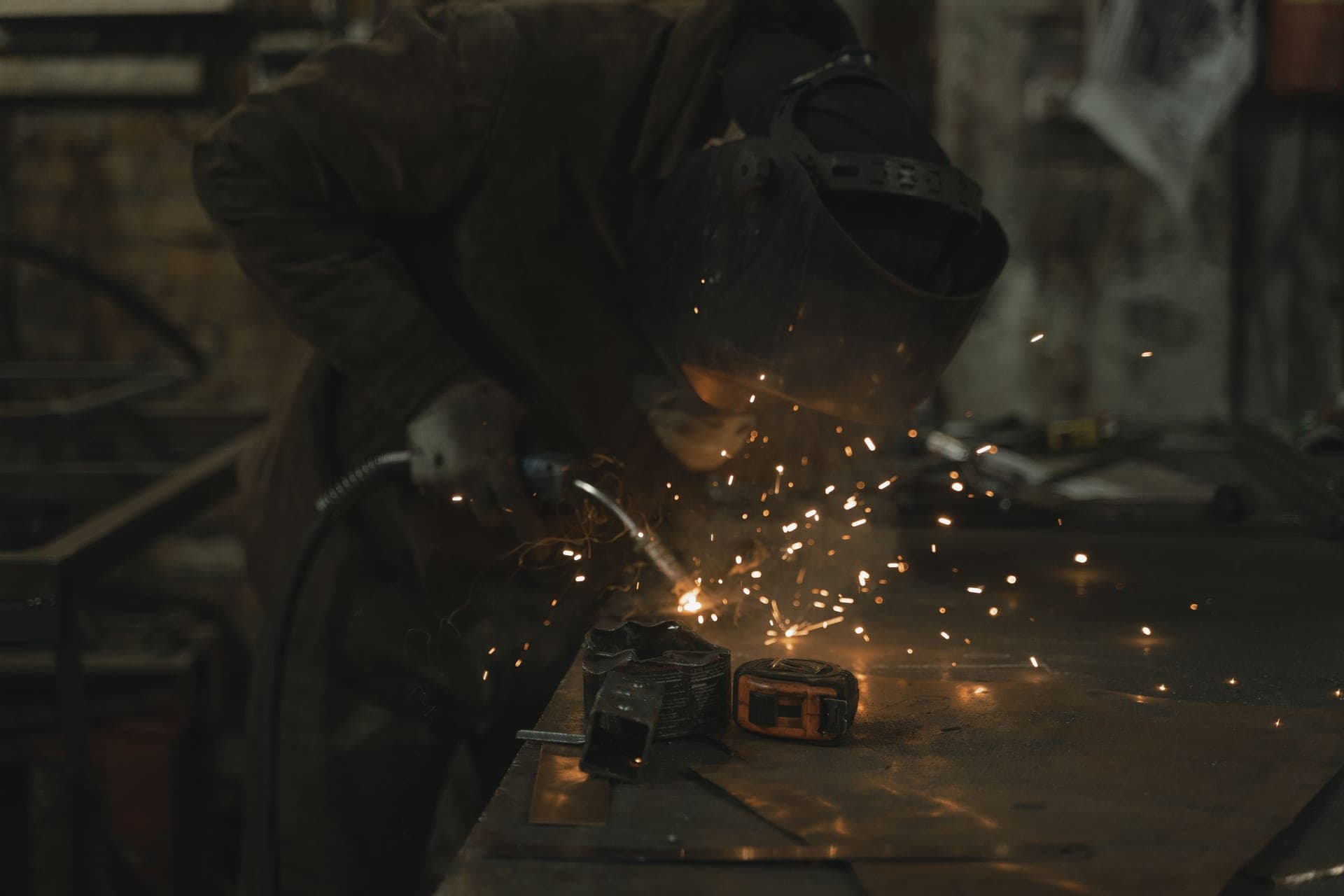
Is welding hard to learn?
It depends entirely on the process. Flux-core and gas MIG are easy — most people get a usable, strong weld on flat plate within an afternoon, and are competent at general fabrication within a weekend of practice. Stick is moderate: striking without the rod sticking and feeding it in as it burns down takes a few sessions. TIG is genuinely hard, because it needs both hands and a foot doing different things at once, and competence is measured in months rather than hours. The hard part in every case is the same: learning to see the weld pool. Everything else is setup.
The reason this question gets inconsistent answers is that "welding" covers four processes with wildly different learning curves, and most people answering have learned only one.
How long each process takes to become usable
| Process | First usable bead | Competent at general work | What is actually hard |
|---|---|---|---|
| Flux-core | An afternoon | A weekend of practice | Reading the bead under slag; setting voltage against wire speed |
| Gas MIG | An afternoon | A weekend of practice | The voltage-to-wire-speed relationship; shielding discipline |
| Stick | A session or two | Several sessions | Striking without sticking; feeding the rod in as it consumes |
| TIG | A session, badly | Months | Two hands and a foot at once; tungsten contamination; cleanliness |
What actually makes welding difficult
Seeing the puddle. This is the skill, and it is the one nobody warns you about. You are watching a small pool of molten metal through a dark lens and judging its size, its shape and whether it is wetting into both edges of the joint. Until you can see it, you are guessing. Once you can, every other correction becomes obvious. A helmet you can actually see through is therefore not a comfort purchase.
Holding four variables steady at once. Travel speed, gun or torch angle, arc length or stickout, and position relative to the joint. Any one of them is easy; all four at once while watching the puddle is what takes practice. Beginner welding mistakes is largely a list of what happens when one of them drifts.
Preparation, which is not welding. Most beginner welds fail on fit-up and cleanliness rather than technique. Two pieces of steel with a gap between them, mill scale still on the surface, nothing clamped — no setting fixes that. The good news is that this part is just carefulness, not skill.
Knowing what "good" looks like. Beginners cannot tell a strong weld from a pretty one, and those are different things. A bead that looks neat can have no penetration; an ugly bead can be perfectly sound.
What is not hard, despite the reputation
Physical strength. None of this is heavy work. Moving the steel is the physical part, not welding it.
The machine. A modern flux-core machine has two knobs. A synergic MIG machine has effectively one — what is synergic MIG welding explains how that works. The settings-chart anxiety that fills forums is mostly solved by a printed chart on the inside of the machine door.
Danger, if you prepare. The hazards are well understood and the precautions are cheap: a helmet, a jacket, gloves, ventilation, a clear ten-foot zone and an extinguisher. Is welding in a garage safe covers the specifics for a home shop.
The honest reason most people give up
Not difficulty. It is starting on the wrong process or the wrong material. Someone whose first attempt is TIG on thin aluminum, or flux-core on 20-gauge car panel, will conclude that welding is impossibly hard — when in fact they picked two of the hardest combinations available. Start with flux-core or MIG on 1/8 inch flat mild steel. It is a different experience entirely.
The fastest route to competent
Start on the right process. Flux-core or gas MIG, on mild steel. Not TIG, not aluminum, not sheet. MIG vs TIG vs stick vs flux core compared lays out the ladder.
Use thick enough material. 1/8 inch to 1/4 inch flat plate is forgiving. Thin sheet punishes every error immediately, which is a terrible way to learn.
Run short beads and stop. Four inches, then look at what you did. Twenty four-inch beads you examined teach more than one eighty-inch bead you did not.
Cut your welds in half. A hacksaw through a practice joint shows you penetration, which is the thing you cannot see from the top. This is the single fastest feedback loop available and almost nobody does it.
Buy cheap wire and waste it. The constraint on learning is almost never talent; it is how willing you are to burn consumables on scrap.
When you are ready for the first session itself, how to weld for the first time is the step-by-step version, and welding projects by skill level gives you something worth making once the beads are landing.
What we would buy
Arc & Bead is an Amazon Associate. If you buy through a link on this page we may earn a commission, at no extra cost to you. We have not physically tested the machines on this page and we say so on How We Pick.
1. Easiest machine to learn on
Forney Easy Weld 261 140 FC-i
One pair of dials, one wall socket, no gas bottle — the shortest distance between opening a box and running a bead.
Forney publishes flux-core (gasless) only; 120 V input on a 20 A circuit minimum; 140 A maximum output; a 30% duty cycle at 90 A; 0.030 inch wire; capacity up to 1/4 inch steel; and 19 lb.
What makes a machine easy to learn on is not power — it is the number of decisions between you and an arc. Here there are two: voltage and wire speed. No gas selection, no bottle, no regulator, no flow rate, no polarity choice if you use the bundled wire as supplied.
Infinite voltage and wire-speed control rather than four fixed taps also matters for learning. Fixed taps mean that when a setting is nearly right you cannot nudge it, and a beginner who cannot nudge a setting cannot learn what nudging does.
The 30% duty cycle at 90 A is a learning feature in disguise. Beginners run hot and dwell, and a machine with headroom does not stop you in the middle of the hour where it finally starts making sense.
The honest difficulty it adds: slag on every weld, more spatter, and more fume than gas MIG — so ventilation and a respirator are part of the first session, not a later upgrade.
What works
- 30% duty cycle at 90 A is unusually generous for a 120 V machine in this class
- Infinite voltage and wire-speed control rather than four fixed taps, so you can actually dial a setting in
- 19 lb — genuinely carryable to the job instead of the job coming to it
- No gas bottle, no regulator, no second purchase before your first weld
What does not
- Flux-core only. It will never run gas, so it cannot become your Level 2 machine
- Every weld leaves slag that has to be chipped and wire-brushed off
- Needs a 20 A circuit — a 15 A garage lighting circuit will trip at higher settings
2. The purchase that makes learning possible
Antra DP3-6404
Shade 3/5–13 with shade lock and a grind button, cheap enough that there is no reason to start without a working helmet.
Antra publishes a true-colour lens with full digital control and display; a 3/5 to 13 shade range with shade lock; a DC TIG rating down to 2 A; tack, weld and cut memory presets plus a grind/weld button; and solar power with battery assist.
Nobody learns to weld through a helmet they cannot see out of, and that is the real reason a cheap but adequate helmet belongs on a page about difficulty. Beginners who struggle usually cannot see the puddle — they are set too dark, or looking through a spattered cover lens, or using a passive helmet they have to flip.
The true-colour lens helps directly with the hardest part of learning: reading the weld pool. A green lens flattens the distinction between molten metal and slag, and that distinction is what you are trying to learn to see.
Shade lock is the quiet one. A lens hunting between two shades is distracting at a point where your attention is fully committed elsewhere.
Limits: Antra does not publish a 1/1/1/1 optical class for it, and budget headgear is the weak point on cheap helmets, this one included.
What works
- A published 2 A TIG rating at the bottom of the market, where the usual answer is no rating at all
- Shade 5 low end covers plasma cutting, so one cheap helmet spans more than MIG
- Quick grind/weld button and shade lock — two things that are normally the first upgrade
- Cheap enough that starting here and upgrading later costs less than agonizing over it
What does not
- Antra does not publish a 1/1/1/1 optical class for it, and over a long session you can feel the difference
- Headgear is the weak point on budget helmets generally, and this one is no exception
- A small shell: next to a VIKING 3350 the view is noticeably tighter
3. The consumable you should waste
Blue Demon E71TGS flux-cored wire
Cheap enough per pound that practising on scrap stops feeling expensive, which is the single biggest factor in how fast anyone learns.
Blue Demon publishes an AWS E71T-GS classification, 0.030 inch and 0.035 inch diameters, and DCEN (electrode negative) polarity.
Practice is the whole answer to "is welding hard", and the thing that stops people practising is the feeling that every inch of bead costs money. Cheap wire fixes that, and it is the most underrated purchase on this list.
Widely stocked matters for the same reason: a spool is rarely more than two days away, so running out does not become a two-week pause in your learning.
The deliberate trade: E71T-GS is single-pass rated, so it is not the wire for a structural multi-pass joint — and it runs dirtier than NR-211-MP, which matters when you are also learning to read your own bead. Use it for practice and buy better wire for the job that counts.
What works
- Cheap enough per pound that practicing on scrap does not feel expensive
- Widely stocked, so a spool is rarely more than two days away
What does not
- E71T-GS is single-pass rated — it is not the wire for a multi-pass structural joint
- Runs dirtier than NR-211-MP, which matters when you are also learning to read your own bead
Who this is wrong for: The first real project. Single-pass-rated practice wire is the wrong choice for anything that has to hold a load.
Questions people actually ask
How long does it take to learn to weld?
For flux-core or gas MIG on flat mild steel, most people get a usable, strong weld within an afternoon and are competent at general fabrication after a weekend of practice. Stick takes a few sessions, mostly to master striking the arc without the rod sticking.
TIG is months rather than hours, because it requires both hands and a foot doing different things simultaneously. Anyone quoting a precise figure for any of these is guessing.
What is the hardest part of learning to weld?
Learning to see the weld pool. You are judging the size and shape of a small pool of molten metal through a dark lens, and whether it is wetting into both edges of the joint. Until you can see it you are guessing; once you can, the corrections become obvious.
That is why a helmet you can actually see through is not a comfort purchase. Most beginners who struggle are set too dark, looking through a spattered cover lens, or flipping a passive hood.
Which welding process is easiest for a beginner?
Flux-core, by a clear margin. There is no gas bottle, no regulator, no flow rate and no gas selection - just voltage and wire speed, on a household outlet. Gas MIG is almost as easy once the bottle is set up.
The trade is slag on every weld, more spatter and more fume than gas MIG, so ventilation and a respirator belong in the first session rather than a later upgrade.
Is TIG welding much harder than MIG?
Yes, and the difference is structural rather than a matter of degree. MIG is one hand on a gun with a trigger. TIG is one hand holding the torch, the other feeding filler rod, and a foot modulating amperage, all while watching a puddle you are keeping clean.
TIG is also unforgiving of contamination - touch the tungsten to the puddle and you stop to re-sharpen it. Nobody should start here, and almost nobody who starts here continues.
Do I need to be strong to weld?
No. None of the actual welding is physical - moving the steel is the heavy part, not joining it. Holding a gun or torch steady for a few inches at a time is a control task, not a strength one.
What does help is a comfortable position. Sitting down, supporting your forearms and being able to see the joint matter far more than physique.
What is the fastest way to get good at welding?
Cut your practice welds in half with a hacksaw. Penetration is the one thing you cannot judge from the top of a bead, and a sectioned joint shows it instantly - it is the fastest feedback loop available and almost nobody does it.
After that: start on 1/8 to 1/4 inch flat mild steel rather than thin sheet, run four-inch beads and stop to look at each one, and buy cheap wire so that practising does not feel expensive.
Why do people give up on welding?
Usually because they started on the wrong process or the wrong material rather than because welding is hard. A first attempt at TIG on thin aluminum, or flux-core on 20-gauge car panel, are two of the hardest combinations available.
Start with flux-core or MIG on 1/8 inch flat mild steel and the experience is completely different. The process you choose first decides whether welding feels difficult.
Sources
- Forney Industries — Easy Weld 261 140 FC-i published specifications: flux-core only, 120 V on a 20 A circuit, 140 A maximum, 30% duty cycle at 90 A, infinite voltage and wire-speed control, 19 lb
- Antra — DP3-6404 published specifications: true-colour full digital lens, shade 3/5–13 with shade lock, DC TIG rating to 2 A, grind/weld button, solar with battery assist
- Blue Demon — E71TGS published specifications: AWS E71T-GS, 0.030 in and 0.035 in diameters, DCEN polarity, single-pass rated
Read next
- How to weld for the first time
A first-session walkthrough in order: setup, scrap, posture, your first bead, and what to look at afterwards.
- Beginner welding mistakes, and how to fix them
Ten causes behind most bad first welds — including the two that look like machine faults.
- MIG vs TIG vs stick vs flux-core
All four processes in one table, and the honest answer about which to learn first.
- Welding projects by skill level
A project sequence where each one teaches one new thing, matched to the machine you have.
- What is the first welder to buy?
The one job a first welder has to do, and the four specifications that decide whether it does it.
- Find your level before you spend a penny
Most bad first welder purchases are not bad machines. They are the right machine bought by the wrong person, one level too early or one level too late.
Back to Find Your Level, or start over at Find Your Level.
Ryder M.
Ryder M. is the hands-on owner behind Magoo Media Group. He writes Arc & Bead's buying guides and picks every machine on the site. What every recommendation is based on — and what it is not based on — is set out on How We Pick.