Welding helmets for large heads
The shell is almost never the problem. The headgear is — and headgear is the part you can often replace without replacing the helmet.
Arc & Bead is an Amazon Associate. If you buy through a link on this page we may earn a commission, at no extra cost to you. We have not physically tested the machines on this page and we say so on How We Pick.
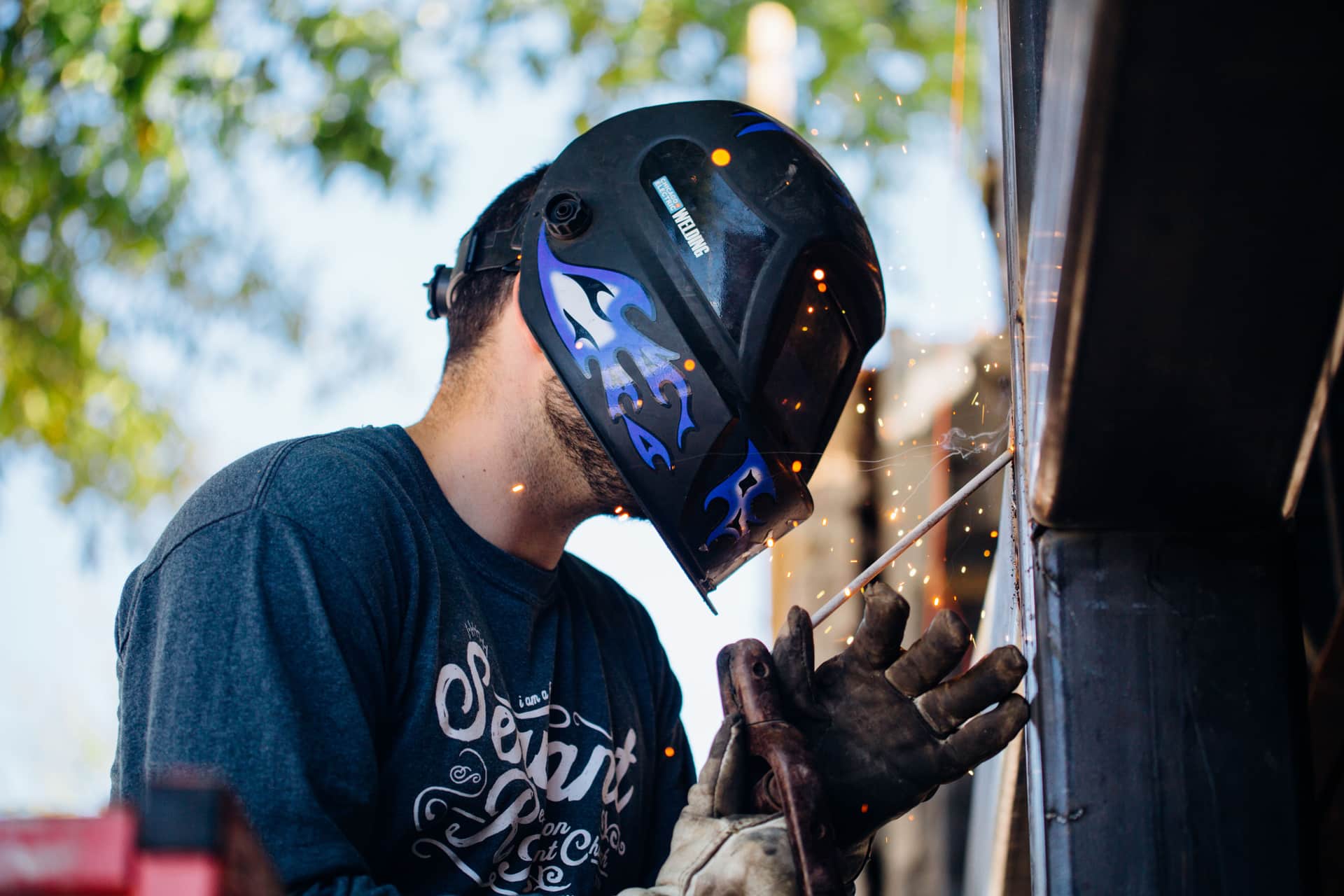
What actually fails to fit
Almost never the shell — welding helmet shells are generously sized because they have to clear a respirator. What runs out is the headgear: the ratchet band's maximum circumference, or the crown strap's ability to sit low enough without pushing the shell too far forward. Headgear is also the part you can most often replace on its own.
The three adjustments that matter
Circumference. The ratchet band around the back of your head. This is the one that runs out, and the maximum is rarely published. Good systems have a long ratchet travel; cheap ones do not.
Crown height. The strap over the top of your head, which sets how high the helmet sits. Too high and it rocks, concentrating weight on the forehead band. Too low and the shell sits in your eyeline when lifted.
Distance from the face. How far forward the shell sits. More distance means more internal room; it also moves the weight further from your head, which is why this adjustment and good load distribution have to work together.
A helmet that adjusts in all three is usually findable. A helmet that only adjusts circumference is a gamble.
Weight distribution, which matters more at the edges of the range
When headgear is at the end of its travel, the load tends to sit on fewer contact points — usually the forehead band alone, because the crown strap has run out of adjustment.
That is why five-point systems like ESAB's Halo, or Lincoln's X6, are worth more at larger sizes than the specification sheet suggests. More contact points means the same weight spread over more area, and it is the difference between a helmet that is fine for an hour and one that is not.
Absolute weight matters too, and it is usually published: 1.4 pounds versus two-plus is a real difference over an afternoon.
Replacing the headgear instead of the helmet
The point most people miss. Headgear is frequently sold separately, and it is often cross-compatible within a brand's range.
So if a helmet you otherwise like does not adjust far enough, the question is whether better headgear exists for it — which is much cheaper than a new helmet, and usually available because headgear is the component most likely to crack anyway.
When buying, checking that headgear is available as a spare is worth doing for durability reasons regardless of head size.
The one shell-size case
There is one situation where the shell genuinely matters: wearing a respirator underneath. A half-mask respirator needs clearance in front of your face, and a low-profile shell may not provide enough — which is also exactly the constraint deep glasses frames create.
If you need both a respirator and a larger headgear setting — and for flux-core work a respirator is worth serious consideration — look at deeper shells rather than low-profile ones. Respirators and fume safety covers the combination.
Before you spend anything
Try the full adjustment range on the helmet you already have. A surprising number of fit complaints are a crown strap still at its factory setting — it is the adjustment people overlook, because the ratchet band is the obvious one.
Loosen everything, put the helmet on, and set crown height first so the shell sits level with your eyeline when lifted. Then tighten the ratchet band. Then set the distance from your face. Doing it in that order often resolves a fit that felt impossible.
What we would buy
1. Best adjustment range
Lincoln Electric VIKING 3350
X6 headgear adjusts in six directions, and it is available as a spare part.
Lincoln's X6 headgear is the reason this helmet is the usual recommendation for larger heads. It adjusts in more directions than most systems — crown height, circumference, tilt, and distance from the face — which is what lets you find a fit rather than settle for the nearest available one.
It is also sold as a spare part, which matters twice over: it is the component most likely to fail, and it means a helmet whose headgear does not suit you can sometimes be fixed rather than replaced.
The 12.5 square inch view and 1/1/1/1 clarity are the rest of the package.
What works
- 12.5 sq in of view at 1/1/1/1 clarity is the combination that makes a helmet stop being something you tolerate
- The external grind button means you switch modes without lifting the hood — the single feature you notice most every day
- Shade 5 low end covers plasma cutting, so one helmet spans all four levels
What does not
- Costs several times a budget auto-darkening helmet
- Physically large, and in a tight corner the shell finds things to bump into
2. Best weight distribution
ESAB Sentinel A50
Five-point Halo headgear and 1.4 lb, which is the other half of comfort.
For a larger head the complaint is often weight rather than circumference, because a helmet that sits slightly high concentrates its load on one contact point.
ESAB publishes a five-point Halo headgear system and 1.4 pounds. Five points spread the load across the skull rather than hanging it off the forehead, which is most of what "comfortable over a long session" actually means.
The shell is low-profile, so this is the wrong choice if you also wear deep glasses frames.
What works
- Rated to trigger below 2 A, which is the specification that matters for low-amperage TIG on thin material
- The touchscreen and memory settings mean you set shade once per job type and never hunt again
- Low-profile shell genuinely helps in tight work — the least head-bumping helmet in this group
What does not
- Optical class 1/1/1/2 rather than 1/1/1/1 — the difference is measurable, though few people see it in use
- Premium price, and the touchscreen is one more thing that can fail
3. Lightest, with parts you can buy
Jackson Safety Insight Variable
Light on the neck, and Jackson headgear is easy to source separately.
Less weight is less load on whatever contact points you have, which helps regardless of head size. Jackson helmets are notably light.
The more useful point is parts availability: Jackson shells and headgear are widely sold separately, so replacing headgear that does not adjust far enough is a real option rather than a theoretical one.
The viewing area is small compared with the others here.
What works
- Light on the neck, which is the complaint that actually ends a long session
- Jackson's shells and headgear parts are easy to source separately
What does not
- Viewing area is small next to a VIKING 3350 or a panoramic helmet
- Not a low-amperage TIG helmet
4. Deepest shell on a budget
YESWELDER LYG-M800H large-view helmet
A deep panoramic shell, though headgear adjustment is coarse.
Where head size comes with a preference for a roomier shell, a deep panoramic helmet gives more internal clearance than a low-profile one.
The reservation is the headgear: adjustment is coarse compared with X6 or Halo systems, which is exactly the axis this page is about. If your issue is circumference rather than internal room, the Lincoln is the better answer.
What works
- Panoramic view at a fraction of a name-brand large-view helmet's price
- True-color lens makes the puddle and the weld pool edge much easier to read than a green lens
- Deep shell accommodates most prescription glasses without pressure on the temples
What does not
- Published optical-class figures are inconsistent between listings — treat unstated clarity as unverified
- Headgear adjustment is coarse compared with the X6 or Halo systems
Who this is wrong for: Anyone whose actual problem is headgear adjustment range. This shell is roomy but the adjustment is the coarsest here.
Questions people actually ask
What welding helmet fits a large head?
One with a wide headgear adjustment range rather than a physically larger shell. Lincoln's X6 and ESAB's Halo systems adjust further than most and distribute weight across more contact points.
Maximum circumference is rarely published, so adjustment design is the practical guide.
Can you replace welding helmet headgear?
Often, yes — headgear is commonly sold separately and is frequently cross-compatible within a brand's range.
That makes it worth checking before buying: it is the component most likely to fail, and replacing it is much cheaper than replacing the helmet.
Why does my helmet feel heavy on my forehead?
Usually the crown strap is set too high or has run out of adjustment, so the load falls on the forehead band alone instead of being shared.
Set crown height first, so the shell sits level with your eyeline when lifted, then tighten the ratchet band, then set the distance from your face.
Are welding helmet shells one size?
Effectively, yes — shells are generously sized because they have to clear a respirator, so the shell is rarely what fails to fit.
The exception is low-profile helmets, which are deliberately shallow and may not clear a respirator or deep glasses frames.
Does a heavier helmet mean better protection?
No. Protection comes from the lens rating and the shell material meeting ANSI Z87.1, not from mass.
A lighter compliant helmet protects exactly as well and is more comfortable, which matters because a helmet that gets taken off protects nothing.
Sources
Read next
- Welding helmets for glasses wearers
Shell depth, temple pressure and fogging — plus the cheater-lens alternative.
- The best auto-darkening welding helmets
Viewing area, optical clarity and low-amperage triggering, compared across four helmets.
- Welding respirators and fume safety
What is in welding fume, what a P100 filter does and does not remove, and when it is mandatory.
- The best welding helmets for beginners
The purchase that improves a beginner's welds fastest, and where spending more stops helping.
- Helmets and PPE: the gear that decides what you can see
Every level needs a helmet. What the right helmet is changes as the level changes — and a bad one is the most common reason a beginner's welds look worse than their technique.
Back to Helmets & PPE, or start over at Find Your Level.
Ryder M.
Ryder M. is the hands-on owner behind Magoo Media Group. He writes Arc & Bead's buying guides and picks every machine on the site. What every recommendation is based on — and what it is not based on — is set out on How We Pick.