Flux-core vs MIG: strength and penetration
The tensile classification is the same number on both wires. The difference that matters is what each one is rated to be used for.
Arc & Bead is an Amazon Associate. If you buy through a link on this page we may earn a commission, at no extra cost to you. We have not physically tested the machines on this page and we say so on How We Pick.
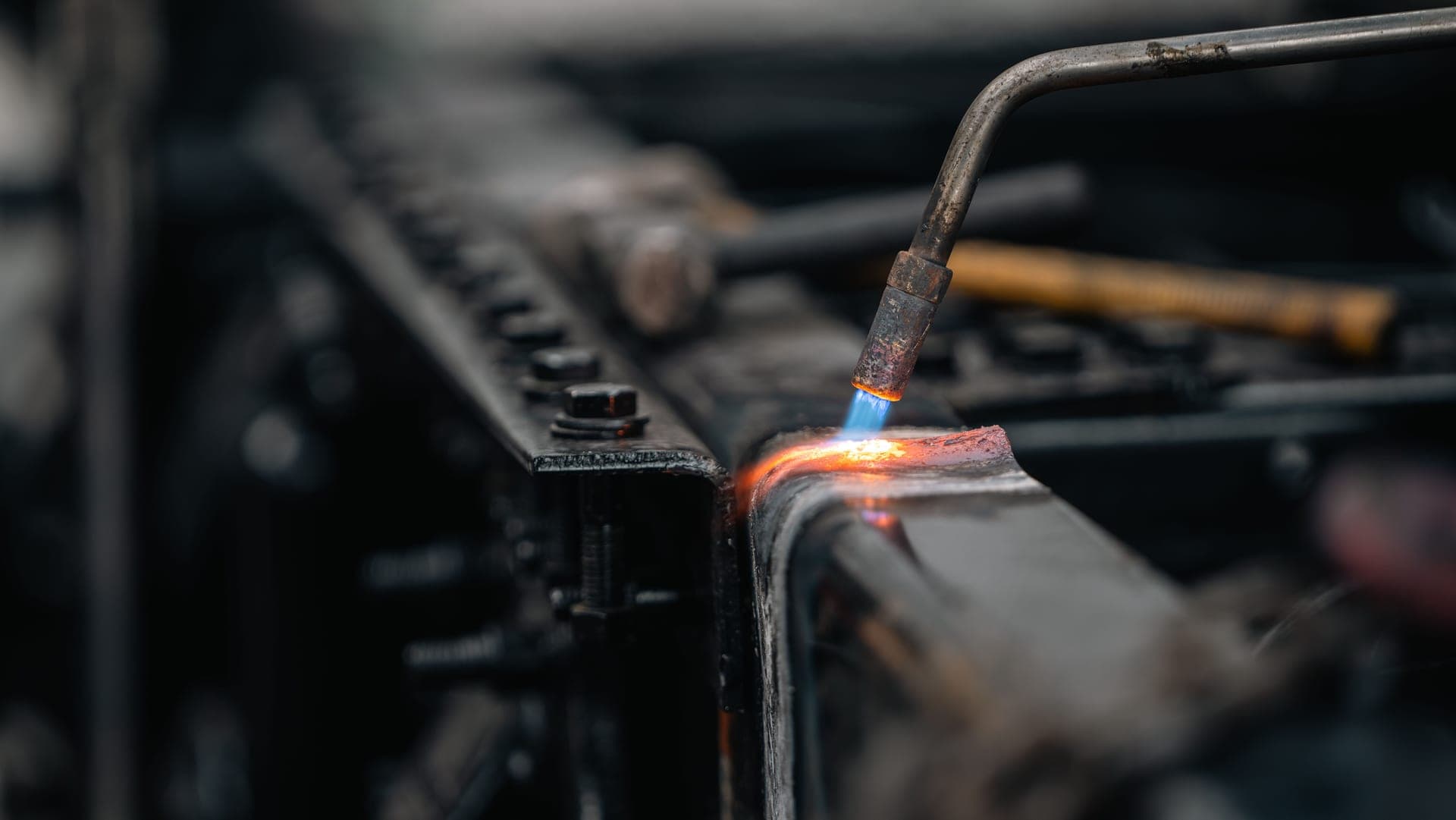
Is flux-core stronger than MIG?
Neither is stronger. Common self-shielded flux-cored wire (E71T-11, E71T-GS) and common solid MIG wire (ER70S-6) are both rated to the same 70 ksi minimum tensile class — the "70" in each designation. The real differences are that some flux-cored wires are single-pass rated, that manufacturers publish maximum plate thicknesses for them, and that flux-core penetrates more aggressively at the same amperage.
If you only wanted the answer, that is it. The rest of this page is about why the question keeps getting asked, and about the two real differences that a "both are 70 ksi" answer hides.
For the broader choice between the processes — cost, learning curve, gas bottles, outdoor work — flux-core versus MIG for beginners is the page. This one stays on strength and penetration.
What the classification numbers actually say
Welding consumables carry a designation that is not marketing. Read left to right:
E71T-11. E for electrode. 7 for a 70,000 psi minimum tensile strength class. 1 for all-position capability. T for tubular, which is what flux-cored means. The suffix after the dash — 11, GS, 1, 8 — identifies the specific wire type, its shielding requirement, its polarity and, critically, whether it is rated for single or multiple passes.
ER70S-6. ER for electrode or rod. 70 for the same 70,000 psi minimum tensile class. S for solid. 6 for its deoxidiser content, which is why it tolerates a bit of mill scale.
Both say 70. That is not a coincidence and it is not a loophole: it is a minimum tensile requirement in the AWS filler metal specifications, and a wire that did not meet it could not carry the designation.
The real divide: single-pass versus multi-pass
Here is the difference that matters, and it is a restriction on use rather than a number for strength.
E71T-GS — the cheapest and most widely sold flux-cored wire, the one in most starter spools — is single-pass rated. It is intended for one run down the joint. Running multiple passes with it is outside what the classification covers, and that matters because multi-pass is how thicker material is properly welded: a bevelled joint, a root pass, then fill and cap.
E71T-11 is all-position and more capable, and manufacturers still publish limits on it. Lincoln states a maximum plate thickness of 5/16 inch for NR-211-MP in 0.045 inch and smaller diameters. That is a published ceiling on a consumable, independent of whether your machine could push more amps.
Solid ER70S-6 under gas carries no equivalent single-pass restriction. That is the honest strength answer for thick, structural work: not that the metal is stronger, but that the consumable is rated for the technique the joint requires.
The question behind the question
People asking "is flux-core as strong" are almost always asking "can I trust this on something that matters" — a trailer tongue, a hitch, a roll bar, a lifting point. For those, the answer is not about the wire at all: anything load-bearing, anything that carries people or travels on a public road, is a job for a qualified welder working to a procedure. That is not caution for its own sake; it is what a weld procedure specification exists to control.
The two wires and the gas process, side by side
| Consumable | AWS class | Tensile class | Passes | Positions | Published plate limit |
|---|---|---|---|---|---|
| Lincoln Innershield NR-211-MP | E71T-11 | 70 ksi | Multi-pass capable within its limits | All-position | 5/16 in for 0.045 in and smaller |
| Blue Demon E71TGS | E71T-GS | 70 ksi | Single-pass rated | Varies by manufacturer | Not published |
| Typical solid MIG wire | ER70S-6 | 70 ksi | Multi-pass | All-position | Set by procedure, not by the wire |
Penetration is a shape, not an amount
The other half of the question is penetration, and this is where flux-core genuinely wins — in a way that is more specific than "deeper".
At the same amperage, self-shielded flux-cored wire tends to produce a narrower, deeper penetration profile than solid wire under a 75/25 gas mix. The flux generates its own shielding as it burns, and the arc characteristic that comes with that digs rather than spreads.
Three practical consequences follow.
On thicker steel, flux-core reaches the root more easily. That is the real reason it has a reputation for strength — not a stronger deposit, but better fusion at the bottom of a joint a 140 amp gas MIG arc struggles to reach.
On thin steel, the same property is a liability. Deep, narrow, aggressive penetration on 20 gauge is a hole. That is why MIG versus flux-core for body work comes out the other way round, and why flux-core burn-through is a page that needed writing.
Penetration is not strength. A joint fails at its weakest region, which is usually a lack-of-fusion defect or an unfilled root rather than the tensile limit of sound weld metal. Deeper penetration helps because it reduces the chance of that defect — not because the metal is stronger.
What actually decides whether a joint holds
Having established that both wires are the same tensile class, it is worth naming what does decide it, because none of these items is the wire.
Fusion. Weld metal that sits on top of the base metal without melting into it has no strength at all, whatever its tensile class. This is the most common real failure in home welding and it looks fine from the outside.
Joint design and preparation. A bevel on thick material exists so the arc can reach the root. Clean metal exists so the weld can fuse. Both outrank consumable choice.
Correct polarity. Self-shielded flux-cored wire runs DCEN — electrode negative — and gas MIG runs electrode positive. Getting this backwards produces a weak, ugly, spattery weld that people blame on the wire. Flux-core polarity covers it.
Number of passes, matched to the consumable's rating. Which is where this page started.
Slag removal between passes. Slag trapped under a subsequent pass is an inclusion, and inclusions are exactly the weakest-region defect described above. This is a real flux-core-specific risk that gas MIG does not have.
So which one for strength?
Thin material, strength irrelevant to the choice: gas MIG, because flux-core will hole it.
Quarter-inch and up with a 120 V machine: flux-core, because the penetration profile gets you fusion the gas arc cannot at that power. Keep inside the wire's published plate limit.
Thick material, multi-pass, done properly: gas MIG with a multi-pass-rated solid wire, or stick — welders for thick steel covers why stick keeps appearing in that conversation.
Anything load-bearing or road-going: neither, from a home shop, without a procedure and a qualified welder.
What we would buy
1. The flux-core wire to compare on
Lincoln Electric Innershield NR-211-MP flux-cored wire
E71T-11, all-position, DCEN, with a published maximum plate thickness of 5/16 in for 0.045 in and smaller diameters.
Lincoln publishes this as an E71T-11 self-shielded wire, all-position rated, running DCEN (electrode negative), available in 0.030 and 0.035 inch, with a stated maximum plate thickness of 5/16 inch for 0.045 inch and smaller diameters.
That last figure is the single most useful number on this entire page, and almost nobody quotes it. It is a manufacturer stating a thickness limit on a wire — not a machine — and it exists because of how the classification is intended to be used rather than because of how strong the deposit is.
Lincoln also publishes full procedure tables for it, which means there is a documented starting setting for every thickness in that range rather than a guess.
It costs noticeably more per pound than unbranded E71T-GS, and like every self-shielded wire it produces slag and more spatter than a gas process.
What works
- Lincoln publishes full procedure tables for it, so there is a documented starting setting for every thickness
- All-position rated — it will run a vertical fillet, not just a flat bead
- Available in 1 lb, 5 lb and 10 lb spools, so a small machine does not need a big spool
What does not
- Noticeably more expensive per pound than unbranded E71T-GS wire
- Like every self-shielded wire it produces slag and more spatter than a gas process
Who this is wrong for: Plate above its published 5/16 in limit for small diameters. Past that you are outside what the manufacturer rates the wire for.
2. The wire that shows the limit
Blue Demon E71TGS flux-cored wire
E71T-GS is single-pass rated — which is a restriction on use, not a statement about tensile strength.
Blue Demon publishes this as E71T-GS in 0.030 and 0.035 inch, running DCEN. The important part is in the classification itself: E71T-GS is a single-pass wire.
That is the clearest illustration of this page's whole argument. The "70" is the same 70 ksi class as a solid MIG wire. The restriction is that it is not intended for multi-pass work, and a multi-pass joint is exactly how thicker material gets welded properly. A wire can have an identical tensile class and still be the wrong wire for a structural joint.
It is cheap per pound, which makes it the right practice wire. Burning a spool learning travel speed should not feel expensive.
It also runs dirtier than NR-211-MP, which matters more than it sounds when you are also trying to read your own bead for feedback.
What works
- Cheap enough per pound that practicing on scrap does not feel expensive
- Widely stocked, so a spool is rarely more than two days away
What does not
- E71T-GS is single-pass rated — it is not the wire for a multi-pass structural joint
- Runs dirtier than NR-211-MP, which matters when you are also learning to read your own bead
Who this is wrong for: Any multi-pass or structural joint. Its own classification rules it out, regardless of how the bead looks.
3. The machine that runs both
Hobart Handler 140EZ
30 to 140 A of gas MIG and flux-core on one 115 V machine — the honest way to compare the two processes.
Hobart publishes 30 to 140 A of output on a 115 V, 20 A dedicated circuit, with both gas MIG and flux-core capability and a 30% duty cycle at 90 A.
A machine that runs both is how this comparison stops being theoretical. Same power source, same operator, same scrap, change the wire and the polarity — and you can see the penetration profile difference on a cut-and-etched coupon rather than reading about it.
It is worth being explicit that the machine is not the variable in a strength comparison. 140 amps is 140 amps. What changes is what the consumable does with it.
The honest limits are its 30% duty cycle at 90 A and the fact that it is single-voltage, so it will never use a 240 V circuit if you run one.
What works
- The most documented 120 V MIG family there is — every settings question has already been answered somewhere
- Runs flux-core on day one and gas MIG the day you buy a bottle, so the machine survives the level change
- EZ Mode sets the machine from two turns of a knob, and infinite voltage control is still there when you want to override it
- Spool-gun ready, so aluminum is a gun purchase rather than a new machine
What does not
- 3/16 in is the published capacity. A trailer deck in one sitting is beyond it
- Single-voltage: it will never take advantage of a 240 V circuit if you later run one
- 53 lb is heavy for a 120 V machine — it wants a cart rather than a shelf
Questions people actually ask
Is flux-core as strong as MIG?
On tensile class, yes - identical. Common self-shielded flux-cored wires (E71T-11, E71T-GS) and common solid MIG wire (ER70S-6) are all rated to the same 70 ksi minimum tensile class, which is what the 70 in each designation means.
Where they differ is what they are rated to be used for. E71T-GS is single-pass rated, and Lincoln publishes a 5/16 inch maximum plate thickness for NR-211-MP in small diameters.
Does flux-core penetrate deeper than MIG?
At the same amperage, self-shielded flux-cored wire generally produces a narrower, deeper penetration profile than solid wire under a 75/25 mix.
That is an advantage on thicker steel, where reaching the root is the problem, and a liability on thin sheet, where the same property blows holes in it.
What does the 70 in E71T-11 and ER70S-6 mean?
A 70,000 psi minimum tensile strength class. It is a requirement in the AWS filler metal specifications, not a marketing figure - a wire that did not meet it could not carry the designation.
It is also why strength is the wrong axis for choosing between the two: both consumables already clear the same bar.
Can you use flux-core for structural welding?
Flux-cored wires are used extensively in structural work, but under a qualified weld procedure with the right classification, the right technique and inspection.
In a home shop the honest answer is different: anything load-bearing, anything carrying people, anything road-going is a job for a qualified welder working to a procedure, regardless of which wire is on the spool.
Why is single-pass rating such a big deal?
Because multi-pass is how thicker material gets welded properly - a bevelled joint, a root pass, then fill and cap. A single-pass-rated wire is outside its intended use the moment you run a second pass over the first.
E71T-GS, which is the wire in most cheap starter spools, is single-pass rated. That is a restriction on use rather than a statement about tensile strength.
What makes a weld actually fail?
Usually a lack-of-fusion defect, an unfilled root or a trapped slag inclusion - not the tensile limit of sound weld metal.
That is why joint preparation, correct polarity, clean metal and proper slag removal between passes all outrank the choice of wire. Deeper penetration helps because it reduces the chance of those defects, not because the metal is stronger.
Is flux-core wire weaker because it leaves slag?
The slag itself is not the problem; leaving it in place is. Slag trapped under a subsequent pass becomes an inclusion, and inclusions are exactly the weak-region defect that joints fail at.
This is a genuine flux-core-specific risk that gas MIG does not have, and it is a technique issue rather than a strength issue.
Sources
- AWS A5.20 — specification for carbon steel electrodes for flux cored arc welding (E71T classifications and tensile requirements)
- AWS A5.18 — specification for carbon steel electrodes and rods for gas shielded arc welding (ER70S-6)
- Lincoln Electric — Innershield NR-211-MP published data: E71T-11, all-position, DCEN, 5/16 in maximum plate for 0.045 in and smaller diameters, full procedure tables
- Blue Demon — E71TGS published data: single-pass rated, 0.030 and 0.035 in, DCEN polarity
- Hobart Welders — Handler 140EZ published specifications: 30–140 A, gas MIG and flux-core, 30% duty cycle at 90 A
Read next
- Flux-core vs MIG for beginners: which should you learn on?
Where the shielding comes from, and how that one difference changes everything downstream.
- MIG vs flux-core for body work
On body panels gas MIG wins clearly. Why flux-core burns through, and the one exception.
- Flux-core polarity: DCEN or DCEP?
Self-shielded flux-core runs DCEN, the opposite of gas MIG. How to check and what wrong looks like.
- Flux-core burn through
Burn-through is heat input, not amperage. The six causes in diagnostic order, with the fix for each.
- Best welders for thick steel
Above a quarter inch, published single-pass capacity and duty cycle are the only specs that matter.
- Level 1 · Flux-Core: one machine, one wall socket, no gas bottle
If you have never struck an arc, this is your page. One machine, a standard household outlet, and nothing else to buy before your first weld.
Back to Level 1 · Flux-Core, or start over at Find Your Level.
Ryder M.
Ryder M. is the hands-on owner behind Magoo Media Group. He writes Arc & Bead's buying guides and picks every machine on the site. What every recommendation is based on — and what it is not based on — is set out on How We Pick.